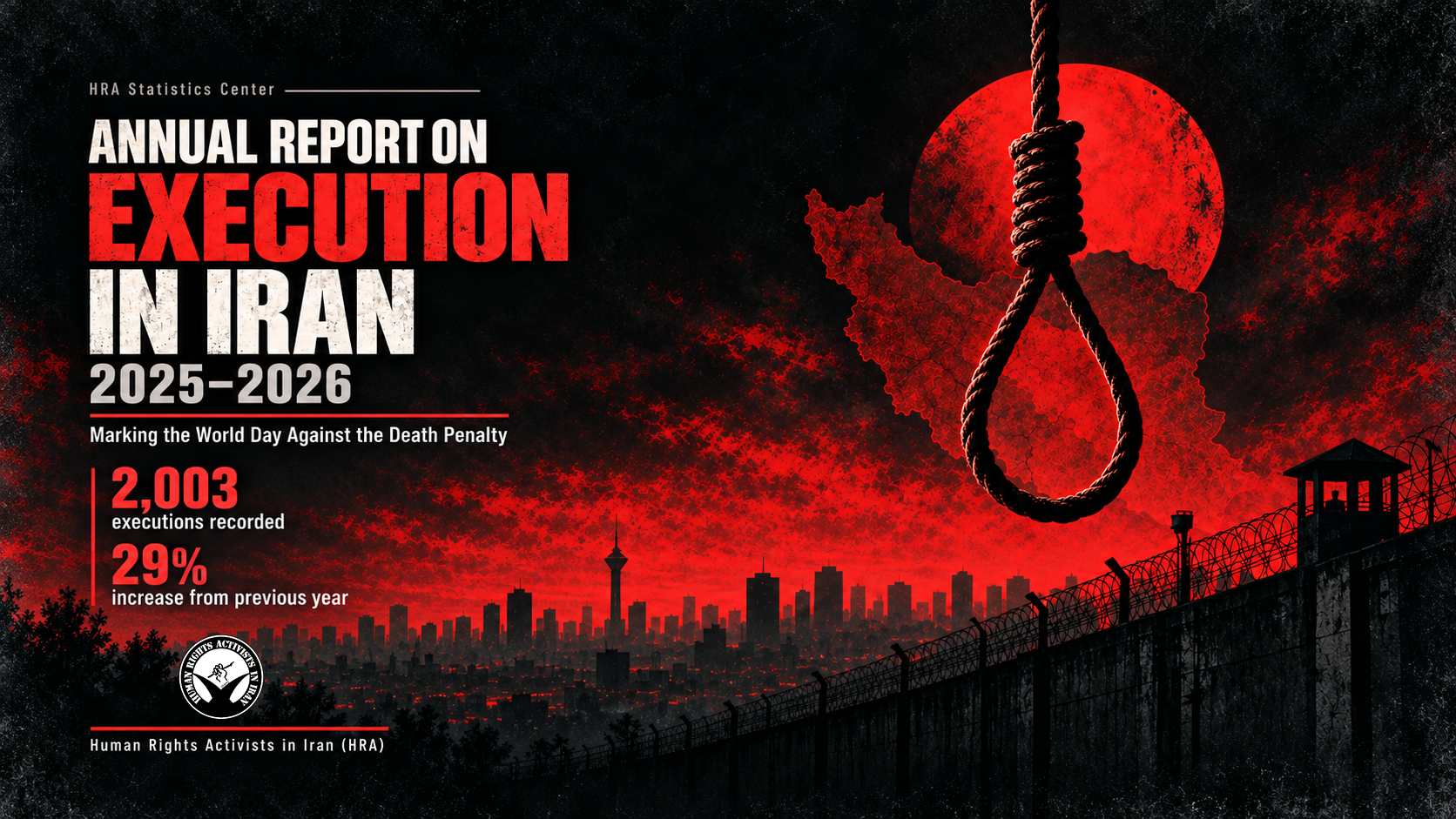
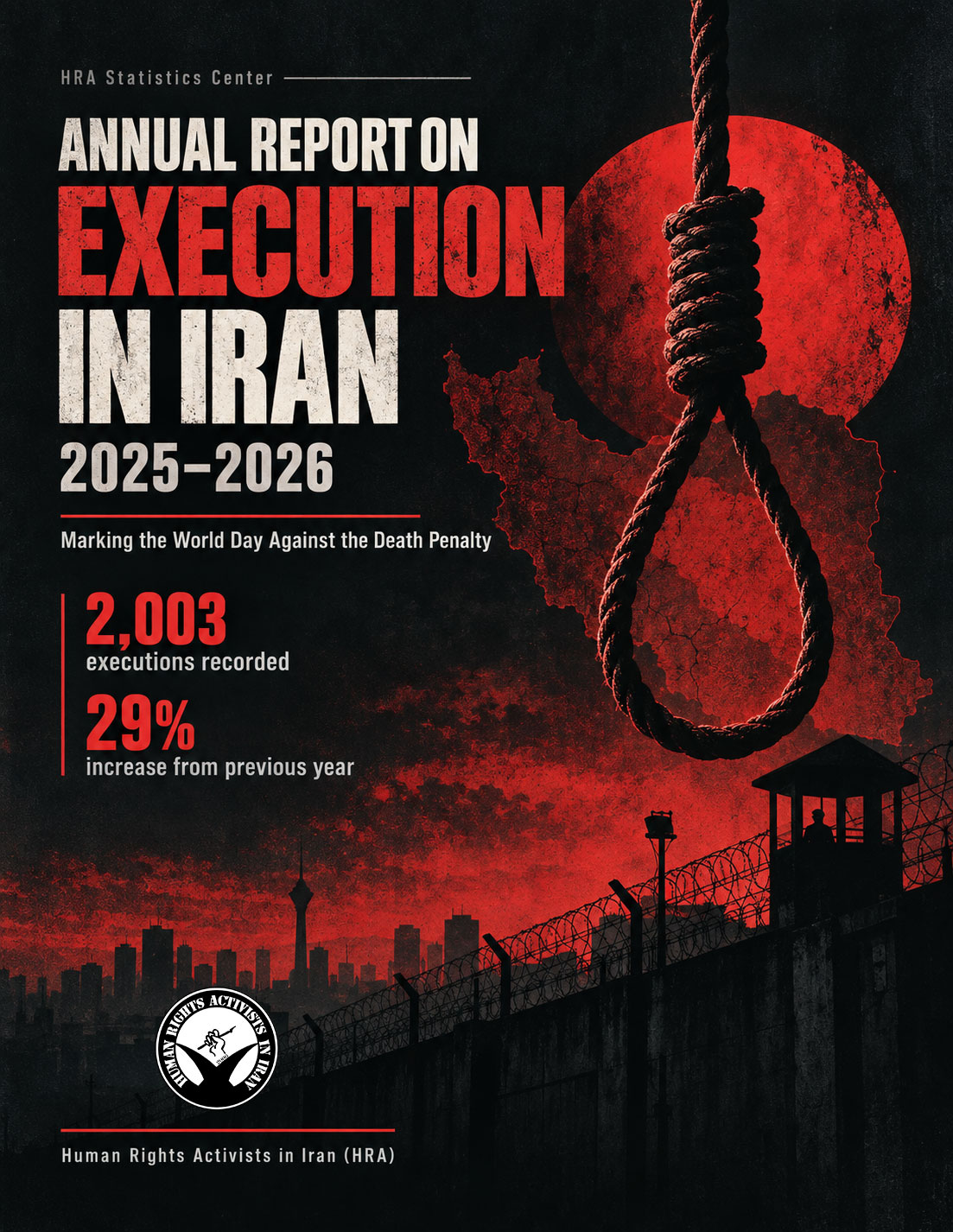
HRANA – Marking the World Day Against the Death Penalty, the Statistics Center of Human Rights Activists in Iran (HRA) has released its annual report on the use of capital punishment in Iran. The findings point to a sharp intensification in executions, continued secrecy surrounding implementation of death sentences, and an increase in political and security-related executions.
Between October 10, 2025 and October 8, 2026, HRANA documented at least 2,003 executions across Iran on the basis of 1,857 reports, an increase of approximately 29% compared with the previous reporting period. During the same period, 230 people were documented as having been sentenced to death. The full report also includes detailed statistical analysis, profiles of political and security-related executions, and documentation concerning judicial officials involved in issuing or upholding death sentences.
Executions in Iran: Key Figures
Indicator
Data
Total executions documented
2,003
Change from previous period
Approximately 29% increase
Average frequency of execution
Approximately one person every 4.35 hours
Death sentences issued
230
Women executed
47
Juvenile offenders executed
4
Public executions
9
Political and security-related executions
69
Executions unannounced by official sources
Approximately 95%
Rising Executions and the Monthly Pattern
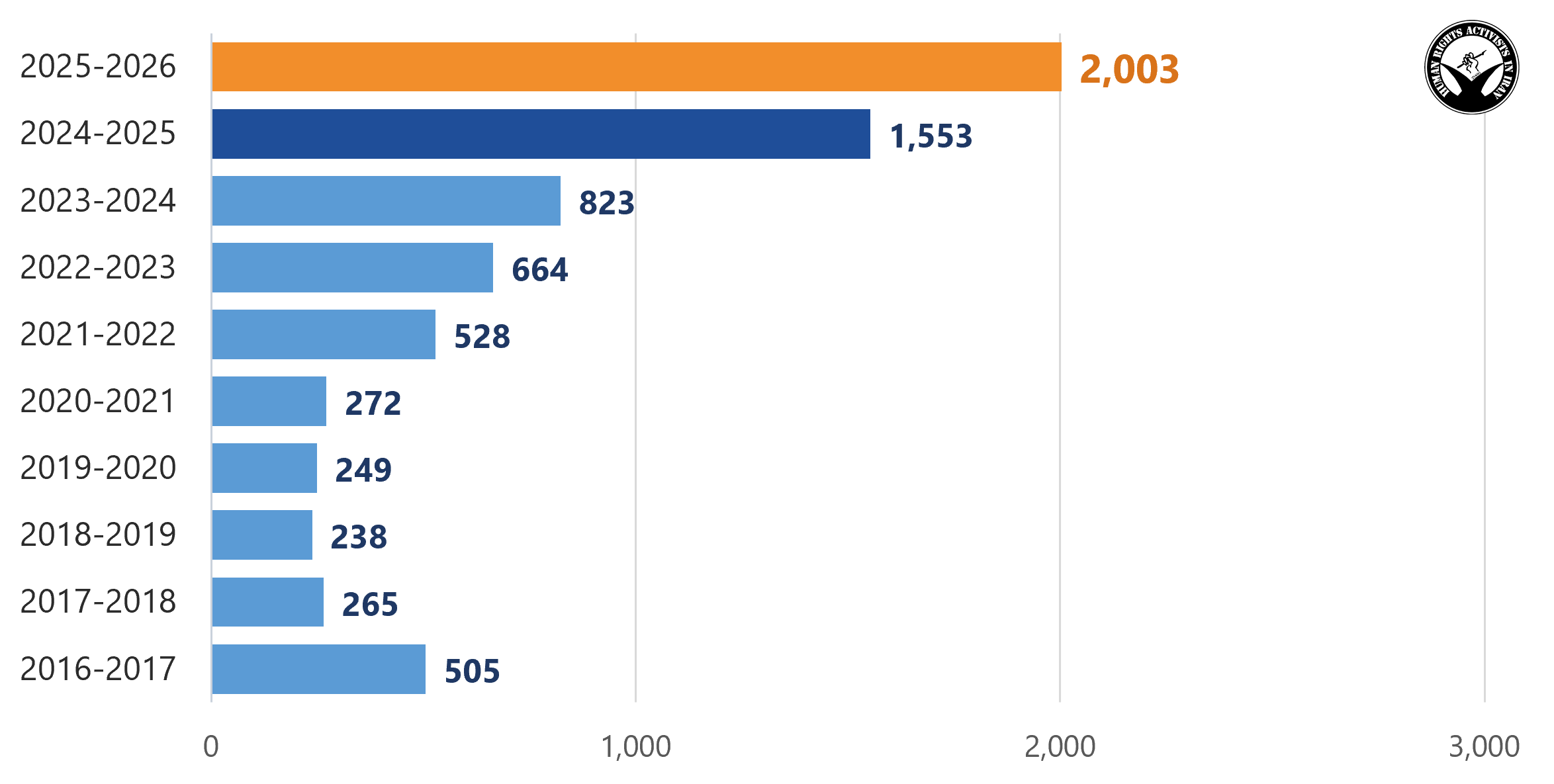
The 2,003 executions documented during the current reporting period represent the highest total recorded across the ten reporting periods examined in the report. Compared with 1,553 executions in 2024–2025, the total increased by approximately 29%. The current figure is also more than 182% above the ten-period average of 710 executions.
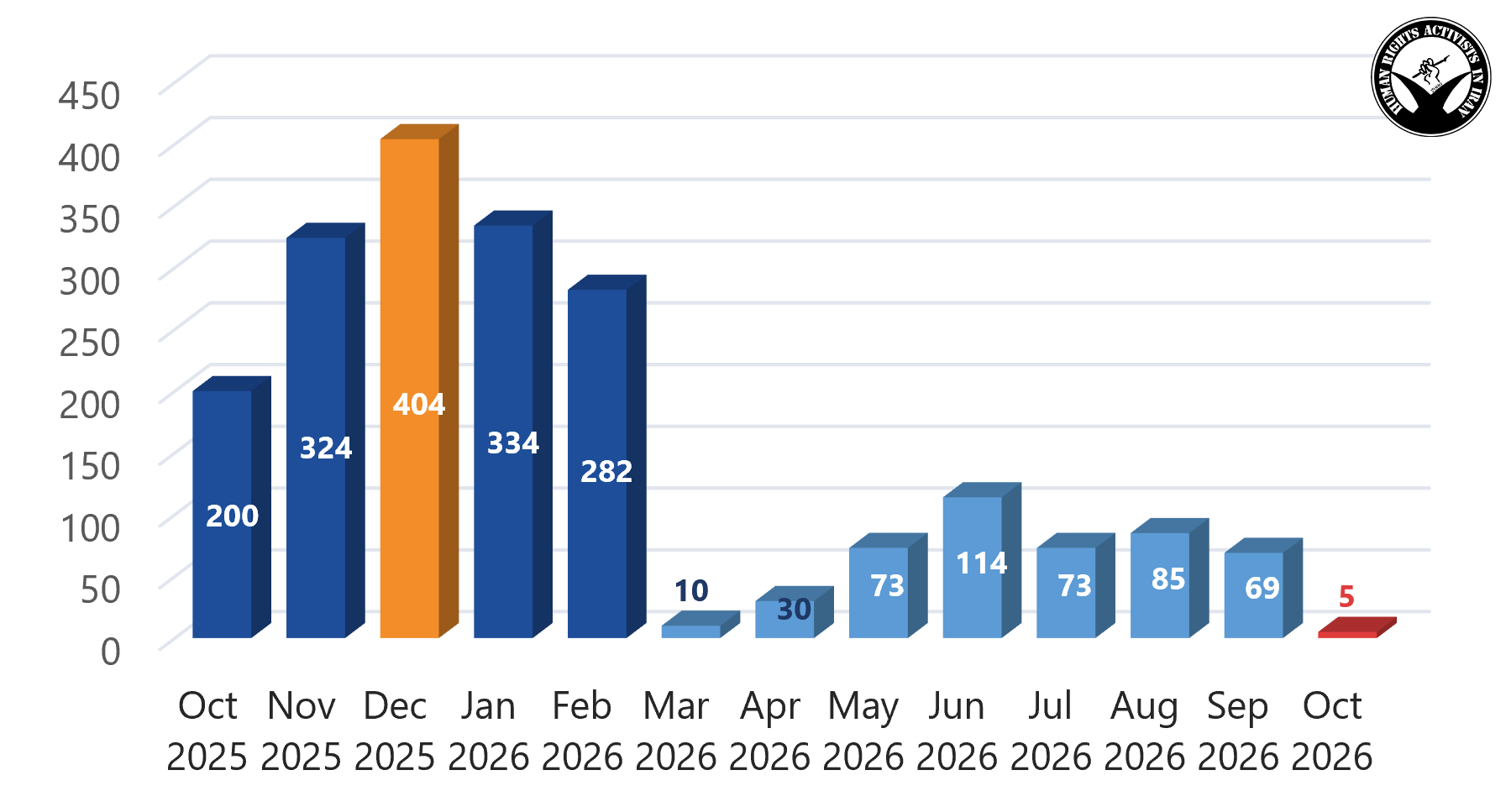
Monthly data show that executions peaked in December 2025. By contrast, March 2026 recorded the lowest total among complete months. The October 2026 figure covers only the first seven days of the month and therefore should not be compared directly with full-month totals.
CHART 1 — Monthly Executions
Charges: Murder and Drug Offenses Dominate
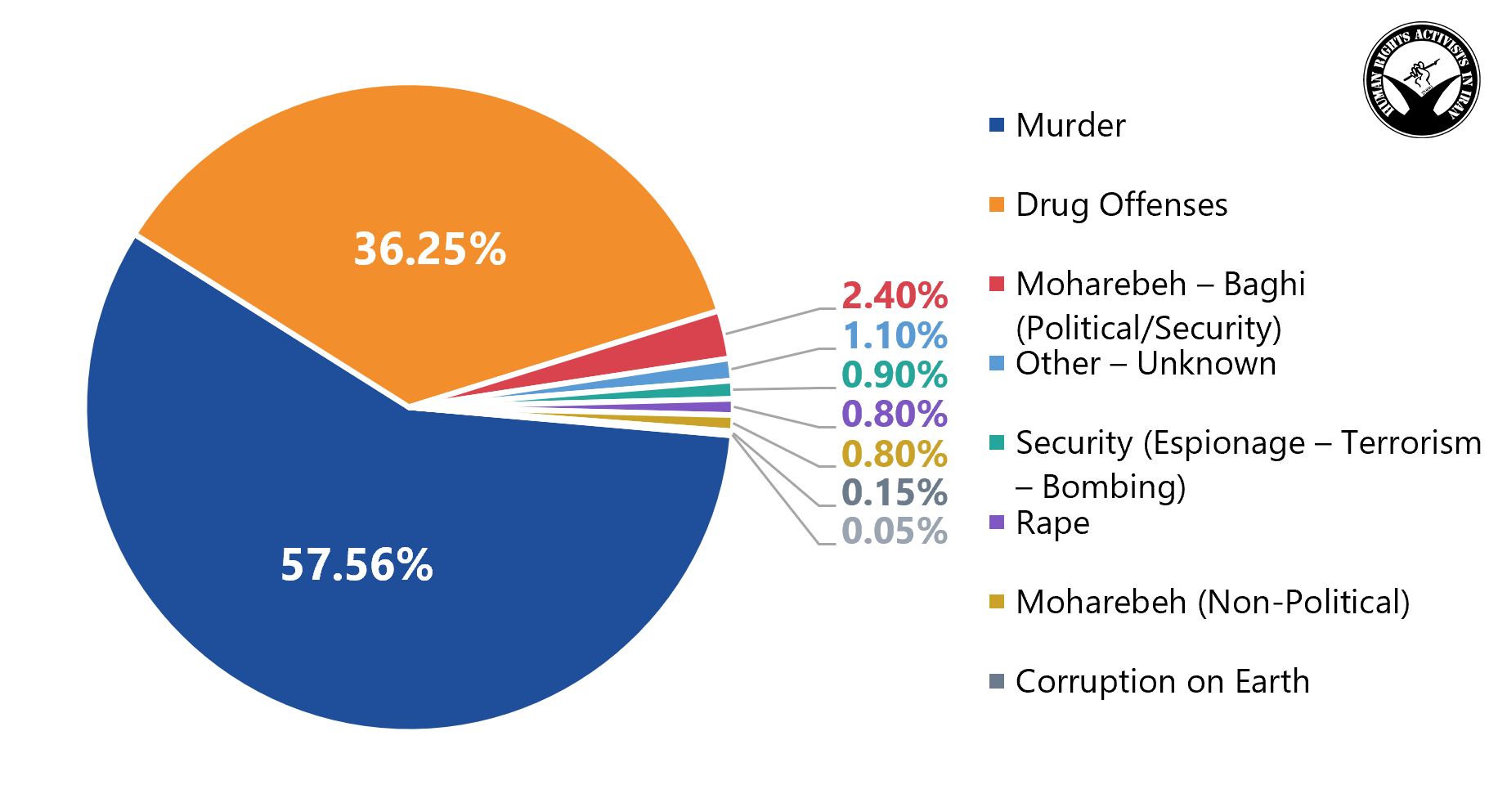
The distribution of charges resulting in execution shows a notable shift from the previous period. According to HRANA documentation, 57.56% of those executed were convicted of murder and 36.25% of drug-related offenses. Political and security-related moharebeh or baghi charges accounted for 2.40%; other or unknown charges for 1.10%; security charges including espionage, assassination or bombing for 0.90%; rape for 0.80%; non-political moharebeh for 0.80%; efsad-e fel-arz (corruption on earth) for 0.15%; and economic crimes for 0.05%.
Taken together, murder and drug-related offenses account for more than 93% of all documented executions. At the same time, the increase in political and security-related executions, and the connection of a significant number of those cases to protests, stands out as a defining feature of the current reporting period.
CHART 2 — Executions by Charge
Geography of Executions: Concentration in Several Provinces and Prisons
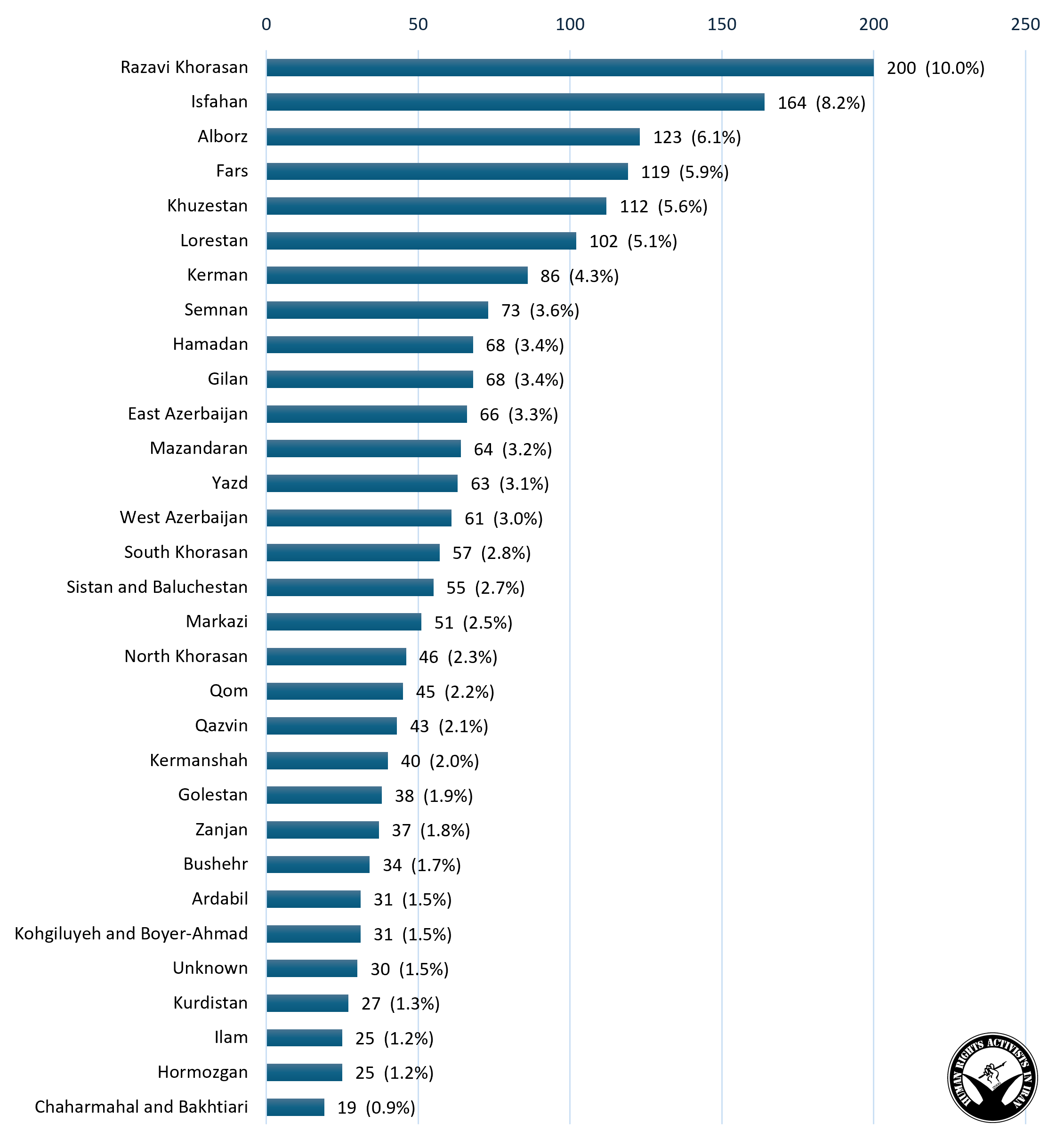
By location of execution, Razavi Khorasan recorded the highest number with 200 executions, followed by Isfahan with 164 and Alborz with 123. Fars recorded 119, Khuzestan 112 and Lorestan 102. These figures are calculated on the basis of prison location and do not necessarily reflect the place of residence or alleged offense of the person executed.
Per-capita figures provide a different picture, particularly in smaller provinces. The report cautions that prisoner transfers and executions carried out outside a prisoner’s province of origin can inflate provincial rates. Tehran is not included in the per-capita table because no executions were recorded there, and 30 executions with an unknown province were excluded from that calculation.
At the prison level, Dastgerd Prison in Isfahan and Adelabad Prison in Shiraz recorded the highest numbers of executions. The spread of executions across dozens of prisons, alongside clear concentration in several facilities, illustrates both the nationwide scope and localized intensity of the death penalty.
CHART 3 — Executions by Province
Secrecy, Public Executions and Gender
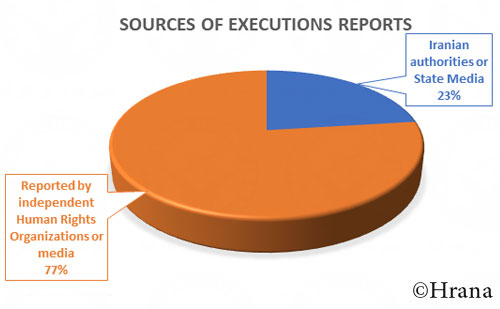
One of the report’s most significant findings is the continued lack of official transparency. Approximately 95% of documented executions were carried out secretly or without announcement in official or domestic media, while only about 5% were reported through official or domestic sources. This pattern sharply limits public oversight and independent assessment of execution practices.
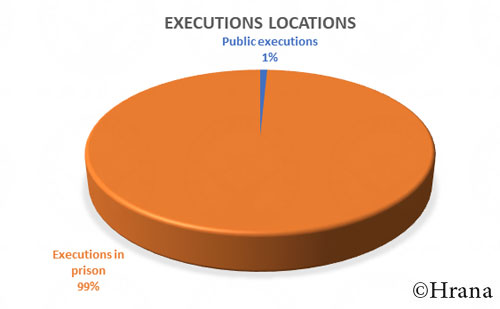
Of the 2,003 executions documented, 9 were carried out in public, representing about 0.4% of the total. Forty-seven women were executed during the reporting period. Four people whose identities and case histories were verified were under the age of 18 at the time of the alleged offense. Overall, 2.3% of those executed were women, 88.8% were men, and the gender of 8.9% remained unknown in the available data.
In relation to sentencing, HRA documented 230 people sentenced to death. At least 16 of those sentenced were women, 6 were sentenced to public execution, and 74 death sentences were upheld by the Supreme Court.
Ten-Year Trend: The Highest Recorded Level
A review of ten reporting periods shows that, after executions declined from 505 in 2016–2017 to 238 in 2018–2019, the trend turned upward from 2019–2020 onward. The totals then rose through 249, 272, 528, 664, 823 and 1,553 before reaching 2,003 in 2025–2026.
This trajectory places the current one-year increase within a longer pattern of escalation. Continued restrictions on access to official information, together with the very high share of unannounced executions, mean that the documented figures should be understood as the minimum that could be independently verified rather than necessarily the complete number of executions carried out.
CHART 4 — Ten-Year Execution Trend
69 Political and Security-Related Executions
During the reporting period, HRANA documented 69 people executed on political and security-related charges. Of these, 35 people — approximately 51% — were executed in connection with the January 2026 (Dey 1404) protests. Twenty-nine people were executed in April and May 2026 alone, with 14 in April and 15 in May, marking the peak of executions in this category.
Among these 69 cases, 29 people were executed on charges of moharebeh, either alone or alongside other charges. Where the province was known, Alborz accounted for the largest share with 19 cases, followed by Isfahan with 10. The province was unknown in 20 cases.
The full report provides an individual case card for each of the 69 people, setting out the charge, date of execution, case background, province or city, and prison where available. This case-level documentation allows the aggregate figures to be examined in greater detail and shows the diversity of charges and case backgrounds included within the political and security-related category.
Judicial Actors Involved in Issuing or Upholding Death Sentences
For the first time in this format of the annual report, a dedicated section documents judges and courts identified in death-penalty cases. This research covers October 10, 2025 through September 26, 2026, meaning that its documentation window ends twelve days before the October 8, 2026 cutoff used for the report’s main statistical sections.
HRA’s review found that several judges identified during the current period had also appeared in earlier political, security-related or protest cases involving death sentences. Among the examples examined are Abolghasem Salavati of Branch 15 of the Tehran Revolutionary Court, Iman Afshari of Branch 26 of the Tehran Revolutionary Court, Vahid Hemmatnejad of Branch 5 of the Isfahan Revolutionary Court, Ahmad Darvish-Goftar of Branch 1 of the Rasht Revolutionary Court, Reza Najafzadeh of Branch 3 of the Urmia Revolutionary Court, and Seyed Mahmoud Sadati of Branch 1 of the Shiraz Revolutionary Court.
The report emphasizes that this list is not exhaustive. Iranian authorities routinely withhold information about capital proceedings, and public reporting often fails to identify the presiding judge or even the relevant branch. Accordingly, the absence of a judge’s name from the report should not be read as evidence that the judge was not involved; rather, it reflects the limits of independently verifiable information.
A separate section also addresses Supreme Court review and distinguishes between issuing a death sentence at trial and later upholding or reviewing that sentence. The available documentation identifies judges from Branches 9, 20, 39 and 41 of the Supreme Court in connection with specific death-penalty cases.
Methodology and Data Limitations
HRA’s Statistics Center relies on HRANA reporting, a nationwide volunteer network, verified open-source material, and official judicial announcements. Because independent human rights groups cannot operate freely in Iran, access to prisons and courts is restricted, and many executions are deliberately concealed, a margin of error is unavoidable.
The figures in this report therefore reflect the capacity of civil society to document and independently verify executions rather than a claim to a flawless count of every execution carried out. The fact that approximately 95% of executions were not announced by official sources underscores the importance of independent monitoring and verification in assessing the true scale of capital punishment in Iran.
Access the Full Report
The full report contains detailed statistical tables, charts, provincial and prison-level data, profiles of all 69 people executed on political and security-related charges, and the section documenting judicial officials. For case details, sources and supporting data, download and read the complete report.
Human Rights Activists in Iran (HRA), through the dedicated efforts of its Department of Statistics and Publications, publishes its annual Gregorian calendar-based analytical and statistical report on the human rights situation in Iran for the one-year period (January 1, 2025, to January 1, 2026). This report is the culmination of the organization’s daily endeavors in recent years, forming part of a daily statistical project that began in 2009. It provides an analytical-statistical overview of human rights in Iran.
This annual report on human rights violations in Iran represents a synthesis of 11,192 human rights reports, gathered from 122 legal and news sources within the past calendar year. HRANA (Human Rights Activists News Agency) contributed 50.79% of the reports utilized in this publication, with 23.94% originating from official or government-affiliated Iranian sources, and the remaining 25.28% from other news or human rights sources.
Download the full version of the report in PDF format
In this 83-page report, various aspects such as women’s rights, workers’ rights, children’s rights, prisoners’ rights, etc., are briefly examined and statistically analyzed, accompanied by relevant charts for enhanced reader comprehension. According to this report, the focus of human rights monitoring in Iran, in comparison between the capital and other areas, remains unequal. This long-standing inequality shows that in the last year, reporting from non-central areas has decreased by 16.4% compared to the capital. This situation continues to indicate the lack of adequate monitoring of other areas of the country relative to the center by civil society.
Although this report predominantly reflects the extensive efforts of courageous human rights defenders in Iran, who bear significant costs in pursuit of their humanitarian ideals, it inevitably has limitations. These include restrictions on the activities of human rights organizations by the Iranian government and governmental impediments to the free flow of information. Consequently, while this report strives for accuracy, it cannot be considered entirely error-free or a complete reflection of the human rights situation in Iran. Nevertheless, it stands as one of the most precise, comprehensive, and well-documented reports on human rights violations in Iran, offering valuable insights for organizations and defenders of human rights to better understand the human rights situation in Iran, its challenges, and potential opportunities.
Monitoring Overview
The following information reflects the scope, geographic distribution, and sources of human rights reporting in Iran during the reporting period. These findings illustrate the relationship between reporting volume and civil society capacity across provinces.
Reporting Volume and Sources
The highest number of reports was published in May
The lowest number of reports was published in April
Sources of Reports
• 50.79 percent of reports were produced by Human Rights Activists News Agency (HRANA)
• 23.94 percent originated from official Iranian government sources or sources close to the government
• 25.28 percent were collected from other human rights news agencies
Protests, Gatherings, and Collective Action
• At least 2,294 protest gatherings were held across all 31 provinces
• 986 professional union protests
• 855 labor-related gatherings
• 257 protests by victims of financial or investment fraud
• 93 protests related to freedom of thought and expression
• 51 student union protests
• 50 environmental protests
• 1 women’s rights protest
• 1 children’s rights protest
In addition:
• 424 labor strikes were recorded
• 39 professional strikes were documented
• 49 protest attempts were prevented by authorities
Geographic Distribution of Reporting
A significant disparity exists between Tehran and the rest of the country in terms of reporting volume
According to the 2024 census:
• Tehran population: 14,425,000
• Population outside Tehran: 71,536,000
Reporting distribution indicates:
• 13.36 percent of reporting focused on Tehran
• 86.64 percent of reporting originated from other parts of the country
Ethnic Rights Overview
The following statistics reflect documented rights violations assessed by HRA as having occurred on the basis of ethnic or national minority status. These figures are drawn from 264 verified reports collected throughout the reporting period.
Key Findings
Arrests and Detention
• 304 individuals were arrested on the basis of ethnic or national minority status
• 188 arrests were carried out without a judicial warrant
• 275 individuals were arrested on charges that remain unknown or undisclosed
• 2 instances of imprisonment sentences were carried out during the reporting period
• 7 interrogations took place inside security or judicial institutions
• 47 individuals were summoned by security or judicial authorities for questioning
Judicial Proceedings
• 20 cases went to trial
• 7 individuals were sentenced to imprisonment
Sentences issued to these individuals totaled 287 months of discretionary imprisonment, as follows:
189 months issued by preliminary courts
74 months issued by appellate courts
24 months upheld by the Supreme Court
Searches and Other Violations
• 29 home searches were reported
• 1 case of physical assault was documented
Trends and Comparative Analysis
Arrests of ethnic minority citizens increased by 16 percent compared to 2024
Prison sentences issued relative to the number of individuals tried decreased by 65 percent
The overall issuance of prison sentences declined by 39 percent compared to 2024
Monthly Trends
The highest number of reported violations occurred in January
The steepest decline in reported violations occurred in April
Tolerance and Religious Freedoms Overview
The following statistics reflect documented rights violations assessed by HRA as having occurred on the basis of religious belief or affiliation. These figures are based on 210 verified reports collected during the reporting period.
Key Findings
Arrests and Detention
• 183 individuals were arrested on the basis of religious belief or affiliation
• 7 arrests were carried out without a judicial warrant
• 142 individuals were summoned to security or judicial institutions for questioning
• 50 interrogations took place inside security or judicial institutions
• 54 instances of sentence enforcement were carried out
• 33 travel bans were imposed
Judicial Proceedings
• 48 cases went to trial
• 88 individuals were sentenced to imprisonment
Sentences issued to these individuals totaled 8,015 months of imprisonment, as follows:
7,277 months of discretionary imprisonment
798 months of suspended imprisonment
3,876 months of imprisonment were issued by the appellate courts
• 14 individuals were fined a total of 5.27 billion tomans
• 35 individuals were sentenced to deprivation of social rights
• 5 individuals were sentenced to 96 months of exile
Searches, Property Violations, and Other Abuses
• 128 home searches were reported
• 33 cases of property or home confiscation were documented
• 5 cases of obstruction of economic activity were recorded
• 1 case involving the destruction of a cemetery was documented
• 4 cases of physical assault were reported
Trends and Comparative Analysis
Arrests related to religious minority rights increased by 101 percent compared to the previous year
Prison sentences issued relative to the number of individuals tried increased by 8.6 percent
The total length of prison sentences increased by 68.7 percent compared to the previous year
Monthly Trends
The highest number of reported violations occurred in June
The lowest number of reported violations occurred in August
Distribution by Religious Group
• Baha’is accounted for 62.41 percent of all reported violations
• Christians accounted for 17.73 percent
• Jews accounted for 7.45 percent
• Other religious groups accounted for 6.21 percent
• Sunni Muslims accounted for 6.21 percent
Freedom of Thought and Expression Overview
The following statistics reflect documented rights violations assessed by HRA as having occurred in relation to freedom of thought and expression. These figures are based on 1,509 verified reports collected during the reporting period.
Key Findings
Arrests and Detention
• 22,062 individuals were arrested in connection with freedom of thought and expression
• At least 180 arrests were carried out without a judicial warrant
• 394 individuals were summoned to security or judicial authorities for questioning
• 62 interrogations were conducted by security agencies
• 97 instances of sentence enforcement were carried out
• 25 travel bans were imposed
Judicial Proceedings
• 175 individuals were tried in judicial institutions
• 405 individuals were sentenced to imprisonment
Sentences issued to these individuals totaled 14,799 months of imprisonment, as follows:
13,931 months of discretionary imprisonment
868 months of suspended imprisonment
3,005 months were issued by appellate courts
816 months were issued by the Supreme Court
• 66 individuals were fined a total of 3,088,600,000 tomans
• 19 individuals were sentenced to 938 lashes
• At least 3 individuals had corporal punishment sentences of 142 lashes carried out
• 12 individuals were sentenced to a total of 444 months of exile
• 47 individuals were sentenced to deprivation of social rights
Censorship, Searches, and Other Violations
• 15 publications were declared criminal
• 61 home searches were reported
• 2 cases of property confiscation were documented
• 27 cases of internet filtering were recorded
• 1 case of communication disruption was documented
• 40 cases of physical assault against citizens were reported
• 1 instance of forced retirement was recorded
• 3 cases of dismissal or downsizing were documented
• 7 incidents of preventing speeches or public events were reported
• 93 gatherings were held
• 28 gatherings were obstructed by authorities
Trends and Comparative Analysis
Arrests related to freedom of thought and expression increased by 1286.6 percent compared to the previous year
Prison sentences issued relative to the number of individuals tried decreased by 33.6 percent
The total length of prison sentences declined by 44.7 percent compared to the previous year
Monthly Trends
The highest number of reported violations occurred in June
The lowest number of reported violations occurred in September
Rights of Trade Unions and Associations Overview
The following statistics reflect documented rights violations assessed by HRA as having occurred in relation to labor, trade union, and professional association rights. These figures are based on 1,178 verified reports collected during the reporting period.
Key Findings
Arrests and Detention
• 44 labor and union activists were arrested
• 55 individuals were summoned to security or judicial authorities for questioning
• 4 interrogations were conducted by security agencies
• 6 instances of sentence enforcement were carried out
• 3 travel bans were imposed
Judicial Proceedings
• 20 cases went to trial
• 30 individuals were sentenced to imprisonment
Sentences issued to these individuals totaled 743 months of imprisonment, as follows:
740 months of discretionary imprisonment
3 months of suspended imprisonment
61 months were issued by appellate courts
• 2 individuals were sentenced to 120 months of exile
• 2 individuals were sentenced to 148 lashes
• 9 individuals were fined a total of 679,100,000 tomans
Workplace and Economic Rights Violations
• 219 cases of workplace closures were documented
• 21 cases of dismissal or layoffs were reported
• 407 cases of forced retirement were documented
• At least 66 months of delayed wage payments were reported
• 1 case of license revocation was documented
• 2 case of physical assault was reported
• 1 case of self-immolation was documented
• 4 home searches were carried out
Protests and Collective Action
• At least 986 labor or professional protests were recorded
• 39 strikes were documented
• 6 cases of protest obstruction were reported
Trends and Comparative Analysis
Arrests of labor and union activists increased by 91.3 percent compared to 2024
The total issuance of prison sentences decreased by 16.5 percent
Prison sentencing relative to the number of individuals tried declined by 60 percent compared to 2024
Monthly Trends
The highest number of reported violations occurred in May
The lowest number of reported violations occurred in July
Right to Education Overview
The following statistics reflect documented rights violations assessed by HRA as having occurred in relation to the right to education. These figures are based on 132 verified reports collected during the reporting period.
Key Findings
Arrests, Discipline, and Institutional Actions
• 15 individuals were arrested in connection with education-related activities
• 1 student was denied admission to postgraduate studies
• 1 case of expulsion from university was documented
• 51 protest gatherings related to educational issues were recorded
• 4 protests were obstructed by authorities
Violence, Abuse, and Health-Related Violations
• 3 cases of physical assault were documented
• 32 cases of corporal punishment against students were reported
• At least 9 male elementary school students were subjected to physical and sexual abuse by a teacher
• 141 cases of food poisoning were documented
• Over 167 cases of student poisoning were reported
Systemic Deprivation of Education
• At least one million students were deprived of continuing their education
The highest school dropout rates were reported in:
• Sistan and Baluchestan Province
• Golestan Province
• Razavi Khorasan Province
Monthly Trends
The highest number of reported violations occurred in October
The lowest number of reported violations occurred in July
Right to Life (Death Penalty) Overview
The following statistics reflect documented violations of the right to life assessed by HRA as having occurred through the issuance and implementation of the death penalty. These figures are based on 1,743 verified reports collected during the reporting period.
Key Findings
Death Sentences and Executions
• 172 individuals were sentenced to death
• 2,063 individuals were executed
• 11 executions were carried out in public
• 57 death sentences were upheld by the Supreme Court
Demographic Breakdown
Of those executed whose gender was identified:
• 1,807 men
• 61 women
• 2 individuals were under the age of 18 at the time of the alleged offense
Of the recorded death sentences:
• 155 were issued against men
• 14 were issued against women
• 5 death sentences were issued for public execution
• 2 death sentences were issued against child offenders
Charges Leading to Execution
• 49.01% for murder
• 44.93% for drug-related offenses
• 1.65% for sexual offenses
• 1.55% for unspecified charges
• 1.26% for moharebeh–baghi (political–security charges)
• 0.73% for security-related charges (including espionage, terrorism, or bombing)
• 0.63% for moharebeh (non-political)
• 0.50% for economic crimes
• 0.50% for armed robbery
• 0.15% for corruption on earth
Trends and Comparative Analysis
The implementation of death sentences increased by 119 percent compared to 2024
The issuance of death sentences decreased by 19.6 percent compared to 2024
Monthly Trends
The highest number of reported violations occurred in December
The lowest number of reported violations occurred in March
Geographic and Institutional Distribution
• Alborz Province accounted for 10.52 percent of executions
• Razavi Khorasan Province accounted for 8.53 percent of executions
• Qezel Hesar Prison (Karaj) and Dastgerd Prison (Isfahan) recorded the highest number of executions
Transparency of Executions
• 95 percent of executions were carried out in secret or without public announcement
Long-Term Trends
After a relative decline between 2018 and 2020, executions have shown a sustained upward trend since 2021
In 2025, 2,063 executions were recorded, marking the highest annual figure over the past eleven years
Cultural Rights Overview
The following statistics reflect documented rights violations assessed by HRA as having occurred in relation to cultural rights. These figures are drawn from 19 verified reports collected throughout the reporting period.
Key Findings
Censorship, Restrictions, and Administrative Actions
• 7 cases of obstruction of cultural programs or public speeches were documented
• 2 individuals were summoned to judicial authorities
• 2 cases of censorship or prevention of publication were recorded
• 7 professional bans were imposed
• 1 case of neglect was documented
• 1 case involving the destruction of a historical site was recorded
Judicial Proceedings
• 6 cases went to trial
• 4 individuals were sentenced to suspended imprisonment
Sentences issued to these individuals totaled 131 months of suspended imprisonment, of which:
• 64 months were issued by appellate courts
• 6 individuals were fined a total of 515 million tomans
Trends and Comparative Analysis
Verdicts issued relative to the number of individuals tried increased by 20 percent compared to the previous year
The issuance of imprisonment sentences decreased by 31.7 percent compared to the previous year
Monthly Trends
The highest number of reported violations occurred in April and December
The lowest number of reported violations occurred in June, August, and September
Labor Rights Overview
The following statistics reflect documented rights violations assessed by HRA as having occurred in relation to labor rights. These figures are based on 1,996 verified reports collected during the reporting period.
Key Findings
Arrests, Detention, and Judicial Actions
• 23 individuals were arrested in connection with labor-related activities
• 11 individuals were summoned to judicial or security institutions
• 3 cases went to trial
• 7 interrogations were conducted by judicial or security entities
• 1 instance of imprisonment enforcement was recorded
• 2 travel bans were imposed
• 3 cases of self-immolation were documented
• 1 case of a worker being physically assaulted was reported
Judicial Proceedings
• 2 individuals were sentenced to imprisonment
Sentences issued to these individuals totaled 75 months of imprisonment, of which:
• 72 months were issued by appellate courts
• 1 individual was fined 30 million tomans
Employment, Wages, and Social Protection
• At least 638 months of delayed wage payments were reported across 182 industrial and service units
• 2,458 cases of dismissal or downsizing were documented
• 550 cases of unemployment were reported
• 663 months of lack of insurance coverage were recorded
• 10 factory closures were documented
• 3,761 workers were reported as being in limbo
Workplace Safety and Accidents
• At least 1,232 worker deaths were recorded due to workplace incidents
• 7,328 cases of physical injury to workers were documented
Protests and Collective Action
• At least 855 labor protests were recorded
• 424 labor strikes were documented
• 4 cases of protest obstruction were reported
Trends and Comparative Analysis
Arrests of workers increased by 109 percent compared to the previous year
Verdicts issued relative to the number of individuals tried decreased by 77.7 percent
The issuance of imprisonment sentences declined by 75 percent compared to the previous year
Monthly Trends
The highest number of reported violations occurred in May
The most significant decline in reports occurred in April
Children’s Rights Overview
The following statistics reflect documented rights violations assessed by HRA as having occurred in relation to children’s rights. These figures are based on 595 verified reports collected during the reporting period.
Key Findings
Violence, Abuse, and Loss of Life
• At least 38 cases of child rape or sexual abuse were documented
• 45 child murders were reported
• 4 cases of so-called honor killings involving children were recorded
• 19 child suicides were documented
• At least 23,000 cases of child abuse were reported
• 5 abandoned infants were documented
• 5 deaths and 10 injuries among child laborers were recorded
• 21 deaths and 385 injuries due to official negligence were documented
Child Labor and Exploitation
• Over 70,000 cases of child labor were reported
Child Marriage and Early Motherhood
• At least 27,448 girls under the age of 15 were married between winter 2021 and fall 2022
• 31,646 girls under 15 were married in 2020
• 32,655 girls under 15 were married in 2021
In fall 2022, marriages of girls under 15 increased by 933 cases compared to the previous season
In fall 2022, over 5,500 girls aged 15 to 19 were married compared to summer 2022
• 69,103 babies were born in 2021 to mothers aged 10 to 19
• 1,474 babies were born to mothers aged 10 to 14
Deprivation of Education
• At least one million students were deprived of continuing their education
Contributing factors included poverty, early marriage, lack of access to virtual education, geographic dispersion, and cultural barriers
Use of Children in State-Organized Activities
• At least 105,425 children under 18 were sent to “Rahian-e Noor” camps in former war zones
The highest participation was recorded in Isfahan, Bushehr, Qom, Markazi, and Razavi Khorasan provinces
Arrests and Executions of Children
• At least 35 individuals under 18 were detained by security institutions
• At least 2 juvenile offenders were executed during the reporting period
Monthly Trends
The highest number of reported violations occurred in November
The lowest number of reported violations occurred in June
Women’s Rights Overview
The following statistics reflect documented rights violations assessed by HRA as having occurred in relation to women’s rights. These figures are based on 190 verified reports collected during the reporting period.
Key Findings
Violence, Abuse, and Gender-Based Killings
• At least 63 cases of rape or sexual abuse were documented
• 118 cases of femicide were reported
• 11 cases of so-called honor killings were recorded, including the killing of 5 men
• 1 case of self-immolation was documented
• 11 cases of physical assault were reported
• At least 179 instances of domestic violence were documented
• 8 acid attacks were reported
Arrests, Judicial Actions, and Punishments
• 13 women were arrested for non-compliance with mandatory hijab laws
• 11 individuals were summoned to judicial or security bodies
• 7 interrogations were conducted by security agencies
• 4 individuals were sentenced to imprisonment
Sentences issued to these individuals totaled 80 months of imprisonment, of which:
• 31 months were issued by appellate courts
• 1 individual was sentenced to 178 lashes
• 7 million tomans in fines were imposed
Enforcement of Mandatory Hijab and Discrimination
• 24 cases of enforcement actions were carried out under the pretext of “improper hijab”
• 193 commercial establishments were shut down for failure to enforce mandatory hijab regulations
• 1 case of discrimination in a public setting was documented
Monthly Trends
The highest number of reported violations occurred in April
The lowest number of reported violations occurred in October
Prisoners’ Rights Overview
The following statistics reflect documented rights violations assessed by HRA as having occurred in relation to the treatment of prisoners and detainees. These figures are based on 1,112 verified reports collected during the reporting period.
Key Findings
Physical Abuse, Health, and Conditions of Detention
• 30 cases of physical assault against prisoners were documented
• 225 cases of denial of or failure to provide medical care to prisoners and detainees were recorded
• 2,513 cases of prisoners being held in inappropriate conditions were reported
• 9 cases of psychological or physical torture were documented
• 18 deaths of prisoners due to illness were recorded
• 23 suicides among prisoners were documented
• 5 cases of prisoners being killed were reported
Solitary Confinement, Transfers, and Coercion
• 368 cases of unlawful transfer to solitary confinement were recorded
• 43 forced transfers of prisoners were documented
• 224 cases of threats or pressure exerted on prisoners were reported
• 30 cases of forced confessions were documented
• 3 cases involving the use of handcuffs or shackles were recorded
Due Process and Legal Rights
• 104 cases of denial of access to legal counsel were documented
• 55 cases of denial of visitation rights were reported
• 263 cases of denial of the right to make phone calls were recorded
• 19 cases of denial of medical leave were documented
• 18 cases of failure to separate prisoners based on the nature of their crimes were recorded
• 7 cases of failure to separate defendants from convicted prisoners were documented
Protests, Hunger Strikes, and Collective Actions
• 190 hunger strikes by prisoners or detainees were reported
• 5 sit-ins by prisoners were documented
Detainee-Specific Violations
• 19 cases of failure to address detainee complaints were recorded
• 689 cases of enforced disappearance or lack of information regarding detainees were documented
• 1,189 cases of detainees being held in legal limbo were reported
Monthly Trends
The highest number of reported violations occurred in July
The lowest number of reported violations occurred in June
Environmental Rights Overview
The following statistics reflect documented rights violations assessed by HRA as having occurred in relation to environmental rights. These figures are drawn from 1,728 verified reports collected throughout the reporting period.
Key Findings
Environmental Damage and Mismanagement
• 1,621 reports of environmental pollution were documented, including air pollution and contamination of surface and groundwater
• 13 cases of failure to protect natural resources were recorded
• 17 cases of improper exploitation of natural resources were documented
• 9 cases of animal abuse were reported
Protests and Collective Action
• 50 environmental protest gatherings were recorded
• 2 protest gatherings were obstructed
Harm to Environmental Protection Personnel
• 55 environmental protection officers were involved in reported incidents, including:
• 7 park rangers killed
• 37 park rangers injured
• 1 wildlife warden injured
• 10 forest rangers injured
Monthly Trends
The highest number of reported violations occurred in May
The lowest number of reported violations occurred in June
Sexual and Gender Minorities Overview
The following information reflects documented violations and structural conditions affecting the rights of sexual and gender minorities in Iran. Due to severe underreporting, cultural taboos, and legal barriers, available data represents only a limited portion of actual violations.
Key Findings
Structural and Legal Discrimination
Same-sex relationships are criminalized under Iranian law
Gender identity is not legally recognized for transgender individuals prior to gender reassignment surgery
State policies and legal frameworks blur the distinction between sexual or gender identity and so-called “moral corruption”
Hate speech and incitement against sexual and gender minorities occur openly and with impunity
Civil society monitoring of violations against sexual and gender minorities remains severely limited due to fear, stigma, and repression
Harassment and Abuse by Authorities
Security and law enforcement agencies have, in some instances, acknowledged the detention and harassment of individuals based on sexual orientation or gender identity
Lethal Violence
In 2025, Sogand Pakdel, a transgender woman approximately 25 years old, was shot and killed by her uncle in Kavar, Fars Province
The killing occurred during a family wedding and was reportedly carried out under a so-called “honor” motive
Unlawful Use of Force and Lethal Force Overview
The following statistics reflect documented rights violations assessed by HRA as having occurred through the unlawful or excessive use of force by military or security forces, as well as related state actions affecting civilian safety. These figures are drawn from verified reports collected throughout the reporting period.
Key Findings
Death and Injury of Civilians by Security Forces
• 193 civilians were shot by military or security forces
• 93 individuals were killed, including:
• 19 kolbars
• 21 fuel carriers
• 53 other civilians
• 100 individuals were injured, including:
• 26 kolbars
• 13 fuel carriers
• 61 other civilians
Kolbar-Related Incidents
• 9 kolbars were harmed due to harsh geographical or climatic conditions
• 3 deaths
• 6 injuries
Fuel Carrier Incidents
• 82 fuel carriers were involved in incidents related to military chases or road accidents
• 74 deaths
• 8 injuries
Victims of Landmines and Explosions
• 20 civilians were killed by landmines in border areas
• 22 civilians were injured due to landmine explosions
Floggings, Amputation, and Corporal Punishment
• 96 individuals were sentenced to a total of 5,041 lashes
• 6 individuals had amputation sentences carried out
• 5 individuals were sentenced to limb retribution (qisas)
• At least 3 individuals had corporal punishment sentences of 142 lashes carried out
Intervention in Personal Affairs
• 76 individuals were arrested for organizing or attending private gatherings
Protests by Victims of Financial and Investment Loss
• 257 protest actions were organized by victims of financial or investment fraud
In 5 cases, their attempts to hold a gathering were prevented.
Protests took place across 31 provinces
The highest number of protests occurred in Tehran, Khuzestan, and Qazvin
Monthly Trends
The highest number of reported violations occurred in August
The lowest number of reported violations occurred in June
Judicial Sentences Overview
The following statistics reflect publicly documented judicial sentences issued by Iranian courts, including primary and appellate courts, across multiple rights categories. These figures are based solely on cases in which specific details of verdicts were made public.
Key Findings
Imprisonment Sentences by Category
• 24,190 total months of imprisonment were issued across all documented categories, including:
• 287 months related to ethnic minority cases
• 8,075 months related to religious minority cases
• 14,799 months related to freedom of thought and expression
• 743 months related to trade unions and associations
• 75 months related to labor rights
• 80 months related to women’s rights
• 131 months related to cultural rights
Corporal Punishment and Financial Penalties
• 5,041 lashes were issued by judicial authorities
• 5 sentences of limb retribution (qisas) were issued
• 932.47 million tomans in fines were imposed
Trends and Comparative Analysis
Overall convictions of activists and citizens decreased by 27.9 percent compared to the previous year
Convictions related to religious minorities increased by 68.7 percent
Convictions related to ethnic minorities decreased by 39 percent
Convictions related to freedom of thought and expression declined by 44.7 percent
Convictions related to trade unions decreased by 16.5 percent
Convictions in the labor sector declined by 75 percent
Convictions related to cultural rights declined by 31.7 percent
Convictions related to women’s rights increased by 40.35 percent
Monthly Trends
The highest number of reported convictions occurred in January
The lowest number of reported convictions occurred in June
• December data is not included in this comparison
Arrests Overview
The following statistics reflect documented arrests of citizens in connection with civil, ideological, political, or rights-related activities. These figures are drawn from verified reports collected throughout the reporting period.
Key Findings
Arrests by Category
• 22,755 individuals were arrested during the reporting period
• 22,062 arrests related to freedom of thought and expression
• 304 arrests involving ethnic and national minorities
• 183 arrests related to religious minorities
• 44 arrests related to trade unions and professional associations
• 23 arrests related to labor rights
• 15 arrests related to student activities
• 35 arrests involving children
Arrests Related to Lifestyle and Personal Activities
• 13 women were subjected to judicial prosecution due to their activities or lifestyle
• 76 individuals were arrested for organizing or participating in private gatherings
Trends and Comparative Analysis
Arrests of activists and citizens increased by 717.6 percent compared to the previous year
Category-specific changes compared to 2024 include:
• Ethnic minority arrests increased by 16 percent
• Religious minority arrests increased by 101 percent
• Trade and union sector arrests increased by 91.3 percent
• Women’s rights–related arrests decreased by 97.9 percent
• Lifestyle-related arrests decreased by 33.3 percent
• Children’s rights–related arrests increased by 2.9 percent
• Labor rights–related arrests increased by 109 percent
• Freedom of thought and expression–related arrests increased by 1286.6 percent
Monthly Trends
The highest number of reported arrests occurred in June
The sharpest decline in reported arrests occurred in April
Individuals Involved in Human Rights Violations Overview
The following information reflects documented cases in which identifiable individuals or institutions were implicated in human rights violations in Iran. These findings are based on reports jointly compiled by Spreading Justice and HRA’s Statistics Department and cover the period from January 1, 2025, to January 1, 2026.
Key Findings
Distribution by Branch of Power
Out of 2,967 reports in which perpetrators were identifiable:
• 2,366 cases were attributed to the Judiciary
• 436 cases were attributed to the Executive branch
• 165 cases were attributed to the Leadership Authority
Human Rights Violating Entities
In reports containing information on responsible institutions, 480 legal entities were identified. The ten institutions with the highest number of documented violations were:
A total of 106 individuals were identified as being directly involved in human rights violations. The ten individuals with the highest number of documented cases—all affiliated with the Judiciary as judges—are listed below:
• Iman Afshari, Judge, Revolutionary Court, Tehran – 43 cases
• Abbasali Houzan, Judge, Court of Appeals, Tehran – 24 cases
• Ali Ansari, Judge, Criminal Court, Oshnavieh – 9 cases
Institutional Patterns
Revolutionary courts accounted for a significant share of judicially attributed violations
Intelligence and security bodies, including the Ministry of Intelligence and IRGC Intelligence Organization, were repeatedly identified across multiple categories
Prison authorities, particularly in facilities such as Evin Prison, were implicated in a substantial number of reported violations
Reflection on the year
In 2025, HRA continued to advance strategic international advocacy aimed at securing accountability for serious human rights violations and violations of international law in Iran through a wide range of legal, diplomatic, and policy tools. While HRA sustained its advocacy for targeted human rights sanctions, it also emphasized that sanctions are only one component of a broader accountability ecosystem. Throughout the year, HRA identified more than twenty judicial and quasi-judicial pathways to accountability and worked with international partners and policymakers to elevate these mechanisms as viable and complementary routes to justice.
HRA engaged directly with member states and policymakers across Europe, Asia, and North and South America, emphasizing the need for coordinated, evidence-based approaches to accountability. These engagements focused on addressing jurisdictional gaps, strengthening cooperation between states, and ensuring that accountability efforts are informed by rigorous documentation and legal analysis in collaboration with civil society. HRA consistently underscored the critical role of civil society in supporting these processes, particularly in providing verified information, contextual analysis, and victim-centered perspectives.
As part of this effort, HRA met with members of prosecution teams in multiple jurisdictions, providing evidence, analysis, and information to support ongoing and prospective accountability efforts. These engagements aimed to facilitate the use of existing legal frameworks, including universal jurisdiction and other domestic and international mechanisms, to advance investigations into crimes under international law.
HRA’s contributions were grounded in its extensive documentation work and long-term analysis of patterns of abuse and chains of responsibility that, while took place in 2025, are a product of more than 20 years of organizational expertise.
Advocacy on behalf of victims remained central to HRA’s international engagement in 2025, including sustained efforts to amplify the experiences of women and others disproportionately impacted by state repression at the United Nations, in the United States, the United Kingdom, and in the European Parliament.
During the twelve-day Israel-Iran conflict, HRA was the first organization to document the impacts on civilians and civilian infrastructure. In the immediate aftermath, HRA was present with European policymakers, providing expert insights and concrete recommendations on civilian harm, legal implications, and accountability considerations at a critical moment when reliable information was limited. This engagement reinforced HRA’s role as a trusted interlocutor during periods of heightened regional escalation.
HRA continued to work closely with international partners to strengthen accountability efforts across jurisdictions, contributing to more coherent and strategic responses to human rights violations. Through collaboration with NGOs, legal experts, and policymakers, HRA supported approaches that move beyond symbolic measures and toward concrete, enforceable outcomes grounded in documentation.
Download the full version of the report in PDF format
HRA’s Spreading Justice initiative continued to document individuals and institutions responsible for human rights violations, supporting advocacy for targeted accountability measures and informing international policy discussions. In parallel, the Pasdaran Documentation Project (PDP) continued to document transnational repression perpetrated by the IRGC, while regularly updating its analysis of the IRGC’s chain of command. This work further strengthened the evidentiary foundation for sanctions, judicial proceedings, and other accountability pathways, efforts that remain ongoing.
Through sustained international engagement, comprehensive documentation, and strategic collaboration, HRA continued in 2025 to advance realistic and impactful pathways to accountability for human rights violations in Iran.
The initial version of this report, covering statistical data from January 1, 2025 to December 20, 2025, was published on December 26, 2025, and was replaced on January 3, 2026 with the full version covering January 1, 2025 to January 1, 2026.
Human Rights Activists in Iran
Department of Statistics and Publications
26 December 2025
info @ hra-iran.org
Each year, Human Rights Activists in Iran (HRA) publishes a comprehensive statistical analysis of human rights violations in Iran. The 2024 Annual Report presents data drawn from 9,487 reports collected from 116 NGOs and news sources, offering an in-depth overview of key areas such as women’s rights, workers’ rights, children’s rights, and prisoners’ rights over the past year.
In addition to this 86-page report, HRA has compiled key statistics into a visual infographic booklet, which you can download here:
The pages of this booklet are also available for separate download:
Iranian labor rights activists and workers face ongoing rights violations.
“Worsening workers’ livelihood rings the alarm. They have to ration a rice sack for the next three months. Many items have vanished from their […] baskets and they [can] afford nothing else but loaves of bread. In this situation, this year, they […] face new problems such as the plan to remove Social Security booklets, mass layoffs, discrimination in recruitment against native laborers, inflation and sky-rocketing prices.”
Ahead of International Workers’ Day, Human Rights Activists in Iran (HRA) highlights the most crucial issues faced by the Iranian worker during past year. Specifically, this report details issues related to wages, wage arrears (or withheld wages), workplace safety, and union rights.
Iran is rank 102nd in the world in terms of occupational safety. According to the Statistics and Publication Center of HRA, over the past twelve months (from May 1, 2021, to April 27, 2022), at least 10,895 workers have been killed or injured in work related accidents. This number is a combination of reports made by State media and workers’ rights organizations.
During this period, at least 10,084 workers were injured at work, of which 9,385 cases have been mentioned in 14 official reports or have been part of comments made by officials at either national or provincial levels, and the remainder, 699 cases, were reported by civil and labor rights associations.
At least 811 workers lost their lives in work related accidents, of which 438 deaths were reported by 13 official reports and the remainder, 373 deaths, were not mentioned by officials, but were reported by independent organizations.
According to official reports, falling from tall heights is a leading cause of death in work related incidents, responsible for 41.5% of workplace deaths over the past ten years.
It is worth noting that although the above-mentioned statistics are high and thus are of grave concern, one must consider that the numbers do not cover all cases and that actual numbers are presumed much higher.
The regimes lack of transparency remains a concern. The official figures do not add up. The Iranian Legal Medicine Organization stated that “during the last 10 years (2008-2018), 15,997 workers lost their lives in work accidents, of which 230 were women.” Based on these figures, the average number of work related casualties would be significantly higher than the officially-announced death toll of 438.
Wage Arrears (Withheld wages)
According to statistics compiled by HRA’s Statistics and Publication Center, at least 45,462 workers have more than 1,366 combined months of wage arrears.
Figure 1: the distribution of wage arrears
Based on data gathered by HRA’s Statistics and Publication Center figure 1 shows the distribution of wage arrears among various economic sectors. The public sector companies and organizations are responsible for 76%. The private sector and energy industry are 14 and 7% respectively. The nature of the organizations responsible for 3% of these wage arrears remains unknown.
Unfortunately, many official reports fail to provide the number of workers awaiting wage arrears, which prevents the reporting of an accurate number.
Peaceful Assembly and Association
Media and civil society organizations have reported 589 workers’ protests and 1,741 trade union protests, which have increased by 57.6% and decreased by 0.6% resepctively compared to the previous year.
Major labor events in the country over the past year include the workers protests of Haft Tappeh Sugarcane Company, Kut-e Abdollah Municipality, Railway Services & Technical Construction Engineering Company, and the working and retired teachers and social security pensioners.
Over the past 12 months, numerous cities across the country witnessed a wide range of labour protests with various demands such as addressing insurance issues and wage arrears, the latter sometimes accumulating up to 30 months.
In total, 383 labour strikes and 397 union strikes have been reported, which shows a large increase of 70% and 99% respectively.
Solidarity among workers in various occupations has grown. Workers have to tackle formidable obstacles of suppression, denial of workers’ rights to protest, suppression of any attempt toward unionization and forming independent labour organizations, and the arrest and imprisonment of labour activists. These challenges present hurdles to many things but notably to organization.
There are no labour unions in the conventional sense. Workers’ efforts to form an independent workers union are suppressed by security and politically-tainted allegations against workers’ rights activists. A striking illustration of such allegation and suppression can be seen in the cases of the Syndicate of Workers of Tehran and Suburbs Bus Company, Haft Tappeh SugarCane Syndicate, the Coordination Council of Iranian Teachers’ Trade Associations and the Independent Iranian Workers Union (IIWU).
Many workers have been summoned, arrested or convicted for peaceful activities such as protests against low wages, signing a petition in support of labour unions, posting photos of workers’ demonstrations on the internet or even receiving an invitation letter to attend world trade union meetings.
At least 69 workers and workers’ rights activists have been arrested in the past 12 months. The top three cases are the arrest of 30 citizens during International Labor Day rallies, 9 workers of Municipality of Ahvaz, and 4 workers of Mobin Mining and Road Construction.
Additionally, 7 workers and workers’ rights activists have been sentenced to a combined total of 248 months imprisonment, a combined total of 124 lashes and paying a combined total fine of 23 million Tomans. In the reporting period, 7 workers committed self-immolation, and 8 workers committed suicide. 2 workers were beaten by the security forces. 20 were summoned by security or judicial institutions. 2,576 workers were subjected to layoffs; 8,250 involuntarily lost their jobs; 1,645,739 workers remain deprived of any labour insurance scheme; 8,978 workers were suspended from work due to factory closure or other reasons for which the employer is liable.
Moreover, 185 trade union activists were arrested. 7 activists were sentenced to a combined total of 229 months imprisonment. 52 individuals were summoned by security or judicial authorities and 3,555 businesses were closed by Public Security Police or other authorities.
During the past 12 months, retired and working teachers and educators from dozens of cities across the country staged numerous protests, strikes, and rallies to ask for their demands. 1,030 protest gatherings and 372 labour strikes have been recorded. Following these protests, 50 teachers were summoned, 12 were convicted, 9 were subjected to violence by police and security forces and one teacher committed suicide. 6 teachers and teachers union activists were sentenced to a combined total of 169 months in prison and a combined total fine of 21.5 million Tomans.
Prohibition of child labor and the provision of free education for children, the establishment of the highest level of safety standards in the workplace, and the elimination of discriminatory laws for women and migrant workers are other demands of the working community. “These practices must also be the demands of the international community as they are in fact the States obligations under international law,” says Skylar Thompson, HRA’s Senior Advocacy Coordinator. “Iran must ensure provisions are in place to protect workers rights and that includes their right to peaceful assembly and association.”
Iranian Women’s participation in the labour market is significantly less than men. In addition, women carrying less legal protections broadly in Iran’s judicial framework are less protected by labor law and receive fewer benefits. As a result, female workers have less bargaining power than their male counterparts. Production and industrial employers are also less inclined to employ married women, and in some cases employ single women with a pre-condition not to marry or become pregnant, practices which are in it of themselves discriminatory and vastly problematic.
The Economic Situation
On raising the minimum wage and its effect the economic situation of the Iranian people, the board member of the Islamic Labour Council of Tehran Province, Alireza Fathi stated: “This begs the question of whether raising the minimum wage at the beginning of each year can catch up with the inflation jump in the first three months of the year, which reduces workers’ purchasing power to one third.”
“As labor law dictates, from 30% insurance contribution, 23% is employer’s share and 7% employee’s. Workers are wondering for which social services, housing or family doctor, these insurance contributions are spent”, he added.
Likewise, the head of the National Center of Construction Workers Associations, Akbar Shokat stated: “high inflation and soaring prices on a daily basis have worsened workers’ livelihood to such an extent that the minimum wage announced for this year can only cover the living costs for a few days in one month.”
A worker of the Municipality of Mariwan describes their diminishing purchasing power: “We have not eaten meat for many months. We spare the yoghurt only for our guests. Earlier, we could afford tomato or potato omelettes several times a week. Now, with such high prices of eggs, we have to suffice to cooked or fried potatoes.”
The head of the Bushehr Trade Association explains how workers’ problems last year have doubled: “Worsening workers’ livelihood rings the alarm. They have to ration a rice sack for the next three months. Many items have vanished from their consumption basket and they afford nothing else but the loaves of bread. In this situation, this year, they have to face new problems such as the plan to remove Social Security booklets, mass layoffs, discrimination in recruitment against native laborers, inflation and sky-rocketing prices.”
As many experts and workers’ rights activists point out, the minimum wage as announced by The Supreme Labor Council falls lower than the actual inflation rate and consumption expenditure of households. Among other reasons, this explains the increase in workers’ protests and their disempowerment to raise their voices.
Prohibition of child labor and the provision of free education for children, the establishment of the highest level of safety standards in the workplace, and the elimination of discriminatory laws for women and migrant workers are other demands of the working community. “These practices must also be the demands of the international community as they are in fact the States obligations under international law,” says Skylar Thompson, HRA’s Senior Advocacy Coordinator. “Iran must ensure provisions are in place to protect workers rights and that includes their right to peaceful assembly and association.”
As Iranian workers celebrate International Workers’ Day there is little prospect of improvement through domestic reform or remedy nonetheless the State remains obligated to uphold its international human rights obligations under both the ICCPR and the ICESCR. Therefore the State is obligated to respect, protect, and fulfill the rights of workers and labour rights activists both in the workplace and when choosing to take to the streets in peaceful assembly or to gather in association.
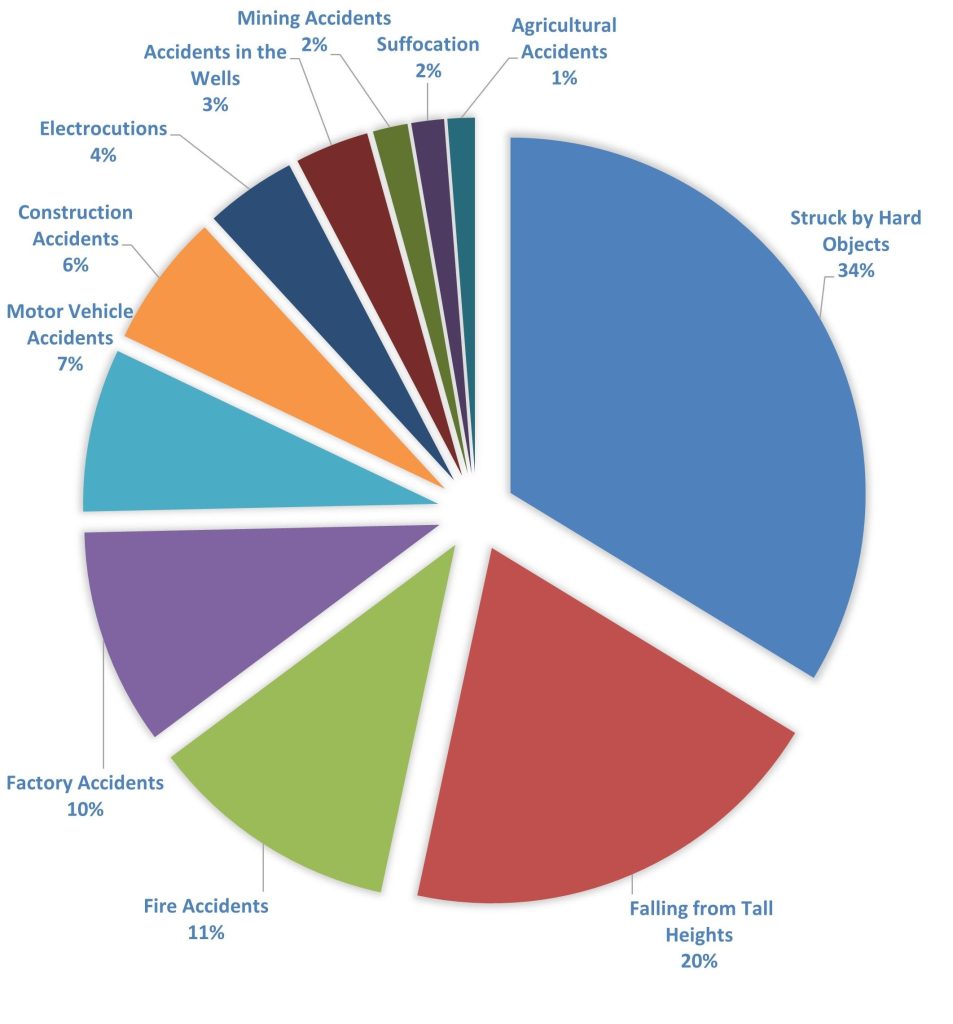
Figure2: Occupational Accident Classification Chart as documented by HRA
Based on data gathered by HRA’s Statistics and Publication Center, (a collection of 3,730 reports published in the 12 month reporting period) 34% of workplace accidents were caused by being struck by hard objects, 20% by falling from tall heights, 7% by motor vehicle accidents, 6% construction accidents, 10% factory accidents, 10% fire accidents, 3% accidents in the wells, 4% electrocutions, 2% accidents in the mine, 2% suffocation and 1% agricultural accidents.
For further inquiries please contact Skylar Thompson, Senior Advocacy Coordinator Human Rights Activists in Iran (HRA) at [email protected]
This report contains the 2020’s analytical and statistical annual report on human rights in Iran, prepared by the Department of Statistics and Publications of Human Rights Activists (HRA). This statistical analysis report presented by HRAI is the result of the daily efforts of this organization and its dedicated members as part of a daily statistic and census project that started in 2009 by this organization.
This annual report on human rights violations in Iran (2020) is the collection, analysis, and documentation of 4472 reports concerning human rights, gathered from various news sources during 2020 [January 1st to December 20th]. Human Rights Activists News Agency (HRANA) has gathered and reported 42%, official or close to the Iranian government sources 45% and other human rights news agencies 13% of all the reports analyzed in this Annual Report.
The following 45-pages includes statistical overviews and related charts on various sections regarding women’s rights, children’s rights, prisoners’ rights, etc. Based on this report, despite the 4% decrease in human rights violations reports in provinces other than Tehran, compared to the last year’s annual report, there is still a major concern on lack of proper reporting and monitoring of the human rights by the civil society in the smaller cities.
This report is the result of endeavors made by courageous human rights activists in Iran who pay a very high cost for the realization of their humanitarian beliefs. However, for obvious reasons (i.e. existing governmental limitations and ban on the free exchange of information and government preventing the existence of human right organizations in the country), this report by no means is free of errors and cannot alone be a reflection on the actual status of human right in Iran. Having said that, it should be emphasized that this report is considered as one of the most accurate, comprehensive, and authentic reports on the human rights conditions in Iran and it can serve as a very informative source of information for human rights activists and organizations working on Iran, to better understand the challenges and opportunities that they may face.
Download the full version of the report
Monitoring
The following map illustrates the number of reports per province made by the human rights organizations and news agencies, this is a direct reflection of the capability of the civil society in each province of the country (2020).
As indicated in the distribution map, there exists a major discrepancy between Tehran, the capital, and other parts of the country in terms of the number of published reports. This is while the census of 2016 reported a population of 13,267,637 in Tehran, compared to a population of 66,658,633 in the rest of the country.
Ethnic Minorities
In the field of national and ethnic minorities’ rights, a total of 234 reports registered by the department of the statistics and publication of Human Rights Activists in Iran (HRAI) in 2020. According to these reports, at least 286 people were arrested, and 39 people were sentenced to a total of 1721 months of prison term. from the total of 1721 months of prison terms issued, 1699 months were imprisonment sentences for 36 individuals, and 22 months were suspended imprisonment sentences for 3 individuals. And a total of 88 individuals were summoned by the security and judicial institutions.
Compared to the previous year there has been a 16.6% decrease in the arrest of ethnic minorities and a35 % decrease in imprisonment sentences.
Religious Minorities
In this category, 136 reports have been registered by the Department of Statistics in 2020. According to these reports, 77 arrests, 49 cases of prevention from economical activities, 126 cases of summon by the judicial and security institutions, and 22 cases of depriving and preventing from education, and 69 cases of police home raids, has taken place.
98 individuals of the religious minorities were sentenced by the judicial institutions to a total of 4351 months of imprisonment. Additionally, the ministry of cultural heritage of Tehran and the Municipality of Tehran demolished the Adventist church of Tehran in the past year.
In the field of religious minorities, the Baha’is constitute the highest of the Human Rights reports on religious minority violations with 45%, Sunnis 26%, Christians 15%, Dervishes 4%, Jews and Yarsans 1%, and others 9%, of the total reports. Note that the reports labeled as “Others” are those that did not belong to a specific group of religious minorities.
The number of citizens arrested in the category of religious minorities has decreased by42 % in 2020 compared to 2019, and the imprisonment sentences issued by the judiciary has increased by28.9 %.
Freedom of Expression
In the category of freedom of thought and expression, in 2020, 883 reports have been registered by the Department of Statistics that included 928 arrested individuals; 287 summonses to the judiciary and security authorities; 4 reports of publication banning; 8 cases of conviction for publications.
In 2020, 420 arrestees were sentenced to a total of 22271 months of imprisonment, that includes 386 individuals sentenced to a total 21523 months in prison and 34 individuals received a total of 748 months of suspended prison terms.
34 people to 191 billion and 765 million rials in financial fines, 85 people get 5844 lashes, and 21 cases of deprivation from civil rights have been reported in this category. Additionally, there has been 40 police home raids recorded.
In the field of Freedom of Expression, there has been a decreased of88.8 % in the reports of arrests compared to the previous year. Similarly, sentences issued by the judiciary have increased by46.5 % based on the number of people being tried, and imprisonment sentences were increased by 52.9 % compared to 2019.
Trade Unions and Associations
In the category of the rights of associations and trade unions in 2020, 359 reports have been registered by the Department of Statistics and Publications. This includes 47 members of the trade union were reported being arrested. Also, in this category, 10 individuals have been sentenced to a total of 554 months in prison, 51 cases of summoning to the judicial and security institutions, and 3930 cases of closing the facilities have been reported.
In 2020, at least 329 protests and 3 union strikes were held. Most of these protests were related to salary/wage demands from corporations, bad economic conditions, and lack of proper management of corporations.
In the category of Trade Unions and Associations, there has been a 31 % decrease in the number of arrests and there has been an 89 % increase in the issue of sentences compared to the previous year.
Academia/ Right to education
In the category of violations of academic rights in 2020, 24 reports have been registered by the Department of Statistics and Publication of Human Rights Activists in Iran. This includes 6 students arrested, 20 students were suspended, and as it was also mentioned in the religious rights section of this report 22 students were prevented from continuing their education because of their religion.
In the category of academia and the right to education, there has been a a94 % decrease in the number of arrests. And based on these reports 1 student was sentenced to 60 months in prison.
Right to Life (Death Penalty)
In the category of right to life, in 2020, 241 reports have been registered by the Department of Statistics and Publication of Human Rights Activists Association in Iran. This included 95 death sentences, 236 death sentences were carried out (including 1 execution in public). Based on the announced identifications of some of the individuals executed, 205 were male and 8 were female.
In addition, 2 juvenile offenders have also been executed in 2020 who were under the age of 18 at the time of committing the crime.
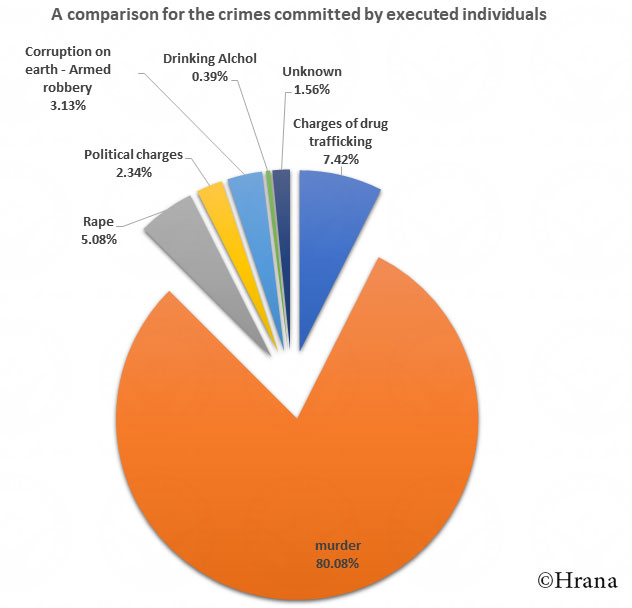
According to these reports, 80% of the executions were based on murder charges. Moreover, 5% charged with rape, another 9% with drug-related charges. 4% were charged with “Waging war against God”, also 1% charged with armed robbery,1% Consumption of alcohol.
The highest number of all death sentences issued are comprised of 80% on murder charges, followed by Drugcharges which make up 9% of the cases.
The province of Alborz ranking first in death sentences in Iranian provinces with 19% of all the death sentences issued, that is due to its two populated and important prisons, followed by Razavi Khorasan province with 12% of all the cases.
The Rajai Shahr prison and Vakil Abad Prison holding the highest number of executions in all prisons in Iran.
According to the statistics, about 0.42% of the executions were carried out in public.
Of those executed in 2020, 3% were female, and 87% were male, while the gender of the other 10% is unknown.
These executions reported by independent sources and human rights associations, indicating that 72% of executions are carried out in secret or without any public notice.
In the category of the death penalty, the execution carried out in comparison to 2019 has decreased by4.8 %. The number of execution sentences issued also has decreased by 12%, and the number of public executions has decreased by 92%.
Cultural Rights
In the category of violations of cultural rights in 2020, 21 reports have been registered by the Department of Statistics and Publication of Human Rights Activists Association in Iran. This included reports on 27 arrests and 4 individuals were sentenced to 257 months of imprisonment, from this number 3 individuals were sentenced to 253 months of imprisonment, while 1 person was sentenced to 4 months of suspended prison term.
1 individual was summoned to the judiciary and security organizations. Moreover, 2 licenses were revoked, 1 person was banned from public speaking or performing, and 1 person was banned from working.
In this category, arrests have increased by51 % compared to the previous year.
Workers’ Rights
In the category of violations of workers’ rights in 2020, 1318 reports have been registered by the Department of Statistics and Publication of Human Rights Activists Association in Iran. This included 30 arrests. 45 workers activists or workers were sentenced to 183 months in prison, and 42 people received 3108 lashes, and 42 people were summoned to judiciary and security organizations.
During 2020, a total of 2011 months of overdue payment of salaries to workers has been reported. 2105 workers were laid off or fired, 2240 cases of unemployment, 18049 lacked work insurance, 3082 workers waiting for work-related decisions. In addition, 1187 people have lost their lives in work-related accidents, and 3259 workers have been injured while at work. On a global scale amongst other counties, Iran ranks 102nd in work safety.
Also, in 2020, at least 473 worker protests and 99 workers strike took place. most of these protests were regarding wages.
Based on these reports the arrest of workers has increased by56 % compared to 2019.
Children’s Rights
In the category of violations of children’s rights in 2020, a total of 176 reports have been registered by the Department of Statistics, however, it should be mentioned because of secretly in the matter of reporting these incidents there is no accurate statistic in this field. These reports included at least 2205 cases of child abuse, 9 cases of rape and sexual abuse of children, 9 cases of murder of childre, 2 self-immolation, 94 cases of child suicide, and more than
1 million students are deprived of education.
Lack of access to devices for virtual education, Child marriages, poverty, cultural context, population density, etc. in Khuzestan province has led to the highest number of deprivations from education in the country.
As mentioned in the right to the life section, at least 2 minor offenders have been executed in Iran during 2020. Additionally, 3 teenagers were sentenced to a total of 264 months of imprisonment.
During the nation-wide protests, 19 children and 1 children’s rights activist were arrested.
Women’s Rights
In the category of violations of women’s rights in 2020, a total of 81 reports have been registered by the Department of Statistics. These reports reflected. At least 572 women were physically and sexually abused, 13 cases of honor-killings,6 self-immolation, 4 cases of acid attacks, and 1 cases of summoned women’s rights activists to judiciary and security organs.
Based on this report 5 women have been detained for reasons related to women’s rights. At least 2 women’s rights activists were sentenced to 180 months in prison.
Prisoners’ Rights
In the category of violations of prisoners’ rights in 2020, a total of 542 reports have been registered, 53 reports on physical assault of prisoners, 366 reports of deprivation
/neglected of medical care, 109 reports of illegal transfer to solitary confinement, 533 attempted hunger strikes, 289 cases of forced transportation or exile, 228 cases of threatening prisoners, 126 cases of banning prisoners of having visitors, 18 cases of torture, 25 case of deaths by diseases,10 arrestees were killed by prison authorities, and 17 prisoners committed suicide, 40 cases of lack of access to lawyers, 1678 reports of prisoners being held in unsuitable circumstances. Also, in this category, there have been 147 cases of keeping prisoners in an unsure state about their sentence and situation.
Security Forces’ Violence and Citizens’ Safety
Death of civilians
This section is dedicated to the killing or injuring of civilians by the police or military institutions. In 2020, a total of 204 people were shot by the military forces; 74 of the victims lost their life including, 36 Kulbar, 5 fuel-Carriers, 33 civilians. 130 people were also injured by the shots of the military forces, including 109 Kulbar, 16 civilian, 5 Fuel-carriers. Addititonally, 9 Kulbers were affected by climate and geographical factors such as freezing and falling from heights, 4 of whom were injured and 5 Kulber lost his life.
Victims of landmines and explosions
The landmines left from the war threaten the lives of civilians of the border cities each year. Iranian government continues manufacture and planting of the anti-personnel mines, and against the international agreements, it believes that the use of these type of landmines is the only effective way in keeping its vast borders safe.
Based on reports, in the past year at least 10 civilians have lost their lives by landmines in the border areas and 14 other civilians have been injured.
Floggings
The International Covenant on civil and Political Rights (ICCPR) has explicitly banned the use of inhuman, or degrading punishments, such as flogging. However, based on the gathered reports in 2020, flogging sentences were carried out for at least 14 accused who were sentenced to a total of 874 floggings. The sentence of 3 of the accused for a total of 222 floggings were carried out in public.
It should be noted that, the judiciary has also issued a total of 23946 flogging sentences in the past year.
Intervention in personal affairs of civilians
In 2020, at least 209 civilians were arrested for attending or hosting personal gatherings and parties. This number is based on 8 official reports of the country.
Additionally, in 2020, at least 180 group of civilians –mostly consist of those who have lost money (exacerbated economically) or those whose civilian rights have been violated– have organize protests for not being able to fulfill their asking and demands. These protests took place in 24 provinces. Tehran, Eastern Azerbaijan, Khuzestan, and Khorasan Razavi were the provinces with most protests.
Sentences
In 2020, the judiciary of the Iranian government, including the initial court and appeal, issued 29841 months of imprisonment. These reports included; 1721 months of imprisonment for the ethnic minorities, 4351 months of imprisonment for religious minorities; 22271 months of imprisonment in the category of freedom of expression, 554 months of imprisonment in the category of Unions, 183 months of imprisonment for workers, 257 months of imprisonment in cultural category, 264 months of imprisonment in children’s rights category, 180 months of imprisonment in women’s rights category, and 60 months of imprisonment for students.
These statistics only include the court sentences that indicated detailed information or characteristics of the verdicts.
A total of One hundred and ninety-four billion and seven hundred and forty-six million rials in fines and 9182 lashes has been issued in 2020.
In 2020, the number of convictions of citizens or activists has increased by35 %. Moreover, the convictions of religious minorities increased by 28.9%, ethnic minorities decreased by 35%, and freedom of expression has been increased by 52.9%, unions increased by 89%, in the cultural field increased by 38%, workers decreased by 73%, women’s rights decreased by 80%, and in the students category decreased by 89%.
Arrests
In 2020, the security forces arrested 1426 individuals because of political or civil rights-related activities.
The statistical analysis exhibited 47 case of arrest in the trade union category, 286 arrests in the category of ethnic minorities, 77 arrests in the category of religious minorities, 928 arrests in the category of freedom of expression, in the children’s rights category 20 arrests, 6 arrests of students in the category of Academia/right to education, 27 arrests in the field of culture, and 30 arrests in the category of workers’ rights.
Moreover, 5 women were prosecuted for their activities, and promotion of their lifestyle; 3 of whom were arrested for modeling, and the other two for participating in sports.
In 2020, the number of arrests decreased by84 %. According to these reports, the number of arrests decreased in ethnic minorities by 16.6%, culture increased by 51%, religion minorities decreased by 42%, unions decreased by 31%, students decreased by 94%, workers’ rights increased by 56%, and in the category of freedom of expression decreased by 88.8%.
This is the brief version and the full report is available for download in PDF format.
Human Rights Activists (in Iran)
Department of Statistics and Publications
December 2020
For media inquiries please contact Skylar Thompson, [email protected]
Human Rights Activists News Agency (HRANA)- On the World Day Against the Death Penalty, the Center of Statistics of Human Rights Activists in Iran (HRAI) has published its annual report, in efforts to sensitize the public about the situation of the death penalty in Iran.
HRANA’s Statistics Center relies on the work of HRANA reporters, as well as a network of independent and verifiable sources. It also incorporates disclosures to the media by judicial authorities announcing or confirming prisoner executions, and as such is exposed to a margin of error representing efforts by the Iranian authorities to omit, conceal, or restrict the collection of such data.
Between October 10, 2019, and October 8, 2020, the death penalty and executions have been the focus of 264 HRANA reports. Over this time period, the Iranian authorities issued the death penalty sentence to 96 individuals and have already carried out 256 executions including 2 public executions.
Click here to download report in PDF format
While execution numbers went down by 2% in comparison to the same time last year, Iranian courts have issued 16% less death sentences. Public hangings and executions of women have decreased by 78% and increased 12%, respectively.
Females account for only 15 of the 256 HRANA-confirmed execution victims this year. . In addition, 2 juvenile offenders, under the age of 18 when they allegedly committed the crime they were charged with, were executed.
The report includes a breakdown of executions by capital offense: 80.08% were charged with murder, 7.42% were charged with drug and narcotic offenses, 5.08% were charged with Rape, 2.34% were charged with armed robbery/offenses classified as “corruption on earth”, 3.13% were charged with political or security-related offenses, 0.39% were charged with drinking alcohol and 1.56% had unknown charges.
The chart below displays execution numbers by the province in which they took place. According to this chart, Alborz had the highest number of executions at 16%. Khorasan Razavi and West Azerbaijan come second and third, with 11% and 9% respectively.
The chart below is a distribution of execution information sources. The chart indicates that 77% of HRANA-confirmed executions were not announced by the official Iranian sources. Undisclosed executions are referred to as “secret” executions.
The chart below displays execution numbers by their location in prison or public. According to statistics, 1% of the executions in Iran were carried out in public.
This leaflet contains the 2019’s analytical and statistical annual report on human rights in Iran, prepared by the Department of Statistics and Publications of Human Rights Activists in Iran (HRAI). This statistical analysis report presented by HRAI is the result of the daily efforts of this organization and its dedicated members as part of a daily statistic and census project that started in 2009 by this organization.
This annual report on human rights violations in Iran (2019) is the collection, analysis, and documentation of 4259 reports concerning human rights, gathered from various news sources during 2019 [January 1st to December 20th]. Human Rights Activists News Agency (HRANA) has gathered and reported 41%, official or close to the Iranian government sources 53% and other human rights news agencies 6% of all the reports analyzed in this Annual Report.
The following 42-pages includes statistical overviews and related charts on various sections regarding women’s rights, children’s rights, prisoners’ rights, etc. Based on this report, despite the 10% increase in human rights violations reports in provinces other than Tehran, compared to the last year’s annual report, there is still a major concern on lack of proper reporting and monitoring of the human rights by the civil society in the smaller cities.
This report is the result of endeavors made by courageous human rights activists in Iran who pay a very high cost for the realization of their humanitarian beliefs. However, for obvious reasons (i.e. existing governmental limitations and ban on the free exchange of information and government preventing the existence of human right organizations in the country), this report by no means is free of errors and cannot alone be a reflection on the actual status of human right in Iran. Having said that, it should be emphasized that this report is considered as one of the most accurate, comprehensive, and authentic reports on the human rights conditions in Iran and it can serve as a very informative source of information for human rights activists and organizations working on Iran, to better understand the challenges and opportunities that they may face.
This is the brief version and the full report is available for download in PDF format.
The following map illustrates the number of reports per province made by the human rights organizations and news agencies, this is a direct reflection of the capability of the civil society in each province of the country (2019).
As indicated in the distribution map, there exists a major difference between Tehran, the capital, and other parts of the country in terms of the number of published reports. This is while the population of Tehran has been reported on the census of 2017 as 15270000 people, compared to the population of other parts of the country being 81160000 people.
Ethnic Minorities
In the field of national and ethnic minorities’ rights, a total of 309 reports regarding 343 individuals have been registered by the department of the statistics and publication of human rights activists in Iran (HRAI) in 2019. According to these reports, at least 1171 people were arrested, and 60 people were sentenced to 2698 months of imprisonment. Compared to the previous year there has been a 70% decrease in the arrest of ethnic minorities and a 13% increase in imprisonment sentences. The highest number of violations occurred in the month of June, in contrast, the highest decline is observed in the month of December.
Religious Minorities
In this category, 162 reports have been registered by the Department of Statistics in 2019, According to these reports, 135 civilians were arrested, 13 cases of prevention from economical activities, 90 cases were summoned to the judicial and security institutions, and 36 cases of depriving and preventing from education. 76 individuals of the religious minorities were arrested and sentenced by the judicial institutions to a total of 2983 months of imprisonment.
The highest number of violations occurred in the month of January, in contrast, the highest decline is observed in the month of April. In the field of religious minorities, the Baha’is constitute the highest of the Human Rights reports on religious minority violations with 54%, Sunnis 30%, Christians 9%, Dervishes 2%, Jews 1%, Yarsans 1%, and others 5%, of the total reports. The number of citizens arrested in the category of religious minorities has decreased by 78% in 2019 compared to 2018, and the imprisonment sentences issued by the judiciary has decreased by 82%.
Freedom of Speech
In the category of freedom of speech, in 2019, 529 reports have been registered by the Department of Statistics that included 8293 arrested individuals; 274 summonses to the judiciary and security authorities; 4 cases of Internet website filtering, 1 case of nationwide internet shutdown, 1 case of cell phones shut down, 5 reports of publication banning; 17 cases of conviction for publications; 14 cases of intimidation and threats. In 2019, 292 arrestees were sentenced to a total of 10474 months of imprisonment, 4 billion and 278 million and 350 thousand Rials in financial fines, 3470 lashes, and 13 cases of deprivation from civil rights have been reported in this category. In the field of Freedom of Speech, there has been an increase of 51% in the reports of arrests compared to the previous year. Similarly, sentences issued by the judiciary have decreased by 11% based on the number of people being tried, and imprisonment sentences were increased by 40% compared to 2018.
The nation-wide protests of November are one of the most significant events of 2019 in this category. During the November protests that lasted more than 10 days simultaneously in 719 parts of the country. At least 7133 people were arrested, and hundreds died on the streets. The highest number of violations in this category occurred in the months of December, in contrast, the highest decline is observed in the month of March.
Trade Unions and Associations
the category of the rights of associations and trade unions in 2019, 339 reports have been registered by the Department of Statistics and Publications. This includes 69 members of the trade unions who reported being arrested. Also, in this category, 10 individuals have been sentenced to a total of 56 months in prison, 17 cases of summoning to the judicial and security institutions, and 1931 cases of closing the facilities have been reported. In 2019, at least 273 protests and 15 union strikes were held. Most of these protests were related to salary/wage demands from corporations, bad economic conditions, and lack of proper management of corporations.
In the category of Trade Unions and Associations, there has been an 83% decrease in the number of arrests and there has been a 72% decrease in the issue of sentences compared to the previous year. Moreover, the highest number of violations occurred in the month of July, in contrast, the highest decline is observed in December.
Right to Education
the category of violations of academic rights in 2019, 50 reports have been registered by the Department of Statistics and Publication of Human Rights Activists in Iran. This includes 104 students arrested, 1 student has been summoned to the court, 1 student banned from continuing their education, as it was also mentioned in the religious rights section of this report 34 students were prevented from continuing their education because of their religion. In the category of right to education, there has been a 6% decrease in the number of arrests. And based on these reports 11 students were sentenced to 570 months in prison. The highest number of violations occurred in the month of October, in contrast, the highest decline is observed in the month of April.
Right to Life
In the category of right to life in 2019, 246 reports have been registered by the Department of Statistics and Publication of Human Rights Activists Association in Iran. This included 108 death sentences, execution of 248 people with death sentences (including 13 executions in public). Based on the announced identifications of some of the individuals executed, 231 were male and 15 were female. In addition, 4 juvenile offenders have also been executed in 2019 who were under the age of 18 at the time of committing the crime. According to these reports, 79% of the executions were based on murder charges. Moreover, 5% charged with rape, another 12.5% with drug-related charges. 1% were charged with “waging war against God”, also 2% charged with armed robbery. The highest number of violations occurred in the month of August, in contrast, the highest decline is observed in the month of March. The highest number of convictions compromised of 79% of all death sentences are on murder charges and followed by rape charges which are 12.5% of the cases. The highest number of death penalty sentences were issued in Alborz province with 27% due to its two populated and important prisons, followed by Fars province with 10% of the cases. In addition, Rajai Shahr prison and Central Urmia Prison holding the highest number of death sentences. The province of Fars and Kohgiluyeh and Boyerr-ahmad have the highest number of executions in public each with 23% of total executions in public.
According to the statistics, about 5% of the executions were carried out in public and 95% were carried out in prison. Secret executions reported by independent sources and human rights association, indicating that 75% of executions are carried out in secret or without any public notice. In the category of right to life, the execution carried out in comparison to 2018 has decreased by 5%. The number of execution sentences issued also has decreased by 44% and the number of public executions has not changed. In addition, 6% of the executed individuals were female, 93% men.
Cultural Rights
the category of violations of cultural rights in 2019, 64 reports have been registered by the Department of Statistics and Publication of Human Rights Activists Association in Iran. This included 13 arrests, 38 people were sentenced to 186 months imprisonment, and 27 individuals were summoned to judiciary and security organizations. Moreover, 4 cultural materials publication were declined, 13 licenses were revoked, 6 people were banned from public speaking or performing, 4 historical places were damaged, 2 historical places were neglected, confiscated 38000 copies of books. In this category, arrests have decreased by 87% compared to the previous year. The highest number of violations have been reported in January, in contrast to the lowest number in September.
Workers’ Rights
the category of violations of workers’ rights in 2019, 1088 reports have been registered by the Department of Statistics and Publication of Human Rights Activists Association in Iran. This included 143 arrests. 33 workers activists or workers were sentenced to 696 months in prison, and 176 months of suspended sentences and 762 lashes, and 198 people were summoned to judiciary and security organizations. During 2019, a total of 799 months of overdue payment of salaries to workers has been reported. 4746 workers were laid off or fired, 10571 cases of unemployment, 50050 lacked work insurance, 199 workers waiting for work-related decisions. In addition, 1412 people have lost their lives in work-related accidents, and 14245 workers have been injured while at work. On a global scale amongst other counties, Iran ranks 102nd in work safety. Also, in 2019, at least 279 worker protests and 21 workers strike took place. most of these protests were regarding wages. Moreover, the arrest of workers has decreased by 35% compared to 2018. In the monthly comparison of workers’ rights violations in 2018, the highest number of violations per month have been in July, in contrast with the lowest being in April.
Women’s Rights
In the category of violations of women’s rights in 2019, a total of 103 reports have been registered by the Department of Statistics. At least 335 women were physically and sexually abused, 12 cases of honor-killings, and 19 cases of summoned women’s rights activists to judiciary and security organs. At least 19 women’s rights activists and 86 others were arrested during the women’s march. At least 13 women’s rights activists were sentenced to 926 months in prison. The highest number of reports in women’s rights violations was in May and June and the highest decline in reports is observed in January.
Prisoners’ Rights
In the category of violations of prisoners’ rights in 2019, a total of 540 reports have been registered, 104 reports on physical assault of prisoners, 141 reports of deprivation/neglected of medical care, 151 reports of illegal transfer to solitary confinement, 302 attempted hunger strikes, 415 cases of forced transportation or exile, 71 cases of threatening prisoners, 67 cases of banning prisoners of having visitors, 7 cases of torture, 14 case of deaths by diseases, 65 cases of lack of access to lawyers, 742 reports of prisoners being held in unsuitable circumstances. Also, in this category, there have been 71 cases of keeping prisoners in an unsure state about their sentence and situation. Based on the number of reports per month, the highest number of reports in prisoners’ rights violations has been in July and the highest decline in reports is observed in December.
Sentences
2019, the judiciary of the Iranian government, including the initial court and appeal, issued 19111 months of imprisonment. These reports included; 2698 months of imprisonment for the ethnic minorities, 2983 months of imprisonment for religious minorities; 10474 months of imprisonment in the category of freedom of speech—it should be noted, these statistics only include the court sentences that indicated detailed information or characteristics of the verdicts. The highest number of reports in this category has been in July and the highest decline in reports is observed in May. In addition, a total of 5 billion and 152 million and 350 thousand Rials in fines and 4676 lashes has been issued in 2019. In 2019, the number of convictions of citizens or activists has decreased by 31%. Moreover, the convictions of religious minorities decreased by 82%, ethnic minorities increased by 13%, and freedom of expression has been increased by 40%.
Arrests
In 2019, the security forces arrested 9201 individuals because of political or civil rights-related activities. The statistical analysis exhibited 69 case of arrest in the trade union category, 343 arrests in the category of ethnic minorities, 135 arrests in the category of religious minorities, 8293 arrests in the category of freedom of speech, 100 arrests of students in the category of right to education, 13 arrests in the field of culture, and 143 arrests in the category of workers’ rights. The highest number of reports in this category has been in November and the highest decline in reports is observed in July. In 2019, the number of arrests increased by 12%. According to these reports, the number of arrests decreased in ethnic minorities by 70%, culture by 87%, religion minorities 78%, unions 83%, students 6%, workers’ rights 35%, and in the category of freedom of speech increased by 51%.
This leaflet contains the 2018’s analytical and statistical annual report on the human rights in Iran, prepared by the Department of Statistics and Publications of Human Rights Activists in Iran (HRAI). This statistic analysis report presented by HRAI, is the result of the daily efforts of this organization and its dedicated members as part of a daily statistic and census project that started in 2009 by this organization.
This annual report on human rights violations in Iran (2018) is the collection, analysis, and documentation of 3677 reports concerning human rights, gathered from various news sources during 2018. Human Rights Activists News Agency (HRANA) has gathered and reported 35%, official or close to the Iranian government sources 58% and other human rights news agencies 7% of all the reports analysed in this Annual Report.
Download PDF file
The following 42-pages includes statistical overviews and related charts on various sections regarding women’s rights, children’s rights, prisoners’ rights, etc. Based on this report, despite the 6% increase in human rights violations reports in provinces other than Tehran, compared to the last year’s annual report, there is still a major concern on lack of proper reporting and monitoring of the human rights by the civil society in the smaller cities.
This report is the result of endeavors made by courageous human rights activists in Iran who pay a very high cost for the realization of their humanitarian believes. However, for obvious reasons (i.e. existing governmental limitations and ban on the free exchange of information and government preventing the existence of human right organizations in the country), this report by no means is free of errors and cannot alone be a reflection on the actual status of human right in Iran. Having said that, it should be emphasized that this report is considered as one of the most accurate, comprehensive, and authentic reports on the human rights conditions in Iran and it can serve as a very informative source of information for human rights activists and organizations working on Iran, to better understand the challenges and opportunities that they may face.
This leaflet contains the 2017’s analytical and statistical annual report on the human rights in Iran, prepared by the Department of Statistics and Publications of Human Rights Activists in Iran (HRAI). This statistic analysis report presented by HRAI is the result of the daily efforts of this organization and its dedicated members as part of a daily statistic and census project that started in 2009 by this organization.
This annual report on human rights violations in Iran ( Jan 1 2017 – Dec 15 2017) is the collection, analysis, and documentation of 2889 reports concerning human rights, gathered from various news sources during 2017.
The following 41-pages includes statistical overviews and related charts on various sections regarding women’s rights, children’s rights, prisoners’ rights and etc. based on this report, despite the 10% decrease in human rights violations reports in provinces other than Tehran, compared to the last year’s annual report, there is still a major concern on lack of proper reporting and monitoring of the human rights situation by the civil society in the smaller cities.
This report is the result of endeavours made by courageous human rights activists in Iran who pay a very high cost for the realization of their humanitarian believes. However for obvious reasons (i.e. existing governmental limitations and ban on the free exchange of information and government preventing the existence of human right organizations in the country), this report by no means is free of errors and cannot alone be a reflection on the actual status of human right in Iran. However, it should be emphasized that this report is considered as one of the most accurate, comprehensive and authentic reports on the human rights conditions in Iran and it can serve as a very informative source of information for human rights activists and organizations working on Iran, to better understand the challenges and opportunities that they may face.
This leaflet contains the 2016’s analytical and statistical annual report on the human rights in Iran, prepared by the Department of Statistics and Publications of Human Rights Activists in Iran (HRAI). This statistic analysis report presented by HRAI is the result of the daily efforts of this organization and its dedicated members as part of a daily statistic and census project that started in 2009 by this organization.
Download report in PDF format
This annual report on human rights violations in Iran (2016) is the collection, analysis, and documentation of 3439 reports concerning human rights, gathered from various news sources during 2016. Human Right Activists News Agency (HRANA) has gathered and reported 28%, official or close to the Iranian government sources 63% and other human rights news agencies 9% of all the reports analyzed in this Annual Report.
The following 31-pages includes statistical overviews and related charts on various sections regarding women’s rights, children’s rights, prisoners’ rights and etc. based on this report, despite the 4% increase in human rights violations reports in provinces other than Tehran, compared to the last year’s annual report, there is still a major concern on lack of proper reporting and monitoring of the human rights situation by the civil society in the smaller cities.
This report is the result of endeavors made by courageous human rights activists in Iran who pay a very high cost for the realization of their humanitarian beliefs. However, for obvious reasons (i.e. existing governmental limitations and ban on the free exchange of information and government preventing the existence of human right organizations in the country), this report by no means is free of errors and cannot alone be a reflection on the actual status of human right in Iran. However, it should be emphasized that this report is considered as one of the most accurate, comprehensive and authentic reports on the human rights conditions in Iran and it can serve as a very informative source of information for human rights activists and organizations working on Iran, to better understand the challenges and opportunities that they may face.