HRANA – The assets and properties of 48 citizens in Hamedan Province have been seized. The judiciary has accused these individuals of “collaboration with the enemy.” Forty-two of these citizens reside abroad.
According to a report by Fars News Agency, the assets of 48 citizens in Hamedan Province have been confiscated. Based on the report, judicial authorities claimed that these individuals were active in a “network of collaborators with the enemy” and that their actions fall under the law intensifying punishment for espionage and cooperation with the Israeli regime against national security and interests.
Fars also claimed that the measure was carried out under orders from judicial authorities and that the confiscated assets are intended to be used for rebuilding sites damaged by the war.
Among these individuals, six reside in the United Kingdom, two in Switzerland, one in Russia, eight in Germany, six in Turkey, eight in Iraq, four in the United States, one in Italy, one in Oman, one in Canada, one in Saudi Arabia, one in Armenia, two in Ghana, and six in Iran.
The report did not disclose the identities of these citizens or provide details regarding the judicial proceedings in their cases.
Previously, the assets and properties of dozens of other individuals in Hamedan had also been confiscated under similar accusations by order of judicial authorities.
Following the start of military attacks on Iran, Gholamhossein Mohseni Ejei, head of the judiciary, announced that judicial orders had been issued for the seizure and confiscation of assets linked to what he described as “elements collaborating with the enemy inside and outside the country.” He also threatened these individuals with execution, stating: “One of the punishments prescribed in this matter is execution, and following investigations, one of the legal punishments will be applied to those subject to these charges.”
Following the issuance of this directive by the judiciary, the “Saham” smart financial inquiry system was launched. With the activation of this system, prosecutor’s offices and courts across the country are able to identify citizens’ assets and properties online in the shortest possible time and take the necessary measures to seize them.
HRANA – Mehdi Shafakhah, an activist involved in education and support for working children and residents of underprivileged areas, was arrested by security forces on Tuesday, May 12, and taken to an undisclosed location.
According to a report by Modara, the social activist was arrested by agents of the Ministry of Intelligence. Based on the report, on Tuesday, May 12, security forces raided Mr. Shafakhah’s home, arrested him, and searched the residence while confiscating his personal belongings.
So far, no information has been obtained regarding the reasons for his arrest, the charges brought against him, or his place of detention.
In recent years, Mehdi Shafakhah had been volunteering in deprived and marginalized areas, working to reduce social harms such as addiction and delinquency by teaching sports and social skills to working children and vulnerable teenagers.
He is the brother of Reza Shafakhah, an attorney and activist for the rights of children and political prisoners.
HRANA – Esti Mohammadi, 67, and Amir Yousefi, residents of Bukan, were arrested by security forces.
Kolbar News has identified these individuals as Amir Yousefi and Esti Mohammadi, 67, both residents of Bukan. Based on the report, Ms. Mohammadi was arrested on the evening of Monday, May 11, while Mr. Yousefi was arrested separately on Tuesday by security forces. Yousefi was reportedly held for one day at a detention center in Bukan following his arrest and was then transferred to one of the security detention facilities in Urmia.
So far, no information has been obtained regarding the reasons for their arrests or the charges brought against these citizens.
HRANA – Varisheh Moradi, a political prisoner held in Evin Prison, has been sentenced to six months in prison in connection with a new case opened against her during her imprisonment.
Based on a verdict recently issued and formally communicated to the political prisoner, Ms. Moradi was sentenced to six months in prison on the charge of “propaganda against the regime.”
The case was opened against Ms. Moradi during her imprisonment, and the evidence cited reportedly relates to her authorship of a statement concerning the anniversary of the 2022 protests.
In late November 2024, Ms. Moradi had previously been sentenced to death by Branch 15 of the Tehran Revolutionary Court, presided over by Judge Abolghasem Salavati, on the charge of baghi (armed rebellion). Late last year, her death sentence was overturned by the Supreme Court, and her case was referred to a parallel branch for retrial.
In late October 2024, Moradi was also sentenced to six months of discretionary imprisonment in a joint judicial case alongside four other prisoners, stemming from incidents inside prison. The sentence was issued by Branch Two of the Qods Judicial Complex Criminal Court in Tehran. “Assaulting an officer and disobedience” were the charges brought against her in that case. The case was opened following events on August 7, 2024, after prisoners in the women’s ward of Evin Prison protested the execution of Reza Rasaei and clashed with prison guards.
Varisheh Moradi was arrested by security forces in the outskirts of Sanandaj in August 2023. On December 26, 2023, following the completion of interrogation procedures, she was transferred from the Ministry of Intelligence detention facility, known as Ward 209 of Evin Prison, to the women’s ward of the prison.
In November 2024, Ms. Moradi had been sentenced to death on the charge of baghi (armed rebellion) by Branch 15 of the Tehran Revolutionary Court, presided over by Judge Abolghasem Salavati.
In October 2024, in a separate joint case opened against her and four other prisoners inside the prison, Ms. Moradi was sentenced by Branch Two of the Qods Judicial Complex in Tehran to six months’ discretionary imprisonment. In that case, she faced charges of assaulting an officer and disobedience. The case stemmed from an incident on August 6, when Evin women’s ward prisoners protested after learning of the execution of Reza Rasaei, leading to confrontations with prison guards.
Varisheh Moradi was arrested in August 2023 by security forces in the outskirts of Sanandaj. She was eventually transferred on December 26 of that year from The Ministry of Intelligence’s detention facility, known as Ward 209 of Evin Prison, after the completion of interrogation, to the women’s ward of the same prison.
HRANA – In recent days, the death sentences of five prisoners, who had previously been sentenced to death in separate cases on charges related to drug offenses and murder, were carried out in the prisons of Kerman, Tabriz, Birjand, and Gorgan.
According to a report by Haal Vsh, two prisoners were executed at dawn on Wednesday, May 13, 2026, in Kerman Prison.
The identities of these prisoners have been reported as Heydar Bamari (Moradkhani), 27, and Mehdi Bamari (Moradkhani), 27, both residents of Dalgan County.
According to the report, the two prisoners had been arrested in 2023 in a joint case on charges related to drug offenses in Kahnooj. After being transferred to Kerman Prison, they were sentenced to death by the Revolutionary Court of the city.
In another report, Haal Vsh announced the execution of a prisoner held in Birjand Prison at dawn on Tuesday, May 12, 2026. The prisoner was identified as Younes Barahoui, 29, married, and a resident of Zahedan.
Mr. Barahoui had also been arrested in 2023 on charges related to drug offenses in the Sahlabad area of Birjand County and was later sentenced to death by the Revolutionary Court of the county.
Additionally, the Iran Human Rights Organization reported the executions of two prisoners in the prisons of Tabriz and Gorgan in recent days.
The prisoner executed in Gorgan Prison was identified as Naser Langarani, 42, and the father of one child. His execution was carried out at dawn yesterday. According to the report, Mr. Langarani had been arrested approximately three years ago on murder charges and was later sentenced to death by a criminal court.
The other prisoner, who was hanged in Tabriz Prison on Sunday, May 10, 2026, was identified as Omid Sadeghi Souri, 26.
Omid Sadeghi Souri had been arrested around four years ago on murder charges following a street fight and was later sentenced to death by a criminal court.
The report quoted an informed source as saying: “Since 20 days ago, when the sentence enforcement unit informed him that he would soon be executed, he had been in extremely poor psychological condition. Omid constantly cried and said that he was very young and afraid of death; he insisted that the killing had been completely accidental and considered himself innocent. He was so devastated that he did not even want to see his family for a final visit and only settled for a brief phone call.”
As of the time of publication of this report, the executions of these prisoners had not been officially announced by prison authorities or the relevant institutions.
According to HRA’s Annual Report, in 2025 at least 2,063 citizens, including 61 women and 2 juvenile offenders, were executed. Of these, the sentences of 11 individuals were carried out in public. During the same period, 172 other individuals were sentenced to death.
HRANA – Branch One of the Appeals Court of Kohgiluyeh and Boyer-Ahmad Province has sentenced Feyzollah Azarnoosh, Milad Kariminasab, Amirhossein Mohsenipour, and Mehdi Karami, in a joint case, to a combined total of 30 years in prison. Of this total, 16 years are enforceable under Article 134 of the Islamic Penal Code.
Based on the issued ruling, Branch One of the Appeals Court of Kohgiluyeh and Boyer-Ahmad Province sentenced these individuals to a total of 30 years of discretionary imprisonment. The ruling was issued with the advisory opinions of Seyed Abolhassan Dadgar and Saeed Jarideh Asl against the named individuals.
The details of the charges and final sentences for each defendant are as follows:
1. Feyzollah Azarnoosh was sentenced to five years in prison for “participation in forming a group with the intent to disrupt national security,” one year for “propaganda against the regime,” three years for “propaganda activities in support of and strengthening Israel,” two years for “insulting the Supreme Leader,” three years for “assembly and collusion against the country’s internal security,” and one year for “insulting Islamic sanctities.” In total, he received 15 years in prison, of which five years are enforceable under Article 134 of the Islamic Penal Code.
2. Milad Kariminasab was sentenced to five years in prison for “participation in forming a group with the intent to disrupt national security” and one year for “propaganda against the regime.” His total sentence amounts to six years in prison, of which five years are enforceable under Article 134 of the Islamic Penal Code.
3. Amirhossein Mohsenipour was sentenced to three years in prison for “membership in a group or association with the intent to disrupt national security,” one year for “propaganda against the regime,” and two years for “insulting the Supreme Leader.” His total sentence amounts to six years in prison, of which three years are enforceable under the aforementioned article of the Islamic Penal Code.
4. Mehdi Karami was also sentenced to three years of discretionary imprisonment for “membership in a group or association with the intent to disrupt national security.” The entirety of this sentence, issued on a single charge, is enforceable.
It should be noted that Hamid Dastvaneh, the fifth defendant in this case, who had previously been sentenced to one year in prison at the trial stage, was acquitted of all charges during the appeals process.
HRANA had previously reported that these individuals had been sentenced in December of 2025 by Branch 102 of the Criminal Court Two of Kohgiluyeh County and the Yasuj Revolutionary Court based in Dehdasht to a combined total of 48 years in prison.
Feyzollah Azarnoosh is the father of Pedram Azarnoosh, one of those killed during the nationwide protests of 2022. He was arrested in Yasuj on June 18, 2025, and was later released from the city’s prison after some time in detention. He was also summoned by the IRGC Intelligence Organization in Yasuj on November 9, 2025. After appearing at the security institution, he was interrogated for several hours.
Milad Kariminasab was arrested by security forces in Kohgiluyeh and Boyer-Ahmad Province on June 11, 2025, while Mehdi Karami was arrested on June 18, 2025.
Amirhossein Mohseni was arrested by security forces on June 23, 2025, and transferred to The Ministry of Intelligence’s detention facility in Dehdasht. Following the completion of interrogation procedures, he was transferred to Dehdasht Prison. He was eventually released from this prison on August 20, 2025.
Hamid Dastvaneh has also previously faced security-related actions due to his activities.
HRANA – Mohammad Abbasi, one of those arrested during the nationwide protests of January 2026 and held in Ghezel Hesar Prison in Karaj, was executed at dawn today. Mr. Abbasi had been arrested during the January 2026 nationwide protests, and his death sentence had recently been upheld by the Supreme Court.
According to HRANA, another protester detained during the 2026 nationwide protests was executed at dawn today, May 13, 2026.
A source informed on condition of anonymity and close to the family of this political prisoner told HRANA: “Officials at Ghezel Hesar Prison in Karaj asked Mohammad Abbasi’s family to come to the prison for a visit. However, after the family arrived, they were denied the opportunity to see him. After the Abbasi family left the prison, they were informed by phone that Mohammad Abbasi’s execution had been carried out.”
HRANA had previously reported on April 27, 2026, that Branch 39 of the Supreme Court had upheld Mohammad Abbasi’s death sentence after rejecting his appeal. In the same case, the 25-year prison sentence of his daughter, Fatemeh Abbasi, who is currently imprisoned in the women’s ward of Evin Prison, was also fully upheld by the Supreme Court.
Mohammad Abbasi had been arrested during the January 2026 nationwide protests in connection with the case involving the killing of Lieutenant Colonel Shahin Dehghani Kakavandi in Malard. Following judicial proceedings, he was sentenced to death by Branch 15 of the Tehran Revolutionary Court, presided over by Judge Abolghasem Salavati, on the charge of “enmity against God” (moharebeh).
After the initial verdict was issued, Ali Sharifzadeh Ardakani, an attorney-at-law, stated in an interview with Emtedad that the cases of Mohammad Abbasi and his daughter Fatemeh Abbasi had been referred to Branch 39 of the Supreme Court following an appeal by a court-appointed lawyer. He also said that Branch 39 of the Supreme Court, citing Note to Article 48 of the Criminal Procedure Code, had prevented him and another independent lawyer from representing the defendants in the case.
The Emtedad report further stated that there were numerous ambiguities and concerns regarding both the judicial process and the contents of the case against the two defendants. However, independent lawyers had been unable to effectively review or pursue the matter due to being denied access to the case file.
According to data collected by HRANA, simultaneous with the outbreak of military clashes, the issuance and implementation of death sentences in political and security-related cases have intensified. Including Mohammad Abbasi, at least 32 prisoners facing such charges have been executed during this period.
HRANA – This report examines Iran’s worsening medicine shortage crisis in the aftermath of the recent U.S.-Israel war and the growing expansion of the informal drug market, a crisis that has driven patients from pharmacy lines to Telegram channels and online groups.
Patients, families, and pharmacy workers describe the daily struggle to obtain medicine, rising prices, concerns over the authenticity of drugs sold on the black market, and the emergence of informal drug supply networks.
It is after 9 p.m., yet the line outside the 24-hour pharmacy on Taleghani Street still has not ended. Some patients hold paper prescriptions in their hands, while others show photos of medicine boxes on their mobile phones. A middle-aged woman repeats the name of her husband’s medication under her breath every few minutes; a young man standing near the entrance constantly calls several other pharmacies, and nearly every response is the same: “We don’t have it.”
The medicine shortage crisis, which has intensified in the months following the war, has now shifted the process of obtaining many medications from official pharmacies to informal markets and Telegram channels. Patients who, until just a few months ago, were able to obtain their medications through official channels with a doctor’s prescription now spend hours searching from one pharmacy to another, often ultimately turning to the black market, where prices are several times higher and there is no guarantee of the medicines’ authenticity.
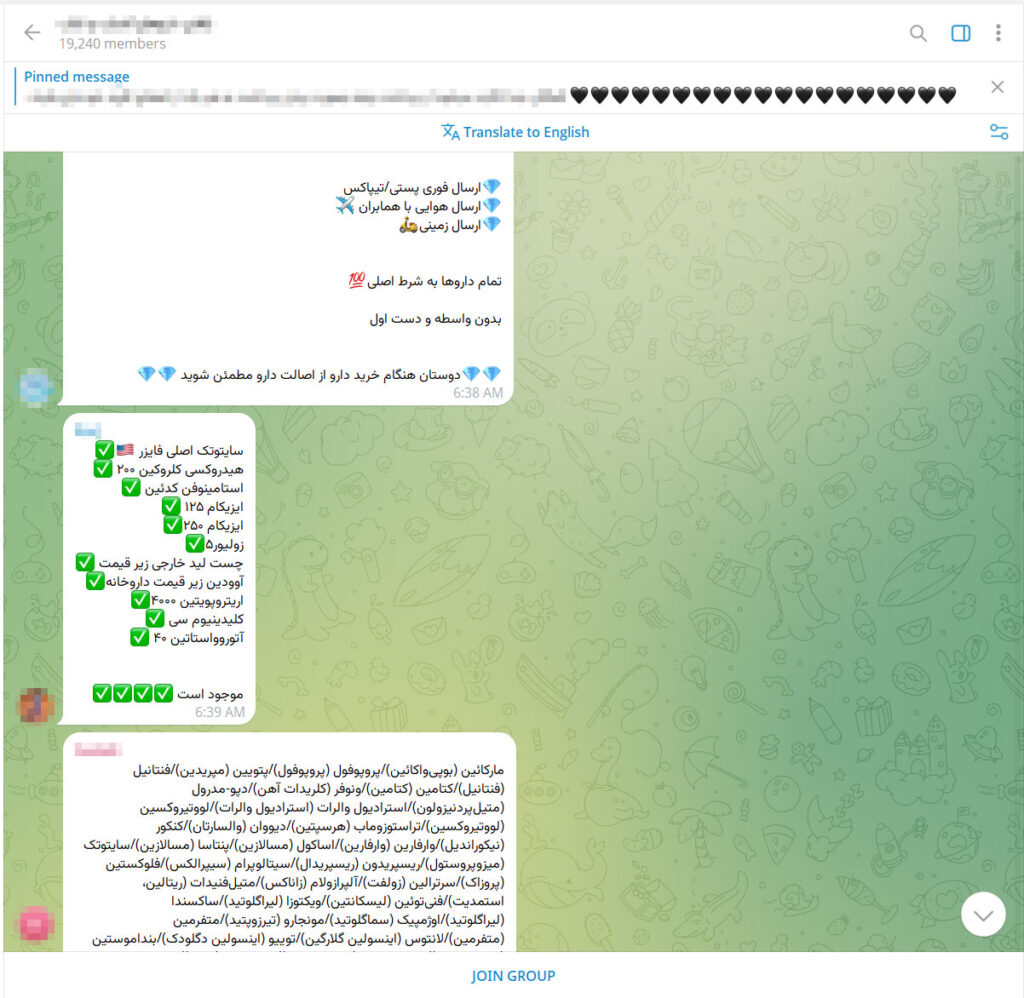
On the windows of some pharmacies, notices have been posted reading: “Insulin unavailable,” “Dispensing only with the patient’s national ID code,” and “We are unable to provide inventory information by phone.” Yet only a few hours later, the same medicines appear advertised in Telegram channels and groups at black-market prices. Some sellers do not even mention the drug’s name publicly and disclose the price only through private messages.
Sudabeh, a 35-year-old woman who has spent the past three days going from one pharmacy to another across Tehran in search of her father’s heart medication, told HRANA that eventually another customer sent her the link to a Telegram channel.
“First they said the pharmacy’s allocated supply had run out, then they said maybe it would be distributed again next week. Everywhere we went either didn’t have it or said they had no idea when it would arrive again.”
She says she ultimately found the same medicine on the informal market, but at a price nearly three times higher than before.
“When we finally found the medicine, we were happy, but then we became afraid that it might be counterfeit. We had no way of making sure.”
A review of several Telegram channels and groups involved in drug sales shows that medications for special-disease patients, diabetes drugs, certain chemotherapy medicines, hormonal injections, and imported pharmaceutical products are bought and sold in these spaces almost every day. Some sellers claim the medicines were obtained “directly from pharmacies” or “from foreign travelers.” In some advertisements, phrases such as “limited quantity,” “last stock,” or “Tehran only” are even used, expressions that resemble the market for foreign currency or smuggled goods more than medicine.
Reza, a 46-year-old taxi driver, told HRANA that he searched multiple pharmacies across different parts of Tehran to find insulin pens for his mother.
“Some pharmacies would say they didn’t have it before we could even finish saying the medicine’s full name. In the end, we found it through those same channels, but the price was much higher.”
He says his family no longer has any option other than buying from the informal market.
“When your patient needs medicine every single day, you can’t wait around hoping distribution might resume next week.”
After the war, pressure on the country’s pharmaceutical system increased simultaneously from several directions. Disruptions in the import of raw materials, difficulties in currency transfers, damage to parts of the transportation infrastructure, accumulated debts owed by insurance providers, and a sudden rise in demand for certain medicines gradually widened the shortages. Medications that had previously become scarce only occasionally have now turned into items patients must search for hours to obtain.
An employee at a pharmacy in central Tehran, who asked not to be named, told HRANA’s reporter that pressure caused by medicine shortages has clearly intensified in recent months.
“Some medicines simply aren’t delivered to pharmacies in sufficient quantities. For certain items, we’ve been instructed to dispense them in limited amounts or provide them only with complete patient documentation.”
He says the emergence of an informal market under such circumstances is almost unavoidable.
“When demand is high and medicine is hard to find, it’s natural for middlemen to step in. Patients, because of their urgent needs, are forced to obtain it by any means possible.”
In some pharmacies, tensions between patients and staff have become a daily occurrence. A man who visited a pharmacy seeking anti-seizure medication for his daughter protests loudly for several minutes after receiving a negative response from the prescription desk clerk, saying: “If there’s no medicine, then why do all these people come here every night?”
Several people in line nod in agreement. A woman holding her young child quietly says: “We’re all looking for the same thing; the hope that maybe we’ll find it here.”
Patients say the problem is not only the shortage of medicine, but also the sharp rise in costs, which has placed heavy pressure on families. Many medicines that were previously obtainable through insurance are now either unavailable altogether or sold only at free-market prices in the informal market.
Soudabeh says the cost of the medicine they obtained for her father was nearly equivalent to one week of the family’s income.
“Before, insurance covered it, but now if you can even find it, you have to buy it at the free-market rate. A lot of people simply can’t afford it.”
Screenshot of a Telegram channel used for the illicit sale of medicines
Alongside rising prices, concerns about the authenticity of medicines are also increasing. The lack of clear oversight regarding the storage and distribution conditions of drugs sold on the informal market has left many patients uncertain whether the medicines they are taking are genuine or counterfeit, expired, or properly stored.
One cancer patient who turned to the black market to obtain chemotherapy medication says:
“When I received the medicine, even the box was slightly damaged. I didn’t know whether I should trust it or not. But I had no other choice.”
Health activists warn that the continuation of this situation could have broader consequences for public health. According to them, the expansion of the informal drug market does not only mean higher prices, but also increases the risk of smuggled, counterfeit, and substandard medicines entering circulation.
An internal medicine physician in Tehran, who asked not to be named due to the sensitivity of the issue, told HRANA that many patients are now abandoning treatment midway or reducing their medication doses so their supplies last longer.
“When a patient cannot find their medicine or afford its cost, treatment is effectively disrupted. This is not just an economic crisis; it is a direct public health crisis.”
He says that in recent weeks he has seen multiple cases of patients arriving in worse condition than before.
“Some patients have gone several days without their medication because they couldn’t obtain it. For chronic or special illnesses, even a short interruption like this can be extremely dangerous.”
Meanwhile, officials have repeatedly cited difficulties in securing foreign currency, import restrictions, and economic pressure as the main reasons behind the medicine shortage. But for many patients, the drug crisis is defined not by statistics, but by their daily experiences: the long hours spent searching between pharmacies, the nightly queues, unanswered phone calls, and messages in Telegram channels.
As the night goes on, the line outside the pharmacy does not grow shorter. Some patients leave in disappointment, while others still hope that a new shipment might arrive. A young man holding a prescription gives his phone number to another person in line before leaving and says: “If you find it somewhere, let me know too.”
In days when the medicine crisis has become part of people’s daily lives, many patients have now built informal networks of acquaintances, channels, and online groups, networks aimed at finding medicines that until recently had been an ordinary part of treatment.
For those who go from one pharmacy to another every day, the medicine crisis is no longer just a news story or an economic statistic. It has now become part of their everyday lives, lives in which finding a few pills, an injection, or an insulin pen has sometimes become harder than the treatment itself.
HRANA – The deputy commander of the Isfahan Provincial Police announced the arrest of three citizens, including a woman, in Shahin Shahr on accusations of what was described as “sending information and cooperating with an anti-government network.”
According to Daneshjoo News Agency, the deputy commander of the Isfahan Provincial Police claimed that a young couple and another individual in Shahin Shahr had been in contact with a media outlet based outside the country and had sent information and cooperated with the network.
Ahmad-Ali Goudarzi further alleged that these individuals had sent images of military sites to the anti-government network and had called for the bombing of those locations. He also claimed that during the burial ceremony of those killed in the January 2026 protests at Behesht-e Masoumeh cemetery in Shahin Shahr, the three individuals had engaged in “propaganda against the Islamic Republic of Iran and created a negative psychological atmosphere.”
The report did not provide further details, including the date of arrest, the identities of the detainees, or their place of detention.
HRANA – Tehran’s Greater Police Command announced the arrest of one individual in the Chitgar area of Tehran. Police claim that the person used Starlink satellite internet equipment to transfer information regarding impact locations during the recent military conflict to networks opposed to the government.
According to Rokna, the Information Center of Tehran’s Greater Police Command announced the arrest of one person. The statement claimed that the arrest followed reports of “suspicious movements” at the individual’s residence. Police stated that after conducting field investigations and identifying the suspect, officers arrested the individual during an operation.
According to police claims, a search of the citizen’s residence led to the seizure of several communication devices and a Starlink receiver. Authorities also alleged that during interrogations, the accused admitted to using the equipment for the “collection and transfer of information.”
The report did not mention the exact date of the arrest, the identity of the detainee, or their place of detention.
In recent months, amid continuing internet restrictions in Iran, multiple reports have emerged regarding judicial and security measures against users of Starlink satellite internet services. In some cases, the Islamic Republic’s security institutions have linked the use of such equipment to security-related accusations.