Arrest of Five Individuals for Filming and Sending Footage to Media

HRANA – At least four citizens in Tehran and one in Yazd have been arrested for filming sites where missiles struck and bombed areas and sending the footage to a foreign-based media outlet.

According to Fars News Agency, the public relations office of the Yazd Public and Revolutionary Prosecutor’s Office announced the arrest of a citizen. The individual was arrested following judicial coordination for filming and sending footage to a foreign-based media outlet (Iran International). After being formally charged and issued a legal bail order, the person was transferred to prison.

The report states that the individual had recorded images or videos from specific locations, including missile launch or impact sites during the recent war.

Meanwhile, Tasnim News Agency reported the arrest of four citizens in Tehran. According to the report, these individuals were also detained by the Special Units of the Law Enforcement Command (FARAJA) for the same actions.

The reports do not mention the identities of the detainees or the dates of their arrests.

Since February 28, Iran’s territory has been targeted by military attacks by Israel and the United States. For more information, you can refer to HRANA’s report on the thirteenth day after the start of these attacks, which was published last night.

Day 13 of the U.S.-Israeli War on Iran: More Than Three Million Displaced

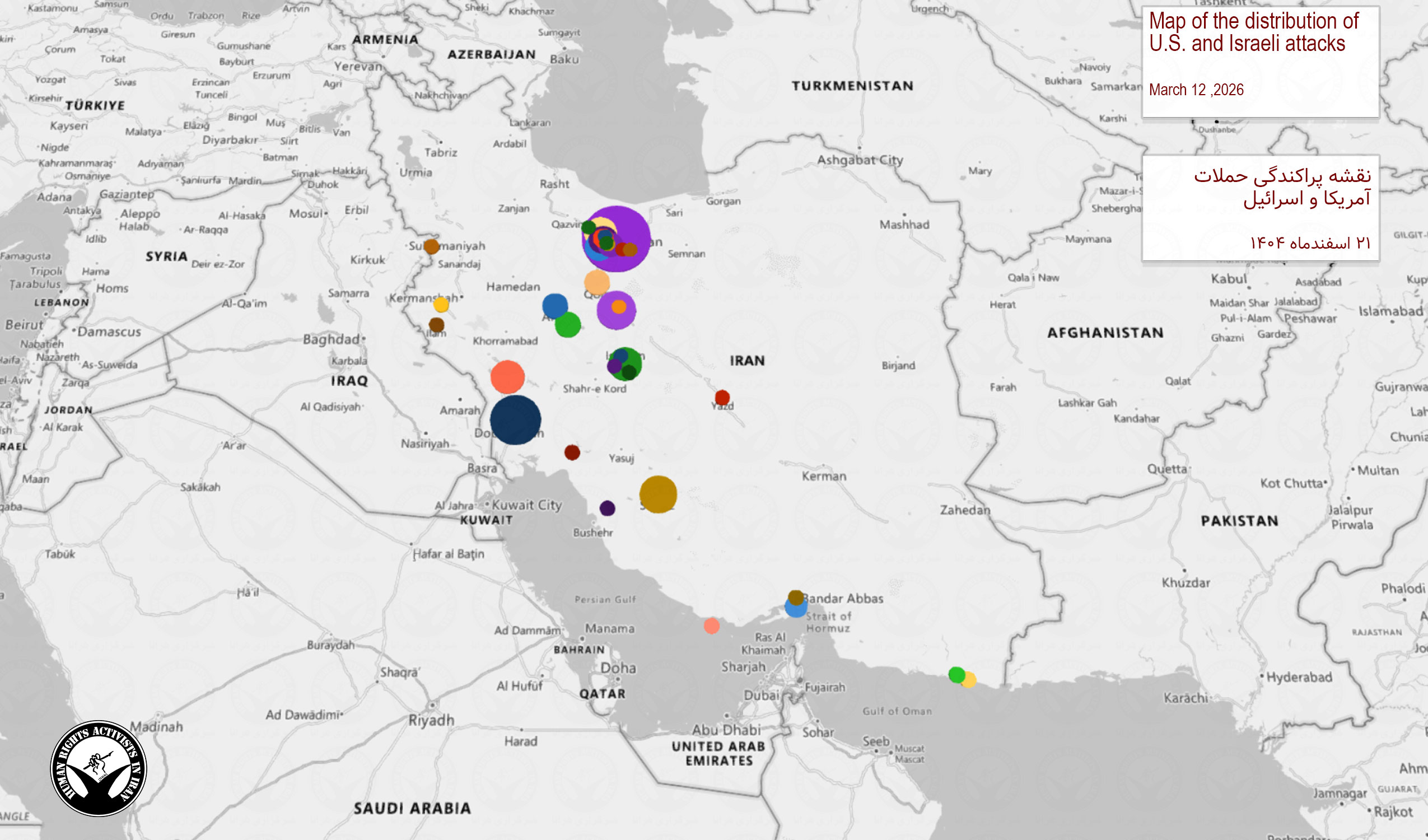
HRANA– In the last 24 hours, and as of March 12, 2026, at 17:00 ET, HRANA has recorded at least 312 attacks across 109 incidents in 15 provinces, resulting in a total of at least 124 casualties (killed and injured, both civilian and military). Today’s reports indicate that, alongside Tehran, the provinces of Khuzestan, Isfahan, and Alborz were among the main areas targeted by the attacks. Meanwhile, the United Nations High Commissioner for Refugees announced today that approximately 3.2 million people have been temporarily displaced within Iran as a result of the ongoing conflict.

According to information recorded and verified by HRANA, from the first minutes of the day until the end of March 12, 2026 (Tehran time), at least ten civilians were killed and 91 civilians injured. Additionally, 21 deaths have been recorded for which the classification (civilian or military) is not specified in the available data. To avoid potential misclassification, these cases are presented in this report under the category of “unspecified.”

Aggregated data since the beginning of the conflict on February 28, 2026, based on incidents recorded in the incident tab and using minimum values for figures marked “more than”:

• Civilian fatalities: 1,286 people (including at least 200 children)

• Military fatalities: 199 people

• Unclassified fatalities (civilian/military): 373 people

This remainder of this report provides a preliminary analytical overview of documented incidents over the past 24 hours. All figures and classifications are based on information available at the time of publication. As verification continues and more information becomes available, casualty figures and classifications may be updated.

Alongside the independent reports of HRANA, organizations such as the United Nations High Commissioner for Refugees have also presented their findings on the latest developments in Iran.

The agency announced that, as a result of the ongoing conflict in Iran, approximately 3.2 million people (equivalent to about 600,000 to 1 million households) have been temporarily displaced within the country. According to the organization, most of the displaced have moved from Tehran and other major cities to northern and rural areas. Among the affected population, refugees residing in Iran, particularly Afghan nationals, are also in a vulnerable situation due to insecurity and limited access to essential services.

1. Overview of Incidents in the Last 24 Hours

Report on the Arrest of 9 Citizens and Security Measures Against 160 Individuals in Kerman Province

HRANA – Following the U.S. and Israeli military attacks on Iran, at least nine citizens have been arrested in Kerman Province and in the cities of Khorramabad, Darab, and Shahr Babak. Additionally, the Intelligence Department of Kerman Province announced that since the start of the war, 160 individuals in the province have been identified and subjected to what it described as “legal action” for alleged “activities against national security.”

Based on the report by Fars News Agency, the police in Lorestan Province introduced the individual as a suspect accused of having connections with Israel. In another report by this agency, a citizen was arrested in Darab County.

The deputy commander of law enforcement in Fars Province claimed that the individual had placed the logo of a relief organization on a vehicle and misused it in an attempt to gather information and send it to foreign countries.

Meanwhile, Islamic Republic of Iran Broadcasting reported that six citizens were arrested in Kerman Province by agents of the Intelligence Department. The report alleged that these individuals were “affiliated with the United States and Israel and were waiting for an opportunity to take to the streets and create unrest.”

Another individual was also arrested in Shahr Babak, in Kerman Province. According to the report, the detained citizen allegedly intended to carry out an armed action, and a firearm reportedly used during the January protests was seized from him.

The Intelligence Department of Kerman Province also announced that since the start of the war it has identified 160 citizens who, according to the authority, were “acting against the country’s security,” and has taken what it described as legal measures against them. Some of the accusations against these individuals include participation in the January protests, damaging public property, using weapons during the protests, and communicating with Persian-language media outlets abroad following the recent war.

These reports did not provide further details about the actions taken, nor did they disclose the identities of the detained individuals or the locations where they are being held.

It should be noted that Iranian territory has been targeted by military attacks by the United States and Israel since February 28. For further information, readers may refer to HRANA’s report on the twelfth day after the beginning of these attacks, which was published last night.

It is worth noting that protests and strikes by shopkeepers and merchants began in Tehran on Sunday, December 28, 2025. Within two days, the movement spread beyond markets and commercial centers. With the participation of students, citizens, and various social groups, these demonstrations became one of the most widespread protests in recent years. Following the suppression of the protests by law enforcement and security forces, thousands of people were killed or injured, and tens of thousands were arrested or summoned by security institutions. For further information, readers may refer to HRANA’s comprehensive report titled Crimson Winter,” which documents the first fifty days after the start of Iran’s nationwide protests.

Baha’is Nita Babanejad and Parsa Emadi Arrested in Isfahan

HRANA – Nita Babannejad and her child, Parsa Emadi, two Baha’i citizens residing in Isfahan, were arrested by the Ministry of Intelligence in the city on March 5.

Based on information received by HRANA, Nita Babanejad and her child Parsa Emadi were arrested on Thursday, March 5, 2026, by agents of the Intelligence Department at their home in Isfahan. Following her arrest, Ms. Babanejad was transferred to the intake ward of Dowlatabad Prison, while Mr. Emadi was taken to The Ministry of Intelligence’s detention facility in Isfahan.

These two citizens remain in detention in an uncertain condition, and the charge against them has been reported as “propaganda against the regime.”

Over the past decade, the Baha’i community in Iran has faced more security and judicial pressure than any other religious minority. A review of the annual reports published by the Statistics, Publications, and Works Center of the Human Rights Activists in Iran shows that over the past year, on average, 62.41% of reports concerning religious minorities were related to violations of the rights of Baha’i citizens.

Shiraz: Retired Teacher Ali Ahmadi Arrested by Security Forces

HRANA – Ali Ahmadi, a retired teacher, was arrested by security forces in Shiraz on March 7 and transferred to Adelabad Prison in the city.

Based on the report, the arrest took place on March 7 and was carried out by forces of the Islamic Revolutionary Guard Corps Intelligence Organization. Ahmadi had previously delivered a speech during the protests regarding those who were killed and had himself been injured after being shot by security forces. The teacher had traveled to Shiraz for medical treatment and was arrested again while returning to Nurabad Mamasani.

Following his arrest, Mr. Ahmadi was transferred to Adelabad Prison in Shiraz.

During this period, the teacher has been in contact with his family and reported that violence was used during interrogations in order to obtain forced confessions. He also stated that he is facing charges such as “spreading corruption on earth.”

The report adds that this citizen’s child was also arrested along with him and transferred to Kazerun Prison; however, no information has been provided regarding the child’s age or identity.

It is worth noting that protests and strikes by shopkeepers and merchants began in Tehran on Sunday, December 28, 2025. Within two days, the movement spread beyond markets and commercial centers. With the participation of students, citizens, and various social groups, these demonstrations became one of the most widespread protests in recent years. Following the suppression of the protests by law enforcement and security forces, thousands of people were killed or injured, and tens of thousands were arrested or summoned by security institutions. For further information, readers may refer to HRANA’s comprehensive report titled Crimson Winter,” which documents the first fifty days after the start of Iran’s nationwide protests.

Subscribe to Our Newsletter

Now is definitely not the time to stop reading!

Over 195 Citizens Arrested Across Iran Amid U.S. and Israeli Attacks; Authorities Cite Media Activity and Espionage Allegations

HRANA –in connection with U.S. and Israeli military attacks on Iran, more than 195 citizens have been arrested in various cities across the country. These arrests took place in the cities of Tehran, Eslamshahr, Tabriz, and Rezvanshahr, as well as in the provinces of Khuzestan, Kurdistan, Lorestan, and Kohgiluyeh and Boyer-Ahmad.

Additionally, according to reports published by official media outlets, a video containing the forced confessions of several of these detainees has been released. It remains unclear under what conditions these confessions were recorded.

These individuals are facing accusations including activity on social media and sending content to foreign media outlets, spreading public anxiety, cooperation with foreign media, espionage and gathering information for foreign countries, as well as attempting to disrupt public security.

Yesterday, the country’s Chief Commander of Law Enforcement announced in a video report the arrest of 82 citizens. Ahmadreza Radan, without specifying the locations of the arrests, claimed that 81 of these individuals were detained due to activity on social media and sending materials to a foreign media outlet (Iran International). One citizen was also arrested for financial connections with foreign networks.

The IRGC’s Abolfazl Unit in Lorestan also announced that three citizens were arrested on charges of spreading public anxiety and cooperating with foreign media outlets. The statement claimed that these individuals had engaged in actions such as “spreading rumors, setting fire to mourning symbols, and sending images to media outlets.”

Tasnim News Agency reported the arrest of a citizen in Eslamshahr. Saeed Doosti-Nejad, the prosecutor of Eslamshahr, claimed that the individual was affiliated with one of the Persian-language media networks operating outside the country and had collected information for them.

In recent days, the Islamic Revolutionary Guard Corps Intelligence Organization announced that 10 individuals who had filmed locations struck in the attacks and sent the footage to foreign media had been arrested so far. At the same time, a video containing forced confessions from these citizens has been released.

On Thursday, March 5, five citizens were arrested by security forces in Tehran. Fars News Agency, a media outlet close to security institutions, claimed that they were collecting information from certain centers and mosques to provide to the United States and Israel. However, the outlet did not mention the identities or the locations where the detainees are being held.

In another report, Fars News Agency stated that 50 citizens were arrested by intelligence agents of the Islamic Revolutionary Guard Corps in Kohgiluyeh and Boyer-Ahmad Province. The report claimed that the individuals “intended to obtain weapons to disrupt public security and were identified and arrested before taking any action.”

According to ILNA, the local police commander announced the identification and arrest of two individuals in this county. Hamed Shadbahr, providing details on the matter, stated that officers from the county’s Public Security Police had identified and arrested two individuals on charges of publishing and republishing false news and producing online content which, according to law enforcement authorities, caused public anxiety and concern within society.

Meanwhile, the Public Relations Office of the Islamic Revolutionary Guard Corps announced the arrest of six citizens and the killing of another by the forces of this institution in Kurdistan Province. In the statement, published by Fars News Agency, it was claimed that these individuals were “armed elements” connected to groups opposed to the political establishment and had been identified and arrested in the northwest of Kurdistan Province.

According to Tasnim News Agency, on February 28 a citizen in Tabriz was arrested for what was described as an “attempt to disrupt the mourning ceremony for the death of Ali Khamenei.” The Deputy for Social Affairs of the East Azerbaijan Law Enforcement Command claimed that the detained individual “intended to drive into the crowd of participants and disrupt the ceremony.”

According to Hamshahri, the Ministry of Intelligence of the Islamic Republic of Iran also announced in a statement the arrest of several individuals in Tehran, claiming that they had been planning to carry out the directives of the United States and Israel in the capital. The statement added that weapons of war, amounts of foreign currency, and a Starlink device were discovered from them. However, the security body did not disclose the identities or the number of those arrested.

Additionally, the General Directorate of Intelligence in Khuzestan Province reported the arrest of six individuals in the province. In the statement, the security body claimed that the detainees were members of an “armed” group linked to foreign countries and that a quantity of military equipment had been discovered in their possession.

Furthermore, at least 30 citizens have been arrested in recent days by forces of the Ministry of Intelligence of the Islamic Republic of Iran. Tasnim News Agency, quoting this security institution, reported that these arrests were carried out on charges described as “espionage for the United States and Israel.”

Although countering espionage is not considered a violation of human rights, given the Iranian government’s record of instrumentally using such accusations against political opponents, such claims—particularly when details and due process remain unclear—are often viewed with skepticism. In the reports mentioned, no information has been provided regarding the identities of the detainees or the locations where they are being held.

It should be noted that the military attacks by the United States and Israel on Iran began on February 27, 2026. Since the beginning of these attacks, HRANA has been documenting and recording developments related to these conflicts across different parts of the country on a daily basis. For further information, readers may refer to HRANA’s detailed report on the twelfth day of the conflict, which was published last night.

Day Twelve of the U.S.-Israeli War on Iran: 39 Percent of Strikes Concentrated in Tehran

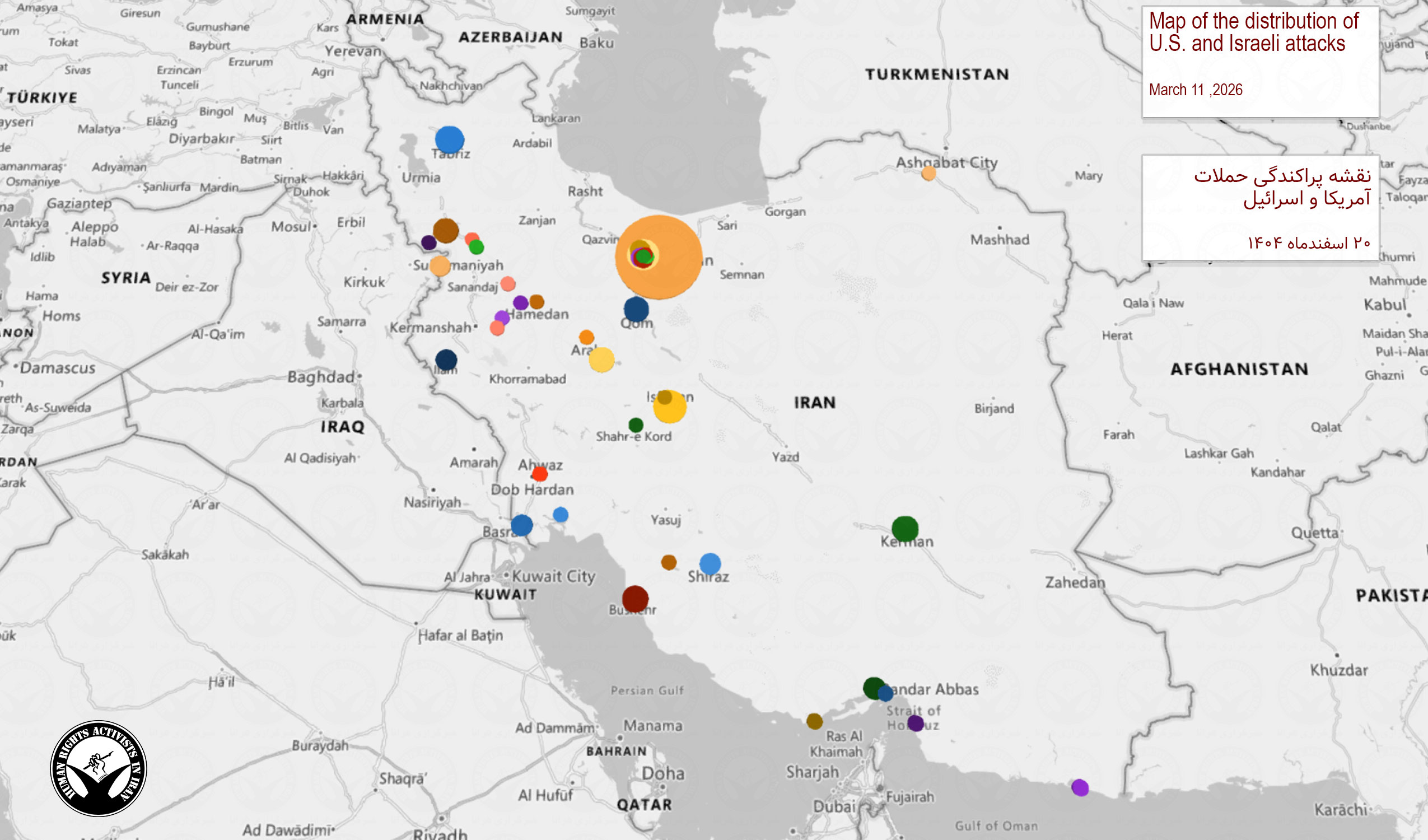
HRANA– In the last 24 hours, and as of March 11, 2026, at 17:00 ET, HRANA has recorded at least 208 attacks across 119 incidents in 22 provinces, resulting in a total of at least 44 casualties (killed and injured, both civilian and military).Today’s reports indicate that Tehran, along with the provinces of Kurdistan, Isfahan, Khuzestan, and Alborz, experienced the majority of the attacks.

Mounting Pressure on Prisoners: Shortages of Water, Food, and Medical Care

HRANA – Following developments arising from wartime conditions in Iran, prisoners in a number of the country’s prisons have faced disruptions in the provision of some of their basic needs. Reports indicate shortages of suitable drinking water, reductions in the quantity and quality of food, limitations on the operation of prison stores, shortages of medication, and a decline in medical services. The present report reviews details of conditions in prisons including Greater Tehran, Evin, Vakilabad in Mashhad, Urmia, Khorin, Ghezel Hesar, Khorramabad, and Kermanshah.

Based on information received by HRANA, in recent weeks prisoners in several prisons across the country have encountered similar problems in obtaining essential items. Among these problems are shortages of drinking water, a decline in the quality and quantity of food, restrictions on the operation of prison stores, and shortages of medication. In many of these prisons, water is supplied from wells and, according to former and current prisoners, it is not suitable for drinking. As a result, prisoners are forced to purchase bottled water from prison stores.

However, under the recent conditions, the supply of bottled water to some prisons has decreased, and the price of each bottle has reached around 25,000 tomans, an amount that, according to reports, many prisoners cannot afford.

In addition, reports indicate that prisoners in most of these prisons receive two meals per day, but the quantity and quality of the food have significantly declined compared to the period before the wartime conditions in Iran. At the same time, many prison stores are facing shortages of goods; in some cases, the stores have been closed for several days or have operated with nearly empty shelves. The high level of overcrowding in prisons has further increased pressure on prisoners and raised concerns regarding their hygienic and living conditions. There have also been reports of restrictions on prisoners’ phone calls and family visits.

A former staff member of Khorramabad Prison told HRANA regarding the prison’s population: “Approximately 4,750 prisoners are held in Khorramabad Prison, with the majority of convictions related to assault, theft, financial crimes, and murder. The prison has nine wards, one of which is allocated to service operations. The wards are assessed as having moderate access to natural light. On average, around 500 prisoners are held in each ward, while the bed capacity per ward is about 360. As a result, some prisoners are forced to sleep on the floor or stay in the prayer hall spaces of the wards.”

He added: “Even under normal conditions, the prison infirmary did not have sufficient medication, and a doctor was present in the prison only one day per week. Additionally, no counseling or psychological services were provided in the prison. With the start of the war, these conditions have worsened and resources have become even more limited.”

Another informed source told HRANA about the quality of food in the prison: “Currently, prisoners receive two meals per day, but the amount of food has been reduced to nearly half compared to before the wartime conditions in Iran began, and its quality has also dropped to roughly half.”

According to information obtained by HRANA, Greater Tehran Prison, despite being considered one of the largest prisons in the country, has faced a shortage of space following the transfer of a large number of prisoners from Evin Prison, including detainees from the nationwide protests of December. As a result, sleeping on the floor in rooms, corridors, and even prayer halls has become a common situation.

A lawyer representing one of the prisoners held in Greater Tehran Prison told HRANA that the conditions of prisoners in this facility are no different from those in other prisons. This attorney, who requested anonymity for security reasons, added that many detainees from the December protests are being held in this prison, and that the principle of separation of prisoners based on their alleged offenses is not being observed. According to him, the quality of food has declined compared to the period before the attacks on Iran, and the portion size of each meal has been reduced to about half. He also described the hygienic conditions of the prison as poor due to overcrowding, adding that these circumstances have raised serious concerns among the families of many detainees and prisoners about the physical well-being of their loved ones. The prison store has been closed, and prisoners are also facing a shortage of drinking water.

A prisoner who was recently released from Kermanshah Prison told an HRANA reporter: “Around 4,000 prisoners are held in this prison, but the accommodation conditions are not the same for everyone.”

He added:“Prisoners receive two meals per day, but the amount of food has decreased compared to the past, and its quality is about 40 percent of what it used to be. In some meals, for a stew prepared for around 20 people, only five small pieces of meat, each weighing about 10 grams, are included.”

At the same time, a relative of a prisoner held in Khorin Prison told HRANA that even before the war the prison had faced problems such as overcrowding and poor food quality, but that these issues have intensified since the outbreak of the war. As in other prisons, food portions have been reduced by half due to wartime conditions. Many prisoners are forced to purchase their food from the prison store, where prices are around 40 percent higher than outside, placing additional financial pressure on families. The prison’s drinking water, which is supplied from a well, is also of poor quality and has reportedly caused health problems such as kidney stones among prisoners. Under the current wartime conditions, the prison store is often closed or its shelves are largely empty. The prison infirmary’s doctor is present only during the early morning hours, and prisoners in need of urgent medical care are often left without treatment. In addition, the infirmary is facing shortages of medication.

In Urmia Prison, prisoners are facing similar conditions. The mother of one of the prisoners held there told HRANA: “Given the widespread attacks in Iran, I am worried about my child’s life. Earlier, in a letter, he had requested the prison authorities to grant him temporary leave during this period, but he has not yet received a response. In Urmia Prison, the quality of food has significantly declined compared to before the war, and meal portions have also been cut in half. Due to the current conditions, the prison store sells many goods to prisoners at prices higher than usual. Our family does not have the financial means to support my child so that he can buy water, food, and hygiene items from the store.”

This elderly mother added: “Visits in this prison have become very limited and are no longer like before. In a phone call my son had with me a few days ago, he said that the prison population is very high. Many people are being held in the quarantine ward. These are the same individuals who were arrested in December. The toilets and bathing facilities are not sufficient for all of us. I am worried about the health of my child and the other prisoners held in this prison.”

The child of a prisoner held in Vakilabad Prison in Mashhad also told HRANA about conditions in the prison and the physical state of ill prisoners, including his father: “Even before the war, the quality of food in this prison was poor, but now under the current conditions both the quantity and quality of food have dropped significantly. My father has heart disease and is currently in the prison infirmary, but due to the absence of a doctor and a shortage of medication, the care he receives has been very limited. In addition, many of the recent detainees are being held in this prison. The overcrowding is severe, and many people sleep in the prison corridors. As far as I know, many individuals are still being held in the prison’s quarantine section.”

He added: “The water in this prison is not drinkable. During this period, the prison store has also run out of goods, and water is being sold there at extremely high prices. Many prisoners cannot afford to buy it. In addition, we have been denied the ability to visit my father. All the families of prisoners are worried about their loved ones under these conditions.”

Prisoners in Evin Prison are also facing shortages of food and water. A prisoner who was recently granted temporary leave from the prison told HRANA: “Water has been cut off in some sections of the prison, the prison stores are closed, and telephone calls have been reduced to a minimum or blocked entirely.”

According to him, prisoners’ food rations have been reduced to one meal per day, and in some cases they are given only “dry bread and something resembling soup.” There are also reports that in some wards prisoners have faced severe shortages of water and food for several days at a time. The prison infirmary is also experiencing shortages of medication.

According to information obtained by HRANA, Ghezel Hesar Prison in Karaj is also facing significant overcrowding in terms of capacity and detention conditions.

An informed source told HRANA: “Overcrowding in this prison is severe, and as a result some prisoners are forced to sleep on the floor. At present, large groups are sleeping on the floors of the prayer halls, and in some of the larger rooms of the prison around five prisoners are also sleeping on the floor.”

The family of one of the prisoners held in this facility told HRANA: “The food given to prisoners is poor in quality, and under the current conditions its quantity has also decreased. Prisoners are forced to purchase the items they need from the prison store. The price of bottled water has increased by about 65 percent, and the price of beef has risen by about 113 percent.”

The spouse of another prisoner held in this prison also told HRANA about the state of medical services: “At present, a doctor is not effectively present, and only a nurse’s aide is available on a limited basis. Medical attention is very minimal, and there are no counseling or psychological support services.”

She added: “Under wartime conditions, prisoners’ concerns about the safety of their families have increased, which has affected their mental well-being. In addition, movement restrictions inside the prison have intensified, and prisoners’ movements are being conducted with greater caution.”

According to information received by HRANA, problems such as food shortages, declining quality of health and medical services, limited access to drinking water, and severe overcrowding are not limited to these prisons. Similar conditions have been reported in many prisons across Iran, particularly following the recent wartime conditions.

It should be noted that military attacks by the United States and Israel on Iran began on February 27, 2026. Since the start of these attacks, HRANA has been documenting and recording related developments across various parts of the country on a daily basis. For more information, readers may refer to HRANA’s detailed report on the eleventh day of the conflict, which was published last night.

Report on the Arrest of Five Individuals in Mahabad, Sanandaj, and Saqqez

HRANA – In recent days, Anvar Moloudi and Avat Rostami, residents of Mahabad, as well as Zeinab Azizi and Sirvan Amini, a couple living in Sanandaj, have been arrested by security forces. So far, no information has been obtained about their whereabouts.

Meanwhile, Sedigh Yousefpour, who had previously been arrested, was released from Saqqez Prison after posting bail.

According to Kurdpa, this citizen was released on March 9 after posting bail from Saqqez Prison. He had been arrested by security forces on January 21.

In another report, Kurdpa announced the arrest of two citizens on March 6 by forces of the Intelligence Office in Mahabad. The identities of these individuals were reported as Anvar Moloudi, a 40-year-old resident of the village of Kheyrabad, and Avat Rostami, a 40-year-old resident of the village of Khorkhoreh in Mahabad.

Additionally, Kolbar News reported that Zeinab Azizi and Sirvan Amini, a couple living in Sanandaj, were arrested by security forces on March 6.

The reports did not mention the reasons for these arrests, the location where the detainees are being held, or the charges brought against them.

Day Eleven of the U.S.-Israeli War on Iran: Tragedy on Resalat Highway

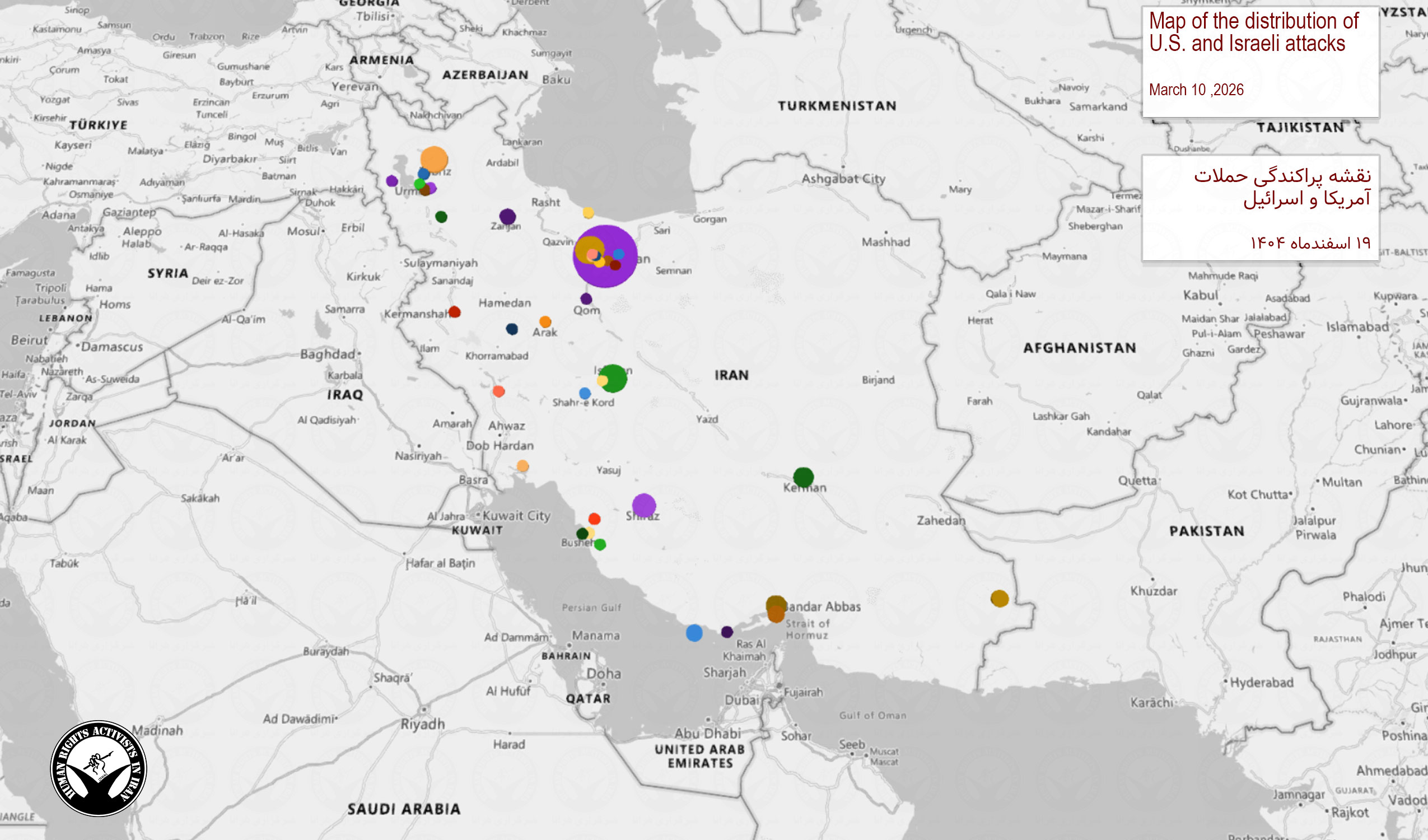
HRANA– In the last 24 hours, and as of March 10, 2026, at 17:00 ET, HRANA has recorded at least 202 attacks across 106 incidents in 19 provinces, resulting in a total of at least 53 casualties (killed and injured, both civilian and military). Today’s reports indicate that in addition to Tehran, central and southern regions of Iran were also targeted by the attacks. Among the most tragic events of the day was an attack on an intersection along Tehran’s Resalat Highway, which resulted in the killing and injury of a large number of civilians.

According to information recorded and verified by HRANA, from the first minutes of the day until the end of March 10, 2026 (Tehran time), at least 17 civilians were killed and 19 civilians injured. Additionally, eight deaths have been recorded for which the classification (civilian or military) is not specified in the available data. To avoid potential misclassification, these cases are presented in this report under the category of “unspecified.”

Aggregated data since the beginning of the conflict on February 28, 2026, based on incidents recorded in the incident tab and using minimum values for figures marked “more than”:

• Civilian fatalities: 1,262 people (including at least 200 children)

• Military fatalities: 190 people

• Unclassified fatalities (civilian/military): 335 people

This remainder of this report provides a preliminary analytical overview of documented incidents over the past 24 hours. All figures and classifications are based on information available at the time of publication. As verification continues and more information becomes available, casualty figures and classifications may be updated.

Note on Official Statements: Alongside the independent reports published by the HRANA, several aggregated official statistics were also recorded today from Iran’s state media, including the following: