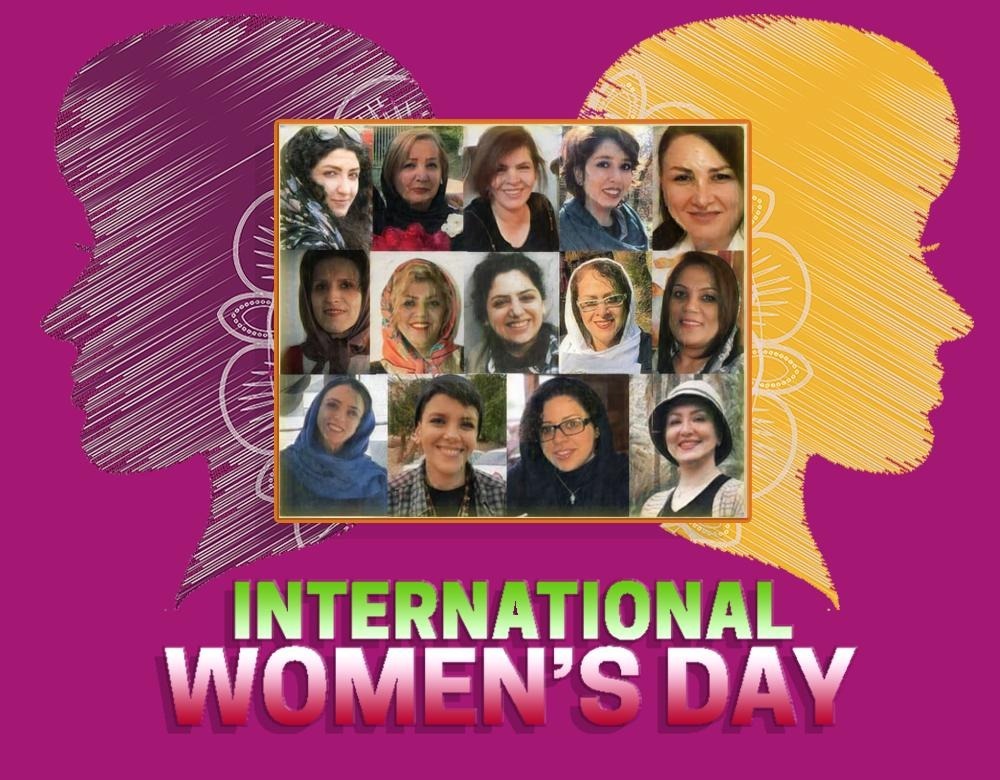
In many countries, International Women’s Day, celebrated on March 8, is designated to commemorate women’s historical struggle for rights, honor their sacrifices and celebrate their cultural and political achievements. The Islamic Republic of Iran, however, refuses to follow this path. The regime never agreed to the Convention on the Elimination of All Forms of Discrimination Against Women, and its law blatantly violates the most fundamental rights of women, including the right of women to make decisions relating to their bodies and clothing choices, as well as equal opportunities in both social and economic realms.
According to HRANA, the news agency of Human Rights Activists, in the absence of any protective laws and punishments against “honor killings”, both domestic and non-domestic violence against women is widespread. Women’s rights defenders and gender equality advocates are frequently subjected to pressure and arbitrary detention by regime security forces, leading to prosecution, unfair trials and convictions by judicial authorities. Currently, many women’s rights activists await verdicts, and others are serving sentences in prison— often in the same ward as prisoners of violent crimes, jeopardizing their safety.
According to HRANA’s Annual Analytical and Statistical Report on Human Rights in Iran, based on 90 registered reports by the Department of Statistics, at least 43 women reported physical and sexual abuse in the last year. In addition, there were 24 reported cases of honor killings, eight self-immolations, three acid attacks, and four cases where women’s rights activists were summoned to judicial and security organizations. There were 20,187 reported cases of domestic abuse against women and 13 murders. This report also details that seven women were detained for reasons related to women’s rights and at least four women’s rights activists were sentenced to a total of 282 months in prison.
It is worth mentioning that this data is merely collected from media reports. The real figures are likely much higher and more daunting, as many domestic violence cases are never reported to legal authorities.
Women’s Rights Violations
Honor Killings: An honor killing is the murder of an individual, often a girl or woman, by a family member or relative in an attempt to restore the honor of the family. The victim’s act, such as refusing forced marriage, being the victim of a rape, getting a divorce, or adultery, is deemed traditionally or religiously shameful or dishonorable by the family or community.
In Iran’s law system, the punishment for murder is usually decided by the “blood avenger”, most often the father, as he is the first degree male relative. Consequently, the perpetrator in an honor killing is either identical to or related to the blood avenger. Thanks to this legal flaw, many honor killers get away without heavy punishment.
For example, Romina Ashrafi, age 13, was beheaded by her father in an honor killing. His father was sentenced to nine years in prison, which is considered a light sentence compared to the death penalty, normally a routine punishment for homicide in Iran.
Violence Against Girls and Women- Iran is one of the four countries in the world that has not recognized the Convention on the Elimination of All Forms of Discrimination against Women. Through the efforts of a number of women’s rights activists, a bill known as the Protection, Dignity, and Security of Women Against Violence was approved by the government on January 3, 2021. However, when the bill was drafted in Hassan Rouhani’s first cabinet, 40 of the 90 articles of the bill were removed. Former Vice President for Women and Family Affairs, Masoumeh Ebtekar, announced that the bill was not presented Parliament for approcal five months after the approval of the cabinet. Recently, Shiva Ghasemipour of the Women’s Faction in Parliament announced that the bill was handed over to the Judiciary for further review.
Bodily Autonomy- In February of 2022, the Medical Equipment Department imposed a regulation whereby pharmacies all over the country were prohibited to provide contraceptives pills without a prescription. The regulation addresses department deputies at medical universities, prohibiting them from distributing free or subsidized birth control or contraceptive implantation. It also prohibits the promotion of contraceptive pills and treatments. In an effort to implement the Rejuvenation of The Population And Support of Family bill such regulations aim to make birth control and abortion harder for women to access. These restrictions on providing contraceptive pills, contraceptive-related services and strict rules against abortion blatantly violate the inalienable rights of women to make decisions relating to their bodies and increase the risk of sexually transmitted diseases and vaginal cancer.
Forced Veiling- Among other restrictions, forcing women to wear a veil is one of the most flagrant violations of women’s rights. As UN Human Rights Council asserts, any coercion pertaining to women’s clothes signifies the blatant violation of the International Covenant on Civil and Political Rights by the government. Nonetheless, Iran’s regime, both in law and practice, not only forces women to wear a veil but also prosecutes and suppress women who oppose the compulsory veil. While Iran’s law cites punishments ranging from a fine of 50,000 tomans to two months imprisonment, citizens are in practice faced with more serious and groundless accusations such as “spreading corruption on earth” which can be punishable up to 10 years in prison. All these penalties stand in violation of Article 9 of the International Covenant on Civil and Political Rights.
Right to Education- According to the Society for Protecting the Rights of the Child’s CEO, in Iran, about one million children in poor areas are deprived of school. From them, 49,000 children are barred from education due to either lacking birth certificates or being forced to work. These numbers vary wildly each year. For example, during the COVID-19 pandemic, the number of children out of school tripled.
Besides poverty, lack of birth certificates and child labour, some girls are barred from school by families who are adhere to traditional norms and prejudices. In 2020, 4142 girls left school because of child marriage or family disallowance.
Cultural Rights- Iran’s regime prohibits women from dancing and singing in the public, which violates Article 15 of the International Covenant on Economic, Social and Cultural Rights, which asserts the right of everyone to take part in cultural activities. Despite women being legally allowed to be in sports stadiums, they face many obstructions by authorities in practice.
Marriage and Family Rights- In violation of the International Covenant on Economic, Social and Cultural Rights, which asserts the abolition of any gender discrimination in the law system, Iranian women are legally subjected to discrimination in many aspects of their family life, such as divorce and child custody. Married women require their husband’s permission to receive passports and leave the country.. Additionally, they do not have the right to choose where they live. The law allows the man to bar his wife from working outside the home if he considers the work in conflict with “family values”. In addition, as a duty of marriage, women are obliged to satisfy their husband’s sexual desires, arguably denying the right to consent during marital intercourse.
The UN Human Rights Council has stated that these discriminative laws violate Article 23.4 of the International Covenant on Economic, Social and Cultural Rights.
Women’s Rights Activists
Convicted (But Not Imprisoned) Women’s Rights Activists
Tahmineh Mofidi
On January 2, 2021,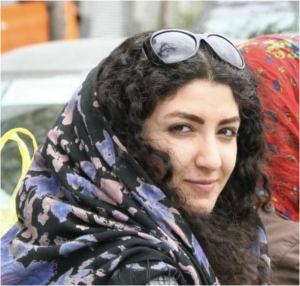 women’s rights activist Tahmineh Mofidi was arrested by IRGCS intelligence agents at her house and transferred to Ward 2-A of Evin Prison On February 2, 2021, she was released on bail of 1.5 billion tomans until the end of legal proceedings. Thereafter, Branch 26 of the Revolutionary Court of Tehran sentenced her to three years and seven months in prison and a fine of 15 million tomans on charges of “acting against national security through assembly and collusion” and “promotion of sexual perversion on social media”. Based on her refusal to appeal, as well as Article 34 of the Islamic Penal Code where only the severest punishment from multiple counts is enforceable, the verdict was reduced to a fine of 37 million tomans.
During the trial, actions such as writing the stories of women who have been the victim of sexual assault, advocating for a symbolic protest against the compulsory veil known as “Girls of Enghelab Street”, and coaching without a veil were invoked to support these charges. Initially, she was also accused of “promoting impurity and indecency ” which later was changed to “promotion of sexual perversion on social media”.
Imprisoned Women’s Rights Activists
Yasaman Aryani and Monireh Arabshahi
Yasaman Aryani and her mother Monireh A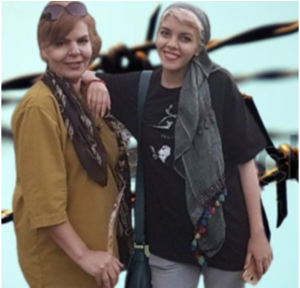 rabshahi, both civil activists and outspoken opponents of the forced veil, are currently serving sentences in Kachooie Prison in Karaj City. On April 10, 2019, one day after the arrest of her mother, Aryani was arrested and transferred to Qarchak Prison in Varamin City. They both were relocated to Evin Prison on August 13, 2019, and transferred again on October 21, 2021 to Kachooie Prison in Karaj.
On August 7, 2021, each was sentenced to 16 years in prison on the charge of “propaganda against the regime” and “provoking impurity and indecency”. These verdicts were reduced for each to nine years and seven months in prison. Per 134 of the Islamic Penal Code, the severest punishment of five years and six months is enforceable. Arabshahi is still imprisoned and denied adequate medical treatment, despite being certified intolerant of punishment, and both an endocrinologist and neurologist asserting her need for lumbar disc and thyroid surgery.
On February 23, Aryani, who is co-housed with prisoners of violent crimes, was beaten by some fellow prisoners.
Saba Kord Afshari and Raheleh Ahmadi
Civil activists Saba Kord Afshari and her mother Raheleh Ahmadi were arrested on June 1 and July 10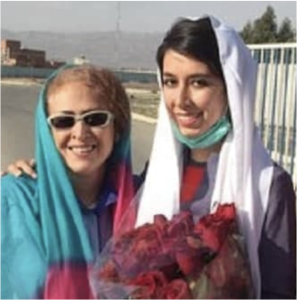 2019, respectively. On August 27, 2019, Afshari was sentenced to 15 years imprisonment on the charge of “promoting corruption and obscenity by appearing without a headscarf in public”, one year and six months on the charge of “propaganda against the regime” and seven years and six months on the charge of “assembly and collusion to act against national security”, totaling 24 years imprisonment.
This verdict was increased two and half times more due to a previous record, before finally being corrected in March of last year and reduced from 15 years to 7 years and 6 months. Per Article 134 of the Islamic Penal Code, the severest punishment of seven years and six months is enforceable.
On January 26, 2021, she was violently relocated from Ward 8 to Ward 6 of Qarchak Prison. Currently, she is held in the same ward as prisoners of violent crimes, which violates Iran prison rules.
On December 10, 2019, Ahmadi was sentenced to three years and six months in prison on charges of “assembly and collusion against national security through collaboration with anti-regime media” and eight months on the charge of “propaganda against the regime”. Ahmadi was granted medical furlough after contracting COVID-19 on February 16. Afshari was also granted short term furlough one day after she was beaten by a prisoner of violent crime on February 20, and was therefore able to meet her mother on furlough.
Aliye Motallebzadeh
On November 26, 2016, Aliye Motallebzadeh, photographer and women’s rights defender, was arrested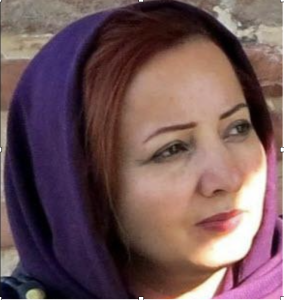 during her appearance at the Ministry of Intelligence office after phone summons. She was detained in Ward 209 at the Ministry of Intelligence’s disposal until December 19 2016, when she was released on bail of 300 million tomans until the end of legal proceedings.
The Revolutionary Court of Tehran sentenced her to three years imprisonment for the charges of “assembly and collusion against national security” and “propaganda against the regime.” This verdict was upheld by Branch 36 of the Court of Appeals.
On October 11, 2020, Motallebzadeh was sent to Evin Prison to serve her sentence after appearing at Evin Courthouse. On January 10, she was transferred to Qarchak Prison in Varamin City to serve the rest of her sentence in exile. On February 23, she was granted medical furlough after contracting COVID-19.
Women’s Rights Activists Who Are Awaiting Imprisonment
Nahid Shaghaghi, Akram Nasirian, Maryam Mohammadi and Asrin Darkaleh
All four activists were arrested by security forces; Akram Nasirian on April 29, 2019, Nahid Shaghaghi on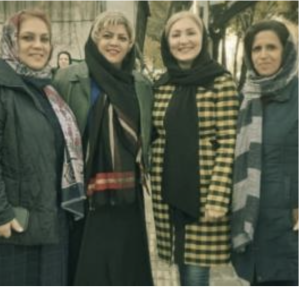 May 15, 2019, Maryam Mohammadi on July 8, 2019 and Asrin Darkaleh on July 28, 2019. They all were released on bail from May to August. Branch 24 of the Revolutionary Court of Tehran, headed by Judge Iman Afshari, sentenced the activists to a total of 16 years and 8 months imprisonment. Per Article 134 of the Islamic Penal Code, the severest punishment of three years sentence on one count was enforceable for each. This was later reduced on appeal to two years and three months each. Recently, they were summoned by the Executive Unit of Evin Courthouse to serve their sentences.
Raha (Raheleh) Askarizadeh
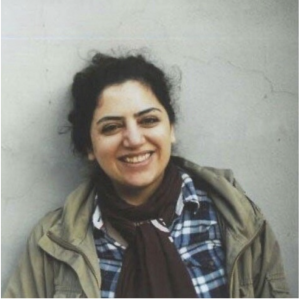
On November 28, 2019, journalist, photographer and women’s rights activist Raha (Raheleh) Askarizadeh was arrested at Imam Khomeini International Airport while leaving the country. On December 31 of that year, she was released on bail until the end of legal proceedings. Initially, the Revolutionary Court of Tehran sentenced her to two years imprisonment, a two year ban from leaving the country and a two year prohibition from political activities in media, political groups and social media. The verdict was upheld on appeal. In April of 2021, she was summoned by the Executive Unit of Evin Courthouse to serveher sentence.
Najmeh Vahedi and Hoda Amidi
On September 1, 2018, women’s rights activists, Najmeh Vahedi and Hoda Amidi were arrested by IRGC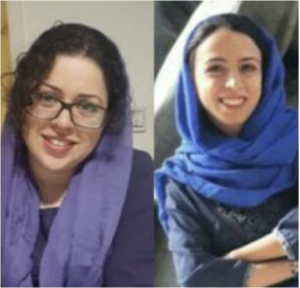 intelligence agents and then released on bail in November of that year. For the charge of “collaboration with the hostile country (U.S.) against the regime regarding women and family issues”, the Revolutionary Court of Tehran sentenced Hoda Amidi to eight years imprisonment, two years prohibiti
on of membership in political groups and parties, prohibition of political activities in media and on the internet, two years ban from leaving the country, two years prohibition of the exercise of the profession as a la
wyer. For the same charge, Najmeh Vahedi was sentenced to seven years imprisonment, two years prohibition of membership in political groups and parties, prohibition of political activities in media and on the internet, two years ban from leaving the country.
These verdicts were upheld on appeal. Running the educational workshops for women on setting out preconditions in marriage such as having the right to divorce (in order to restore the denied rights on divorce for women), was invoked during the trial as examples of the above-mentioned charges.
Atsa Ahmadai Rafsanjani
On January 20, 2019, the Baha’i resident of Tehran was arrested by security forces at her house and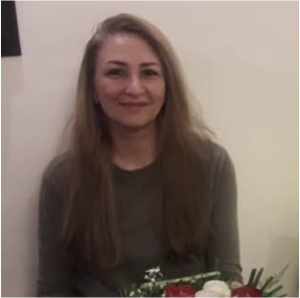 transferred to a solitary confinement cell in Ward 241 of Evin Prison at the disposal of the Judiciary’s counterintelligence. On March 6, 2019, she was released on bail of 200 million tomans until the end of legal proceedings. In May 2021, Branch 26 of the Revolutionary Court of Tehran sentenced her to four years imprisonment on the charge of “formation of a group to act against national security through registering an NGO on women empowerment”, three years in prison on the charge of “assembly and collusion to act against national security”, and one year in prison on the charge of “propaganda against the regime”.
She was condemned for the first charge despite the Ministry of Interior had already rejecting her request to form an NGO due to being Baha’i. If the verdict is upheld on appeal, four years imprisonment for the first count is enforceable per Article 134 of the Islamic Penal Code.
_________________________
For further inquiries please contact Skylar Thompson, Senior Advocacy Coordinator Human Rights Activists in Iran (HRA) at skylar@hramail.com