Day 21 of the U.S.-Israeli War on Iran: New Year begins with 640 strikes

HRANA– In the last 24 hours, and as of March 20, 2026, at 17:00 ET, HRANA has recorded at least 640 attacks across 130 incidents in 17 provinces, resulting in a total of at least 68 casualties (killed and injured, both civilian and military). These numerous attacks took place simultaneously with the arrival of the New Year in Iran. Reports received indicate that many citizens viewed the Nowruz holidays as an opportunity to leave major cities, and heavy traffic formed on routes out of cities, particularly along routes toward the northern provinces of Gilan and Mazandaran.

According to information recorded and verified by HRANA, from the first minutes of the day until the end of March 20, 2026 (Tehran time), at least 4 civilians were killed and 8 civilians injured.

Aggregated data since the beginning of the conflict on February 28, 2026, based on incidents recorded in the incident tab and using minimum values for figures marked “more than”:

• Civilian fatalities: 1,398 people (including at least 210 children)

• Military fatalities: 1165 people

• Unclassified fatalities (civilian/military): 657 people

Note on official statements: Alongside HRANA News Agency’s independent reports, several aggregated official statistics were also recorded today by state-affiliated media, including:

The Deputy Security Governor of Lorestan stated: “Of the total recorded fatalities from the American–Zionist attacks in the province, 80 were military personnel and 64 were civilian citizens. During this period, 2,427 people were injured in Lorestan, of whom 266 were military personnel and 2,161 were civilians.”

The Ministry of Health announced: “At present, 1,016 individuals injured in the American–Zionist attacks are hospitalized in medical centers. From the beginning of the war until today, 208,073 people have been treated and discharged.”

1. Overview of Incidents in the Last 24 Hours

In the last 24 hours, incidents were reported across multiple provinces, reflecting a geographically dispersed pattern of hostilities.  In a large portion of the incidents, the method/type of attack has not yet been confirmed and has been recorded as “undetermined.” In cases where the attack type was identifiable, airstrikes and drone attacks were reported.

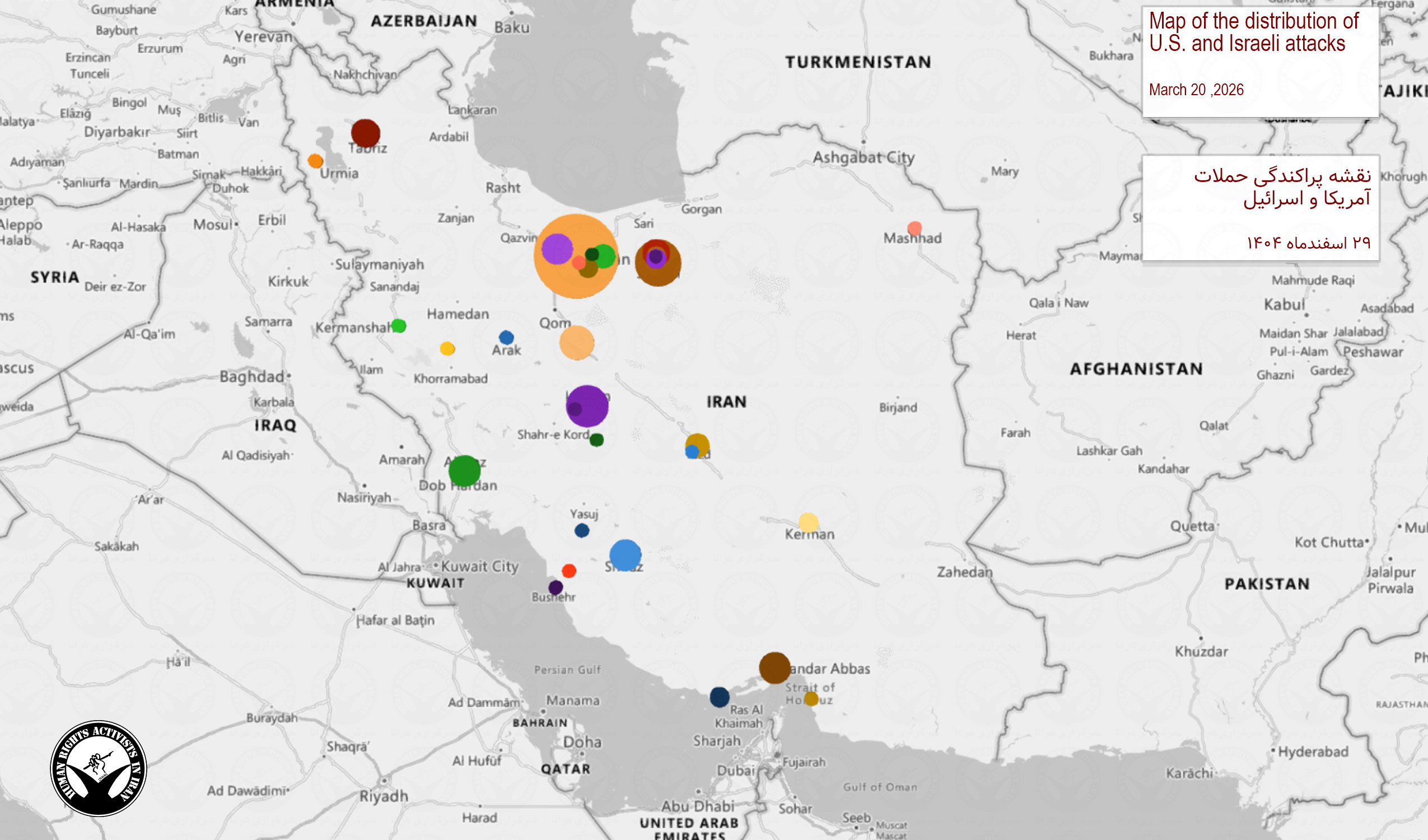
Preliminary analysis indicates that Tehran Province, having borne 36% of all recorded attacks, ranks first among the provinces targeted. Semnan Province, with 17%, and Isfahan Province, with 14%, follow in the next positions. Continuing down the list are Hormozgan, Alborz, and Khuzestan provinces, respectively.

Distribution of attacks-Day 21

2. List of Objects Reported Hit

In the past 24 hours, the recorded attacks have damaged 21 distinct objects or facilities. These include a range of different types of targets. In some cases, damage caused by nearby strikes or secondary consequences of the attacks has also been reported.

Examples of targets recorded over the past 24 hours:

• Al Mohammad Corps Headquarters (Semnan)

• 92nd Armored Division (Ahvaz)

• Army Air Base (Bandar Abbas)

• Al-Mahdi Corps Garrison (Urmia)

• Basij Resistance Base (Semnan)

For a number of the listed targets, the exact nature of the target (civilian/military/dual-use) is still under review, and classifications may be revised as additional information becomes available.

Facilities Protected Under International Humanitarian Law:

Under international humanitarian law, medical facilities, educational institutions, humanitarian facilities, religious sites, and emergency service centers are among the many objects that maintain special protected status and are afforded special protection. In the past 24 hours, HRANA has preliminarily recorded the following cases:

• Three residential and commercial buildings (Tehran)

• Falak-ol-Aflak Historic Site (Khorramabad)

• Accommodation complex of the Sepah Kolahdooz Complex (Shahmirzad)

• A residential building (Karaj)

• An administrative building on Palestine Street (Tehran)

3. Civilian Casualties

In the past 24 hours, at least 4 civilians have been killed and 8 civilians, including one child, have been injured. All classifications are preliminary and may be updated as new information becomes available.

4. Military Casualties

During the reporting period, 12 military personnel were killed. Military casualties are generally reported in the context of attacks on Army and Islamic Revolutionary Guard Corps (IRGC) bases. Where possible, organizational affiliation and operational context are being assessed; however, not all details have yet been independently verified.

In some incidents, individuals have been killed in the vicinity of military targets; however, their official status has not yet been definitively determined. These cases remain under review, and if reliable information indicating a different status becomes available, the classification may be revised accordingly.

It is believed that military casualties are significantly higher than the figures reported in these reports. However, due to the sensitive nature of military information and the limited access of human rights groups and media to locations where military forces are present, this section largely reflects reports of senior officers or military personnel who were present in urban areas.

5. Confirmed but Unspecified Casualties

Of the reported casualties in the past 24 hours, 18 deaths and 26 injuries remain classified as unverified, meaning that HRANA has not yet been able to determine with sufficient certainty whether these individuals were civilians or military personnel.

Burials: Today, 21 burials resulting from attacks in previous days have been recorded.

A Note on HRANA Methodology

Note that, in line with HRANA policy, this report reflects only incidents that occurred within the territorial borders of Iran.

The information contained in this report is compiled through HRANA’s established documentation network. Data is collected from a combination of field reports, local contacts, medical and emergency sources, civil society networks, and open source materials, including publicly available images, videos, and official statements where relevant. Each reported incident is logged and assessed through an internal review process before publication.

Given the evolving nature of hostilities, information is gathered on a rolling basis and reflects the status of documentation at the time of publication.

The figures presented in this report may not reflect the full scope of harm. Ongoing hostilities, damage to infrastructure, communication disruptions, restricted access to affected areas, and security risks for sources may limit the ability to document incidents comprehensively.

Delays in medical reporting, difficulties in confirming identities, and restricted access to certain provinces may result in temporary undercounting. As access improves or additional evidence emerges, casualty figures and incident classifications may be revised accordingly.

HRANA remains committed to transparency, methodological rigor, and the continual updating of its findings as new verified information becomes available.

140 Individuals Arrested on Charges of Sending Images to Foreign Media and Espionage

HRANA – Official domestic media have reported the arrest of at least 127 citizens in the cities of Tehran, Kazerun, and Zahedan, as well as in Alborz and Khuzestan provinces. These individuals were arrested on charges described as “sending images to foreign media and espionage.” At the same time, a video containing the forced confession of one of these individuals has been released, although the conditions under which it was recorded remain unclear. Additionally, Iran’s Ministry of Intelligence announced in a statement the arrest of 13 citizens and the killing of another individual by agents of this institution in Sistan and Baluchestan Province.

According to Fars News Agency, one citizen was arrested in Tehran. In the video report, it is claimed that this individual filmed locations targeted in airstrikes and sent the images to foreign media outlets. The video also includes his forced confession, though the circumstances of its recording are unknown.

Meanwhile, Mehr News Agency reported the arrest of a citizen in Kazerun by law enforcement officers. The county’s police commander stated that the individual had been “communicating via text messages with foreign media to disclose the coordinates of military and security bases.” The official added that the individual was referred to the prosecutor’s office for legal proceedings.

According to Fars, the police commander of Alborz Province announced that 41 citizens were arrested in the province. He claimed that these individuals had sent images of U.S. and Israeli attacks to foreign media.

Tasnim News Agency reported that Iran’s Ministry of Intelligence announced the arrest of 97 citizens. In its statement, the ministry claimed that 69 of them had intended to create unrest during the final days of the year. It also alleged that some of these individuals had participated in the protests of the month of Dey (December–January).

The statement further claimed that 13 individuals affiliated with opposition groups and allegedly supported and directly guided by Israeli intelligence services were identified and arrested in a joint operation by the Quds Headquarters of the IRGC Ground Forces and Faraja (Law Enforcement Command) in Sistan and Baluchestan Province. Their locations were reported to be the counties of Chabahar, Iranshahr, and Zahedan. It was also reported that one citizen, identified as “Nematollah Shahbakhsh, known as Jamuk,” was killed during the operation.

Moreover, another four-member team affiliated with the same group was identified in hard-to-access mountainous areas around Zahedan and arrested in a joint operation by intelligence agents from Sistan and Baluchestan and Kerman provinces.

In addition, at least 11 citizens in Khuzestan Province, described as “armed and in contact with the enemy,” were identified and arrested.

The reports do not mention the identities or places of detention of these individuals.

Since February 28, Iranian territory has been targeted by military attacks carried out by Israel and the United States. For further details, see HRANA’s report on the twentieth day since the onset of these attacks, published last night.

At Least 90 Citizens Arrested in Various Provinces in Connection with the War

HRANA –Security authorities announced that a total of 90 individuals have been arrested in various provinces on charges of “anti-security” activities.

According to HRANA, citing Fars News Agency, the Public Security Police (FARAJA) reported the arrest of 54 citizens. In the statement, without specifying where the arrests took place, authorities claimed that the detainees intended to act as leaders in organizing street protests and damaging citizens’ property. It was further stated that at the time of arrest, 11 of these individuals opened fire on police officers, and several firearms and ammunition were seized from them.

FARAJA described these individuals as “monarchists” and claimed that two of them had sent the geographic coordinates of important locations to the intelligence services of countries involved in the war.

In another report, the news agency stated that 13 citizens in Qom Province were arrested by IRGC forces in the province on charges of “security-related” activities. Three Starlink satellite devices were confiscated from them.

According to the Islamic Republic of Iran Broadcasting (IRIB) News Agency, the Ministry of Intelligence also announced the arrest of 23 citizens in the provinces of Mazandaran, Razavi Khorasan, and Khuzestan.

The Ministry of Intelligence stated that 10 individuals were arrested in Mazandaran, 10 in Razavi Khorasan, and 3 citizens in Khuzestan. The reported reason for the arrest of 20 of these individuals was sending images of military locations and economic infrastructure to countries involved in the war.

Regarding the three individuals arrested in Khuzestan, the report claimed that they had carried out armed attacks against security forces and public places in recent days.

The reports did not provide information about the identities or places of detention of these individuals.

Since February 28, 2026, Iran has been subjected to a series of military attacks carried out by Israel and the United States. For further details, readers can refer to HRANA’s report, which provides a statistical overview of the war and its consequences.

Day Eight of the U.S.-Israeli War on Iran: Roar of Explosions Across 30 Provinces of the Country

HRANA – In the last 24 hours, and as of March 7, 2026, at 17:00 ET, HRANA has recorded at least 485 attacks across 133 incidents in 30 provinces, resulting in a total of at least 53 casualties (killed and injured, both civilian and military). The recent attacks have geographically spread across the entire country, although the focus of the strikes still remains on Tehran and several specific provinces.

According to information recorded and verified by HRANA, from the first minutes until the end of March 7, 2026 (Tehran time), at least 33 civilians have been killed and 8 civilians injured. Additionally, one death has been recorded at the event level whose classification (civilian or military) is not specified in the available data. Therefore, to avoid classification errors, it is presented in this report under the category of “undetermined.”
Aggregated data since the beginning of the conflict on February 28, 2026 — based on incidents recorded in the incident tab and using minimum values for figures marked “more than”:

• Civilian fatalities: 1,205 people (including at least 194 children)

• Military fatalities: 187 people

• Unclassified fatalities (civilian/military): 283 people

This remainder of this report provides a preliminary analytical overview of documented incidents over the past 24 hours. All figures and classifications are based on information available at the time of publication. As verification continues and more information becomes available, casualty figures and classifications may be updated.

1. Overview of Incidents in the Last 24 Hours

In the last 24 hours, incidents were reported across multiple provinces, reflecting a geographically dispersed pattern of hostilities.  In a large portion of the incidents, the method/type of attack has not yet been confirmed and has been recorded as “undetermined.” In cases where the attack type was identifiable, airstrikes and drone attacks were reported.

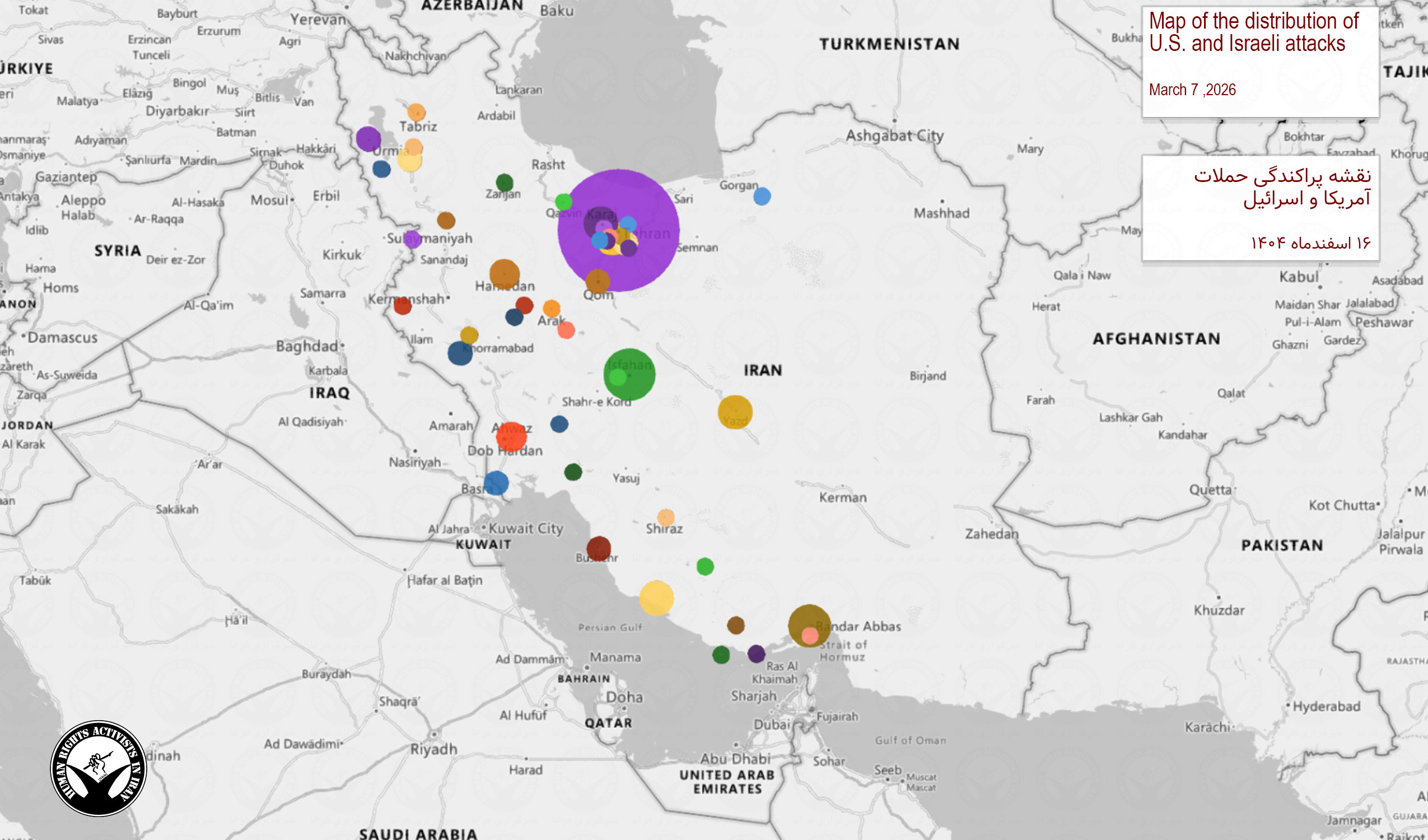
Preliminary analysis indicates that Tehran Province, accounting for 37% of the attacks, continues to be targeted more than any other part of the country. After that, as on the previous day, the provinces of Khuzestan (about 6%) and Kermanshah (about 6%) recorded a larger share of today’s attacks. As in previous days, overall the western regions of the country, along with Tehran, show the main concentration of the attacks.

Day-8-map-war

2 List of Objects Reported Hit

In the past 24 hours, the targeting or damage of 63 unique objects or facilities has been confirmed. These objects include a range of targets. Please note that this list includes not only objects reportedly directly targeted, but also those documented as damaged as a result of nearby strikes or blast effects. This list is not exhaustive; the items listed are illustrative.

Examples of targets recorded in the past 24 hours:

• Mehrabad Airport (Tehran)

• Municipality of District 16 (Tehran)

• Shahid Boroujerdi Logistics and Support Garrison (Tehran)

• Khatam al-Anbia Joint Air Defense Headquarters (Ahvaz)

• Shahid Babaei 8th Tactical Air Base (Isfahan)

For a number of the listed targets, the exact nature of the target (civilian/military/dual-use) is still under review, and classifications may be revised as additional information becomes available.
In the past 24 hours, at least 33 civilians, including one woman, have been killed and 8 civilians injured. All classifications are preliminary and may be updated if new information becomes available.

4. Military Casualties

5. Unverified Casualties

Report on the Arrest of Masoud Yousef Hasirchin

HRANA– Masoud Yousef Hasirchin, a translator and writer residing in Khuzestan Province, was arrested by agents of the IRGC Intelligence on January 18. Prior to his arrest, agents searched his home and confiscated some of his personal belongings, including digital devices.

Based on information received by HRANA, Masoud Yousef Hasirchin was arrested by agents of the IRGC Intelligence in Khuzestan Province and transferred to a security detention facility, where he has been subjected to interrogation. Two days prior to his arrest, agents searched his private residence and confiscated several personal belongings, including books, a mobile phone, and a laptop.

As of the time of this report, no information has been obtained regarding the reasons for his arrest, his place of detention, or the charges brought against Mr. Hasirchin.

In recent days, a group of writers, researchers, translators, and journalists issued a statement calling for Mr. Yousef Hasirchin’s release.

Masoud Yousef Hasirchin, a resident of Khuzestan Province, is a researcher and translator of works in the fields of political science, economics, and history.

It should be noted that gatherings and strikes by shopkeepers and bazaar merchants began in Tehran on Sunday, December 28. After two days, they spread beyond bazaars and commercial centers. With the participation of students, citizens, and various social groups, these protests became one of the most widespread demonstrations in recent years. For further information, readers can refer to HRANA’s detailed report on the thirty-sixth day since the start of the protests, which was published last night.

Subscribe to Our Newsletter

Now is definitely not the time to stop reading!

Faramarz Se-Dehi Sentenced to One Year in Prison

HRANA – Faramarz Se-Dehi, a poet and member of the Iranian Writers’ Association, has been sentenced to one year in prison by Branch 104 of the Behbahan Criminal Court.

Farshteh Tabanian, Mr. Se-Dehi’s lawyer, wrote in a post regarding this case that he was sentenced to one year in prison on the charge of “insulting sacred values.”

Earlier, a court hearing addressing Faramarz Se-Dehi’s charge had been held in Branch 104 of the Behbahan Criminal Court (Second).

In April 2024, in a separate case, Faramarz Se-Dehi had also been sentenced to over 22 months in prison by Branch 1 of the Mahshahr Revolutionary Court.

Mr. Se-dehi was formally charged on February 17, 2025, by the Second Branch of the Behbahan Prosecutor’s Office and released on bail.

Faramarz Se-Dehi, a poet from Khuzestan and a member of the Iranian Writers’ Association, has previously faced convictions related to his activities.

Families of Six Executed Prisoners in Ahvaz Threatened Against Holding Mourning Ceremonies

HRANA – Security forces in Khuzestan Province have severely threatened the families of six executed Arab prisoners, warning them not to hold mourning ceremonies or communicate with media outlets and human rights organizations.

The six men – Ali Mojaddam, Mohammadreza Moghaddam, Moein Khanfari, Habib Deris, Adnan Ghobeishavi, and Salem Mousavi – were executed at dawn on Saturday, October 4, 2025, in Sepidar Prison, Ahvaz, without prior notice to their families or lawyers.

According to HRANA, agents of the Ministry of Intelligence contacted the families by phone on the day of the execution to inform them of the death of their loved ones. Prior to these calls, the families had received no information regarding the scheduled execution or the prisoners’ transfer to solitary confinement.

Sources close to the families told HRANA that, following the executions, security authorities summoned several relatives and tribal elders to intelligence offices, including the local headquarters of the Ministry of Intelligence, and explicitly forbade them from holding mourning ceremonies in mosques or public halls. The authorities also prohibited the recitation of the Quran, poetry, or other religious rituals over loudspeakers – traditional mourning practices among the Arab community in Khuzestan.

According to information obtained by HRANA, family members and tribal elders were compelled to sign written pledges promising not to organize any public gatherings. They were further warned that any communication with media or international human rights organizations would result in punitive measures.

The six Arab prisoners were arrested by security forces in February 2019 and later sentenced to death by a branch of the Ahvaz Revolutionary Court in March 2023. The judiciary of the Islamic Republic accused them of “membership in the armed wing of Harakat al-Nidal al-Arabi li-Tahrir al-Ahwaz and armed action against the foundations of the Islamic Republic.”

As of two days after the executions, the families remain unaware of the burial locations or the circumstances under which the sentences were carried out.

Judiciary Media Center Announces Execution of Six Prisoners in Khuzestan

HRANA News Agency – On Saturday, October 4, 2025, the Judiciary Media Center announced the execution of six prisoners in Khuzestan, describing them as “members of a separatist terrorist network affiliated with the Zionist regime.”

Mizan News Agency, the Judiciary Media Center stated: “The death sentences of six separatist terrorist elements who, in recent years, carried out a series of armed operations and bombings targeting the security of Khuzestan Province were carried out this morning after completing all legal procedures and approval by the Supreme Court.”

The report further alleged that these prisoners were involved in the deaths of four security and police officers identified as Allah-Nazar Safari, Mohammadreza Rafiei-Nasab, Ali Salehi-Majd, and Younes Bahr.

The Judiciary’s statement also attributed actions such as “collaboration with Israel, designing and carrying out sabotage operations including bomb-making and planting explosives, the explosion at the Khorramshahr gas station, armed attacks on banks, throwing grenades at a military center, and shooting at mosques” to the executed individuals.

Hours after the initial announcement, Mizan updated its report, releasing the names and photos of the six executed prisoners: Ali Mojaddam, Mohammadreza Moghaddam, Moein Khanfari, Habib Deris, Adnan Ghobeishavi, and Salem Mousavi.

The six men were arrested by security forces in Khuzestan in February 2019.

In March 2023, Ali Mojaddam and Mohammadreza Moghaddam were sentenced to death by the Ahvaz Revolutionary Court on charges of leading and membership in the “military wing of the Arab Struggle Movement for the Liberation of Ahvaz (Harakat al-Nidal al-Arabi fi Ahvaz),” for “armed action against the Islamic Republic.” Moein Khanfari, Habib Deris, Adnan Ghobeishavi, and Salem Mousavi were also sentenced to death for membership in the same group and for “armed action against the Islamic Republic.”

Before the executions, Mojaddam, Moghaddam, Khanfari, and Ghobeishavi were held in Sepidar Prison of Ahvaz, and Deris and Mousavi were also detained in the same facility.

The report did not specify the exact location where the executions were carried out.

Report on the Execution of a Prisoner in Aligudarz Prison

HRANA – At dawn on Tuesday, August 26, the death sentence of a prisoner previously convicted of murder was carried out in Aligudarz Prison.

HRANA has identified the executed prisoner as Mohammadreza Moridan, a resident of Khuzestan. Based on information received by HRANA, Mr. Moridan had been arrested in 2021 on charges of murder and later sentenced to death by the Criminal Court.

As of the time of this report, the execution of this prisoner has not been announced by prison officials or the responsible authorities.

In 2024, according to 812 reports compiled by HRANA, the Iranian regime executed 930 individuals in its prisons—marking the highest number of executions in the past 12 years. Despite the scale of these executions, prison officials and other relevant authorities publicly acknowledged only 6% of them, highlighting the regime’s lack of transparency and accountability.

Following Sentence Consolidation, Shahab Nazari’s Prison Term Increased to 10 Years

HRANA– After the request for sentence consolidation was approved, the Khuzestan Province Court of Appeals increased the prison sentence of Shahab Nazari, a political prisoner held in Sheiban Prison in Ahvaz, to 10 years. He had previously been sentenced to a total of 4 years and 91 days in two separate cases.

According to a ruling issued by Branch 14 of the Khuzestan Court of Appeals, Mr. Nazari has been sentenced to a total of 10 years in prison on four charges. The court sentenced him to five years in prison for the most severe charge, “blasphemy.” He was also sentenced to two years for “spreading falsehoods,” two years for “insulting the Supreme Leader,” and one year for “propaganda against the regime.”

This verdict was issued on July 29, 2025, and was recently communicated to Mr. Nazari’s lawyer, Hossein Ali Hatami.

On Wednesday, April 24, 2025, Shahab Nazari was transferred to Sheiban Prison in Ahvaz after appearing at the Sentence Enforcement Office of the Ahvaz Public and Revolutionary Prosecutor’s Office.

Nazari, 24-year-old resident of Izeh, was arrested on April 22, 2023, by security forces in Ahvaz and was eventually released on bail of 500 million tomans from Sheiban Prison on May 21, 2023.

Previously, Branch 1 of the Ahvaz Revolutionary Court had sentenced him to two years in prison for “insulting the Supreme Leader” and one year for “propaganda against the regime,” totaling three years of imprisonment. This verdict was upheld in full by Branch 14 of the Khuzestan Court of Appeals. Based on Article 134 of the Islamic Penal Code, two years of this sentence are enforceable.

Additionally, in a separate part of the same case, Mr. Nazari was sentenced by Branch 2 of the Ahvaz Criminal Court to one year and 91 days in prison for “spreading falsehoods.” This sentence was also upheld in full by the Khuzestan Court of Appeals.