Three Inmates Executed in Neyshabur and Zanjan Prisons

On October 13 and 15, 2022, three inmates convicted of murder and drug-related crimes were executed in Neyshabur and Zanjan Prisons.

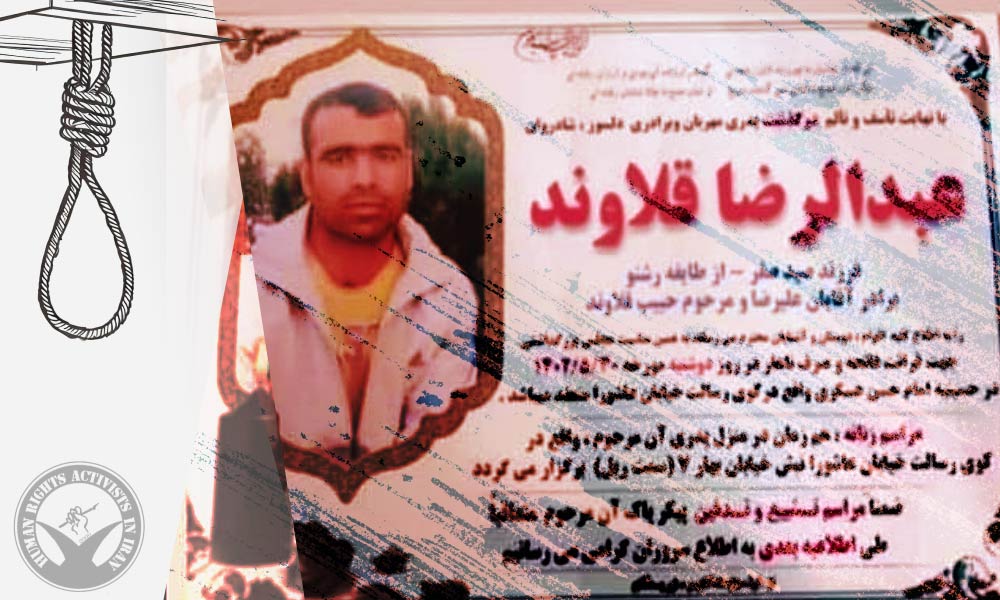
According to HRANA, the news agency of Human Rights Activists, quoting Iran Human Rights Organization, on October 13 and 15, 2022, three inmates identified as Reza Gharelu, Ali Mohammad Saeedi and Sadegh Afkandeh (age 43) were executed in Neyshabur and Zanjan Prisons.

According to an informed source, Gharelu was convicted of killing one of his friends three years ago. Afkandeh was sentenced to death on drug-related charges four years ago. Mohammad Saeedi had been convicted of murder.

None of these executions has been reported by official sources and media outlets inside Iran so far.


59 Human Rights Organizations Call for Abolition of Death Penalty for All Offences

On October 10, the 20th anniversary of the World Day Against the Death Penalty, Human Rights Activists in Iran and 58 other human rights organizations issued a joint statement to draw attention to gender bias and discrimination against women and LGBTQIA+, which can negatively impact the judicial process. They also called for the abolition of the death penalty for all offenses.

The following is the full text of this statement:

20TH WORLD DAY AGAINST THE DEATH PENALTY

On this 20th anniversary of the World Day Against the Death Penalty dedicated to the link between torture and the use of the death penalty and in continuation of the 2021 World Day Against the Death Penalty dedicated to women facing capital punishment, sentenced to death, executed, pardoned or charged with a capital crime and found not guilty, the members of the World Coalition and allies of women and LGBTQIA+ individuals sentenced to death take this opportunity to:

  • Draw attention to gender bias in the use of torture in the judicial process leading to the imposition of the death penalty. Women and LGBTQIA+ individuals are particularly at risk to abuse, including physical, sexual, and psychological torture. In addition, women victims of gender-based violence, who are over-represented on death row, are at risk of making false confessions when subjected to coercive investigative methods, especially those carried out by men.
  • Emphasize that violence against women and LGBTQIA+ individuals in detention – including gender and sexual abuse and harassment, inappropriate touching during searches, rape, and sexual coercion – can rise to the level of torture or cruel, inhuman, or degrading treatment or punishment, in violation of the International Covenant on Civil and Political Rights (ICCPR) and the Convention Against Torture (CAT), among others.
  • Accentuate that women and LGBTQIA+ individuals have specific needs, including sexual and reproductive health care, medical and mental health care, harm reduction services for those using drugs, and protection from gender-based violence, among others. These needs are not systematically considered and covered in prisons, which can turn detention into torture.
  • Stress that in many countries, particularly those with the mandatory death penalty, women and LGBTQIA+ individuals may be sentenced to death without considering their experiences of gender-based violence, among their other vulnerability aspects, prior to incarceration.

More broadly, the members of the World Coalition and allies of women and LGBTQIA+ individuals sentenced to death and at risk of being sentenced to death wish to use this 20th anniversary to:

  • Emphasize that, as done by the Special Rapporteur on extrajudicial, summary or arbitrary executions in its 2022 report, the death penalty as currently practiced can be considered as torture.
  • Call attention to the intersectional discrimination and inequalities that women and LGBTQIA+ individuals face, as these can negatively impact the judicial process leading to the death penalty. Pervasive gender biases in criminal legal systems influence: the investigation, through gender bias by law enforcement; the trial, where marginalized women and LGBTQIA+ individuals tend to be denied fair trial; and at the sentencing stage, where mitigating circumstances that might benefit women and LGBTQIA+ individuals sentenced to death are not considered.
  • Recall that, in violation of international human right law and standards, 12 countries continue to criminalize consensual same-sex relations, imposing the death penalty upon conviction.
  • Address the recognition of the intersectional dimension of discrimination. An analysis of the profiles of women sentenced to death reveals that most are from ethnic and racial minorities, are non-literate, and live with intellectual or psychological disabilities, often as a result of the gender-based violence they have suffered. Gender-based discrimination does not operate in isolation but is compounded by other forms of discrimination, including discrimination based on age, race, ethnicity, nationality, sexual orientation, gender identity and expression, sex characteristics, economic status, and disability, among others.
  • Make visible the lack of accurate and up-to-date data on the number and status of women and LGBTQIA+ individuals sentenced to death, executed, or whose death sentences have been commuted or pardoned.

We recommend that governments in countries that still retain the death penalty:

  1. Abolish the death penalty for all offences, regardless of gender, sexual orientation, gender identity and expression, and sex characteristics;
  2. Establish a moratorium on executions with a view to abolishing the death penalty, as called for by the UN General Assembly in its resolutions calling for a moratorium on the use of the death penalty;
  3. Pending full abolition, we call on governments to:
    1. Eliminate the death penalty for offences that do not meet the threshold of  “most serious crimes” under international law and standards including same-sex relationships and drug offences;
    2. Repeal provisions that allow for the mandatory imposition of the death penalty, which does not allow judges to consider the circumstances of the offence for the defendant at sentencing;
    3. Commute the sentences of women sentenced to death for killing close family members who perpetrated gender-based violence against them and for women sentenced to death for drug trafficking and other offenses that do not involve the loss of human life;
    4. Acknowledge the compounding forms of violence and discrimination experienced by girls, women and LGBTQIA+ individuals – including gender-based violence, early and forced marriage;
    5. Review laws, criminal procedures, and judicial practices and implement policies and legislative reforms to protect women and LGBTQIA+ individuals from violence and discrimination;
    6. Ensure that the criminal legal system takes full account of any mitigating factors linked to women’s and LGBTQIA+ individuals’ backgrounds, including evidence of prior abuse as well as psycho-social and intellectual disabilities;
    7. Ensure publicly available disaggregated data on people sentenced to death, their profile, age, gender, the courts that have pronounced the judgements charges and places of detention;
    8. Prevent the disproportionate detention and prosecution of women for “moral and sexual” crimes and of people for their sexual orientation and decriminalize such offenses;
    9. Promote the training of all those involved in the investigation, legal defense, prosecution, trial, adjudication and conviction of crimes involving women on gender-based discrimination and violence, pathways to crime, and gender-sensitive mitigations;
    10. Ensure that all those facing the death penalty have access to free and effective legal representation by counsel with experience representing individuals charged with capital offences and who are trained to recognize and bring forward mitigating factors, including those linked to gender-based discrimination and violence;
    11. Develop and implement programs to prevent gender-based violence and discrimination, and to promote the human rights of women, girls and LGBTQIA individuals+;
    12. Guarantee access to consular assistance for foreign women charged with death-eligible offenses, as required by the Vienna Convention on Consular Relations;
    13. In accordance with the Bangkok Rules and the Mandela Rules, adopt gender-sensitive policies regarding the detention of women, ensuring their safety and security before trial, during admission to prison, and while incarcerated.

Signatory organizations:


  1. ACAT Germany
  2. AdvocAid
  3. The Advocates for Human Rights
  4. American Constitution Society
  5. Anti-Death Penalty Asia Network (ADPAN)
  6. Association pour les Droits Humains au Kurdistan d’Iran-Genève (KMMK-G)
  7. Avocats sans frontières France
  8. Capital Punishment Justice Project
  9. Center for Constitutional Rights
  10. Coalition Tunisienne Contre la Peine de mort
  11. Colegio de Abogados y Abogadas de Puerto Rico
  12. Cornell Center on the Death Penalty Worldwide
  13. The Death Penalty Project
  14. Droit et Paix
  15. Ensemble Contre la Peine de Mort
  16. Federal Association of Vietnamese Refugees in the Federal Republic of Germany
  17. Fédération internationale pour les droits humains (FIDH)
  18. Fédération internationale des ACAT (FIACAT)
  19. Forum Marocain pour la Vérité et la Justice
  20. Gender Violence Clinic – University of Maryland Carey School of Law
  21. German Coalition to Abolish the Death Penalt
  22. Global Alliance Against Traffic in Women
  23. Greater Caribbean for Life
  24. Harm Reduction International
  25. Human Rights Activists in Iran
  26. Human Rights and Legal Profession Project Assistant
  27. International Commission of Jurist
  28. Institute for Criminal Justice Reform
  29. Institute for the Rule of Law of the International Association of Lawyers
  30. IraQueer
  31. Italian Federation for Human Rights
  32. Japan Innocence and Death Penalty Information Center
  33. Kenya Human Rights Commission
  34. Lawyers Collective India
  35. Lembaga Bantuan Hukum Masyarakat
  36. Ligue des droits de l’Homme (LDH)
  37. Madrid Bar Association
  38. MASUM & PACTI
  39. Mouvement contre le racisme et pour l’amitié entre les peuples (MRAP)
  40. Parliamentarians for Global Action (PGA)
  41. Pax Christi Uvira
  42. Penal Reform International
  43. Persatuan Sahabat Wanita Selangor
  44. Red para la Abolición de la Pena de Muerte y las Penas Crueles
  45. Resilient Women’s Organization
  46. Planète Réfugiés-Droits de l’Homme
  47. The Rights Practice
  48. Sandigan Kuwait
  49. The Sentencing Project
  50. Society for Human Rights and Development Organisation (SHRDO)
  51. Taiwan Alliance to End the Death Penalty (TAEDP)
  52. Terre des Femmes e.V.
  53. The Texas After Violence Project
  54. Union Chrétienne pour le Progrès et la Défense des Droits de l’Homme
  55. The William Gomes Podcast
  56. Witness to Innocence
  57. Women Beyond Walls
  58. The Women and Harm Reduction International
  59. World Coalition Against the Death Penalty


World Day Against the Death Penalty: Annual Report on Execution in Iran 2021-2022

Human Rights Activists News Agency (HRANA)- On the World Day against the Death Penalty, the Center of Statistics of Human Rights Activists in Iran (HRA) has published its annual report in an effort to sensitize the public about the death penalty situation in Iran, particularly thousands of death-row convicts awaiting their looming executions.

HRA’s Statistics Center relies on the work of HRANA reporters, as well as a network of independent and verifiable sources. It also incorporates the judicial authorities’ announcements or confirmations of prisoner executions on media, and as such, is exposed to a margin of error representing efforts by the Iranian authorities to omit, conceal, or restrict the collection of such data.

Between October 10, 2021, and October 7, 2022, at least 528 convicts were executed by hanging in Iran, rising to 98% compared to the same period last year. Of these executions, one was carried out in public. Many of the defendants were denied a fair trial and due process.

Click here to download report in PDF format

HRANA obtained 439 reports regarding executions and death penalty in Iran during this period. The identified executed individuals, include 20 women and 6 juvenile offenders under the age of 18 at the time of alleged crime. Compared to the last period, the execution of female offenders has raised 55%.

According to the reports obtained by HRANA, over this period, Iranian authorities sentenced at least 89 defendants to death penalty, including at least 5 women, and 7 public executions.  Issuing death sentence decreased by 1% compared to the last year.

As the chart below shows a breakdown of executions by capital offense: 50.38% were charged with murder, 41.29% with drug and narcotic offenses, 3.03% with rape, 1.70% with non-political armed robbery/offenses classified as “corruption on earth,” and 0.38% with political or security-related offenses. Moreover, 0.38% were convicted of security charges (spying, terror, and bombing), 0.38% were convicted of armed robbery, and 2.46% of charges are unknown.

The pie chart below displays execution numbers by the province in which they took place. According to this chart, the Sistan and Baluchestan Province had the highest number of executions at 16%. Alborz (where three overcrowded prisons are located) and Fars Provinces come second and third, with 16.48% and 11.93%, respectively.

The chart below depicts the distribution of executions’ information sources. The chart indicates that 70% of HRANA-confirmed executions were not announced by the official Iranian sources. Undisclosed executions are referred to as “secret” executions.


The chart above shows the execution numbers by gender.

The pie chart below displays execution numbers by the prison where the executions were carried out. The Rajai-Shahr Prison officials have carried out the highest number of executions with 14.42%. Zahedan Prison ranks second with 12,33% executions.

The chart below displays percentage of executions carried out in public Vs. the number of executions that were carried out in prison. According to statistics, 0.19% of the executions in Iran were carried out in public.

***

Click here to download the report in PDF format.

For further inquiries please contact Skylar Thompson, Senior Advocacy Coordinator Human Rights Activists in Iran (HRA) at [email protected]

Eight Inmates Executed in Qazvin and Adel-Abad Prisons

On October 5, 2022, two inmates convicted of rape in one legal case were executed in Qazvin Prison. Moreover, on October 2 and 3, six inmates were executed in Adel-Abad Prison in Shiraz.

According to HRANA, the news agency of Human Rights Activists, quoting Iran Human Rights Organization, on October 5, 2022, two inmates, identified as Kiomars Parvaneh and Hasan Hojjati, were executed in Qazvin prison.

These individuals had been arrested and convicted of rape two years ago.
 
Also, last Sunday, Adel-Abad prison officials executed four inmates, of which two have been identified as Abbas Fathalian and Heydar Ramezani. On Monday, two other unidentified prisoners were executed in this prison. All six individuals were previously convicted of drug-related crimes.


Five Inmates Executed in Mashhad

On Sunday, October 2, five inmates convicted of drug-related crimes were executed in Vakilabad Prison in Mashhad.

According to HRANA, the news agency of Human Rights Activists, quoting Haal Vsh, on October 2, 2022, five inmates, of which four have been identified as Asef Shakib, Saeed Shakib, Ramezan Mazarzeh and Avaz Bilrani, were executed in Vakilabad Prison in Mashhad.

All of these prisoners had been convicted of drug-related crimes.

These executions have not been reported by official sources and media outlets inside Iran so far.

Subscribe to Our Newsletter

Now is definitely not the time to stop reading!

Inmate Executed in Karaj Central Penitentiary

On September 19, 2022, an inmate convicted of drug-related crimes was injured in Karaj Central Penitentiary, Alborz Province.

According to HRANA, the news agency of Human Rights Activists, on September 19, 2022, the Karaj Central Penitentiary officials executed an inmate identified as Sirus Sha’alani, 22.

This execution has not been reported by official sources and media outlets inside Iran so far.

Report: Prisoners’ Families Demonstrate as Executions Surge

Since May 2022, the number of executions, especially of prisoners convicted of drug-related crimes has significantly increased. Since the judiciary carries out the executions without prior notice, the new wave has raised concerns among the prisoners’ families, who organized protests in Tehran and Karaj during the past six days. Although the protests have been peaceful, the police have arrested several individuals.

According to HRANA, the news agency of Human Rights Activists, from May 22 to June 21, the number of executions spiked to 99 cases, four times more than the months before. Executions have remained at this high rate since, causing panic among death row prisoners and their families.

During this period, half of the executed inmates had been convicted of drug-related offences. Unlike murder cases in which the convict is at the mercy of the victim’s family for judgment, the execution of inmates convicted of drug-related crimes is decided by the judicial authorities’ decision.

The families have been gathering peacefully for six consecutive days in Tehran and Karaj. On September 11, the protest turned violent and 30 people were arrested, of which eight currently are kept in detention.

As the figure below illustrates, the judicial authorities have not been transparent as only 39% of the executions have been reported by official sources and media outlets inside Iran so far.

From March 21, 2022 (the beginning of the Iranian year) to September 11, 2022, the Judicial authorities have executed a total of 306 people, including 267 men, 30 women and 30 gender-unspecified individuals. Four of these individuals were under the age of 18 at the time of the arrest. One Pakistani and one Afghan National are among these individuals.

The figure below illustrates the breakdown of executions by capital offence.

Of these convictions, 151 people had been convicted of murder (Qisas or reprisal), 130 of drug-related crimes, 12 of rape, and two of security charges. The charges against 11 individuals remain unknown.

Geographically, 56 executions have been carried out in Sistan and Baluchestan Province. Fars Province ranks second with 28 executions.

In the above-mentioned period, the authorities have sentenced 42 defendants to the death penalty.

One prisoner’s spouse expressed to HRANA that the number of executions has increased exponentially in recent weeks and the prisoners live in fear of imminent execution. 

A prisoner who is currently on furlough said the prisoners are fearful and worried about the prospects of speedy Judgements. 

According to the head of State prisons and the Security and Corrective Measures Organization, 45% of prisoners in Iran are jailed for drug-related offences.

Since under international law, drug smuggling does not fall into the category of violent crimes,  the government has been criticized by the Human Rights Organization and the UN Special Rapporteur on Human Rights in Iran for the execution of drug-related offenders.

In 2017, the former prosecutor of Tehran, Abbas Jafari Dolatabadi, announced the reform in drug-related crime laws and promised the reduction of the death sentences and executions. According to the recent report from the Statistics and Publication Center of the Human Rights Activists in Iran (SPC-HRA), drug-related executions have been reduced, but the number of recent executions is alarming. 

According to the SPC-HRA report, between January 1, 2021, and December 20 2021, at least 299 individuals, including four juvenile offenders were executed. 85 others were sentenced to death. 

The video reportage is a compilation of  26 videos of recent protests.

Two Inmates Executed in Isfahan

On September 11, 2022, Dastgerd Prison’s officials executed two inmates who were previously sentenced to death on the charge of “enmity against God (Moharebeh).”

According to HRANA, the news agency of Human Rights Activists, quoting Haal Vsh, on September 11, 2022, two inmates identified as Mehran Noor-Mohammadi, 27 and Hassan Mohammadipour, 27 were executed in Dastgerd Prison of Isfahan.

These inmates were convicted of armed robbery and shooting in 2016.

Nine Inmates Executed in Zanjan, Birjand, and Zahedan Prisons.

Nine inmates have been executed in Zanjan, Birjand, and Zahedan Prisons.

According to HRANA, the news agency of Human Rights Activists, quoting Haal Vsh, on September 10, 2022, the Zahedan Prison officials executed five inmates, including a woman. 

Four of the inmates have been identified as Khaled Raisi, 38, Amrollah Basij, 27, Abdolnasir She Bakhsh, 42, and Hooshang Kurd, 27. All have been convicted of murder. The female prisoner is still unidentified. 

Haal Vsh also reported the execution of an inmate identified as Mansoor Barahooie in Birjand Prison. Birjand Revolutionary Court sentenced Barahooie to death on drug-related charges in 2019.

On September 11, Iran Human Rights Organization further reported the execution of two inmates identified as Mehdi Aghoosh, 30, and Hassan Aghamohammadi, 27, in Zanjan and Isfahan Prisons, both convicted of murder. Four years ago, Aghoosh was accused and convicted of killing a man in a group fight. Aghamohammadi was convicted of murder three years ago.

Iran Human Rights Organization has additionally reported that an inmate identified as Ahmad Panahi Khanghah, 40, convicted of murder was executed in Ardabil Prison.

These executions have not been reported by official sources and media outlets inside Iran so far.

Nine Inmates Executed in Rajai Shahr, Gonbad-e Kavus, and Bandar Abbas

On September 7, 2022, Rajai Shahr Prison officials executed seven inmates who were previously convicted of murder.

According to HRANA, the news agency of Human Rights Activists, on September 7, 2022, seven inmates were executed in Rajai Shahr Prison in Karaj.

HRANA has identified three out of the seven inmates as Khosro Noorbakhsh, Mohammad Arab, and Abolfazl Shahi.

On that day, in Gonbad-e Kavus, Golestan Province, an inmate identified as Ghafoor Nejat Pour, age 22, was executed. He was convicted of murder.

Haal Vsh also reported the execution of an Afghan National, Yarmohammad Eshagh-Zehi, age 40, in Bandar Abbas. He was arrested and sentenced to death on drug-related charges two years ago. Eshagh-Zehi’s family has not yet been informed about his execution.

These executions have not been reported by official sources and media outlets inside Iran so far.