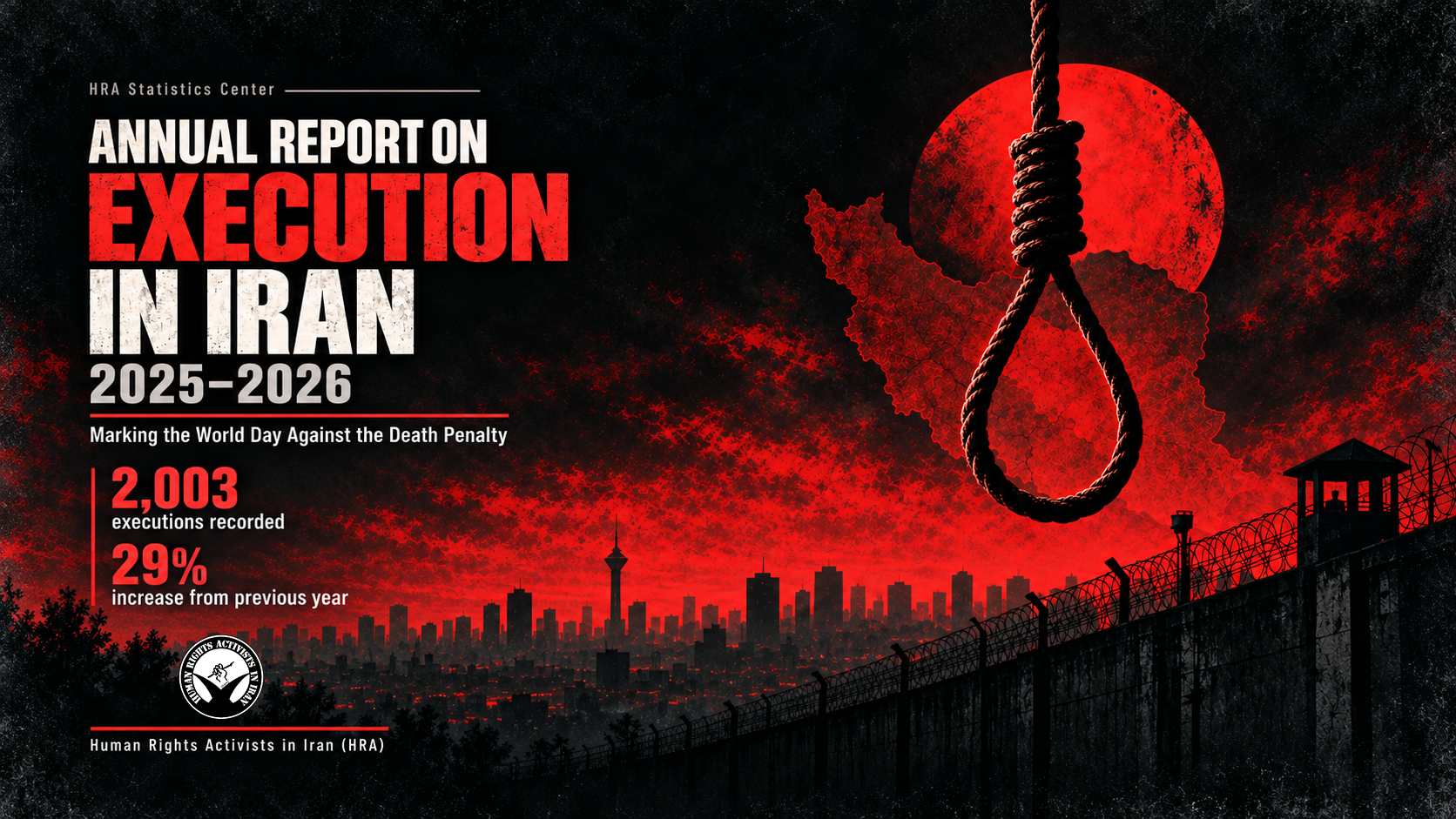
Annual Report on Execution in Iran; Marking the World Day Against the Death Penalty

HRANA – Marking the World Day Against the Death Penalty, the Statistics Center of Human Rights Activists in Iran (HRA) has released its annual report on the use of capital punishment in Iran. The findings point to a sharp intensification in executions, continued secrecy surrounding implementation of death sentences, and an increase in political and security-related executions.

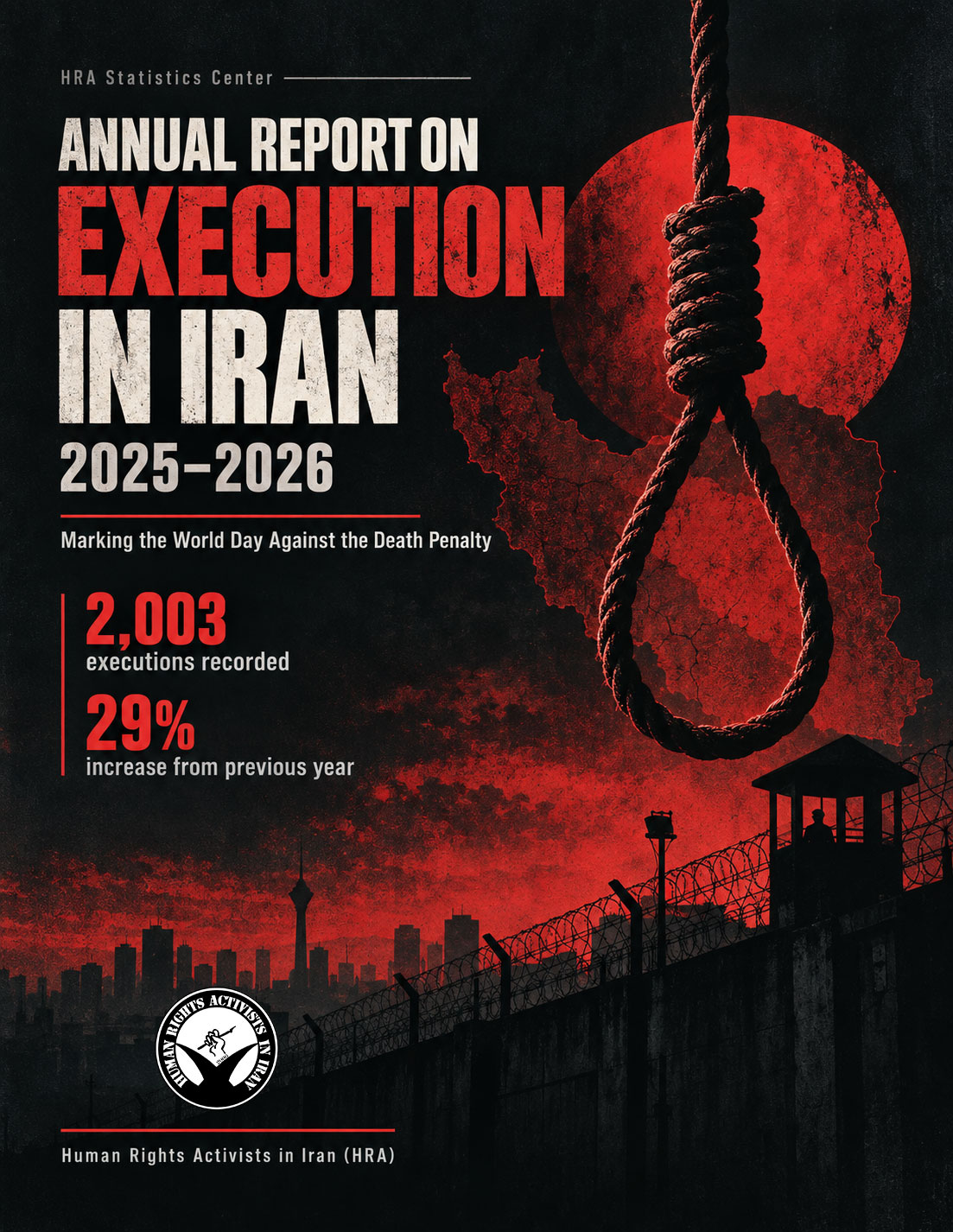
Between October 10, 2025 and October 8, 2026, HRANA documented at least 2,003 executions across Iran on the basis of 1,857 reports, an increase of approximately 29% compared with the previous reporting period. During the same period, 230 people were documented as having been sentenced to death. The full report also includes detailed statistical analysis, profiles of political and security-related executions, and documentation concerning judicial officials involved in issuing or upholding death sentences.

Executions in Iran: Key Figures

IndicatorData
Total executions documented2,003
Change from previous periodApproximately 29% increase
Average frequency of executionApproximately one person every 4.35 hours
Death sentences issued230
Women executed47
Juvenile offenders executed4
Public executions9
Political and security-related executions69
Executions unannounced by official sourcesApproximately 95%

Rising Executions and the Monthly Pattern

The 2,003 executions documented during the current reporting period represent the highest total recorded across the ten reporting periods examined in the report. Compared with 1,553 executions in 2024–2025, the total increased by approximately 29%. The current figure is also more than 182% above the ten-period average of 710 executions.

Monthly data show that executions peaked in December 2025. By contrast, March 2026 recorded the lowest total among complete months. The October 2026 figure covers only the first seven days of the month and therefore should not be compared directly with full-month totals.
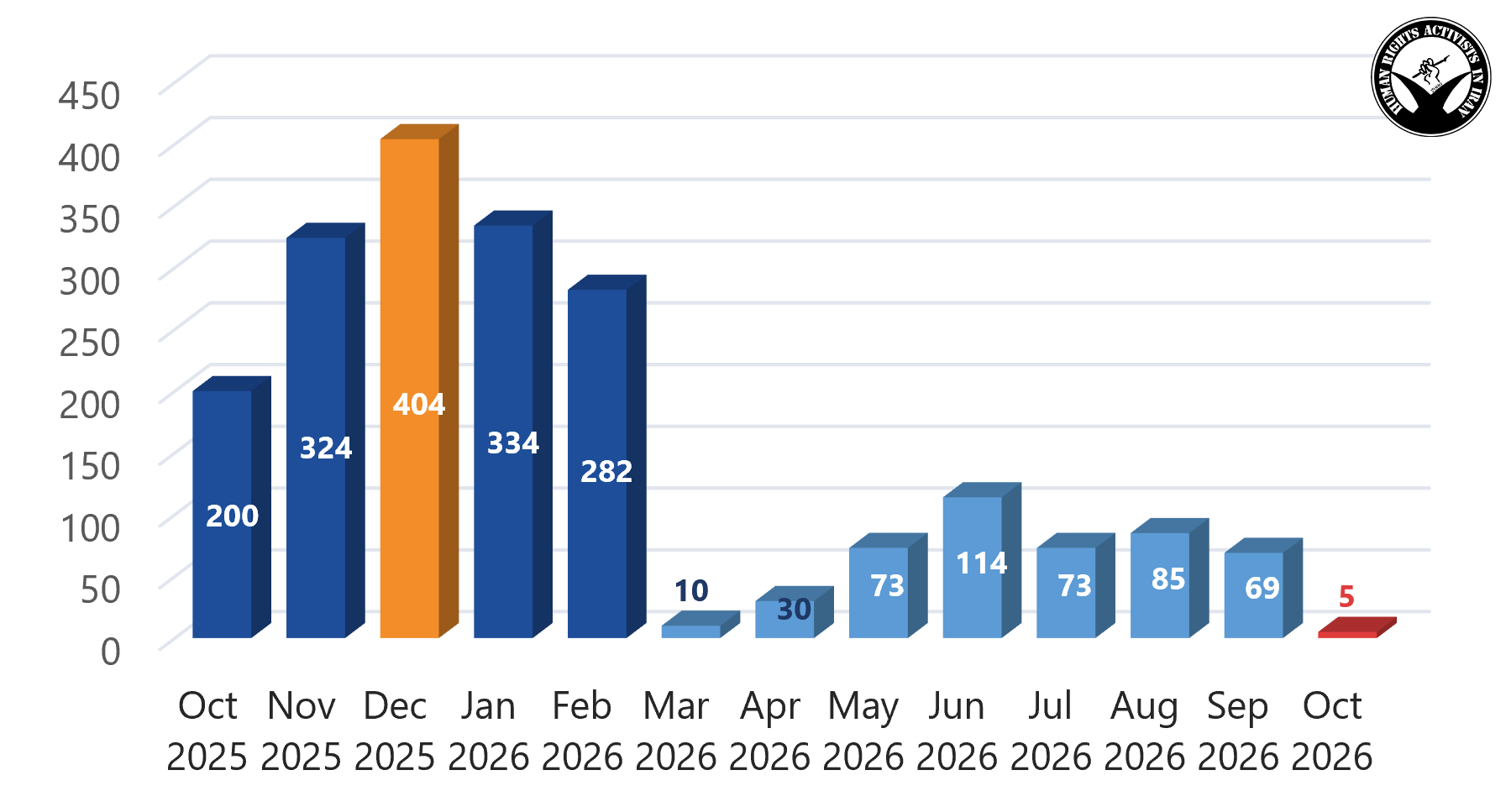
CHART 1 — Monthly Executions

Charges: Murder and Drug Offenses Dominate

The distribution of charges resulting in execution shows a notable shift from the previous period. According to HRANA documentation, 57.56% of those executed were convicted of murder and 36.25% of drug-related offenses. Political and security-related moharebeh or baghi charges accounted for 2.40%; other or unknown charges for 1.10%; security charges including espionage, assassination or bombing for 0.90%; rape for 0.80%; non-political moharebeh for 0.80%; efsad-e fel-arz (corruption on earth) for 0.15%; and economic crimes for 0.05%.

Taken together, murder and drug-related offenses account for more than 93% of all documented executions. At the same time, the increase in political and security-related executions, and the connection of a significant number of those cases to protests, stands out as a defining feature of the current reporting period.
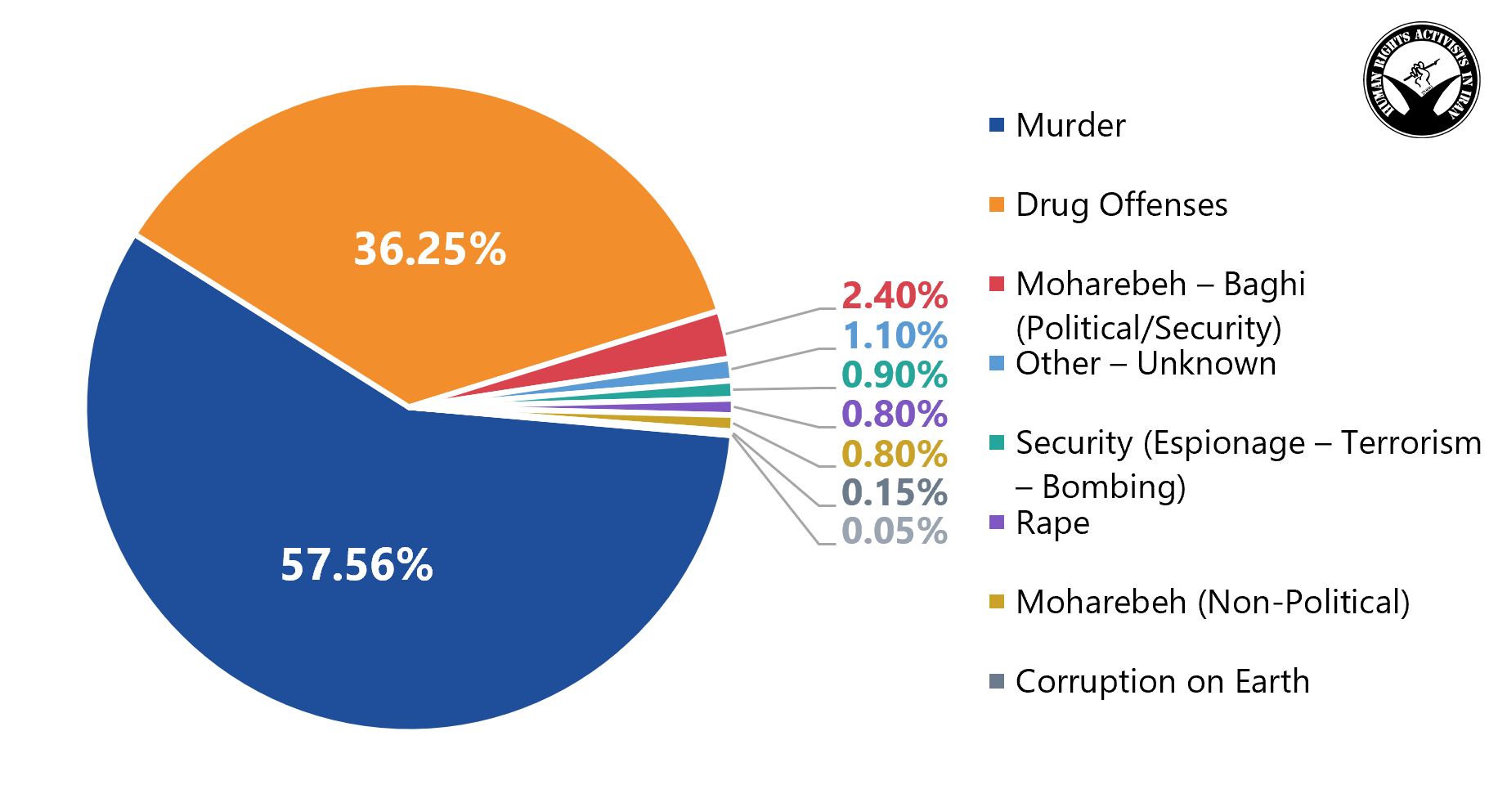
CHART 2 — Executions by Charge

Geography of Executions: Concentration in Several Provinces and Prisons

By location of execution, Razavi Khorasan recorded the highest number with 200 executions, followed by Isfahan with 164 and Alborz with 123. Fars recorded 119, Khuzestan 112 and Lorestan 102. These figures are calculated on the basis of prison location and do not necessarily reflect the place of residence or alleged offense of the person executed.

Per-capita figures provide a different picture, particularly in smaller provinces. The report cautions that prisoner transfers and executions carried out outside a prisoner’s province of origin can inflate provincial rates. Tehran is not included in the per-capita table because no executions were recorded there, and 30 executions with an unknown province were excluded from that calculation.

At the prison level, Dastgerd Prison in Isfahan and Adelabad Prison in Shiraz recorded the highest numbers of executions. The spread of executions across dozens of prisons, alongside clear concentration in several facilities, illustrates both the nationwide scope and localized intensity of the death penalty.
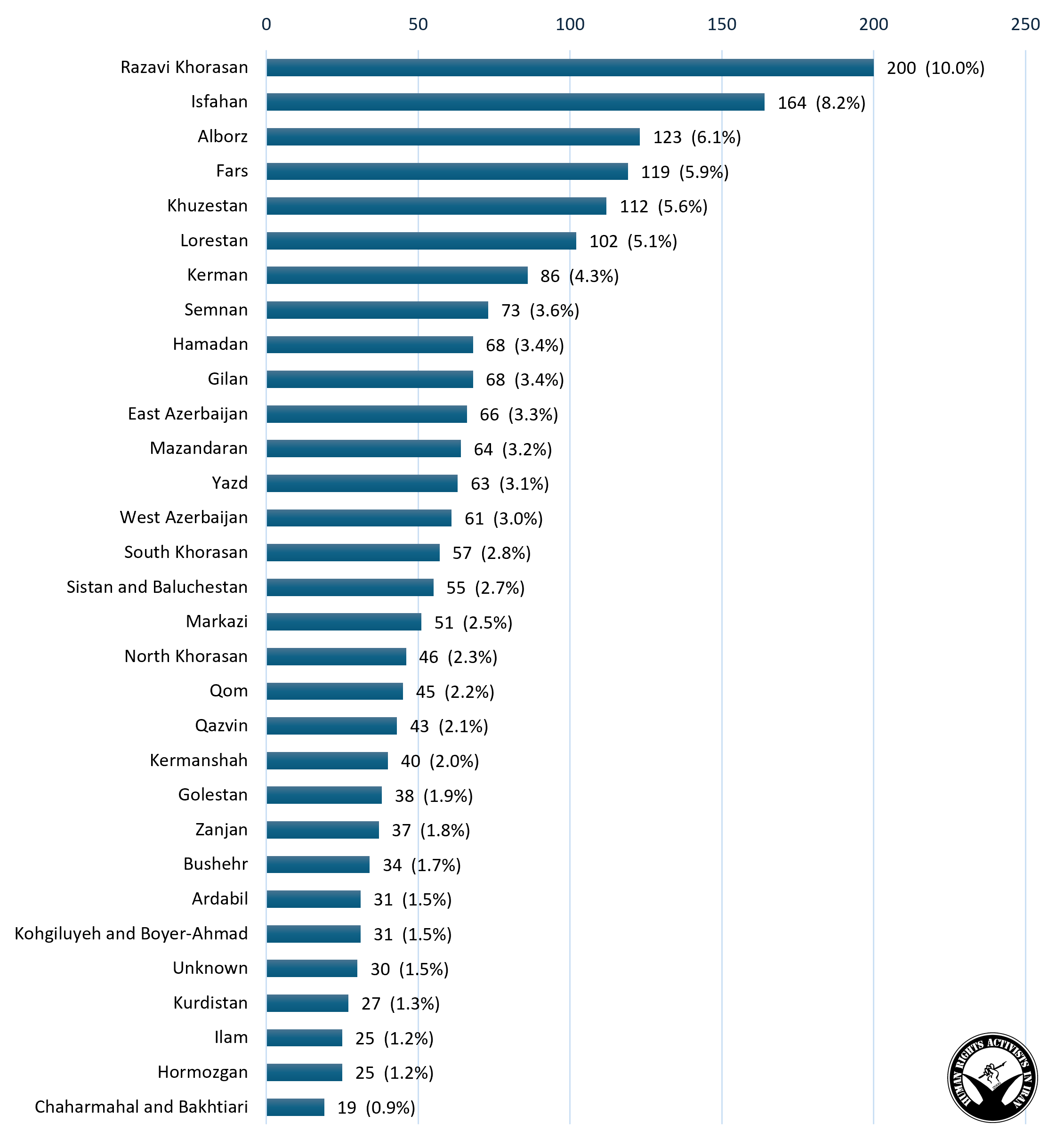
CHART 3 — Executions by Province

Secrecy, Public Executions and Gender

One of the report’s most significant findings is the continued lack of official transparency. Approximately 95% of documented executions were carried out secretly or without announcement in official or domestic media, while only about 5% were reported through official or domestic sources. This pattern sharply limits public oversight and independent assessment of execution practices.

Of the 2,003 executions documented, 9 were carried out in public, representing about 0.4% of the total. Forty-seven women were executed during the reporting period. Four people whose identities and case histories were verified were under the age of 18 at the time of the alleged offense. Overall, 2.3% of those executed were women, 88.8% were men, and the gender of 8.9% remained unknown in the available data.

In relation to sentencing, HRA documented 230 people sentenced to death. At least 16 of those sentenced were women, 6 were sentenced to public execution, and 74 death sentences were upheld by the Supreme Court.

Ten-Year Trend: The Highest Recorded Level

A review of ten reporting periods shows that, after executions declined from 505 in 2016–2017 to 238 in 2018–2019, the trend turned upward from 2019–2020 onward. The totals then rose through 249, 272, 528, 664, 823 and 1,553 before reaching 2,003 in 2025–2026.

This trajectory places the current one-year increase within a longer pattern of escalation. Continued restrictions on access to official information, together with the very high share of unannounced executions, mean that the documented figures should be understood as the minimum that could be independently verified rather than necessarily the complete number of executions carried out.
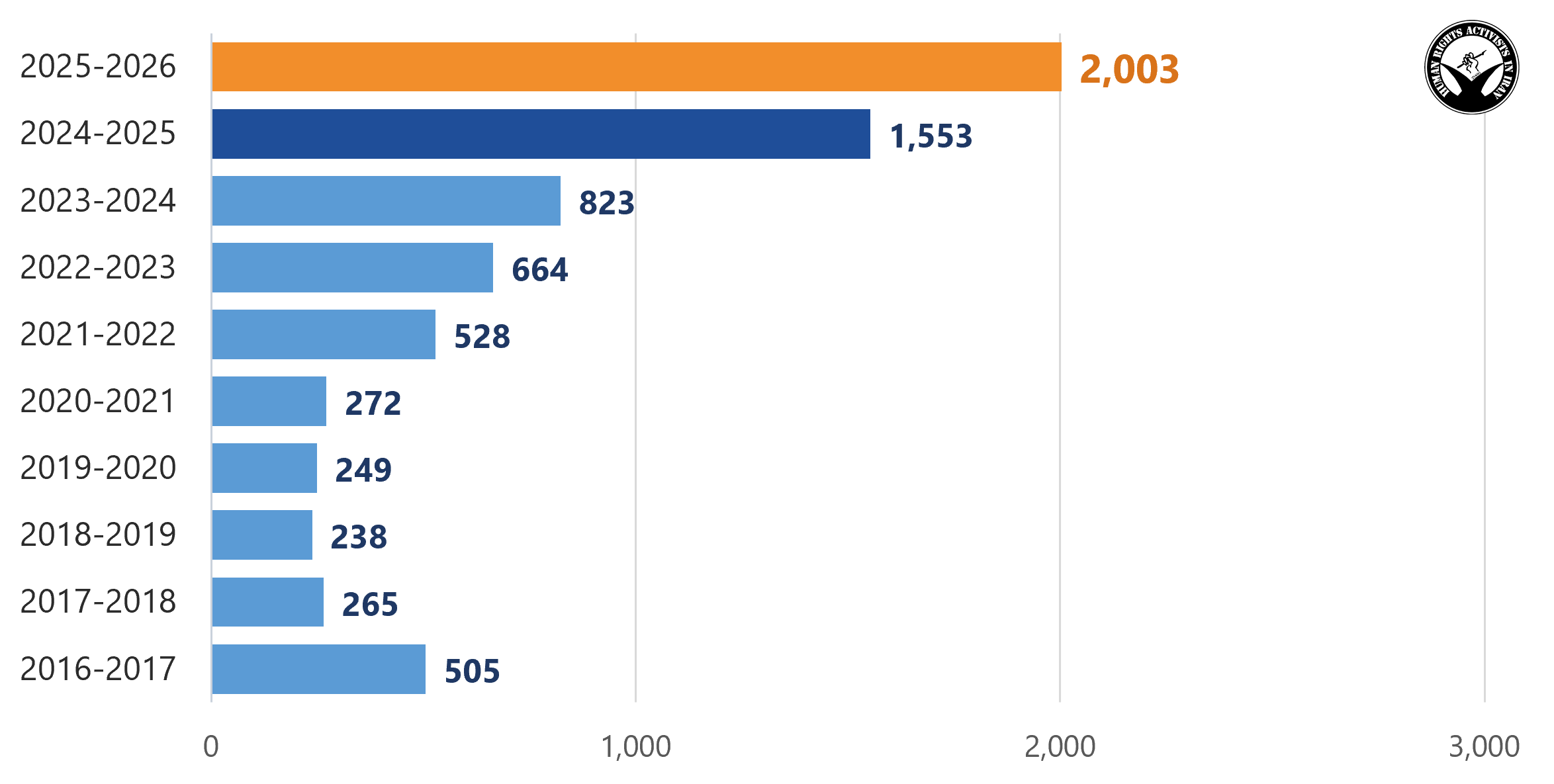
CHART 4 — Ten-Year Execution Trend

69 Political and Security-Related Executions

During the reporting period, HRANA documented 69 people executed on political and security-related charges. Of these, 35 people — approximately 51% — were executed in connection with the January 2026 (Dey 1404) protests. Twenty-nine people were executed in April and May 2026 alone, with 14 in April and 15 in May, marking the peak of executions in this category.

Among these 69 cases, 29 people were executed on charges of moharebeh, either alone or alongside other charges. Where the province was known, Alborz accounted for the largest share with 19 cases, followed by Isfahan with 10. The province was unknown in 20 cases.

The full report provides an individual case card for each of the 69 people, setting out the charge, date of execution, case background, province or city, and prison where available. This case-level documentation allows the aggregate figures to be examined in greater detail and shows the diversity of charges and case backgrounds included within the political and security-related category.

Judicial Actors Involved in Issuing or Upholding Death Sentences

For the first time in this format of the annual report, a dedicated section documents judges and courts identified in death-penalty cases. This research covers October 10, 2025 through September 26, 2026, meaning that its documentation window ends twelve days before the October 8, 2026 cutoff used for the report’s main statistical sections.

HRA’s review found that several judges identified during the current period had also appeared in earlier political, security-related or protest cases involving death sentences. Among the examples examined are Abolghasem Salavati of Branch 15 of the Tehran Revolutionary Court, Iman Afshari of Branch 26 of the Tehran Revolutionary Court, Vahid Hemmatnejad of Branch 5 of the Isfahan Revolutionary Court, Ahmad Darvish-Goftar of Branch 1 of the Rasht Revolutionary Court, Reza Najafzadeh of Branch 3 of the Urmia Revolutionary Court, and Seyed Mahmoud Sadati of Branch 1 of the Shiraz Revolutionary Court.

The report emphasizes that this list is not exhaustive. Iranian authorities routinely withhold information about capital proceedings, and public reporting often fails to identify the presiding judge or even the relevant branch. Accordingly, the absence of a judge’s name from the report should not be read as evidence that the judge was not involved; rather, it reflects the limits of independently verifiable information.

A separate section also addresses Supreme Court review and distinguishes between issuing a death sentence at trial and later upholding or reviewing that sentence. The available documentation identifies judges from Branches 9, 20, 39 and 41 of the Supreme Court in connection with specific death-penalty cases.

Methodology and Data Limitations

HRA’s Statistics Center relies on HRANA reporting, a nationwide volunteer network, verified open-source material, and official judicial announcements. Because independent human rights groups cannot operate freely in Iran, access to prisons and courts is restricted, and many executions are deliberately concealed, a margin of error is unavoidable.

The figures in this report therefore reflect the capacity of civil society to document and independently verify executions rather than a claim to a flawless count of every execution carried out. The fact that approximately 95% of executions were not announced by official sources underscores the importance of independent monitoring and verification in assessing the true scale of capital punishment in Iran.

Access the Full Report

The full report contains detailed statistical tables, charts, provincial and prison-level data, profiles of all 69 people executed on political and security-related charges, and the section documenting judicial officials. For case details, sources and supporting data, download and read the complete report.
Download the full PDF report here

HRA records highest number of death sentences imposed by the Islamic Republic in more than 12 months

The Human Rights Activists News Agency (HRANA) – HRA has reported a concerning increase in the number of death sentences in the Islamic Republic, reaching a 12-month peak with 35 individuals sentenced to death in January 2024 alone.

According to documentation recorded by the Human Rights Activists in Iran (HRA) statistics team, the Islamic Republic witnessed a significant uptick in the issuance of death sentences in January 2024, with 35 individuals sentenced to capital punishment—the highest recorded in more than 12 months, and a total of 86 individuals executed.

January 2024 was also marked by the heinous execution of Mohammad Ghobadlou. Ghobadlou was executed in connection with the “Women, Life, Freedom” protests. His case gained international attention due to reports of mental illness and trials lacking any semblance of due process.

In Iran, the death penalty is routinely imposed following trials that fall short of due process guarantees, in a judicial system that lacks transparency and impartiality, and for crimes that do not amount to the most serious crimes under international law. The continued use of the death penalty in this manner amounts to a grave violation of the right to life under article 6 of the ICCPR.

Additionally, and noteworthy in the case of Mohammad Ghobadlou, the imposition of the death penalty on individuals with mental disorders is strictly prohibited under international law, as reiterated by Section 3(e) of the UN Commission on Human Rights Resolution (2000/85).

An examination of the execution of death sentences and the issuance of death sentences spanning from January 2023 to January 2024 demonstrates that the number of executions consistently surpasses the number of new death sentences issued. This disparity is evident and suggests an apparent backlog.

Iran continually ranks among the highest in the world in terms of capital punishment despite international calls for the abolishment of the death penalty, in particular for crimes that do not amount to the most serious crimes under international law. It is evident that the Islamic Republic refuses to head the calls of the international community. Members of Iran’s judiciary, complicit in its utter lack of compliance with international human rights standards, must continue to be held accountable through various international accountability mechanisms such global Magnitsky style sanctions regimes that designate judges, interrogators, and members of law enforcement for their involvement in the continued use of capital punishment as a means to victimize and silence.

DateExecution of the death sentenceDeath sentence
Jan-236323
Feb-234615
Mar-233520
Apr-231911
May-2313614
Jun-23499
Jul-236411
Aug-23675
Sep-232412
Oct-237816
Nov-2310811
Dec-2310716
Jan-248635

Political Prisoner Habibollah Latifi Granted Furlough after Fourteen Years Imprisonment.

On December 15, political prisoner Habibollah Latifi was granted furlough on bail in the fourteenth year of his life imprisonment.

According to HRANA, the news agency of Human Rights Activists, quoting Kurdpa, Latifi was finally granted furlough for medical treatment. Reportedly, years of refusal by security and judicial authorities has exacerbated his illness. Sanadaj’s Revolutionary Court agreed to the request after vigorous persuasion from Latifi’s family and lawyer.

Latifi was an engineering student in his final year at the University of Ilam when he was arrested on October 22, 2007. After more than three months of torture and solitary confinement, he was sentenced to death by the Islamic Revolutionary Court in Sanandaj on charges of “enmity against God” and “spreading corruption on Earth” by Judge Hasan Babaei.

His lawyers appealed the sentence but in the winter of that year, the Court of Appeals confirmed his death sentence. The verdict was the referred to the Supreme Court for a final appeal where it was upheld.

Finally, in 2015, in the eighth year of his imprisonment, he was pardoned by the leadership and his death sentence was suspended.

Inmate Executed in Ghayen Prison on Drug-Related Charges

On Monday morning, October 11, 2021, an inmate who had previously been sentenced to death on drug-related charges was executed in Ghayen Prison.

According to HRANA, quoting The Baloch Activists Campaign, the inmate has been identified as Ibrahim Rakhshani, a native of Zabol.

According to the last report of the Statistics and Publication Center of the Human Rights Activists in Iran (HRA), between October 8 of 2020 and October 9 of 2021, at least 266 citizens were executed and 90 citizens were sentenced to death.

As the report points out, Iran’s judicial authorities do not publicly announce over 82% of carried-out executions, dubbed as “secret executions” by human rights organizations.

This execution has not been announced by official sources in Iran as of this writing.

Two Men Spared from Execution, One Sentenced to Death

Recently, two men facing death sentences were spared from conviction while a third was sentenced to death.

According to HRANA, the news agency of Human Rights Activists, quoting Dideban,  one man in Tehran was sentenced to death on a charge of murder on Wednesday, 29 September.

Two men were spared from execution in separate criminal lawsuits, in Urmia and Karaj respectively. Both cases were ruled upon exacting satisfaction from the “avenger of blood”, meaning that the victim’s relative or closest acquaintance agreed to refrain from demanding the perpetrators’ execution.

A man indicted for murder was sentenced to the death penalty. He was detained after one man was stabbed to death in a street fight that took place in a park in Islamshahr, July 2018. This 30-year-old man, named Mahmoud, has denied the charge of first-degree murder and claimed that his actions were self-defense.

According to IRNA, a death-row inmate in Urmia Prison, after 11 years imprisonment, could exact the satisfaction of ‘blood avengers’ with the mediation of elders of the community.

The second spared inmate was a 20-year-old Meysam, who was sentenced to death on a charge of killing a 21-year-old man in a fight. After 5 years, he could exact the satisfaction of the victim’s parent by paying 2.5 billion tomans as reparation.

Subscribe to Our Newsletter

Now is definitely not the time to stop reading!

Two Inmates on Death Row Executed in Dastgerd and Zahedan Prisons

Yesterday, September 29, at dawn, two inmates in Dastgerd and Zahedan Prisons were executed.

According to HRANA, the news agency of Human Rights Activists, in Dastgerd, one of the inmates was hanged in a city in Isfahan province. He was previously convicted on drug-related charges, and had spent 20 years in prison until his execution. HRANA identified him as Abasgholi Salehi, aged 42. Reportedly, tomorrow his body will be delivered to his parent.

In addition, 20-year-old Jasin Abdollahi was executed in Zahedan Prison after being convicted of murder. His execution has not yet been confirmed by the regime’s official authorities.

Iran ranks first in the world in executions per capita, according to international organizations. The Statistics and Publication Center of the Human Rights Activists in Iran (HRA) reported that between January 1 and December 20 of 2020, at least 236 citizens were executed.

Six Afghans Sentenced to Death in Tehran

Six men were recently sentenced to death on charges of rape by Branch 7 of the First Criminal Court in Tehran.

According to HRANA, the news agency of Human Rights Activists, quoting Rokna, these men are citizens of Afghanistan.

In addition to the death penalty, two men were sentenced to seven years in prison for stealing the victim’s cell phone.

Iran ranks first in the world in citizen executions per capita, according to international organizations. The Statistics and Publication Center of the Human Rights Activists in Iran (HRA) reported that between January 1 and December 20 of 2020, at least 236 citizens were executed.

One of these citizens was executed publicly, and two were juvenile offenders. An additional 95 citizens were sentenced to death. According to the same report, more than 72% of executions in Iran are not reported by the government or the judiciary, which human rights organizations call “secret” executions.

Inmate Executed in Rajai Shahr Prison in Karaj

A man named Jafar was recently executed in Rajai Shahr Prison in Karaj.

According to HRANA, the news agency of Human Rights Activists, the prisoner had previously been sentenced to death for murder, and the sentence was later upheld by the Supreme Court.

Iran ranks first in the world in citizen executions per capita, according to international organizations. The Statistics and Publication Center of the Human Rights Activists in Iran (HRA) reported that between January 1 and December 20 of 2020, at least 236 citizens were executed.

One of these citizens was executed publicly, and two were juvenile offenders. An additional 95 citizens were sentenced to death. According to the same report, more than 72% of executions in Iran are not reported by the government or the judiciary, which human rights organizations call “secret” executions.

Death Sentences Issued to Two Men in Tehran

Two death sentences were recently issued to male defendants in Tehran.

According to HRANA, the news agency of Human Rights Activists, quoting Shargh newspaper, a defendant named Farid was sentenced to death by the Second Branch of the Criminal Court of a Tehran province for the murder of his colleague.

Another defendant was sentenced to death by a criminal court in Tehran province for the murder of his aunt.

Iran ranks first in the world in citizen executions per capita, according to international organizations. The Statistics and Publication Center of the Human Rights Activists in Iran (HRA) reported that between January 1 and December 20 of 2020, at least 236 citizens were executed. An additional 95 citizens were sentenced to death.

According to the same report, more than 72% of executions in Iran are not reported by the government or the judiciary, which human rights organizations call “secret” executions.

Two Death Sentences Issued in Tehran

Two death sentences were recently issued in Tehran.

According to HRANA, the news agency of Human Rights Activists, quoting Shargh Newspaper, a man was sentenced to death for the murder of a police officer he committed in April, 2004. Mehdi was sentenced under Qisas (“eye-for-an-eye”),  a pillar of Islamic sharia law .

It took 14 years following the incident until police officers discovered that Mehdi had started a secret new life in the city of Bonab and arrested him. Now, three years after his arrest, Mehdi has been sentenced to death, five years in prison, and 50 lashes.

According to HRANA, quoting Shahrvand Newspaper, another man was sentenced to death in Tehran on a charge of Moharebeh. Moharebeh, loosely translated as “waging war against God”, is a pillar of Islamic sharia law that is typically applied to those suspected of connection to any acts against the state.

Per the report, in late May 2017, detectives from the capital’s police station began investigating the case, and several men were arrested for extortion.

The case was sent from the Theft Court to the Revolutionary Court after a confession was obtained from the accused. Finally, the judge sentenced the leader of the extortionists to death.

Iran ranks first in the world in citizen executions per capita, according to international organizations. The Statistics and Publication Center of the Human Rights Activists in Iran (HRA) reported that between January 1st and December 20th of 2020, at least 236 citizens were executed. One of these citizens was executed publicly, and two were juvenile offenders. An additional 95 citizens were sentenced to death.