International Workers’ Day: A Year in Review of Iranian Workers’ Conditions

HRANA – May 1st marks International Workers’ Day, offering another opportunity to reflect on the condition of the country’s labor community and their numerous challenges, particularly regarding wages and salaries, unpaid wages, workplace safety, and the right to form labor unions.

According to a report by HRA’s Statistics and Documents Center, based on a review of labor-related reports published over the past 12 months (from May 1, 2025 to April 28, 2026), at least 5,019 workers were reported injured or killed in workplace incidents during this period by media outlets or organizations active in this field.

At least 586 workers lost their lives in workplace incidents during this period. Authorities and relevant institutions reported 284 deaths in 10 official reports, while independent organizations collected and updated 302 additional cases of worker fatalities that had not been mentioned in official statements.

At least 4,433 workers were also injured in workplace accidents. In 9 official reports or statements at national and provincial levels, authorities announced that 3,846 individuals had been injured. In addition, 587 other cases were documented and reported by civil or labor organizations.

Despite the significance of these figures, it should be noted that, due to the lack of transparency in reporting by responsible institutions and officials, the majority of workplace incidents go unreported in the media.

Most workers in Iran operate under conditions lacking job security and adequate insurance coverage. A shortage of inspectors and weak safety infrastructure have created serious challenges in the registration and prevention of occupational accidents.

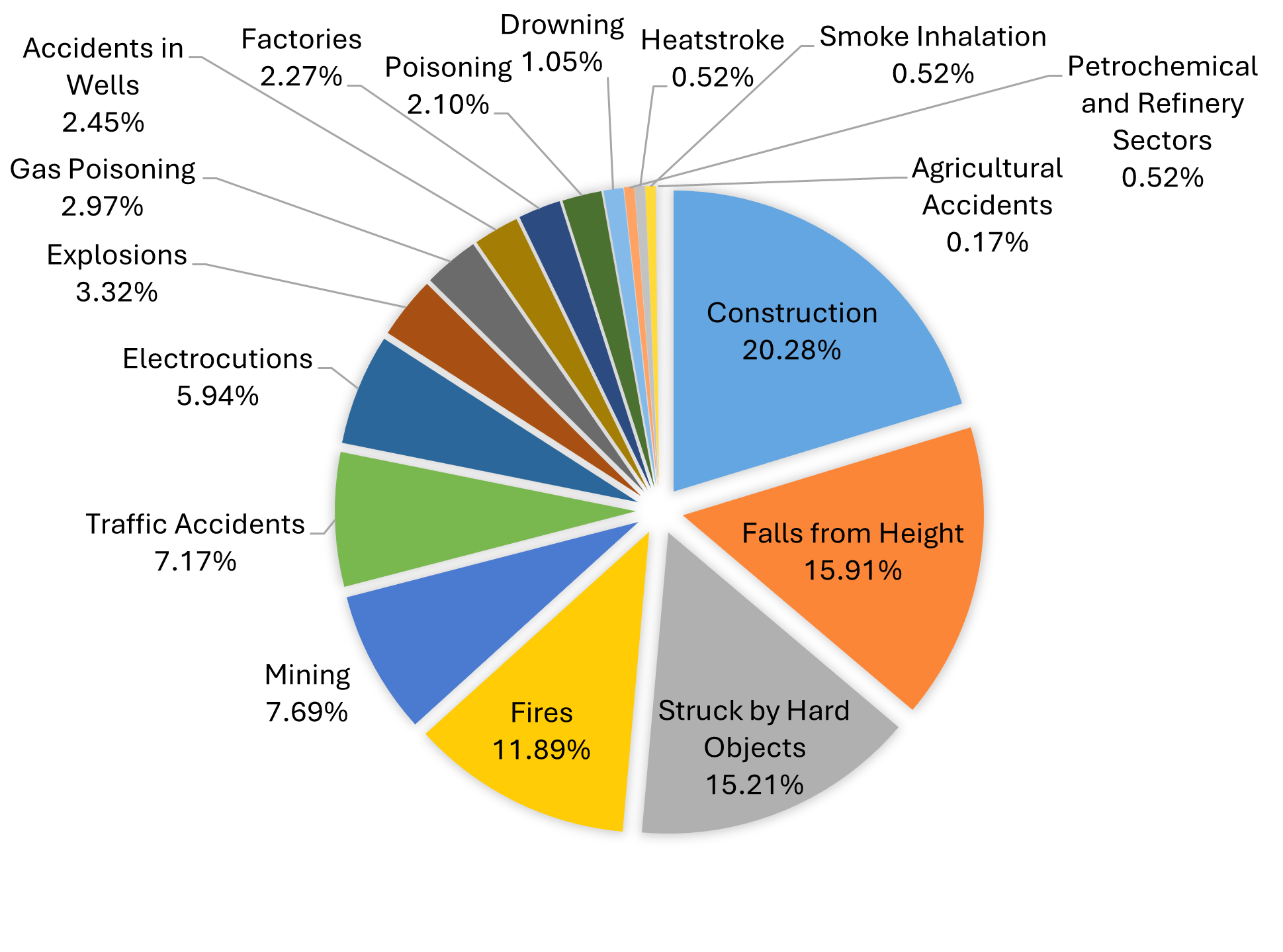
As shown in the chart below, based on the data collected by HRA’s Statistics And Documents Center, the causes of these incidents are distributed as follows: 20.28% construction-related accidents, 15.91% falls from height, 15.21% struck by hard objects, 11.89% fires, 7.69% mining incidents, 7.17% traffic accidents, 5.94% electrocutions, 3.32% explosions, 2.97% gas poisoning, 2.45% accidents in wells, 2.27% in factories, 2.10% poisoning, 1.05% drowning, 0.52% heatstroke, 0.52% smoke inhalation, 0.52% in petrochemical and refinery sectors, and 0.17% agricultural accidents.

Workplace Accident Categorization Chart

According to data compiled by HRA’s Statistics and Documents Center, at least 613 months of unpaid wages have been recorded across 119 industrial and service units.

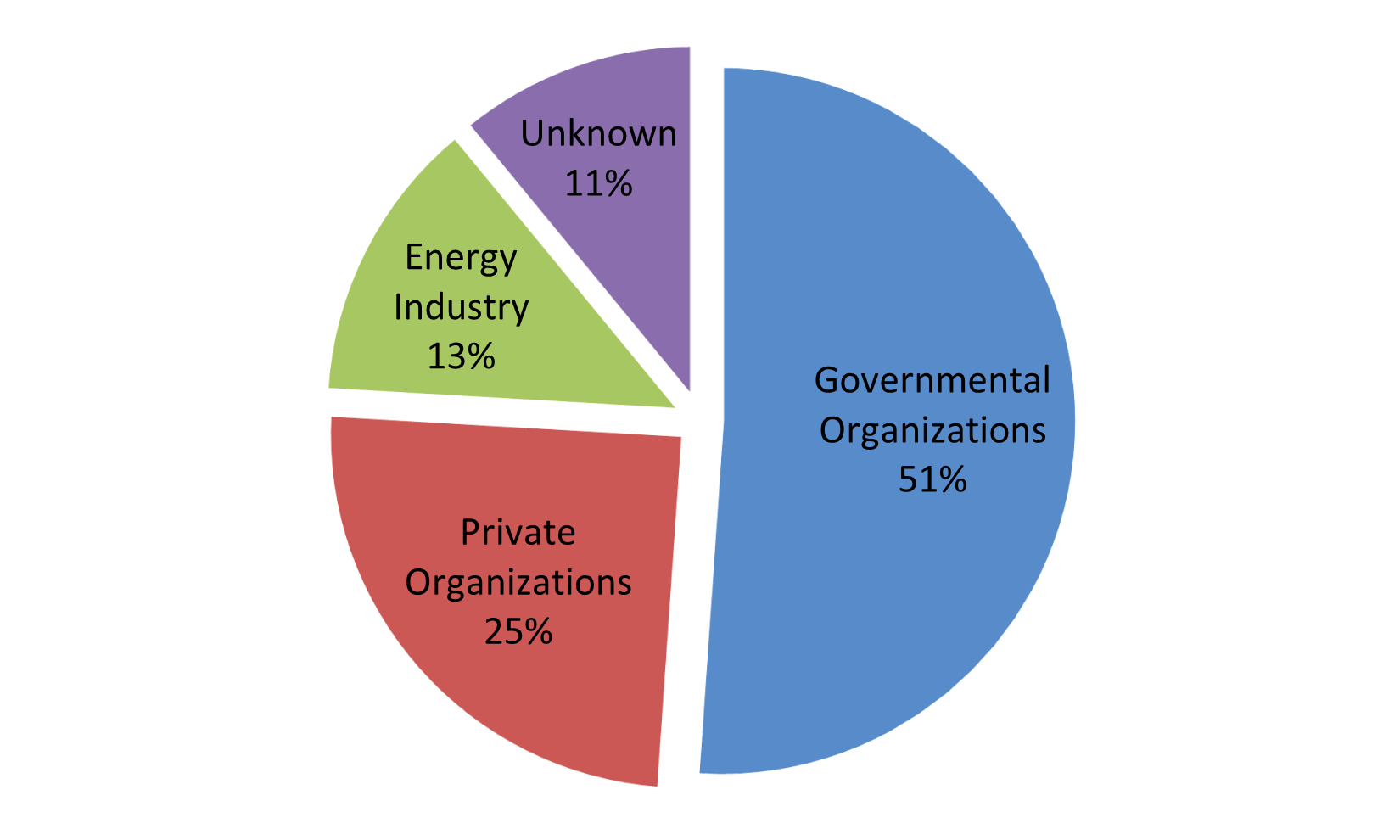
Breakdown of Wage Arrears by Sectors

Based on reports collected by this organization’s statistics department, 51% of wage arrears are related to government entities, 25% to private sector organizations, 13% to the energy sector, and 11% remain unspecified.

Estimates indicate a high level of protest activity within the labor community; however, over the past year, only a portion of these protests, specifically 682 labor gatherings and 691 guild-related gatherings, have been reported by media outlets or civil society organizations. Compared to the previous year, guild-related gatherings decreased by 39.6%, while labor gatherings declined by 7.5%.

Among the most significant events in Iran over the past year were protests by workers of the Middle East Sugarcane Agro-Industry Company, the Karkheh Mianab Sugarcane Agro-Industry Company, railway technical and infrastructure workers, the National Iranian Steel Industrial Group, the Qalat Ghareh Oil Company, as well as guild-related protests by teachers, retirees, and Social Security pensioners.

Over the past 12 months, various cities across Iran have witnessed diverse forms of protest actions by workers. A wide range of workers have taken to the streets due to non-payment of their monthly wages and the neglect of their insurance-related demands. Some of these workers have gone on strike and protested after going as long as 30 months without receiving their pay. In total, 383 labor strikes and 39 guild-related strikes took place. Labor strikes decreased by 72.1%, while guild-related strikes declined by 43.4%.

Workers’ ability to organize in Iran to pursue their demands faces legal challenges and state repression. Repression, obstruction, and the refusal to recognize the rights of trade unions and independent labor organizations, along with the imprisonment and issuance of prison sentences for several labor activists, as well as restrictions on the right to protest, have contributed to the fragmentation and disorganization of some labor gatherings and protests.

In Iran, labor organizations do not exist in the conventional global sense, and independent groups such as the Syndicate of Workers of the Tehran and Suburbs Bus Company, the Haft Tappeh Sugarcane Workers’ Syndicate, the Coordinating Council of Teachers’ Union Organizations, and the Free Union of Iranian Workers face security and political charges.

Many workers have been arrested or sentenced on charges such as organizing peaceful gatherings and protesting low wages. Over the past 12 months, at least 10 workers and labor activists have been arrested. Among the most notable cases are the arrests of several workers from the Isfahan Steel Company and five workers from the Middle East Sugar Factory in Shush.

It is also worth noting that Sharifeh Mohammadi and Mehran Raouf are among the prominent labor activists currently imprisoned, alongside union activists such as Asghar Amirzadegan, Ahmad Alizadeh, and Mohammad Hassan Davoudi.

In addition, one can point to the sentencing of two labor activists to a total of 75 months of discretionary imprisonment and fines amounting to 30 million tomans, two cases of self-immolation, the trial of two individuals, the summoning of nine individuals to judicial and security authorities, the closure of 10 factories, 2,922 cases of dismissal and workforce reduction, 114,954 cases of unemployment, 839,953 instances of workers lacking insurance coverage, and 3,806 cases of employment uncertainty.

Furthermore, in the area of unions and union/guild activities, a total of 40 arrests of union activists, 317 months of discretionary imprisonment and 3 months of suspended sentences, 24 cases of deprivation of social rights, 148 lashes, fines totaling 359.1 million tomans, and 120 months of internal exile for 67 union activists were reported. Additionally, there was 1 case of travel ban, 16 trials in judicial authorities, 43 summonses to judicial-security bodies, 195 cases of business closures (sealings), 18 cases of dismissal and workforce reduction, at least 105 months of unpaid wages, 407 cases of forced retirement, 8 house searches, 4 sentence enforcements, 2 cases of physical assault, and 1 case of self-immolation.

Over the past year, teachers and education sector workers, both active and retired, across various cities and provinces in the country staged protest gatherings and strikes in response to the failure to address their demands. In total, 40 gatherings were recorded. Over the past year, 32 cases of arrest, 37 summonses, 16 trials in judicial authorities, 4 instances of sentence enforcement, 18 cases of dismissal, workforce reduction, and bans from teaching, as well as 7 cases of forced retirement among teachers, were documented.

Additionally, 64 teachers and activists in this field were sentenced to a total of 269 months of discretionary imprisonment and 3 months of suspended sentences, 74 lashes, 23 cases of deprivation of social rights, and fines amounting to 359.1 million tomans.

The head of the National Association of Union Organizations of Construction Workers reported a worsening state of uncertainty and deteriorating living conditions for this group due to wartime circumstances. Akbar Shokat stated: “The most important issue for construction workers is employment. Many of them work on a daily wage basis and rely on just a few days of work per week to cover their living expenses. However, under current conditions, even these limited opportunities have declined, and their livelihoods are facing serious challenges. Wartime conditions have led to the closure of many workshops, and rising prices—especially in the steel sector—have further reduced employment in this field.”

A workers’ representative in the Supreme Labor Council announced that the cost of a basic livelihood basket for a worker’s household this year has reached approximately 40 to 45 million tomans per month, while the minimum income of workers is around 15 million tomans. This highlights a significant gap between income and living expenses. According to Mohammadreza Tajik, to bridge this gap, the minimum wage would need to increase by 17 million tomans to reach around 31 million tomans. Even with a 100% wage increase, workers’ livelihood problems would not be fully resolved, and wage-setting should be based on preserving purchasing power rather than merely percentage increases.

The executive secretary of the Workers’ House in Rey, referring to the sharp rise in healthcare costs and deficiencies in the supplementary insurance of the Social Security Organization, stated that in recent months, increasing imposed and unlawful medical expenses have become a problem worse than the illness itself for many retirees and workers. Mohammadali Torkashvand added that the ability to pay for medical expenses has become impossible for many. He further noted that the “Obligation Plan” of the Social Security Organization, one of its core responsibilities, has not been properly implemented for years. If properly enforced, there would be no need for supplementary insurance, and many healthcare-related problems of retirees would be resolved.

The executive secretary of the Workers’ House in Qazvin stated that today, workers remain hungry despite working double shifts. Wages are not aligned with current inflation, and with daily price changes, 70 to 80 percent of workers’ income is spent on food. Eydali Karimi added that housing allowance is only 900,000 tomans, while in many cases, an entire worker’s salary is spent on rent. Workers and retirees are also under severe pressure from medical costs, with even a simple surgery now costing over 100 million tomans.

Ali Moghaddasi-Zadeh, head of the Coordinating Council of Islamic Labor Councils of South Khorasan, stated that in mining cities such as Tabas and Eastern Alborz, there are still no Social Security hospitals. According to him, this has forced mine workers, who earn very low wages, to bear heavy medical costs in public and private hospitals in the event of accidents. Moghaddasi-Zadeh identified the main cause of this situation as the “existing Social Security law,” explaining: “According to current regulations, a dedicated hospital will not be built until the number of insurance booklets reaches 100,000, whereas in Tabas alone, at least 11,000 workers and their families require insurance services.” He emphasized that this law must be revised so that workers can access Social Security healthcare services in their place of residence.

The prohibition of child labor and the provision of free education for children, the establishment of the highest safety standards in work environments, and the removal of discriminatory laws against women and migrant workers are among the key demands of the labor community.

Despite being described as the cheapest labor force in the country, Iranian women workers face worse employment conditions than men and receive fewer legal protections, rights, and benefits.

At the same time, women workers have less bargaining power compared to their male counterparts. Moreover, production and industrial units show less willingness to hire married women, and in some cases employ single women under commitments not to marry or become pregnant.

The situation of women workers in small workshops is significantly worse. Women make up half of the workforce in brick kilns, where they work under extremely harsh conditions.

In Iran, International Workers’ Day arrives at a time when the privatization of factories and state-owned companies continues without regard for the long-term interests of workers, a trend that has led to widespread labor protests.

World Day for Safety and Health at Work: One-Year Statistical Report on Workplace Accidents in Iran

HRANA – On the occasion of World Day for Safety and Health at Work, the Human Rights Activists in Iran have examined the situation of workplace accidents caused by unsafe environments or working conditions over the period from 3 May 2025 to 27 April 2026.

According to data compiled by the organization’s statistics department, during this period, at least 586 workers lost their lives and at least 4,424 workers were injured due to workplace accidents resulting from unsafe environments or working conditions.

In 2003, the International Labour Organization (ILO), after extensive review, designated April 28 as World Day for Safety and Health at Work. The aim is to raise awareness about occupational safety and health, with an emphasis on preventing workplace accidents and diseases. In effect, it is an international campaign highlighting the importance of improving workplace safety and its impact on reducing work-related fatalities. Accordingly, governments are required to develop systematic policies and programs to monitor and enforce compliance with occupational safety and health regulations. It is also noteworthy that since 1996, labor unions worldwide have marked this day as a global day of remembrance for workers killed or injured on the job.

According to HRA’s Statistics And Documents Center, based on reports published over the past 12 months, the deaths of at least 586 workers due to workplace accidents linked to unsafe conditions have been reported by media outlets or relevant organizations.

In addition, 4,424 cases of work-related injuries have been reported and compiled by the organization’s statistics department.

Among the most tragic and notable incidents of the past year are: the deaths of 9 workers in a fire at an industrial workshop in Borkhar, located in Isfahan province; the poisoning of 17 workers by carbon monoxide gas in a cold storage facility in Fariman, Razavi Khorasan Province; the death and injury of 13 workers in a fire at the Kaveh Methanol Petrochemical plant; and the death and injury of 3 miners following a coal mine collapse in Nahroudbar, located in Mazandaran Province.

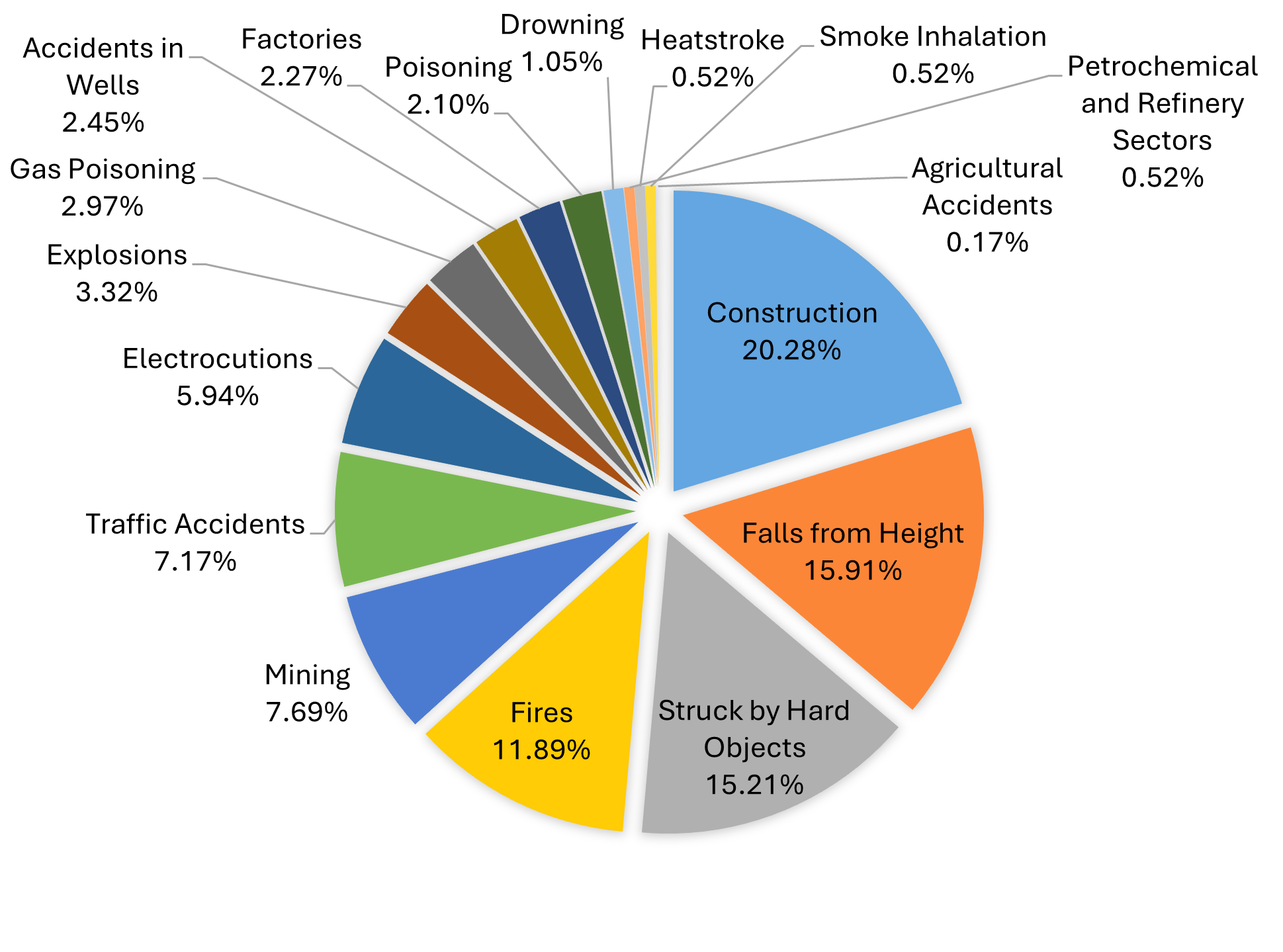
Based on the data collected by HRA’s Statistics And Documents Center, the causes of these incidents are distributed as follows: 20.28% construction-related accidents, 15.91% falls from height, 15.21% struck by hard objects, 11.89% fires, 7.69% mining incidents, 7.17% traffic accidents, 5.94% electrocutions, 3.32% explosions, 2.97% gas poisoning, 2.45% accidents in wells, 2.27% in factories, 2.10% poisoning, 1.05% drowning, 0.52% heatstroke, 0.52% smoke inhalation, 0.52% in petrochemical and refinery sectors, and 0.17% agricultural accidents.

Workplace Accident Categorization ChartWorkplace Accident Categorization Chart

War-Driven Industrial Damage Fuels Unemployment Crisis for Workers Across Multiple Provinces

HRANA – Following the recent military attacks, workers employed in various industrial sectors, particularly in the provinces of Tehran, Khuzestan, and Bushehr, have been facing unemployment, lack of access to relevant insurance coverage, and other challenges.

According to HRANA, citing ILNA, the spread of unemployment caused by the war has been more visible in the provinces of Tehran, Khuzestan, and Bushehr than in other parts of the country.

The report states that with the outbreak of the recent war, many of the country’s production and service units suffered serious damage. Some of these units were directly targeted by airstrikes, while others were pushed into crisis by the war-driven economic conditions. This crisis led to a significant rise in the number of unemployed people, workforce reductions in various units, business stagnation, and consequently a several-fold increase in unemployment insurance applicants across different provinces. Tehran, Khuzestan, and Bushehr are considered among the principal economic victims of the war, and the expansion of war-related unemployment has been more tangible there than elsewhere in the country.

Akbar Ghorbani, Executive Secretary of the Workers’ House for West Tehran and a labor market expert, said in this regard: some factories in Tehran Province, especially in western Tehran, which has always been highly industrially active, still have not resumed operations after the Nowruz holidays. He added that the Workers’ House remains in contact with its representatives and is monitoring workforce reductions in small, medium, and large units. According to him, one well-known company in western Tehran reported laying off 10 to 12 workers in each unit. Most of these layoffs are due to the current economic conditions. This has led to two major demands from the government and the Social Security Organization: first, strengthening the unemployment insurance fund with government credits, and second, assisting units directly and indirectly damaged by the war, while also imposing strict oversight to preserve the labor market in the country’s industrial units.

The labor relations expert further emphasized that there are also other cases in which the reason for the shutdown of industrial units is the employer’s exploitation of the existing conditions. Some employers, due to a particular economic outlook and fear of wartime conditions, have taken steps to reduce staff. Some employers have also carried out layoffs to increase pressure on the workforce, avoid wage payments, and evade compliance with this year’s wage increase resolution.

The report further cites Ghorban Darvishi, Executive Secretary of the Workers’ House in Khuzestan Province and a member of the Abadan Social Security Retirees’ Association, who pointed to the province’s problems during wartime and the ceasefire period. He said that in Khuzestan alone, at least 35 major production units were recently lost after military attacks. Most of these attacks targeted the Imam Port Special Economic Zone, the Mahshahr region, and the petrochemical sector. Khuzestan Steel and Oxin Steel also sustained damage. According to their estimates, if the problems caused by these layoffs are not managed, between 50,000 and 55,000 people could become directly unemployed due to the attacks and the economic and industrial pressures on the province.

Darvishi added that some of the province’s steel industries had already been facing serious difficulties even before the twelve-day war, and many workers had been staying home while still receiving wages. He warned that 100,000 unemployed people in one province means turning 100,000 sources of Social Security income into expenses for the fund. These industries urgently need immediate, out-of-turn unemployment insurance support. He also noted that some industries, due to falling sales and disappearing demand, had implemented widespread layoffs, the number of which may even exceed the directly war-related unemployment figures. This number also excludes construction workers in the province, a significant portion of whom have become completely unemployed. He stressed that many employers in units not directly damaged say they are unable to pay workers’ insurance and salaries even at last year’s rates.

Layoffs After Contract Expiration in the Second Phase of the Ilam Gas Refinery Project

According to ILNA, contract workers in the second phase construction project of the Ilam Gas Refinery in Chavar County reported the layoff of about 150 local coworkers from the beginning of Mehr last year up to the present. In this unit, located in Chavar County, around 350 workers are employed under the responsibility of the contractor company Jahanpars, and since the beginning of Mehr last year, more than 150 of them, who are local to the county, have become unemployed after the end of their employment contracts.

The report quotes one of the project’s contract workers as saying that 58 workers were laid off in Mehr last year, 52 at the end of Esfand, and 42 in Farvardin this year, all after their contracts expired. The worker also stated that some laid-off workers have still not received their wages for Bahman and Esfand of last year. The status of these workers’ unemployment insurance is also unclear. Meanwhile, the remaining coworkers are worried about their own job security.

This contract worker said that the layoffs are taking place even though at least three to four years remain until the completion of the second phase of the Ilam Gas Refinery project, and the parent employer appears to feel no obligation toward the workers. It is also unclear which authority or institution should be approached to pursue this issue.

Teachers’ Union Activist Mohammad-Ali Zahmatkesh Arrested

HRANA – Yesterday, Tuesday, April 14, Mohammad-Ali Zahmatkesh, a teachers’ union activist in Fars Province, was arrested by security forces in Shiraz.

According to a report by the Coordinating Council of Iranian Teachers’ Trade Associations, Mohammad-Ali Zahmatkesh was arrested in Shiraz. Based on this report, the arrest of this teachers’ union activist took place yesterday, Tuesday, April 14, at his private residence by security forces.

As of the time of this report, no information has been obtained regarding the reasons for his arrest or his place of detention.

Zahmatkesh had previously been arrested and convicted due to his union activities.

A Report on the Insurance and Livelihood Problems of Construction Workers Worsened by the War

HRANA – In a report on the difficulties faced by construction workers in the country, the Iranian Labor News Agency stated that since the Hijri year 1404, these workers have been confronted with new challenges such as widespread unemployment due to the war, lack of job security, insurance-related problems, and the absence of adequate government support.

According to HRANA, citing ILNA, the country’s construction workers are facing widespread crises. According to the report, in the Hijri 1404 year, construction workers have experienced one of the most difficult periods of their working and living conditions. Over the past year, they have faced worsening problems such as mass unemployment caused by the war, lack of job security, an insurance crisis, and the absence of effective state support.

Many workers have also become unemployed following the reduction or suspension of construction projects because of the war. Given the daily-wage nature of construction work, the shutdown of projects even for a few days can significantly worsen the serious livelihood difficulties faced by these citizens.

The report further points to the failure to allocate sufficient insurance quotas to construction workers and the deprivation of many of their Social Security insurance rights, stating:

“More than two years after the amendment to Article 5 of the Construction Workers’ Insurance Law was passed, and despite officials’ promises to resolve the workers’ insurance problem, the plan has still not reached a satisfactory outcome. Construction workers pay only 7% of the insurance premium, while the remaining 27.5% must be financed through construction levies and employers’ contributions. However, difficulties in securing these resources have disrupted the full implementation of the Construction Workers’ Insurance Law.”

Strict inspections by the Social Security Organization and the termination of insurance coverage are another major problem for these workers. Despite expectations that such inspections would cease following the amendment to Article 5, this has not happened, and in some cases inappropriate treatment of workers has also been reported.

In addition to the above, rising living costs, inflation, and reduced job opportunities have further intensified workers’ livelihood problems, leaving many unable to meet their basic needs.

According to HRA’s annual report, in 1404 there were reports of delayed or unpaid wages amounting to at least 672 months across 188 industrial-service units, 2,457 dismissals or workforce reductions, 658 cases of unemployment, 560 months without worker insurance, 9 factory closures, and 2,259 workers left in limbo in the labor sector.

Subscribe to Our Newsletter

Now is definitely not the time to stop reading!

Reza Amani Far, Teachers’ Union Activist in Bushehr, Arrested

HRANA – Yesterday, Reza Amani Far, a teachers’ union activist in Bushehr, was arrested by security forces in this city.

According to the channel of the Coordinating Council of Iranian Teachers’ Trade Associations, Reza Amani Far, a teachers’ union activist in Bushehr, has been arrested. Based on this report, Mr. Amani Far was arrested on Saturday, April 4, 2026, by security forces in Bushehr.

So far, no information has been obtained regarding his place of detention or the charges brought against this teachers’ union activist.

Reza Amani Far, an inspector for the Coordinating Council of Iranian Teachers’ Trade Associations and a member of the Bushehr Teachers’ Trade Association, has previously also faced judicial action due to his activities.

Nationwide Protests: Report on the Arrest of 12 Teachers in Various Cities

HRANA – Foruzan Yektaei in Rasht; Hossein Khaleghi and Ahanali Jahandideh in Darab; Shokrallah Ahmadi in Nurabad Mamasani; Rahmatollah Khodavandi, Moslem Parvizi, Firooz Brizi, Mehrdad Faribarzi, and Amin Brizi in Zarin Dasht; and Hadi Monfared, Hassan Jafari, and Jafar Taheri in Qir and Karzin were arrested by security forces on January 8 and 9 in connection with nationwide protests. Of these 12 employed and retired teachers, Foruzan Yektaei, Hossein Khaleghi, and Ahanali Jahandideh remain in detention, while the other nine have been released on bail.

Based on this report, on January 8 and 9, Hossein Khaleghi and Ahanali Jahandideh, both retired teachers in Darab; Shokrallah Ahmadi, a teachers’ union activist in Nurabad Mamasani; Rahmatollah Khodavandi (retired teacher), Moslem Parvizi, Firooz Brizi, Mehrdad Faribarzi, and Amin Brizi (teachers) in Zarin Dasht; Hadi Monfared (teacher); and Hassan Jafari and Jafar Taheri (both retired teachers) in Qir and Karzin were arrested by security forces in connection with the January protests. Among these 11 teachers, Hossein Khaleghi and Ahanali Jahandideh remain in detention, while the other nine have been released on bail.

Additionally, Foruzan Yektaei, a teacher residing in Rasht, was arrested by security forces in the city on January 9. Following her arrest, she was transferred to Lakan Prison in Rasht and remains there in a state of uncertainty. Despite the family’s follow-ups with security and judicial authorities, officials have so far refused to grant her release on bail.

As of now, no information has been obtained regarding the charges brought against these teachers or the place of detention of Hossein Khaleghi and Ahanali Jahandideh.

Among them, Shokrallah Ahmadi, a teachers’ union activist, has previously faced judicial action due to his activities.

It should be noted that gatherings and strikes by shopkeepers and bazaar merchants began in Tehran on Sunday, December 28, 2025. After two days, the protests expanded beyond markets and commercial centers. With the participation of students, citizens, and various social groups, these demonstrations became one of the most widespread protests in recent years. Following the suppression of the protests by law enforcement and security forces, thousands were killed or injured, and tens of thousands were arrested or summoned by security institutions. For further information, refer to HRANA’s comprehensive report titled “The Crimson Winter: A 50 Day Record of Iran’s 2025–2026 Nationwide Protests.”

Ahmad Alizadeh Arrested by IRGC Intelligence in Ilam

HRANA – Yesterday, January 28, Ahmad Alizadeh, a high school physical education teacher in Abdanan County, was arrested by agents of the Islamic Revolutionary Guard Corps Intelligence in Ilam Province and transferred to an undisclosed location.

A source close to the family confirmed the arrest, telling HRANA that Ahmad Alizadeh was detained on Wednesday evening, January 28, 2026, by IRGC intelligence agents without the presentation of a judicial warrant. Following his arrest, he was transferred to an unknown location and has had no contact with his family so far.

As of the time of this report, no information has been obtained regarding the reasons for his arrest or the charges brought against him.

In February 2025, Ahmad Alizadeh had been sent to the city of Fanuj in Sistan and Baluchestan Province to serve a two-year sentence of compulsory residence.

He was previously arrested on October 17, 2022, in connection with the nationwide protests in Abdanan, Ilam Province, by security forces, and was later released on bail.

Ahmad Alizadeh, aged approximately 53, is an employee of the Abdanan Department of Education and a high school physical education teacher with more than 29 years of work experience. He has previously faced arrest and judicial action due to his activities.

Arbitrary arrests, transferring detainees to undisclosed locations, and leaving families in the dark about the fate of their loved ones are routine practices of the Iranian regime’s security agencies, such as the Ministry of Intelligence and the IRGC Intelligence Unit. This pattern of behavior stands in clear violation of the United Nations Standard Minimum Rules for the Treatment of Prisoners, known as the Nelson Mandela Rules.

Detailed Report on the Tenth Day of Protests: 36 Dead in 285 Demonstrations

HRANA – Today marked the tenth consecutive day of protests and strikes by citizens across various cities in Iran. Reports indicate that violence by law enforcement and security forces has extended to medical centers as well, with some facilities subjected to intervention and attack. Over the past days, at least 285 locations in 92 cities across 27 provinces have witnessed protest gatherings. During these events, at least 2,076 citizens have been arrested, and at least 36 people have lost their lives, including 34 protesters and two members of security and law enforcement forces.

Protests that initially began with strikes and labor-related gatherings have entered a new phase on their tenth day. Alongside the continuation of some labor actions, reports point to the emergence of street demonstrations, the expansion of strikes by shopkeepers, and student protests at a number of universities. At the same time, there are reports that violence by law enforcement and security forces has extended to medical facilities, including attacks on hospitals.

Background of the Protests

The new wave of protests has emerged at a time when economic pressure on broad segments of society has reached a critical point, and clear signs of disruption to citizens’ daily livelihoods are evident. The continuous rise in exchange rates, chronic market instability, and the steady decline in purchasing power have darkened and destabilized the economic outlook for households and business owners alike, turning financial insecurity into a widespread experience.

In the days leading up to the start of these protests, reports indicated that currency rates had surpassed unprecedented levels, coinciding with a downturn in the capital market and an intensification of capital outflows. Analysts have interpreted this trend as a shift of liquidity toward safer markets such as gold and foreign currency, as well as a sign of declining public confidence in economic policies. The social consequences of this situation have included widespread closures or partial shutdowns of businesses, increasing difficulty for small enterprises to continue operating, and ultimately the spread of protests and strikes in various cities. These demonstrations are seen less as reactions to a single, temporary trigger and more as the result of the long-term accumulation of economic pressures and the ongoing erosion of hope for improvements in economic and social conditions.
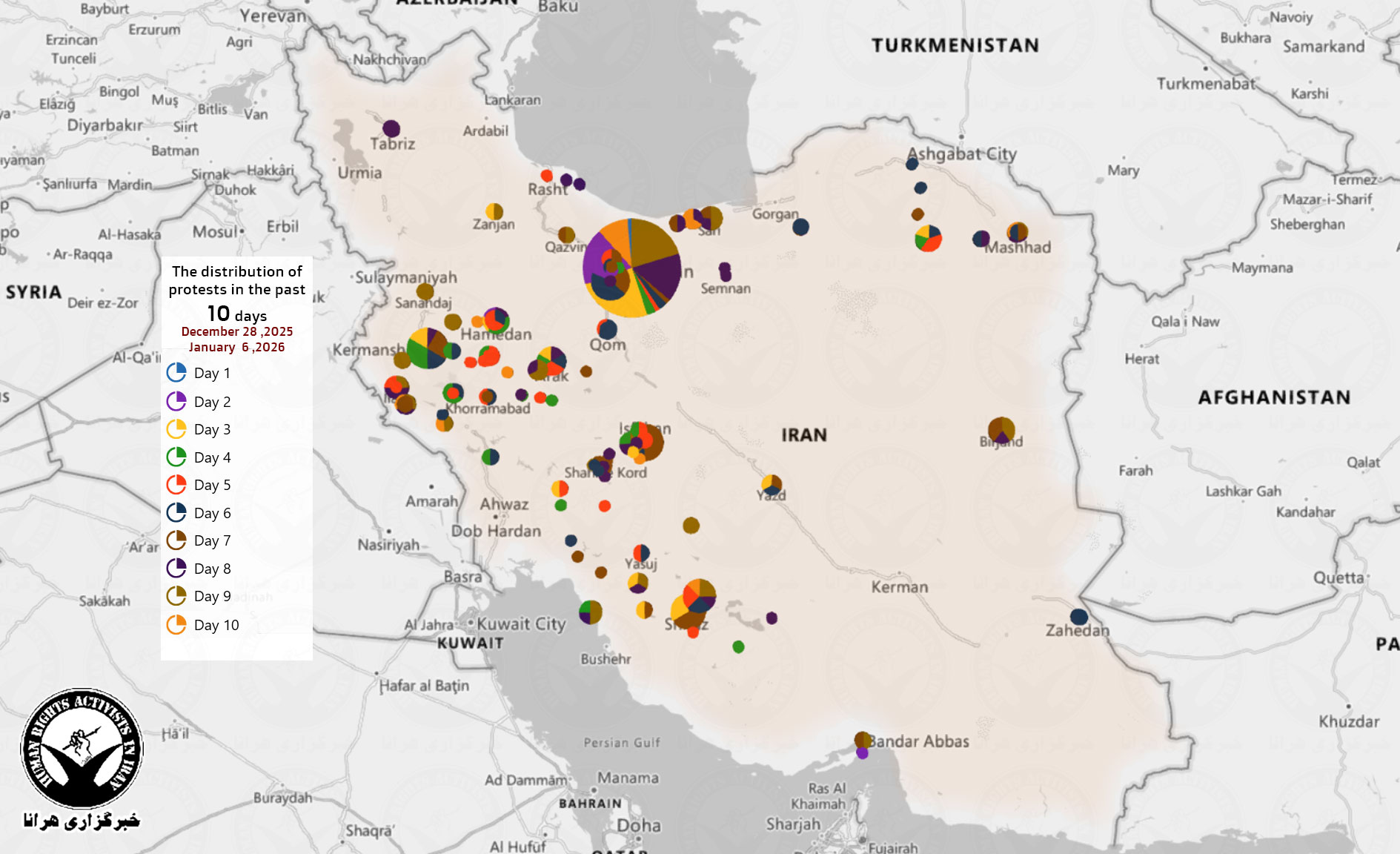
Geography of the Protests

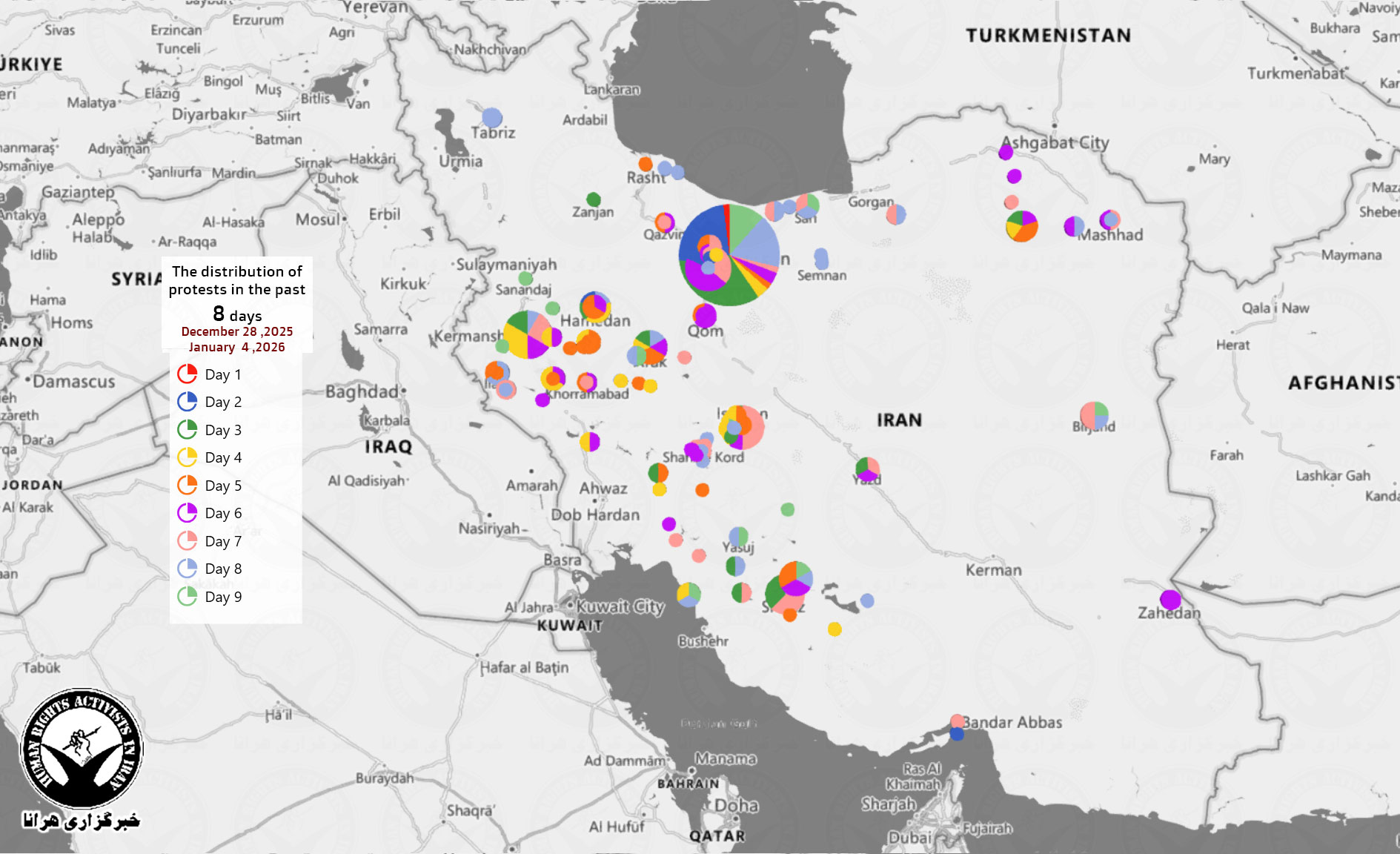
Based on updated and consolidated data, over the past 10 days at least 285 locations across Iran have witnessed protests, street gatherings, or labor strikes. These protest activities have been reported in 27 provinces nationwide, and at the same time, 22 universities have seen protest actions by students.

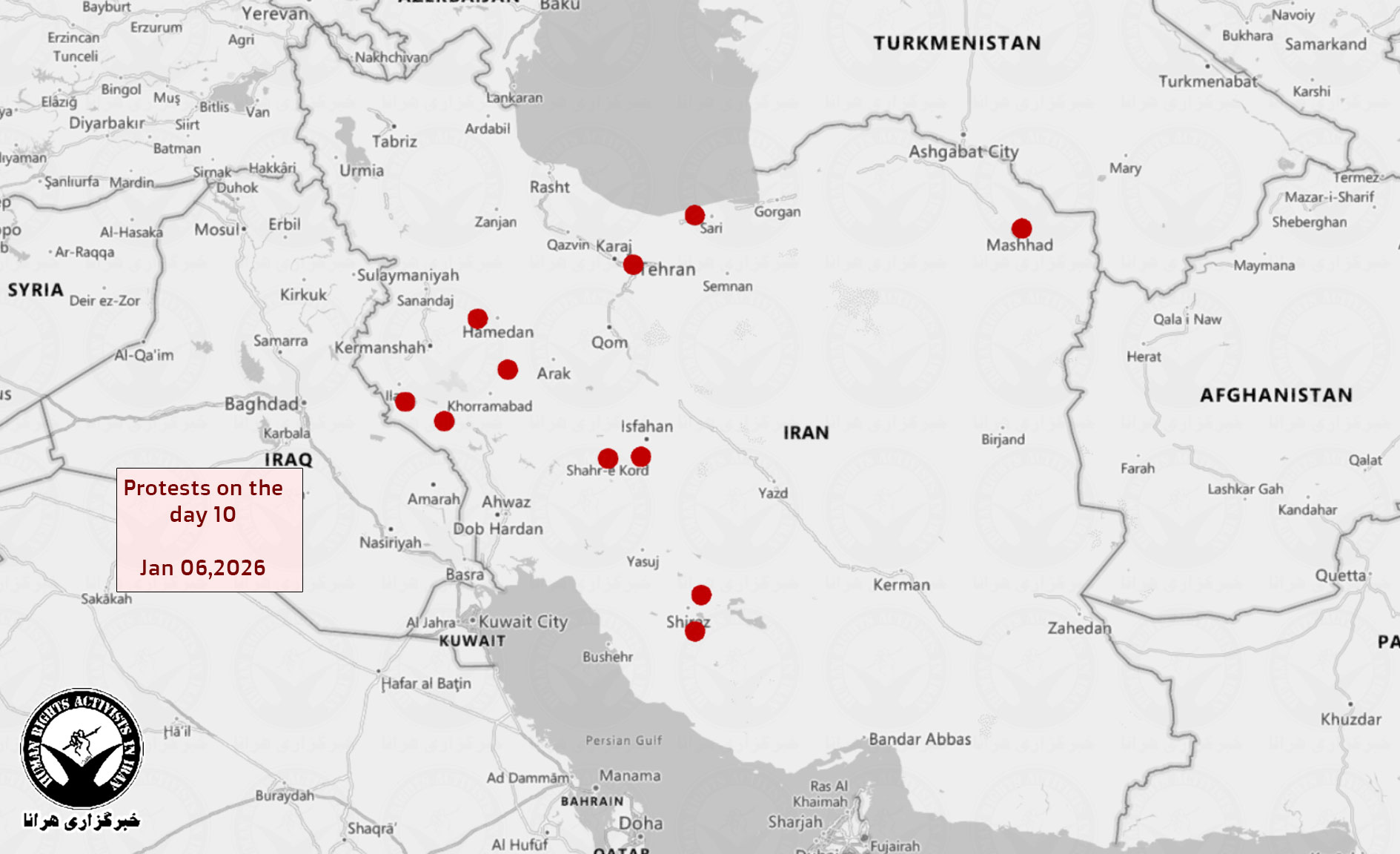
On the tenth day of the protests, demonstrations were held in the cities of Mashhad, Qazvin, Abdanan, Tehran, Shiraz, Bandar Abbas, Zanjan, Ilam, Malekshahi, Shahrekord, Yazdanshahr, Kavar, Asadabad, Babol, Marvdasht, and Borujerd.

One of the most significant protest focal points today in Iran was the demonstrations by bazaar merchants. Today, strikes took place in Tehran’s Grand Bazaar, particularly concentrated in the main corridors, including the gold and currency market, the fabric market, and parts of the footwear and home appliances sections. A considerable number of business units were either fully or partially closed. Reports indicate that this strike emerged spontaneously, without any formal call, and that the main grievances of merchants were sharp currency fluctuations, the surge in gold prices, market stagnation, and the severe decline in purchasing power.

Following the closure of shops, the presence of security and law enforcement forces increased at the entrances to the bazaar and at intersections leading to it, and in some areas the formation of gatherings was prevented. Nevertheless, the strike caused a noticeable disruption to the bazaar’s daily activities and a reduction in customer traffic, and is being assessed as one of the most significant manifestations of the link between street protests and occupational discontent in Tehran.
Forms of Protest and Slogans

A review of verified reports indicates that the protests on the tenth day, similar to previous days, encompassed a wide range of demands. The content of slogans chanted during the gatherings was not limited solely to livelihood and economic issues, but also reflected criticism of governance structures, opposition to restrictions imposed on individual and social freedoms, and demands for justice.

Within the framework of its human rights mandate, HRANA focuses its reporting on slogans and demands that are directly related to violations of, or calls for, human rights, fundamental freedoms, and citizens’ civil rights. The persistence of these demands across various parts of the country points to the depth of public dissatisfaction and the overlap of economic, social, and political grievances within the context of the ongoing protests.

Conduct of Law Enforcement and Security Forces and Details of Violence

On the tenth day of the nationwide protests, reports received by HRANA indicate the continuation of a heavy security atmosphere in various cities across the country. These reports suggest that law enforcement and security forces have continued to use various repressive measures aimed at preventing the formation or expansion of protest gatherings.

Documented instances of the suppression of protests over the past day include the use of pellet guns, deployment of tear gas, and direct attacks on demonstrators.

At the same time, official accounts presented by some local authorities regarding the deaths do not fully align with eyewitness testimonies and unofficial reports. For this reason, details surrounding how these incidents occurred remain under review and subject to further verification.

Deaths and Injuries

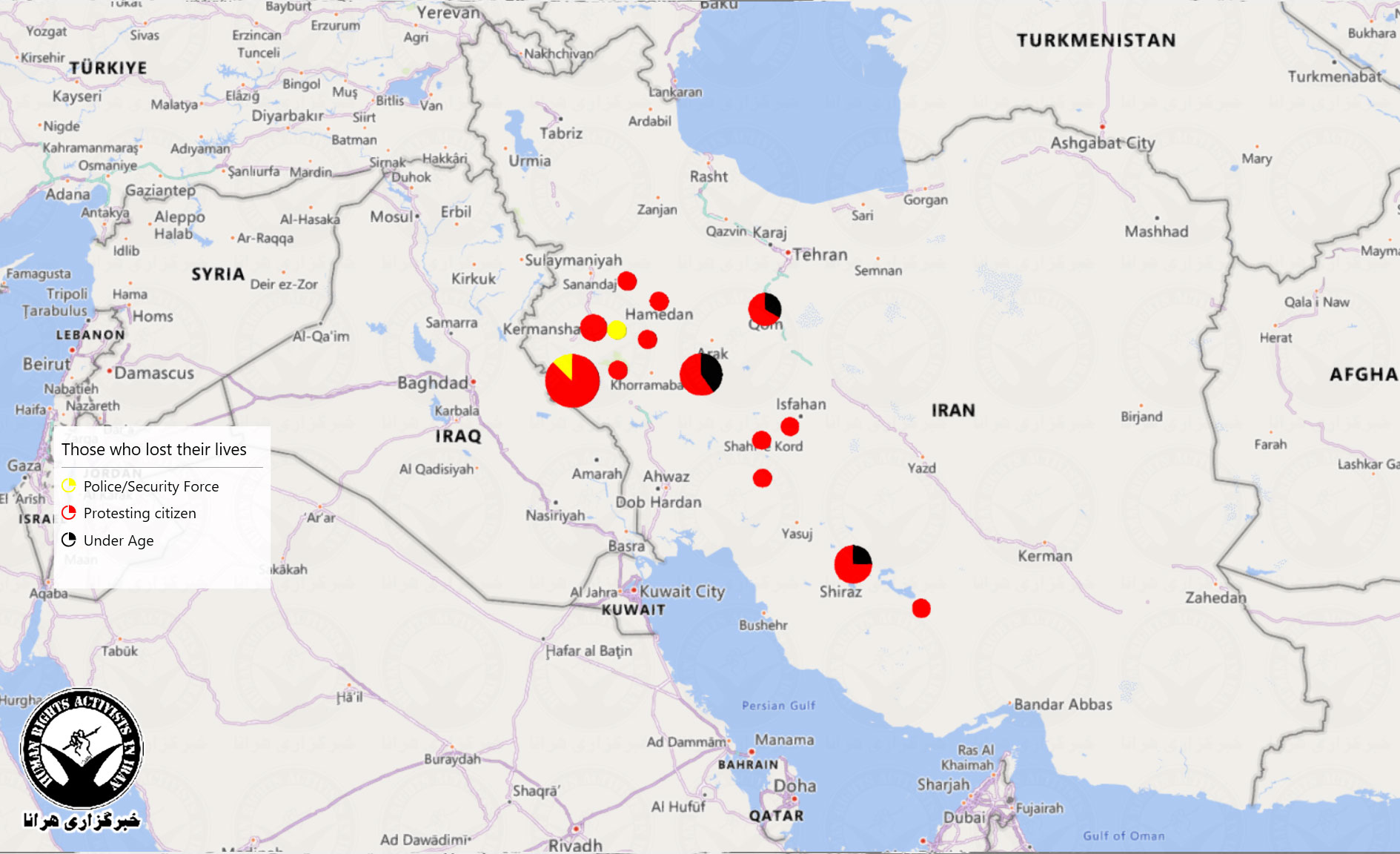
According to HRANA’s updated data, at least 36 people have been confirmed killed during the past ten days of protests. Among them were four individuals under the age of 18, as well as two members of security and law enforcement forces. In addition, dozens of cases of injuries among protesting citizens have been recorded so far. According to reports, these injuries were mostly caused by pellet and plastic bullets.

Over the past 24 hours, HRANA has confirmed the identities of Mohammadreza Karami, (Lieutenant) Ehsan Aghajani, and Ali Golfroosh as individuals killed during the protests.

On the same date, Sadegh Parvizadeh, a wildlife photographer and videographer, announced in a video posted on his Instagram page that he had been struck in the face and eye by pellets during the protests. In part of the video, while showing samples of the pellets fired, he stated: “The person who shot me was a teenager under the age of 20. What occupies my mind is that killing a human being was really like hunting prey or a game to him.”

Tasnim News Agency, which is close to security institutions, reported that based on presented statistics, from the beginning of the protests up to last night, around 568 law enforcement personnel and 66 Basij forces were injured. The outlet further claimed that among them, two were injured by live ammunition, 152 by shotgun pellets, and 11 by knife attacks.
Security Forces’ Raids on Medical Centers: Attacks on Imam Khomeini Hospital in Ilam and Sina Hospital in Tehran

Amid developments in the nationwide protests in Iran, reports indicate that security forces have attacked and entered at least two medical centers in the cities of Ilam and Tehran, incidents that have sparked widespread domestic reactions and heightened concerns over violations of the security of medical facilities and patients’ rights.

Imam Khomeini Hospital, Ilam: Tear Gas in a Treatment Facility

According to published videos and reports, on Saturday evening, January 3, security forces surrounded Imam Khomeini Hospital in Ilam and attempted to arrest a number of protesters injured in Malekshahi who had been transferred there for treatment.

Reports indicate that patients’ families and some medical staff opposed the entry of security forces, leading to verbal and physical altercations. Subsequently, images were released showing tear gas being fired inside the hospital grounds and buildings, an action that created emergency conditions in treatment wards and caused alarm among patients and staff. Eyewitnesses stated that several patients experienced breathing difficulties following the dispersal of tear gas.

In response, the Ministry of Health issued a statement announcing that, by order of the Minister of Health, the matter was being examined “urgently,” emphasizing the need to safeguard the security of medical centers, patients, and healthcare workers. Additionally, by order of Masoud Pezeshkian, the Minister of Interior was tasked with following up on the incident and submitting a report. Meanwhile, Fars News Agency, which is close to the Islamic Revolutionary Guard Corps, confirmed the presence of security forces at the hospital but claimed that some protesters had used the medical facility “to hide.”

Sina Hospital, Tehran: Arrests of the Injured and a Security Atmosphere

Parallel to the events in Ilam, reports published today, Tuesday, January 6, from Tehran indicate that security forces also entered Sina Hospital. According to these reports, a number of protesters injured during demonstrations and transferred to the hospital for treatment were arrested by security forces inside or around the hospital.

Eyewitnesses told media outlets that the presence of security forces on hospital grounds created an atmosphere of fear and disrupted the treatment process, with some families reportedly avoiding medical centers out of fear of arrest.

As of the time of this report, officials have not provided a clear explanation regarding the details of the operation at Sina Hospital.

Arrests

Over the ten days of protests, at least 2,076 protesting citizens have been arrested; however, the actual number of detainees is estimated to be significantly higher.

Of these, 878 individuals were either arrested on the tenth day of protests or had been detained earlier but were confirmed by HRANA today. This includes the transfer of approximately 200 detained women to Kachooie Prison in Karaj and 500 detained men to the Central Prison of Karaj.

Other detained protesters whose identities have been individually confirmed on this day are listed in an appendix at the end of this report.

So far, at least 15 videos of forced confessions by detainees have been broadcast by official media outlets or those close to security institutions, videos for which it remains unclear under what conditions individuals were compelled to confess against themselves.

International Reactions

As nationwide protests continue in Iran and security crackdowns intensify, international reactions and statements have also persisted.

UN Secretary-General António Guterres expressed concern over recent developments in Iran, stating that he was “deeply saddened” by the killing and injury of protesters and stressing the need to prevent further loss of life. He called on Iranian authorities to respect the rights to freedom of expression, assembly, and peaceful protest, and to allow people to express their grievances peacefully.

The Persian-language account of the U.S. State Department on X, referring to yesterday’s raid by security forces on Imam Khomeini Hospital in Ilam, described the action as a “clear crime against humanity” and wrote that hospitals are not battlefields. The statement added that the actions of the Islamic Republic constitute a gross violation of international law and demonstrate a complete disregard for human life.

Amnesty International, condemning the attack by security forces on a hospital in Ilam that was being used to treat or shelter injured protesters, described the incident as a clear violation of international law. The organization emphasized that the attack once again shows how far Iranian authorities are willing to go to suppress protests and silence dissent.

Reaction of Iranian Government Officials

In response to U.S. warnings, Iran’s Ministry of Foreign Affairs described these positions as “psychological warfare” and sought to frame them as part of a media and external pressure campaign.

The most significant focal point of domestic reactions on the tenth day was the release of a video showing security forces raiding Imam Khomeini Hospital in Ilam, an incident highlighted as a sensitive turning point in media coverage. According to accounts, protesters injured in Malekshahi had been transferred to the hospital, after which the facility was surrounded. Security forces attempted to enter and arrest some of the injured but faced resistance from families and medical staff. Subsequently, images emerged showing tear gas being fired inside the hospital building.

In response, the Ministry of Health issued a statement announcing that the matter was under serious review “by explicit order of the Minister of Health” and would be pursued “within the framework of the law,” emphasizing the security of medical centers, patients’ rights, and support for healthcare workers.

At the same time, Masoud Pezeshkian ordered an investigation into the incident, and according to BBC reports, Eskandar Momeni (Minister of Interior) assigned a delegation to follow up and submit a report.

On the political and economic front, Masoud Pezeshkian, speaking at an official ceremony in an unusually candid tone, placed responsibility for the current situation on the governing structure, stating that “the parliament and the government together have brought the country to this point,” and emphasizing that “we are all to blame.” This stance was reflected in coverage of the tenth day as a sign of social pressure and a crisis of governance.

In contrast, media outlets close to the Islamic Revolutionary Guard Corps, including Fars News Agency (as reported by the BBC), confirmed the presence of security forces at the hospital but claimed that protesters had used the hospital as a “stronghold”, a narrative aimed at justifying and reframing the security forces’ actions.

Meanwhile, the public and revolutionary prosecutor of Shahrod stated that protesters’ voices should be heard, but warned that those who engage in what he described as “rioting” would face the law.

Domestic Reactions (Civil Society, Labor Groups, and Public Figures)

Alongside official reactions, part of the tenth day’s responses included expressions of solidarity from artists, as well as supportive actions abroad.

The Teachers’ Trade Association of Aligudarz issued a statement in support of the recent protests, declaring that the expansion of poverty, corruption, discrimination, special privileges, unemployment, and runaway inflation has pushed society to a point of despair and anger. The statement noted that the loss of hope for the future has turned employment, marriage, and housing into unattainable dreams for young people, creating a generation with nothing left to lose. According to the association, despite all the risks, protesters have courageously put their lives and health on the line to voice their demands in the streets.

Continuing reactions from sports and cultural figures, Mohammad Khakpour, former captain of Iran’s national football team, criticized labeling protesters as “rioters,” writing that people crushed by inflation, unemployment, and insecurity cannot be silenced with a label. Ali Ghamsari, a musician and composer, described the protests as stemming from poverty and hardship, emphasizing that they are rooted in concern for the country and a sense of social responsibility. Alireza Haghighi, former national team goalkeeper, also shared a message stating that protesting is not a crime—the real crime is not listening to the people’s voices.

Ali Daei, a legendary Iranian footballer, criticized the economic situation, saying that the sharp rise in the dollar exchange rate shows officials have become disconnected from the people’s suffering, and stressed that nothing can replace the people of Iran. Pantea Bahram, a theater and film actress, also expressed solidarity with protesting bazaar merchants and announced that she was joining the strikes. Alireza Ghorbani, a traditional music singer, citing the country’s current conditions and the hardships imposed on the people, announced the postponement of his “Iranam” concert in Tabriz and other upcoming performances, stating that holding concerts at this time does not align with the public mood.

Individually Identified Arrests on the Tenth Day

  1. 1. Amin Yousefi – City of arrest: Ilam – Place of detention: Unknown – Current status: Detained – Source: Kurdpa

  2. 2. Amirhossein Ta’mirkari – City of arrest: Ilam – Place of detention: Unknown – Current status: Detained – Source: Kurdpa

  3. 3. Reza Dousti-Nejad – City of arrest: Ilam – Place of detention: Unknown – Current status: Detained – Source: Kurdpa – Notable detail: 17-year-old minor

  4. 4. Artin Sohrabi – City of arrest: Ilam – Place of detention: Unknown – Current status: Detained – Source: Kurdpa – Notable detail: 17-year-old minor

  5. 5. Amir Ali Abdian – City of arrest: Ilam – Place of detention: Unknown – Current status: Detained – Source: Kurdpa – Notable detail: 16-year-old minor

  6. 6. Firooz Faraji – City of arrest: Ilam – Place of detention: Unknown – Current status: Detained – Source: Kurdpa

  7. 7. Mohammad Sadra Mansouri – City of arrest: Ilam – Place of detention: Unknown – Current status: Detained – Source: Kurdpa

  8. 8. Alireza Paryab – City of arrest: Dehloran – Place of detention: Unknown – Current status: Detained – Source: Kurdpa

  9. 9. Mohammad Amin Mahmoudian – City of arrest: Sarableh – Place of detention: Unknown – Current status: Detained – Source: Kurdpa

  10. 10. Mohammad Amin Mahmoudian – City of arrest: Sarableh – Place of detention: Unknown – Current status: Detained – Source: Kurdpa

  11. 11. Mohammadhossein Moradi – City of arrest: Sarableh – Place of detention: Unknown – Current status: Detained – Source: Kurdpa

  12. 12. Ahmadreza Mohammadian – City of arrest: Karzan – Place of detention: Unknown – Current status: Detained – Source: Kurdpa

  13. 13. Arman Dadfar – City of arrest: Badreh – Place of detention: Unknown – Current status: Detained – Source: Kurdpa

  14. 14. Milad Seyed Moradi – City of arrest: Dehloran – Place of detention: Unknown – Current status: Detained – Source: Kurdpa

  15. 15. Misagh Seyed Moradi – City of arrest: Dehloran – Place of detention: Unknown – Current status: Detained – Source: Kurdpa

  16. 16. Mehdi Hatami – City of arrest: Yasuj – Place of detention: Unknown – Current status: Detained – Source: HRANA

  17. 17. Shahin Yousefi – City of arrest: Yasuj – Place of detention: Unknown – Current status: Detained – Source: HRANA

  18. 18. Ali Ahmadi – City of arrest: Yasuj – Place of detention: Unknown – Current status: Detained – Source: HRANA

  19. 19. Hossein Ahmadi – City of arrest: Yasuj – Place of detention: Unknown – Current status: Detained – Source: HRANA

  20. 20. Afshin Najafi – City of arrest: Yasuj – Place of detention: Unknown – Current status: Detained – Source: HRANA

  21. 21. Ramin Mohammadi – City of arrest: Yasuj – Place of detention: Unknown – Current status: Detained – Source: HRANA

  22. 22. Mohammadreza Heidari – City of arrest: Yasuj – Place of detention: Unknown – Current status: Detained – Source: HRANA – Notable detail: 17-year-old minor

  23. 23. Saha Ilbeigi – City of arrest: Tehran – Place of detention: Unknown – Current status: Detained – Source: Amirkabir Newsletter – Notable detail: Student

  24. 24. Sheida Namjoo – City of arrest: Birjand – Place of detention: The Ministry of Intelligence’s detention facility – Current status: Detained – Source: Amirkabir Newsletter – Notable detail: Student

  25. 25. Zeynab Ivani – City of arrest: Birjand – Place of detention: The Ministry of Intelligence’s detention facility – Current status: Detained – Source: Amirkabir Newsletter – Notable detail: Student

  26. 26. Faizeh Shamaili – City of arrest: Sonqor – Place of detention: Unknown – Current status: Detained – Source: Kurdpa

  27. 27. Javad Estavari – City of arrest: Darreh Shahr – Place of detention: Unknown – Current status: Detained – Source: Kurdpa

  28. 28. Ehsan Vineh – City of arrest: Kermanshah – Place of detention: Unknown – Current status: Detained – Source: HRANA

  29. 29. Abolfazl Dorqaidi – City of arrest: Yasuj – Place of detention: Unknown – Current status: Detained – Source: HRANA

  30. 30. Abolfazl Khoshnood – City of arrest: Yasuj – Place of detention: Unknown – Current status: Detained – Source: HRANA

  31. 31. Abolfazl Rahimi – City of arrest: Yasuj – Place of detention: Unknown – Current status: Detained – Source: HRANA

  32. 32. Abolfazl Sharifi – City of arrest: Yasuj – Place of detention: Unknown – Current status: Detained – Source: HRANA

  33. 33. Abolfazl Oshal – City of arrest: Yasuj – Place of detention: Unknown – Current status: Detained – Source: HRANA

  34. 34. Ahmadreza Khaleghipour – City of arrest: Yasuj – Place of detention: Unknown – Current status: Detained – Source: HRANA

  35. 35. Amin Ezzati – City of arrest: Yasuj – Place of detention: Unknown – Current status: Detained – Source: HRANA

  36. 36. Amir Mohammad Bakhtiari – City of arrest: Yasuj – Place of detention: Unknown – Current status: Detained – Source: HRANA

  37. 37. Amirhossein Rahi – City of arrest: Yasuj – Place of detention: Unknown – Current status: Detained – Source: HRANA

  38. 38. Amirhossein Karimi-Pour – City of arrest: Yasuj – Place of detention: Unknown – Current status: Detained – Source: HRANA

  39. 39. Omid Mohammadpour – City of arrest: Yasuj – Place of detention: Unknown – Current status: Detained – Source: HRANA

  40. 40. Omid Mohammadpour – City of arrest: Yasuj – Place of detention: Unknown – Current status: Detained – Source: HRANA

  41. 41. Arya Samsami – City of arrest: Yasuj – Place of detention: Unknown – Current status: Detained – Source: HRANA

  42. 42. Anahita Hekmatinia – City of arrest: Yasuj – Place of detention: Unknown – Current status: Detained – Source: HRANA

  43. 43. Ainaz Parvaneh – City of arrest: Yasuj – Place of detention: Unknown – Current status: Detained – Source: HRANA

  44. 44. Behnam Armoon – City of arrest: Yasuj – Place of detention: Unknown – Current status: Detained – Source: HRANA

  45. 45. Benyamin Arshadi – City of arrest: Yasuj – Place of detention: Unknown – Current status: Detained – Source: HRANA

  46. 46. Parisa Mousavi – City of arrest: Yasuj – Place of detention: Unknown – Current status: Detained – Source: HRANA

  47. 47. Parichehr Ansari – City of arrest: Yasuj – Place of detention: Unknown – Current status: Detained – Source: HRANA

  48. 48. Hamid Jahanbazian – City of arrest: Yasuj – Place of detention: Unknown – Current status: Detained – Source: HRANA

  49. 49. Hadis Sheybaz – City of arrest: Yasuj – Place of detention: Unknown – Current status: Detained – Source: HRANA

  50. 50. Hossein Aghajani – City of arrest: Yasuj – Place of detention: Unknown – Current status: Detained – Source: HRANA

  51. 51. Hossein Haghigh-Mofrad – City of arrest: Yasuj – Place of detention: Unknown – Current status: Detained – Source: HRANA

  52. 52. Hossein Hosseini – City of arrest: Yasuj – Place of detention: Unknown – Current status: Detained – Source: HRANA

  53. 53. Hossein Khajehyar – City of arrest: Yasuj – Place of detention: Unknown – Current status: Detained – Source: HRANA

  54. 54. Hossein Sousanzadeh – City of arrest: Yasuj – Place of detention: Unknown – Current status: Detained – Source: HRANA

  55. 55. Davoud Zarghami – City of arrest: Yasuj – Place of detention: Unknown – Current status: Detained – Source: HRANA

  56. 56. Diana Moradian – City of arrest: Yasuj – Place of detention: Unknown – Current status: Detained – Source: HRANA

  57. 57. Reza Farhadi Sisakht – City of arrest: Yasuj – Place of detention: Unknown – Current status: Detained – Source: HRANA

  58. 58. Reza Nourian – City of arrest: Yasuj – Place of detention: Unknown – Current status: Detained – Source: HRANA

  59. 59. Reyhaneh Pourkaram – City of arrest: Yasuj – Place of detention: Unknown – Current status: Detained – Source: HRANA

  60. 60. Saman Akbari – City of arrest: Yasuj – Place of detention: Unknown – Current status: Detained – Source: HRANA

  61. 61. Sanaz Davoudi – City of arrest: Yasuj – Place of detention: Unknown – Current status: Detained – Source: HRANA

  62. 62. Setayesh Ansari – City of arrest: Yasuj – Place of detention: Unknown – Current status: Detained – Source: HRANA

  63. 63. Soroush Amini – City of arrest: Yasuj – Place of detention: Unknown – Current status: Detained – Source: HRANA

  64. 64. Samira Karimi-Pour – City of arrest: Yasuj – Place of detention: Unknown – Current status: Detained – Source: HRANA

  65. 65. Sima Sajjadi – City of arrest: Yasuj – Place of detention: Unknown – Current status: Detained – Source: HRANA

  66. 66. Shayan Mohedian – City of arrest: Yasuj – Place of detention: Unknown – Current status: Detained – Source: HRANA

  67. 67. Shahab Asadi – City of arrest: Yasuj – Place of detention: Unknown – Current status: Detained – Source: HRANA

  68. 68. Shahab Parand – City of arrest: Yasuj – Place of detention: Unknown – Current status: Detained – Source: HRANA

  69. 69. Shahram Omrani – City of arrest: Yasuj – Place of detention: Unknown – Current status: Detained – Source: HRANA

  70. 70. Shahreh Nigh-Eghbal – City of arrest: Yasuj – Place of detention: Unknown – Current status: Detained – Source: HRANA

  71. 71. Shima Khorshidian – City of arrest: Yasuj – Place of detention: Unknown – Current status: Detained – Source: HRANA

  72. 72. Sheghayegh Zahedi – City of arrest: Yasuj – Place of detention: Unknown – Current status: Detained – Source: HRANA

  73. 73. Taha Kazemi – City of arrest: Yasuj – Place of detention: Unknown – Current status: Detained – Source: HRANA

  74. 74. Abbas Varestegi – City of arrest: Yasuj – Place of detention: Unknown – Current status: Detained – Source: HRANA

  75. 75. Erfan Bazdan – City of arrest: Yasuj – Place of detention: Unknown – Current status: Detained – Source: HRANA

  76. 76. Ghorfan Rahman-Pour – City of arrest: Yasuj – Place of detention: Unknown – Current status: Detained – Source: HRANA

  77. 77. Ghazal Hamzeh Amaleh – City of arrest: Yasuj – Place of detention: Unknown – Current status: Detained – Source: HRANA

  78. 78. Fatemeh Mousa-Pour – City of arrest: Yasuj – Place of detention: Unknown – Current status: Detained – Source: HRANA

  79. 79. Farzad Foroughi – City of arrest: Yasuj – Place of detention: Unknown – Current status: Detained – Source: HRANA

  80. 80. Farnoush Azar – City of arrest: Yasuj – Place of detention: Unknown – Current status: Detained – Source: HRANA

  81. 81. Farid Alizadeh – City of arrest: Yasuj – Place of detention: Unknown – Current status: Detained – Source: HRANA

  82. 82. Farid Hatami-Pour – City of arrest: Yasuj – Place of detention: Unknown – Current status: Detained – Source: HRANA

  83. 83. Mahan Mahmoudi – City of arrest: Yasuj – Place of detention: Unknown – Current status: Detained – Source: HRANA

  84. 84. Mohammad Abdollah-Pour – City of arrest: Yasuj – Place of detention: Unknown – Current status: Detained – Source: HRANA

  85. 85. Mohammad Ravansalar – City of arrest: Yasuj – Place of detention: Unknown – Current status: Detained – Source: HRANA

  86. 86. Mohammad Mehdi Alipour – City of arrest: Yasuj – Place of detention: Unknown – Current status: Detained – Source: HRANA

  87. 87. Mohammad Hormoz-Pour – City of arrest: Yasuj – Place of detention: Unknown – Current status: Detained – Source: HRANA

  88. 88. Mehrdad Shaban-Nejad – City of arrest: Yasuj – Place of detention: Unknown – Current status: Detained – Source: HRANA

  89. 89. Mahshid Mousa-Pour – City of arrest: Yasuj – Place of detention: Unknown – Current status: Detained – Source: HRANA

  90. 90. Mohaddeseh Mohammadi – City of arrest: Yasuj – Place of detention: Unknown – Current status: Detained – Source: HRANA

  91. 91. Mojgan Forouzan – City of arrest: Yasuj – Place of detention: Unknown – Current status: Detained – Source: HRANA

  92. 92. Milad Karimi – City of arrest: Yasuj – Place of detention: Unknown – Current status: Detained – Source: HRANA

  93. 93. Neda Ahmadi – City of arrest: Yasuj – Place of detention: Unknown – Current status: Detained – Source: HRANA

  94. 94. Yasin Mohammadi – City of arrest: Yasuj – Place of detention: Unknown – Current status: Detained – Source: HRANA

  95. 95. Yalda Pezhvani – City of arrest: Yasuj – Place of detention: Unknown – Current status: Detained – Source: HRANA

  96. 96. Zahra Darfarin – City of arrest: Yasuj – Place of detention: Unknown – Current status: Detained – Source: HRANA

  97. 97. Zohreh Dejman – City of arrest: Yasuj – Place of detention: Unknown – Current status: Detained – Source: HRANA

  98. 98. Alireza Sadeghi – City of arrest: Yasuj – Place of detention: Unknown – Current status: Detained – Source: HRANA

  99. 99. Ali-Asghar Farhadi – City of arrest: Yasuj – Place of detention: Unknown – Current status: Detained – Source: HRANA

  100. 100. Emad Dashtban – City of arrest: Yasuj – Place of detention: Unknown – Current status: Detained – Source: HRANA

  101. 101. Javad Javadpour – City of arrest: Yasuj – Place of detention: Unknown – Current status: Detained – Source: HRANA

  102. 102. Saeid Deil – City of arrest: Yasuj – Place of detention: Unknown – Current status: Detained – Source: HRANA

  103. 103. Sina Dana – City of arrest: Yasuj – Place of detention: Unknown – Current status: Detained – Source: HRANA

  104. 104. Abolfazl Khodadi – City of arrest: Yasuj – Place of detention: Unknown – Current status: Detained – Source: HRANA

  105. 105. Saber Vafaei – City of arrest: Yasuj – Place of detention: Unknown – Current status: Detained – Source: HRANA

  106. 106. Kiarash Afshanandeh – City of arrest: Yasuj – Place of detention: Unknown – Current status: Detained – Source: HRANA

  107. 107. Hamid Dadras – City of arrest: Yasuj – Place of detention: Unknown – Current status: Detained – Source: HRANA

  108. 108. Mehrdad Kamayi – City of arrest: Dehdasht – Place of detention: Unknown – Current status: Detained – Source: HRANA

  109. 109. Sadegh Bazkar – City of arrest: Dehdasht – Place of detention: Unknown – Current status: Detained – Source: HRANA

  110. 110. Mohammad Miri – City of arrest: Gachsaran – Place of detention: Unknown – Current status: Detained – Source: HRANA

  111. 111. Qasem Mahmoudi – City of arrest: Gachsaran – Place of detention: Unknown – Current status: Detained – Source: HRANA

  112. 112. Nazgol Mahmoudi – City of arrest: Gachsaran – Place of detention: Unknown – Current status: Detained – Source: HRANA

  113. 113. Mehraneh Mousavi-Pour – City of arrest: Gachsaran – Place of detention: Unknown – Current status: Detained – Source: HRANA

  114. 114. Kianoush Noshadi – City of arrest: Gachsaran – Place of detention: Unknown – Current status: Detained – Source: HRANA

  115. 115. Maryam Nezha Sobhani – City of arrest: Yazdanshahr – Place of detention: Unknown – Current status: Detained – Source: HRANA – Notable detail: Minor (under 18)

  116. 116. Sogand Soleimani – City of arrest: Yazdanshahr – Place of detention: Unknown – Current status: Detained – Source: HRANA – Notable detail: Minor (under 18)

  117. 117. Negar Ghorbani – City of arrest: Yazdanshahr – Place of detention: Unknown – Current status: Detained – Source: HRANA – Notable detail: Minor (under 18)

  118. 118. Javid Mour – City of arrest: Yazdanshahr – Place of detention: Unknown – Current status: Detained – Source: HRANA – Notable detail: Minor (under 18)

  119. 119. Saeid Soleimani – City of arrest: Yazdanshahr – Place of detention: Unknown – Current status: Detained – Source: HRANA – Notable detail: Minor (under 18)

  120. 120. Pejman Khajouei-Nia – City of arrest: Yazdanshahr – Place of detention: Unknown – Current status: Detained – Source: HRANA – Notable detail: Minor (under 18)

  121. 121. Seyed Kazem Hosseini – City of arrest: Yazdanshahr – Place of detention: Unknown – Current status: Detained – Source: HRANA – Notable detail: Minor (under 18)

  122. 122. Mehri Alghasemi – City of arrest: Yazdanshahr – Place of detention: Unknown – Current status: Detained – Source: HRANA – Notable detail: Minor (under 18)

  123. 123. Amir Mohammad Mansouri – City of arrest: Yazdanshahr – Place of detention: Unknown – Current status: Detained – Source: HRANA – Notable detail: Minor (under 18)

  124. 124. Ali-Asghar Tabouhi – City of arrest: Yazdanshahr – Place of detention: Unknown – Current status: Detained – Source: HRANA – Notable detail: Minor (under 18)

  125. 125. Arsalan Bakhtiarvand – City of arrest: Yazdanshahr – Place of detention: Unknown – Current status: Detained – Source: HRANA – Notable detail: Minor (under 18)

  126. 126. Alireza Mari – City of arrest: Yazdanshahr – Place of detention: Unknown – Current status: Detained – Source: HRANA – Notable detail: Minor (under 18)

  127. 127. Zabihollah Limoochi – City of arrest: Yazdanshahr – Place of detention: Unknown – Current status: Detained – Source: HRANA – Notable detail: Minor (under 18)

  128. 128. Abolfazl Rahimi – City of arrest: Yazdanshahr – Place of detention: Unknown – Current status: Detained – Source: HRANA – Notable detail: Minor (under 18)

  129. 129. Amirhossein Sani – City of arrest: Yazdanshahr – Place of detention: Unknown – Current status: Detained – Source: HRANA – Notable detail: Minor (under 18)

  130. 130. Elaheh Moghaddasi – City of arrest: Yazdanshahr – Place of detention: Unknown – Current status: Detained – Source: HRANA – Notable detail: Minor (under 18)

  131. 131. Amir Abbas Homayouni – City of arrest: Yazdanshahr – Place of detention: Unknown – Current status: Detained – Source: HRANA – Notable detail: Minor (under 18)

  132. 132. Narges Abdollahi – City of arrest: Yazdanshahr – Place of detention: Unknown – Current status: Detained – Source: HRANA – Notable detail: Minor (under 18)

  133. 133. Younes Mari – City of arrest: Yazdanshahr – Place of detention: Unknown – Current status: Detained – Source: HRANA – Notable detail: Minor (under 18)

  134. 134. Mohammad Dousti – City of arrest: Yazdanshahr – Place of detention: Unknown – Current status: Detained – Source: HRANA – Notable detail: Minor (under 18)

  135. 135. Mohammad Javad Dousti – City of arrest: Yazdanshahr – Place of detention: Unknown – Current status: Detained – Source: HRANA – Notable detail: Minor (under 18)

  136. 136. Khadijeh Beigi – City of arrest: Yazdanshahr – Place of detention: Unknown – Current status: Detained – Source: HRANA – Notable detail: Minor (under 18)

  137. 137. Hamidreza Saadati – City of arrest: Mashhad – Place of detention: Unknown – Current status: Detained – Source: HRANA

  138. 138. Morteza Kamel – City of arrest: Mashhad – Place of detention: Unknown – Current status: Detained – Source: HRANA

  139. 139. Mojtaba Fekri – City of arrest: Mashhad – Place of detention: Unknown – Current status: Detained – Source: HRANA

  140. 140. Ehsan Seyfouri – City of arrest: Sonqor – Place of detention: Unknown – Current status: Detained – Source: Kurdpa

  141. 141. Amir Farhadi – City of arrest: Sonqor – Place of detention: Unknown – Current status: Detained – Source: Kurdpa

  142. 142. Mehdi Bagheri – City of arrest: Sonqor – Place of detention: Unknown – Current status: Detained – Source: Kurdpa

  143. 143. Bahar Rafiei – City of arrest: Sonqor – Place of detention: Unknown – Current status: Detained – Source: Kurdpa

  144. 144. Asal Begvand – City of arrest: Sonqor – Place of detention: Unknown – Current status: Detained – Source: Kurdpa

  145. 145. Yasin Hashemian – City of arrest: Sonqor – Place of detention: Unknown – Current status: Detained – Source: Kurdpa

  146. 146. Alireza Abdi – City of arrest: Sonqor – Place of detention: Unknown – Current status: Detained – Source: Kurdpa

  147. 147. Sahar Rezadoust – City of arrest: Zanjan – Place of detention: Unknown – Current status: Detained – Source: Amirkabir Newsletter

  148. 148. Dina Salari – City of arrest: Sonqor – Place of detention: Unknown – Current status: Detained – Source: Kurdpa

  149. 149. Homayoun Eftekhariannia – City of arrest: Tehran – Place of detention: Unknown – Current status: Detained – Source: HRANA

  150. 150. Mohammad Salehi – City of arrest: Hamedan – Place of detention: Unknown – Current status: Detained – Source: HRANA – Notable detail: Student

  151. 151. Raheleh Zardkouhi – City of arrest: Mashhad – Place of detention: Unknown – Current status: Detained – Source: HRANA

  152. 152. Hashem Amini – City of arrest: Mashhad – Place of detention: Unknown – Current status: Detained – Source: HRANA


Collective or Unidentified Arrests on the Tenth Day: Based on Media Reports or HRANA Field Investigations

  1. 1. According to domestic media reports, at least eight citizens were arrested individually or in groups in the cities of Zarqan (Fars Province), Shahrud (Semnan Province), Bushehr, Bojnurd, Dezful, and Baharestan in Tehran Province.

  2. 2. The arrest of 200 women and their transfer to Kachooie Prison in Karaj.

  3. 3. The arrest of 500 individuals and their transfer to the Central Prison of Karaj.

  4. 4. The arrest of 10 individuals in Mazandaran Province.

  5. 5. The arrest of one individual in Tonekabon.

In Conclusion

The ongoing protests, which initially began in Tehran’s Grand Bazaar, have entered their tenth day marked by geographical expansion, increased public participation, and an intensified presence of security forces. The combination of livelihood-related and political demands, the rising number of arrests, and authorities’ efforts to simultaneously contain the crisis through economic and security measures indicate the high level of sensitivity within the ruling establishment regarding the continuation of these protests.

HRANA continues to collect, verify, and complete information related to these protests and will publish supplementary reports should the gatherings persist or expand.

Detailed Report on the Ninth Day of Protests: More Than 1,200 Protesters Arrested

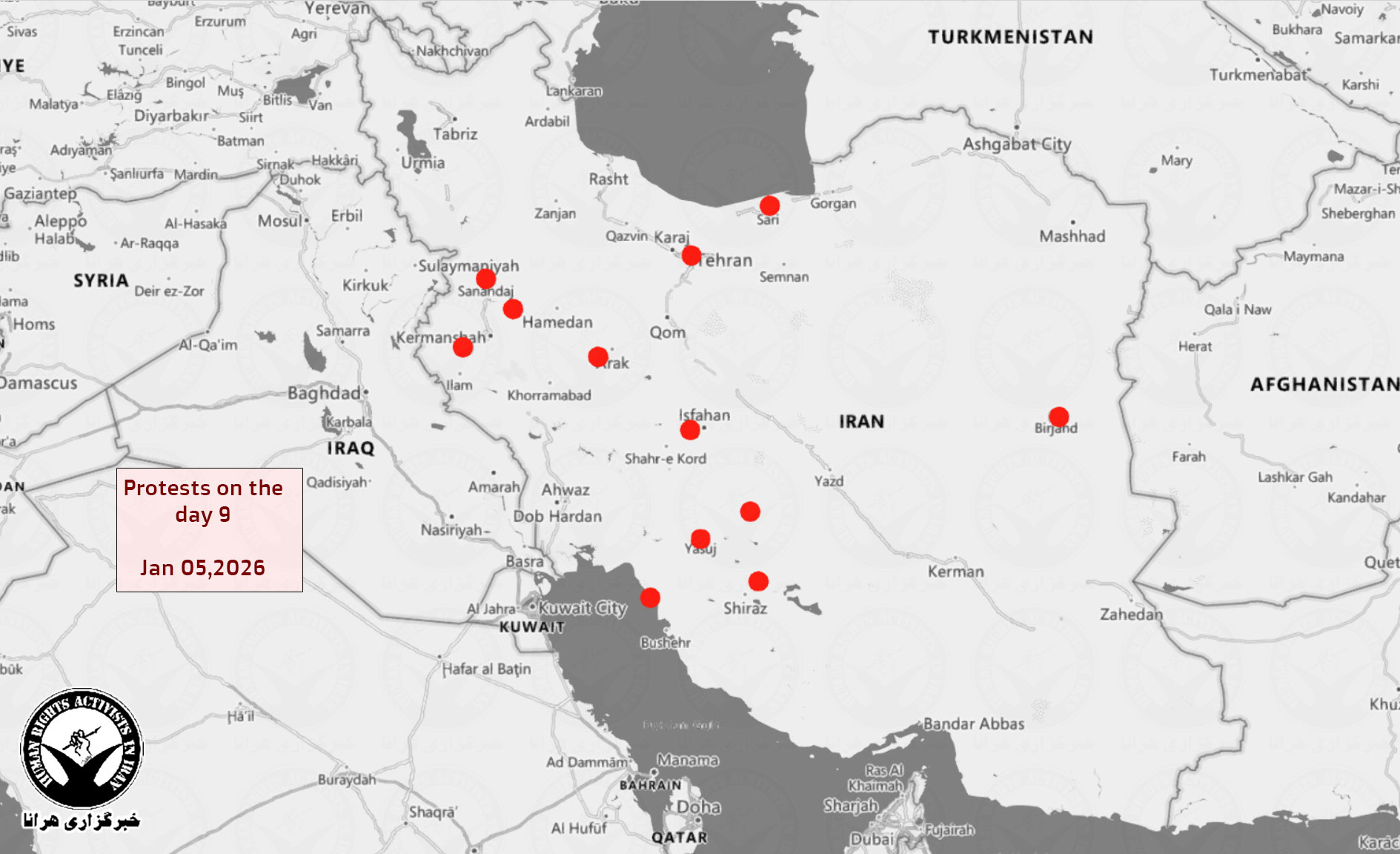
HRANA – For the ninth consecutive day, protests and strikes continued across numerous cities in Iran. Analysis of collected and verified data shows that despite an increasingly securitized environment, the expanded presence of law enforcement and security forces, ongoing street-level confrontations, and the use of live ammunition in some areas, the geographic scope of the protests has not diminished. On the contrary, diverse forms of protest activity have persisted nationwide. In recent days, at least 257 locations in 88 cities across 27 provinces have witnessed protest gatherings. During this period, at least 1,203 citizens were arrested, and at least 29 protesters lost their lives.

Protests that initially took shape in the form of strikes and labor-related gatherings entered a new phase on the ninth consecutive day. Alongside the continuation of some labor actions, street protests and student demonstrations at several universities have also been reported.

Background to the Protests

The protests emerged in a context where economic pressures on broad segments of society have reached a critical stage, and clear signs of disruption in the cycle of daily livelihoods are visible. Repeated surges in exchange rates, prolonged market instability, and the continuous decline in purchasing power have darkened and rendered unpredictable the economic outlook for households and trade activists alike, turning financial insecurity into a widespread experience.

In the days leading up to the start of the protests, reports indicated that exchange rates had crossed new thresholds, alongside a downturn in the capital market and capital outflows. Analysts have interpreted this trend as a shift of liquidity toward safer markets such as gold and foreign currency, and a decline in public trust in economic policies. At the grassroots level, the consequences have included the closure or partial shutdown of trade units, increasing difficulty in sustaining small businesses, and the spread of protest and strike waves in various cities, protests rooted not in a single short-term factor, but in the long-term accumulation of livelihood pressures and the erosion of hope for improved conditions.

Geography of the Protests

Based on updated and aggregated information, at least 257 locations across Iran have witnessed protests, street gatherings, or labor strikes in recent days. These protest activities have been reported in 27 provinces nationwide, and during the same period, 17 universities have also seen student-led protest actions.

Over the past 24 hours, reports have been received of protest gatherings in the cities of Ilam, Arak, Hamedan, Amol, Lahijan, Malekshahi, Semnan, Shalamzar, Bojnord, Babol, Koushk, Yasuj, Parand, Tehran, Asgharabad, Bandar Ganaveh, Marvdasht, Najafabad, Abadeh, Eslamabad-e Gharb, Sanandaj, Sari, Farsan, Shandiz, Sonqor, and Birjand.

An examination of the geographic pattern of the protests indicates that these activities have not been limited to major metropolitan areas, but have also extended to smaller cities and various regions across the country. This reflects the increasingly widespread nature of the protests and the participation of diverse social groups in the protest movement.

Methods of Protest and Slogans

Verified reports indicate that the protests on the ninth day, similar to previous days, encompassed a diverse range of demands. Slogans voiced during gatherings went beyond livelihood and economic grievances, also including criticism of governance, objections to restrictions on individual and social freedoms, and calls for justice.

Within the framework of its human rights mission, HRANA focuses its reporting on slogans and demands that are directly related to violations of human rights or the pursuit of fundamental freedoms and civil rights. The persistence of these demands across different parts of the country reflects the depth of public discontent and the overlap of economic, social, and political grievances within the ongoing protests.

Conduct of Law Enforcement–Security Forces and Details of Violence

On the ninth day of nationwide protests, reports and videos received by HRANA continue to indicate the persistence of a heavy security atmosphere and the use of repressive measures by law enforcement and security forces to prevent the formation or expansion of protest gatherings. Reports from various cities document violent crackdown, gunfire, the use of tear gas, and the arrest of protesters.

On the ninth day of protests, at least four videos of forced confessions by detained citizens in Tehran, Malard, Parand, and Darreh Shahr were published by official media outlets. It remains unclear under what conditions these videos were recorded, and there are serious ambiguities regarding how these confessions were obtained. Similar videos of forced confessions by protesters had also been broadcast in previous days by security institutions or media outlets close to them.

Alongside these developments, official narratives presented by local authorities regarding some of the fatalities have been met with skepticism from eyewitnesses and unofficial reports. Details surrounding the circumstances of these deaths remain under review and subject to verification.

Fatalities and Injuries

According to HRANA’s updated information, the deaths of at least 29 people during the nine days of protests have been confirmed. Of these, two were affiliated with law enforcement–security forces. Additionally, 64 cases of injuries among protesting citizens have been recorded to date, most of which resulted from pellet and rubber bullets.

Fars News Agency, a media outlet close to security institutions, claimed in a report that from the beginning of the protests up to last night, approximately 250 police officers and 45 Basij members were injured. Based on these figures, the number of injured military and law enforcement personnel reaches 314 as of the time of this report.

According to information confirmed by HRANA, during the past 24 hours, the deaths of Reza Moradi Abdolvand in Azna; Sajad Babaei in Qorveh; Mohammad Qasem Rousta in Marvdasht; Mansour Mokhtari in Marvdasht; Erfan Bozorgi in Marvdasht; Vahab Ghaedi in Azna; and Mostafa Fallahi in Azna have been confirmed in connection with protests in these cities.

The newspaper Emtedad, citing an informed source, confirmed that as a result of violence by law enforcement–security forces in Malekshahi and the use of live ammunition, at least 12 people were injured and three others lost their lives.

Internet Disruption

During the recent protests, the policy of imposing internet restrictions has not relied on a complete network shutdown, but rather on the implementation of gradual, localized, and calculated disruptions. Under this approach, basic connectivity has been maintained, while the quality and stability of the connection have been weakened to the extent that practical use of the internet for communication, messaging, and coordination has faced serious difficulties. This method reflects an approach that, instead of overt disconnection, relies on eroding network functionality and undermining users’ trust in internet access.

Field observations from Tehran and other cities show that these restrictions have not been applied uniformly; their intensity and form have varied depending on location, time, and service provider. In some areas, mobile or fixed-line internet access was cut off for hours, while in others the connection was weak, unstable, and effectively unusable. This apparent dispersion and lack of uniformity indicate the targeted implementation of restrictions in sensitive areas and protest sites, a model that reduces protesters’ communication capabilities without provoking widespread public backlash.

From a technical perspective, many of these disruptions are not clearly visible in aggregate data, as they are applied at local network levels or higher communication layers. At the same time, intensified filtering, widespread blocking of circumvention tools, and interference with commonly used protocols have led to service instability and a noticeable decline in traffic. The result of these combined measures is a network that may appear technically “connected,” but in practice has lost the capacity for stable data transmission and has become an ineffective tool for users.

Arrests

Over nine days of protests, at least 1,203 protesting citizens have been arrested; however, the actual number of detainees is estimated to be significantly higher.

Individually identified arrests on the ninth day:

  1. 1. Navid Kahro – Arrested in Rasht; place of detention unknown; released.
    Source: United Students
    Note: Student

  2. 2. Hessam Ghadiri – Arrested in Rasht; place of detention unknown; detained.
    Source: HRANA
    Note: Student

  3. 3. Mohammad Babakhani – Arrested in Eqbaliyeh; place of detention unknown; detained.
    Source: HRANA

  4. 4. Mehdi Kahani – Arrested in Ilam; place of detention unknown; detained.
    Source: Kurdpa
    Note: 17-year-old minor

  5. 5. Reza Chakav – Arrested in Ilam; place of detention unknown; detained.
    Source: Kurdpa

  6. 6. Milad Shapsandi – Arrested in Ilam; place of detention unknown; detained.
    Source: Kurdpa

  7. 7. Mehdi Fahimi – Arrested in Ilam; place of detention unknown; detained.
    Source: Kurdpa

  8. 8. Armin Karimi – Arrested in Ilam; place of detention unknown; detained.
    Source: Kurdpa

  9. 9. Amir Mohammad Sohrabian – Arrested in Ilam; place of detention unknown; detained.
    Source: Kurdpa

  10. 10. Mohaddeseh Razzazadeh – Arrested in Ilam; place of detention unknown; detained.
    Source: Kurdpa

  11. 11. Ali Saraei – Arrested in Ilam; place of detention unknown; detained.
    Source: Kurdpa

  12. 12. Amir Yousefzadeh – Arrested in Ilam; place of detention unknown; detained.
    Source: Kurdpa

  13. 13. Mohammad Mehdi Aydian – Arrested in Ilam; place of detention unknown; detained.
    Source: Kurdpa

  14. 14. Jafar Rahbari – Arrested in Darreh Shahr; place of detention unknown; detained.
    Source: Kurdpa

  15. 15. Nima Naseri – Arrested in Darreh Shahr; place of detention unknown; detained.
    Source: Kurdpa

  16. 16. Hassan Nourdinvand – Arrested in Darreh Shahr; place of detention unknown; detained.
    Source: Kurdpa

  17. 17. Mohammad Amin Bazgir – Arrested in Darreh Shahr; place of detention unknown; detained.
    Source: Kurdpa

  18. 18. Mehdi Gheysar Beigi – Arrested in Malekshahi; place of detention unknown; detained.
    Source: Kurdpa

  19. 19. Nabi Omidi – Arrested in Ilam; place of detention unknown; detained.
    Source: Kurdpa
    Note: Associate Professor of Economics at the University of Ilam

  20. 20. Iman Cheshteh – Arrested in Mahabad; place of detention unknown; detained.
    Source: Kurdpa
    Note: Student

  21. 21. Meysam Nouri – Arrested in Ilam; place of detention unknown; detained.
    Source: Kurdpa

  22. 22. Moein Fazeli – Arrested in Badreh; place of detention unknown; detained.
    Source: Kurdpa

  23. 23. Reza Abdshahi – Arrested in Badreh; place of detention unknown; detained.
    Source: Kurdpa

  24. 24. Arya Karimi – Arrested in Badreh; place of detention unknown; detained.
    Source: Kurdpa

  25. 25. Behzad Abbasi – Arrested in Chardavol; place of detention unknown; detained.
    Source: Kurdpa

  26. 26. Hiva Abbasi – Arrested in Chardavol; place of detention unknown; detained.
    Source: Kurdpa

  27. 27. Mostafa Faraji – Arrested in Malekshahi; place of detention unknown; detained.
    Source: Kurdpa

  28. 28. Javad Malek – Arrested in Malekshahi; place of detention unknown; detained.
    Source: Kurdpa

  29. 29. Ali Sajadian – Arrested in Sarableh; place of detention unknown; detained.
    Source: Kurdpa

  30. 30. Milad Karami – Arrested in Ilam; place of detention unknown; detained.
    Source: Kurdpa

  31. 31. Amir Morad Haseli – Arrested in Badreh; place of detention unknown; detained.
    Source: Kurdpa

  32. 32. Alireza Naghizadeh – Arrested in Sarableh; place of detention unknown; detained.
    Source: Kurdpa

  33. 33. Omid Aini – Arrested in Dehloran; place of detention unknown; detained.
    Source: Kurdpa

  34. 34. Sahand Nejatbakhsh – Arrested in Tehran; place of detention unknown; released.
    Source: United Students
    Note: Student

  35. 35. Amin Karimi – Arrested in Tehran; place of detention unknown; released.
    Source: Amir Kabir Newsletter
    Note: Student

  36. 36. Mobin Safdari – Arrested in Tehran; place of detention unknown; detained.
    Source: Amir Kabir Newsletter
    Note: Student

  37. 37. Ali Bijani Banari – Arrested in Gachsaran; place of detention unknown; detained.
    Source: HRANA

  38. 38. Alireza Maki Zadeh Banari – Arrested in Gachsaran; place of detention unknown; detained.
    Source: HRANA

  39. 39. Mohsen Sabzi Zadeh Banari – Arrested in Gachsaran; place of detention unknown; detained.
    Source: HRANA

  40. 40. Hassan Maili – Arrested in Hamedan; place of detention unknown; detained.
    Source: HRANA

  41. 41. Sajad Nazemkani – Arrested in Gachsaran; place of detention unknown; detained.
    Source: HRANA

  42. 42. Ayoub Karimi – Arrested in Malekshahi; place of detention unknown; detained.
    Source: HRANA

  43. 43. Parviz Yazdani – Arrested in Bojnord; place of detention unknown; detained.
    Source: Baloch Activists Campaign

  44. 44. Ehsan Masoudi – Arrested in Tehran; place of detention unknown; released.
    Source: United Students
    Note: Student

  45. 45. Alireza Rasouli – Arrested in Tehran; place of detention unknown; detained.
    Source: Amir Kabir Newsletter
    Note: Student

  46. 46. Ruhollah Karami – Arrested in Dehloran; place of detention unknown; detained.
    Source: Kurdpa

  47. 47. Mobin Oulad – Arrested in Darreh Shahr; place of detention unknown; detained.
    Source: Kurdpa

  48. 48. Bijan Maghsoudi – Arrested in Darreh Shahr; place of detention unknown; detained.
    Source: Kurdpa

  49. 49. Noushad Arabi – Arrested in Sarableh; place of detention unknown; detained.
    Source: Kurdpa

  50. 50. Amirhossein Seidi Boujani – Arrested in Kermanshah; place of detention unknown; detained.
    Source: Kurdpa

  51. 51. Amir Lotfi – Arrested in Ilam; place of detention unknown; detained.
    Source: Kurdpa

  52. 52. Mohammad Alinesab Banari – Arrested in Gachsaran; place of detention unknown; detained.
    Source: HRANA

  53. 53. Amir Hossein Bahrampour – Arrested in Mashhad; place of detention unknown; detained.
    Source: HRANA

  54. 54. Erfan Kaskani – Arrested in Sabzevar; held in the quarantine ward of Sabzevar Prison; detained.
    Source: HRANA

  55. 55. Esmail Salehabadi – Arrested in Joveyn; place of detention unknown; detained.
    Source: HRANA

  56. 56. Abolfazl Mohammadi – Arrested in Sabzevar; place of detention unknown; detained.
    Source: HRANA

  57. 57. Ebrahim Derakhshan – Arrested in Yasuj; held at the IRGC Intelligence detention facility; detained.
    Source: HRANA

  58. 58. Ahmadreza Madani – Arrested in Yasuj; held at the IRGC Intelligence detention facility; detained.
    Source: HRANA

  59. 59. Ahmad Karami – Arrested in Yasuj; held at the IRGC Intelligence detention facility; detained.
    Source: HRANA

  60. 60. Arya Sabzpour – Arrested in Yasuj; held at the IRGC Intelligence detention facility; detained.
    Source: HRANA

  61. 61. Omid Mohammadi – Arrested in Yasuj; held at the IRGC Intelligence detention facility; detained.
    Source: HRANA

  62. 62. Hassan Emouri – Arrested in Yasuj; held at the IRGC Intelligence detention facility; detained.
    Source: HRANA

  63. 63. Shahab Gholamian – Arrested in Yasuj; held at the IRGC Intelligence detention facility; detained.
    Source: HRANA

  64. 64. Ali Hassan Behamin – Arrested in Yasuj; held at the IRGC Intelligence detention facility; detained.
    Source: HRANA

  65. 65. Alireza Oveisi – Arrested in Yasuj; held at the IRGC Intelligence detention facility; detained.
    Source: HRANA

  66. 66. Alireza Rostami – Arrested in Yasuj; held at the IRGC Intelligence detention facility; detained.
    Source: HRANA

  67. 67. Mohammad Amin Rasti-Zadeh – Arrested in Yasuj; held at the IRGC Intelligence detention facility; detained.
    Source: HRANA

  68. 68. Mohammad Mokhtari – Arrested in Yasuj; held at the IRGC Intelligence detention facility; detained.
    Source: HRANA

  69. 69. Mehrdad Shabanzadeh – Arrested in Yasuj; held at the IRGC Intelligence detention facility; detained.
    Source: HRANA

  70. 70. Neda Gerami – Arrested in Yasuj; held at the IRGC Intelligence detention facility; detained.
    Source: HRANA

  71. 71. Yashar Shahbazi – Arrested in Yasuj; held at the IRGC Intelligence detention facility; detained.
    Source: HRANA

  72. 72. Abolfazl Azarian – Arrested in Behbahan; place of detention unknown; detained.
    Source: HRANA

  73. 73. Ahmad Reza Hashemi – Arrested in Behbahan; place of detention unknown; released.
    Source: HRANA

  74. 74. Siroos Mohammadi Khorasani – Arrested in Behbahan; place of detention unknown; released.
    Source: HRANA

  75. 75. Mohammad Shafiei – Arrested in Behbahan; held in Behbahan; detained.
    Source: HRANA

  76. 76. Sadra Yousefi – Arrested in Darreh Shahr; place of detention unknown; detained.
    Source: Kurdpa

  77. 77. Ali Darabi – Arrested in Darreh Shahr; place of detention unknown; detained.
    Source: Kurdpa

  78. 78. Keyomars Vaezhi – Arrested in Sonqor; place of detention unknown; detained.
    Source: Kurdpa

Group Arrests or Arrests Without Identity Confirmation on the Ninth Day
(Based on media reports or HRANA field investigations):

  1. 1. The arrest of at least 100 citizens in Bojnord

  2. 2. The arrest of 7 citizens in Tehran, Bandar Abbas, Qom, Yasuj, Malard, and Darreh Shahr

  3. 3. The arrest of five students at the University of Birjand

  4. 4. The arrest of 14 individuals in Qazvin

  5. 5. The arrest of a number of citizens under the age of 20 in Yazdanshahr

  6. 6. The arrest of two individuals in Isfahan

  7. 7. The arrest of at least four students at Noushirvani University of Technology in Babol

International Reactions

As nationwide protests continued and security crackdowns intensified in Iran, international reactions and statements also increased.

Donald Trump, the President of the United States, once again warned the Iranian government against the use of violence against protesters. He stated, “If they start killing people like they did in the past, in my view they will face a very severe blow from the United States of America.”

Reaction of Iranian Government Officials

Inside the country, government officials continued to emphasize a security-based narrative of the protests. Today, Mohammad Bagher Ghalibaf, the Speaker of Parliament, described protesters as “rioters” and “instigators of unrest,” and claimed they were linked to “intelligence services.”

The head of the judiciary, speaking at a meeting of the Supreme Judicial Council, threatened protesters and stated that those arrested would face decisive action and that there would be “no leniency.” Stressing zero tolerance toward what he described as “riots,” he ordered that individuals who had assisted protesters, even if they had not participated directly in demonstrations, should be prosecuted.

The IRGC’s Lorestan branch also issued a statement announcing the end of what it called a “period of leniency,” declaring that the “agents and organizers of the unrest will be identified decisively and dealt with legally in the shortest possible time.” Meanwhile, the spokesperson for Iran’s Ministry of Foreign Affairs described the U.S. president’s warnings regarding the suppression of protesters in Iran as “psychological warfare” by the United States and Israel.

In the executive sphere, the government announced internet restrictions and shutdowns in certain areas. The Minister of Communications stated that this policy was neither “absolute nor permanent” and was being implemented with security and livelihood considerations in mind. At the same time, Parliament approved the general outline of the 2026 budget bill, promising “livelihood reforms”, a move observers have interpreted as an attempt to contain growing public discontent.

Domestic Reactions (Civil and Public Figures)

The Iranian Writers’ Association issued a statement supporting the people’s “unconditional right to protest,” calling on writers, freedom-seeking artists, and aligned institutions around the world to “be the loud voice of support for the people of Iran and not allow the government to once again fill prisons and cemeteries with protesters.” The statement noted that the Islamic Republic was founded on the “killing, torture, and imprisonment of opponents, critics, and freedom seekers,” emphasizing that the government has consistently responded to street protests with a “uniform pattern,” including “direct gunfire at protesters and the fabrication of cases against detainees.”

The Khorasan Bar Association, reacting to the recent protests, stressed the need to uphold citizens’ rights and human dignity and announced its readiness to play an advisory role in legal dialogue. The statement emphasized that peaceful protest against economic conditions is legitimate and must be distinguished from violent or destructive acts that exploit such protests.

Cinema actor Reza Kianian, in defense of the protesters, wrote on his personal page that it is young people with no future, the unemployed, shopkeepers, and employees whose income does not cover their expenses who are protesting. He stressed that protesters take to the streets out of desperation to make their voices heard.

Homayoun Shajarian, a traditional Iranian music singer, announced the cancellation of his concerts, writing that due to the pain and suffering experienced by the people and the violence faced by protesters, he was unable to perform. Parviz Boroumand, former goalkeeper of Iran’s national football team, addressed officials, stating: “The voice of Iran’s oppressed, dignified, and honorable people must be heard; these people are not rioters.”

Conclusion

The ongoing protests, which began in Tehran’s bazaar, have entered their ninth day marked by geographic expansion, increased public participation, and an intensified presence of security forces. The combination of livelihood-related and political demands, rising arrests, and authorities’ simultaneous economic and security-oriented efforts to contain the crisis reflect the government’s heightened sensitivity to the continuation of these protests.

HRANA continues to collect, verify, and complete information related to these protests and will publish supplementary reports should the gatherings persist or expand further.