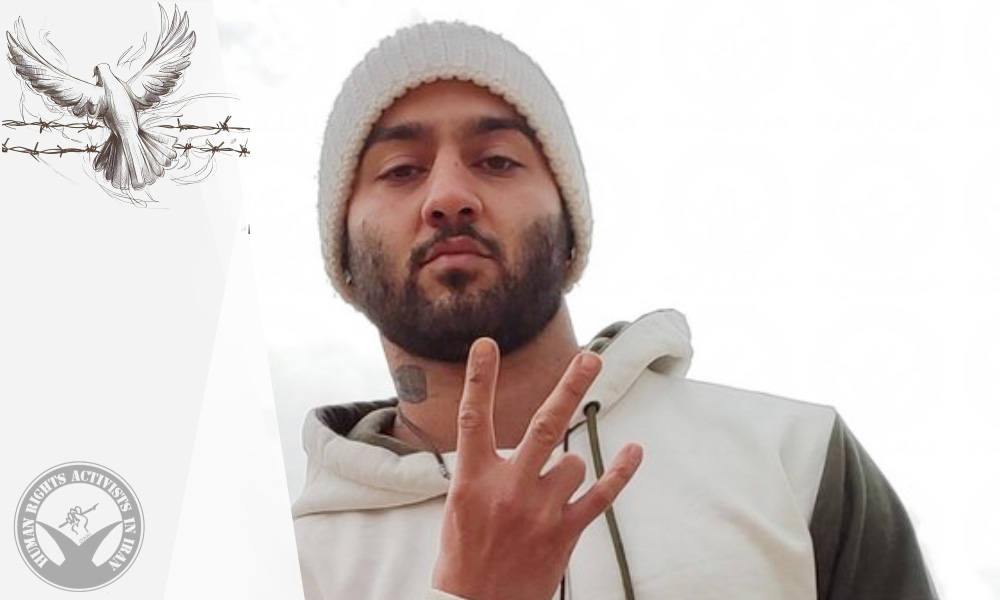
Toomaj Salehi Released from Prison After Serving Sentence

The public relations office of Isfahan’s Judiciary has announced that Toomaj Salehi, a protest rapper, was released from prison on Sunday, December 1, 2024, after completing a one-year sentence for “propaganda against the regime.”

The Judiciary’s media center, citing the Isfahan Judiciary’s public relations office, confirmed that Mr. Salehi’s release marked the end of his imprisonment on these charges.

Recently, Mostafa Nili, one of Salehi’s lawyers, revealed that Branch 5 of the Revolutionary Court of Isfahan had closed his 2022 case, issuing a decision to discontinue prosecution.

Earlier, another of Salehi’s lawyers, Amir Raisian, had disclosed that the same court had dismissed the charge of “spreading corruption on earth” (efsad-e-fel-arz), which had initially resulted in a death sentence, and instead acquitted him of that charge.

In April of this year, Salehi was sentenced to death by Branch 1 of the Revolutionary Court of Isfahan on the charge of “corruption on earth.” However, following an appeal, Branch 39 of the Supreme Court overturned the death sentence in early July and referred the case to Branch 5 of the Revolutionary Court for further review.

Salehi’s release concludes a complex legal ordeal that included facing and ultimately overcoming charges that carried the death penalty.

Salehi was arrested in late October 2022 in connection with the nationwide protests by security forces. Official news agencies claimed that he was attempting to illegally leave the country through the western borders, a claim denied by his associates. In July last year, he was sentenced by Branch 1 of the Revolutionary Court in Isfahan to six years and three months in prison, a travel ban, a ban on producing music and singing, and two years of mandatory behavior management and skills training. After this sentence was overturned by Branch 39 of the Supreme Court, he was released on bail on November 18, 2023.

Nevertheless, Salehi’s freedom was short-lived as he was re-arrested in Babol on November 30, just twelve days after being bailed out from Dastgerd Prison in Isfahan. The Judiciary spokesperson cited Salehi’s post-release statement as grounds for this subsequent arrest.

In January of 2024, in another part of his case, the Revolutionary Court of Isfahan sentenced him to one year in prison, two years of passport invalidation, and participation in behavior management courses on the charge of ‘propaganda against the regime.’ This sentence was upheld by the Isfahan Provincial Court of Appeals in late February. Late last year, Branch 117 of Criminal Court 2 in Isfahan acquitted him of the charges of ‘spreading falsehoods’ and ‘inciting violence.’

Toomaj Salehi, a protest rapper from Shahin Shahr, Isfahan, had previously been sentenced to six months in prison and a fine in 2021 for ‘insulting the Supreme Leader’ and ‘propaganda against the regime.’
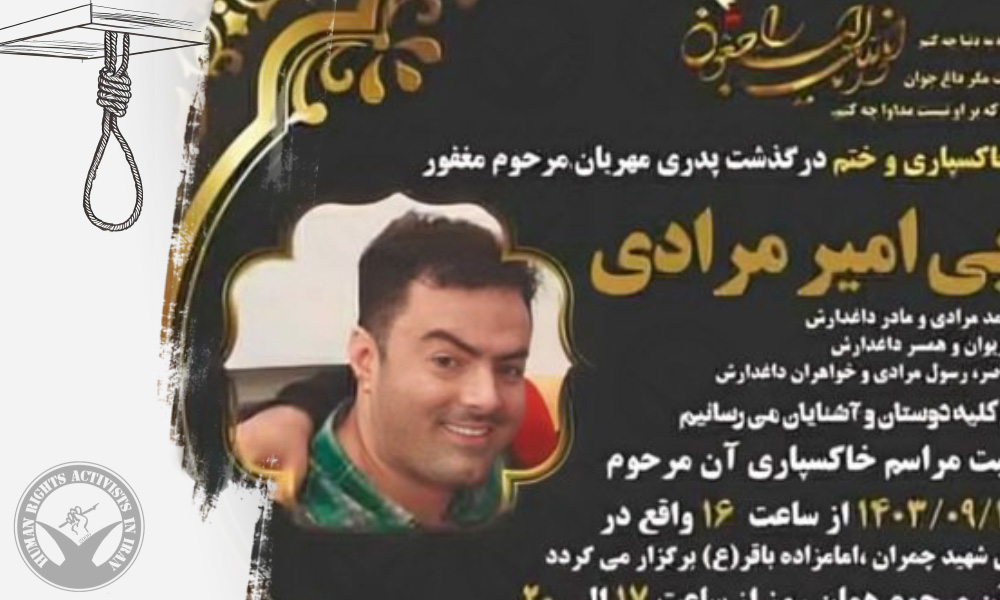

Four Prisoners Executed in Ghezel Hesar Prison, Karaj

The death sentences of four prisoners, convicted on charges related to drug offenses and murder, were carried out yesterday in Ghezel Hesar Prison, Karaj.

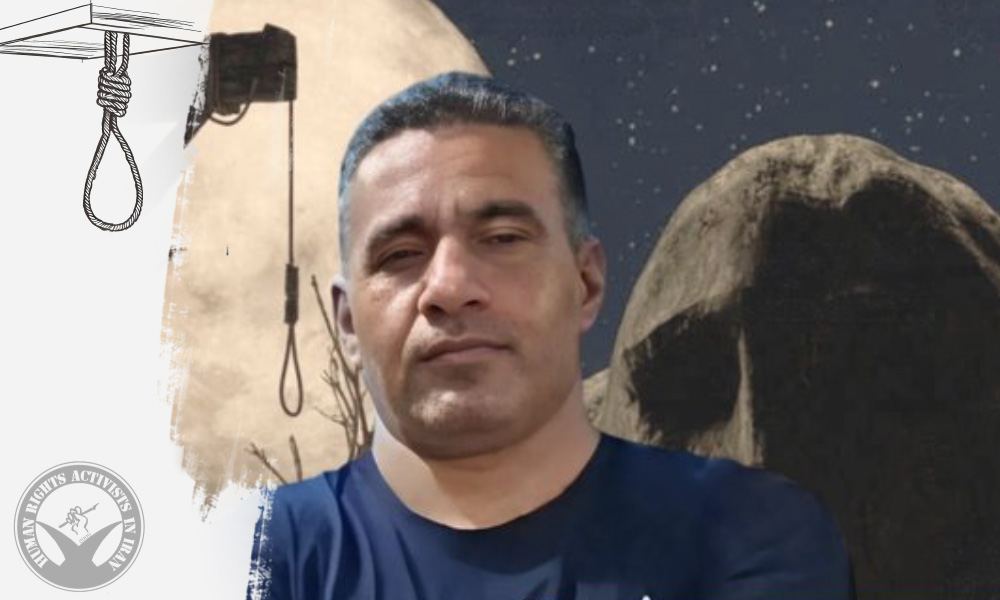
According to HRANA, the news agency of Human Rights Activists in Iran, the executions took place at dawn on Saturday, November 30, 2024. Among the executed was Amir Moradi, who had been arrested on drug-related charges and sentenced to death by the Revolutionary Court. The other three prisoners had been convicted and sentenced to death for murder.

HRANA is working to verify additional details, including the identities of the three prisoners convicted of murder.

As of this writing, neither prison authorities nor relevant institutions have officially announced the executions.

According to data gathered by the Department of Statistics and Publication of Human Rights Activists, Ghezel Hesar Prison in Karaj witnessed the highest number of executions in 2023, with Zahedan Prison following closely behind. For a comprehensive examination of the details and statistics surrounding the executions in Iran, refer to HRANA’s report.

Amir Moradi
Amir Moradi

Three Prisoners Executed in Yazd Prison

According to Haal Vsh, three prisoners were executed at Yazd Prison at dawn on Thursday, November 28, 2024.

The report states that Davood Mohammadi Takht-Shah (Dahmardeh) and Othman Dahmardeh, previously sentenced to death for drug-related charges by the Yazd Revolutionary Court were executed. The third prisoner has been identified as Esmail Barakzaie, approximately 18 years old and an Afghan national residing in Yazd. He was arrested for murder in Meybod, Yazd, and subsequently sentenced to death by the judiciary.

Haal Vsh also reported that Esmail Barakzaie was about 17 years old at the time of the murder.

As of this report’s publication, the execution of these three prisoners has not been officially announced by prison authorities or responsible institutions.

According to latest HRANA’s annual report over between October 10, 2023, and October 8, 2024, at least 811 individuals were executed by hanging in Iran, rising to 23.06% compared to the same period last year. Of these executions, four were carried out in public. Many of the defendants were denied a fair trial.

Six Death Sentences and Over 54 Years of Imprisonment Issued for Eight Political Prisoners in Tehran

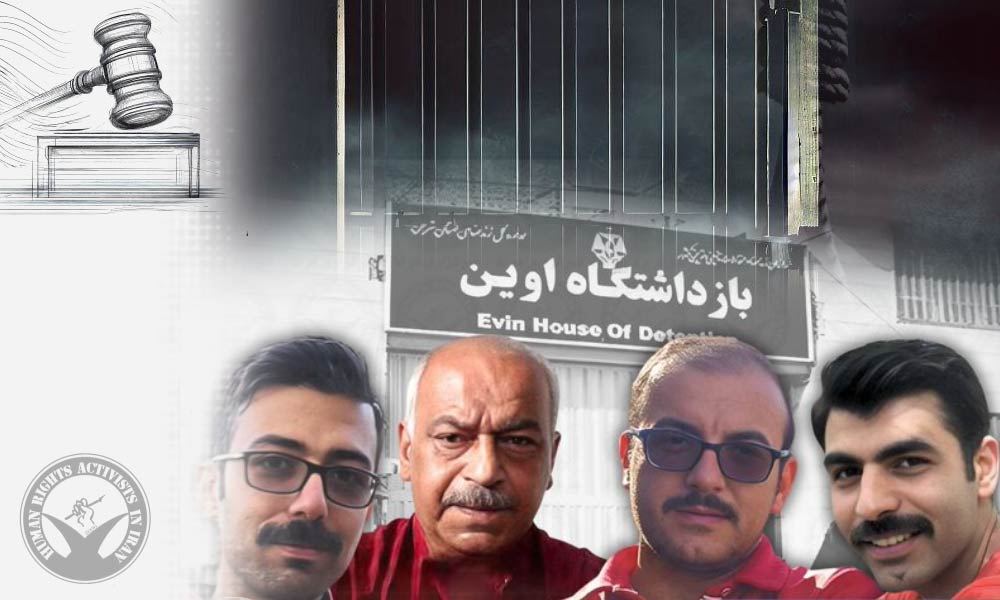
Branch 26 of the Tehran Revolutionary Court has sentenced six political prisoners—Akbar Daneshvar Kar, Seyed Mohammad Taghavi Sang-Dehi, Babak Alipour, Pouya Ghobadi Bistoni, Vahid Bani-Amerian, and Seyed Abolhassan Montazer—to death on charges of armed rebellion (Baghi) through membership in anti-regime groups. Additionally, these individuals, along with Seyed Ali Taghavi Sang-Dehi and Seyed Mojtaba Taghavi Sang-Dehi, were collectively sentenced to over 54 years of imprisonment and 20 years of exile.

According to HRANA, the news agency of Human Rights Activists in Iran, Judge Iman Afshari of Branch 26 issued severe sentences for these eight political prisoners.

Details of the Sentences:

  1. Akbar Daneshvar Kar
    • Death sentence for Baghi through membership in anti-regime groups.
    • 5 years in prison for assembly and collusion with intent to disrupt national security.
    • 10 years in prison for forming illegal groups.
  2. Seyed Mohammad Taghavi Sang-Dehi
    • Death sentence for Baghi.
    • 5 years in prison for assembly and collusion.
    • 10 years in prison for forming illegal groups.
  3. Babak Alipour
    • Death sentence for Baghi.
    • 5 years in prison for assembly and collusion.
    • 20 years of exile to the city of Khash for destruction of public property.
  4. Pouya Ghobadi Bistoni
    • Death sentence for Baghi.
    • 1 year in prison for illegal border crossing.
  5. Vahid Bani-Amerian
    • Death sentence for Baghi.
    • 5 years in prison for assembly and collusion.
  6. Seyed Abolhassan Montazer
    • Death sentence for Baghi.
    • 5 years in prison for collusion with intent to disrupt national security.
  7. Seyed Ali Taghavi Sang-Dehi
    • 2 years in prison for membership in anti-regime groups.
  8. Seyed Mojtaba Taghavi Sang-Dehi
    • 3 years and 7 months in prison for assembly and collusion with intent to disrupt national security.
    • 3 years in prison for membership in groups opposing the regime.


The court sessions for these individuals, who share a common legal case, were held in mid-October this year.

Vahid Bani-Amerian and Abolhassan Montazer were arrested in December 2023, while Babak Alipour was detained in the fall of 2023 by security forces in Tehran.

On February 23, 2024, Pouya Ghobadi and Seyed Mohammad Taghavi were arrested in Chaldoran County and transferred to Maku Prison, seven days later, being moved to Evin Prison.

Akbar Daneshvar and Mojtaba Taghavi had previously been detained and transferred to Evin Prison. Ali Taghavi had also been arrested earlier but was released on bail.

These individuals were formally charged in late May 2024 at Branch 5 of the Public and Revolutionary Prosecutor’s Office in Tehran.

Notably, Abolhassan Montazer and Seyed Mohammad Taghavi were political prisoners in the 1980s, while Vahid Bani-Amerian, Pouya Ghobadi, and Babak Alipour have prior records of imprisonment for their activism.

Prisoner Executed in Arak Prison for Murder Charges

At dawn on Thursday, November 28, 2024, a prisoner sentenced to death for murder was executed in Arak Prison.

HRANA, the news agency of Human Rights Activists in Iran, has confirmed the identity of the executed individual as Kamran Hemmati. He was arrested on murder charges and later sentenced to death by a criminal court.

Despite the execution, neither prison officials nor responsible institutions have made any public announcement regarding the case at the time of this report.

In 2023, 66% of HRANA’s reports on executions lacked official announcements by judicial authorities and went unreported by media inside Iran, highlighting a troubling lack of transparency in due process.

According to latest HRANA’s annual report over between October 10, 2023, and October 8, 2024, at least 811 individuals were executed by hanging in Iran, rising to 23.06% compared to the same period last year. Of these executions, four were carried out in public. Many of the defendants were denied a fair trial.

Kamran Hemmati
 

Subscribe to Our Newsletter

Now is definitely not the time to stop reading!

Prolonged Legal Limbo: Fariborz Sebghatollahi Held Without Trial in Rasht

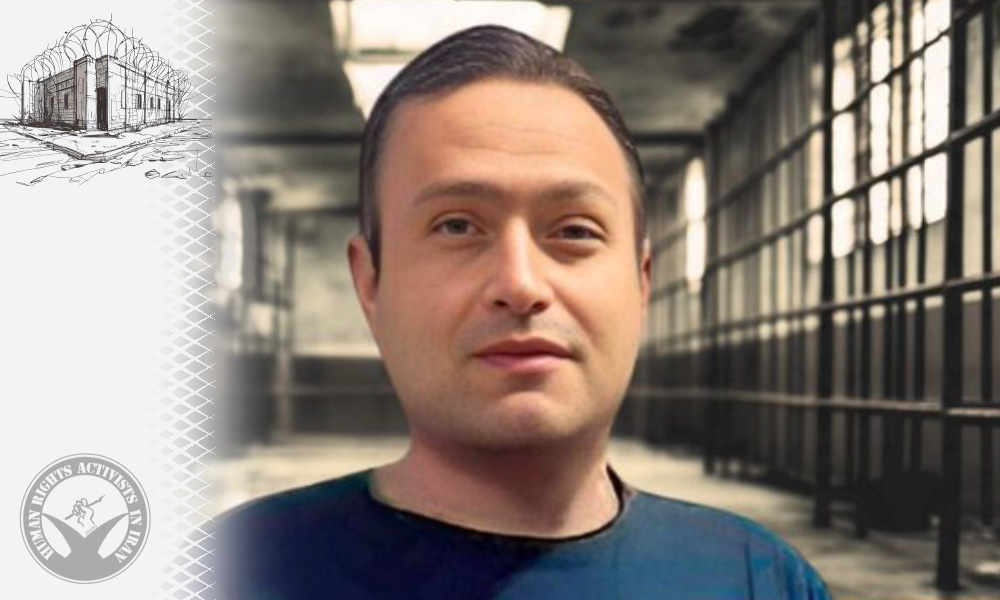
Fariborz Sebghatollahi, a political detainee from Astara, has been held in legal limbo at Lakan Prison in Rasht for over 130 days.

HRANA’s sources report that he was charged in a Rasht prosecutor’s office on suspicion of membership in an opposition group. For the past 136 days, he has been held without resolution in Lakan Prison, and no court hearing has been scheduled.

Sebghatollahi was arrested on July 17, 2024, by Astara Intelligence Ministry agents. He was initially detained at The Ministry of Intelligence’s detention facility in Astara for two days before being transferred to the Ministry’s detention center in Rasht. After interrogation, he was moved to Lakan Prison.

Previously, a source informed HRANA: “Sebghatollahi was repeatedly subjected to interrogations, psychological torture, threats against his family, and humiliation while in detention at the Ministry of Intelligence facility in Rasht. During his arrest, his daughter, daughter-in-law, ex-wife, and several friends were also detained but later released.”

Sebghatollahi, approximately 50 years old, resides in Astara.

Ruhollah Khosrawi Transferred to Sepidar Prison in Ahvaz; 15 Months in Legal Limbo

Political detainee Ruhollah Khosrawi remains in limbo over 15 months after his arrest. In mid-November, he was transferred from Sheiban Prison to Sepidar Prison in Ahvaz.

A source close to his family confirmed to HRANA: “On November 9, Mr. Khosrawi protested the relocation of Sheiban Prison’s public telephones to a noisy area near the kitchen. After a confrontation with guards, he was beaten and violently removed from the general ward. Following this, and under the orders of Sheiban Prison’s deputy security chief Mr. Ahmadi, coordinated with prison oversight judge Mr. Kooti, he was transferred to Sepidar Prison in Ahvaz.”

Khosrawi recently informed his family that, after 18 days in solitary confinement, he was moved to the general ward of Sepidar Prison.

He was arrested on August 23, 2023, in Izeh by security forces and initially held at The Ministry of Intelligence’s detention facility in Ahvaz before being transferred to Sheiban Prison.

On October 19, Khosrawi began a hunger strike in Sheiban Prison to protest his prolonged detention without trial. During the strike, he was moved to solitary confinement but returned to the general ward after ending his strike.

Khosrawi’s case is being investigated by a branch of the Izeh Prosecutor’s Office, with charges reportedly linked to national security. Since his arrest, he has been denied access to legal counsel, and no court hearings have been held.

As of this report, no information has been provided about the charges against him.

Khosrawi, aged around 35, is married and the father of a young daughter and son.

Behzad Dadkhah Arrested by Security Forces in Saqqez

On November 25, Behzad Dadkhah, a resident of Saqqez, was arrested by security forces in the city and transferred to an undisclosed location.

Behzad Dadkhah is a resident of Saqqez, and the father of a young child.

A source close to the family confirmed the news to HRANA, stating: “He was arrested by security forces at his workplace on Vahdat Boulevard in Saqqez and taken to an unknown location. The lack of information about his whereabouts has caused great concern among his family and loved ones.”

The reasons for his arrest and the charges against him remain unknown at this time.

Prisoner Executed in Qazvin Prison

At dawn today, November 28, a prisoner previously sentenced to death on drug-related charges was executed in Qazvin Prison.

According to HRANA, the news agency of Human Rights Activists in Iran, the prisoner has been identified as Mohammad-Ali Taheri, 46, from Kangavar.

Taheri had been arrested on drug-related charges and subsequently sentenced to death by the Revolutionary Court.

As of the time of this report, the execution has not been officially announced by prison authorities or relevant institutions.

The reports from the Department of Statistics and Publication of Human Rights Activists for the year 2023 reveal a concerning prevalence of executions for drug offenses in Iran, constituting 56.4% of the total executions. For a comprehensive examination of the details and statistics surrounding the executions in Iran, refer to HRANA’s report.


Appeals Court Upholds Sentences of Mothers of November 2019 Protest Victims

The prison sentences of Mahboubeh Ramazani, mother of Pejman Gholipour, and Rahimeh Yousefzadeh, mother of Navid Behboodi—victims of the November 2019 protests—have been upheld by Branch 36 of the Tehran Court of Appeals. Both were previously sentenced to 18 months and one day in prison by the Shahriar Revolutionary Court.

According to HRANA, the news agency of Human Rights Activists in Iran, the appeals court confirmed the verdict issued by Branch 2 of the Shahriar Revolutionary Court, rejecting the defendants’ appeals.

Reza Shafakhah, the women’s lawyer, stated that the upheld convictions include charges of “propaganda against the regime,” “membership in the Mothers of the November 2019 Victims group,” and “insulting the Supreme Leader.” The original sentence was handed down in September.

Both women have faced prior arrests and convictions for their activism. As mothers of victims killed during the November 2019 protests, they have become vocal advocates for justice.

The November 2019 protests, sparked by a sharp rise in fuel prices, erupted on November 15, 2019, and quickly spread across dozens of cities in Iran. The protests, which lasted several days, saw participation in 719 locations, according to Mohammad Javad Kolivand, an MP from Karaj. Seyed Hossein Naqavi Hosseini, spokesperson for the National Security and Foreign Policy Commission at the time, reported around 7,000 arrests. Human rights organizations estimate that hundreds were killed in the violent crackdown that followed.

This ruling underscores the ongoing suppression of dissent in Iran, particularly targeting those seeking accountability for the deaths of protesters during the November 2019 unrest.