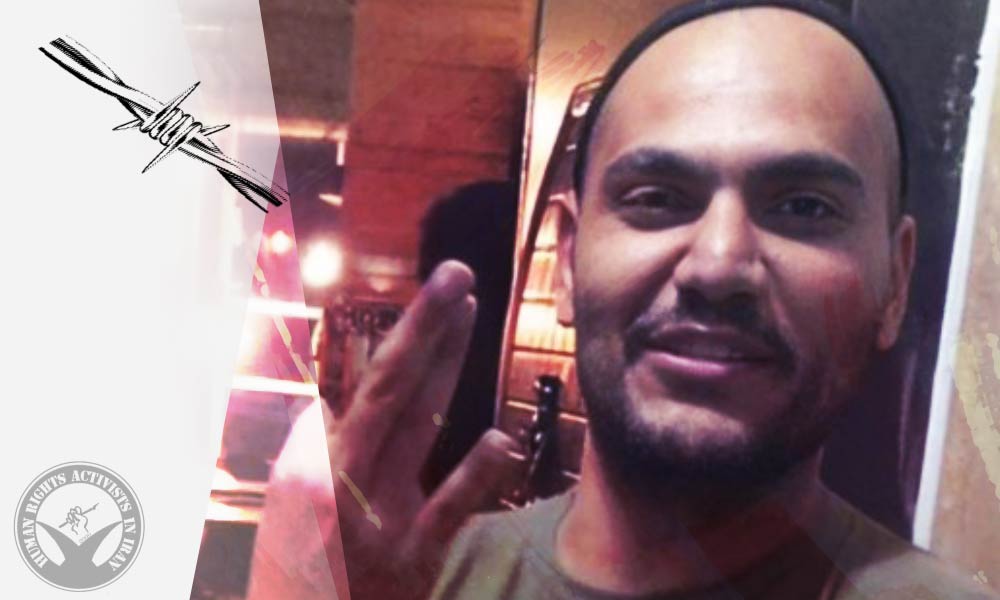
Mohammad Havashemzadeh, arrested during nationwide protests, is still in prolonged detention for over four months in Great Tehran Penitentiary.
According to HRANA, the news agency of Human Rights Activists, Mohammad Havashemzadeh is still detained for over four months, awaiting further legal proceedings.
An informed source told HRANA, “Havashemzadeh was held about 20 days of this detention in solitary confinement. He has been charged with a crime against national security for participating in protests. After 142 days, he is still jailed in uncertainty in Great Tehran Penitentiary.”
Mohammad Havashemzadeh, age 28, was arrested by security forces amid nationwide protests in Tehran.
About Iran Nationwide Protests 2022
The arrest of Mahsa Amini by Tehran Morality Police for her alleged improper hejab and her suspicious death on September 16 sparked protests sweeping across Iran. During these protests, at least about 19760 people, including journalists, artists, lawyers, teachers, students and civil rights activists, were arrested.
The Mashhad Revolutionary Court sentenced Amir Sheibani Zaveh, arrested during nationwide protests, to eight years and six months imprisonment.
According to HRANA, the news agency of Human Rights Activists, protestor Amir Sheibani Zaveh was sentenced to imprisonment.
Sheibani received four years and six months for “assembly and collusion against the regime,” three years for “membership in anti-regime groups,” and one year for “propaganda against the regime.”
If the verdict is upheld on appeal, based on Article 134 of the Islamic Penal Code, four years and six months for the first count will be enforceable.
According to Sheibani, “publishing the calls for protests, the pictures of Mahsa Amini and Nika Shakarmi’s burial place on social media, and attending one of the killed protestors’ funeral in Mashhad” was presented in the court as pieces of evidence for the charges.
Since the beginning of nationwide protests, about 19570 people, including journalists, artists, lawyers, teachers, students and civil rights activists, have been arrested. So far, over protests, about 737 people have been sentenced to a total of about 12330 months imprisonment.
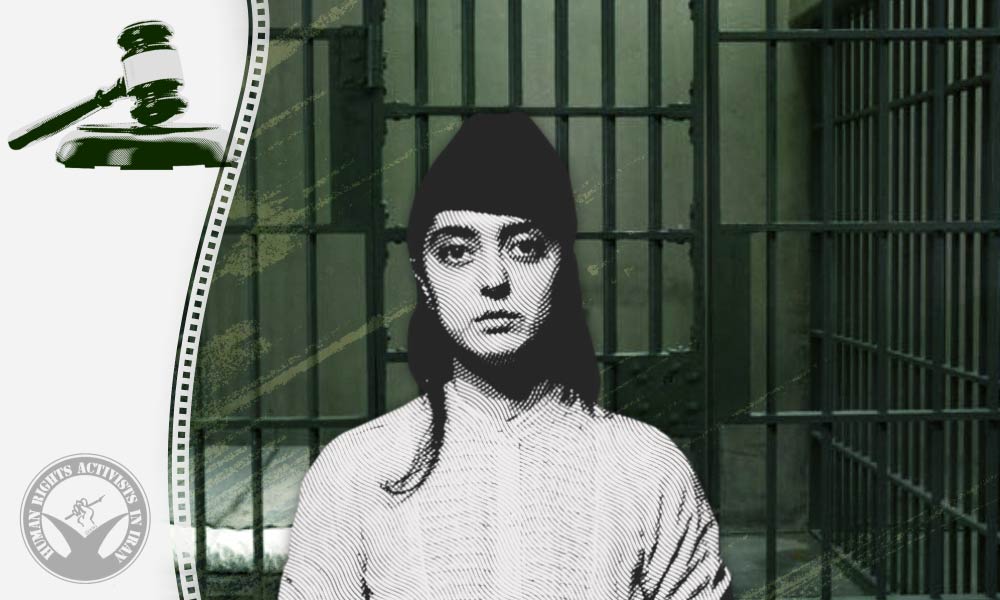
The Tehran Revolutionary Court sentenced workers’ rights activist Neda Naji to eight months in prison, 60 lashes, banned from leaving the country, paying a fine and other punishments.
According to HRANA, the news agency of Human Rights Activists, workers’ rights activist Neda Naji was sentenced to imprisonment and flogging.
According to this verdict issued on December 7, 2022, Naji has been sentenced to eight months in prison, 60 lashes for “disturbing public order,” and a 15 million toman fine for “spreading falsehood.” She was also banned from leaving the country and using a cell phone for two years. She should also write a research paper as an additional punishment.
During the trial, she did not have access to her attorney.
On October 2, 2022, Naji was arrested in front of Kasra Hospital, where Mahsa Amini died, and jailed in Evin Prison. She was released on a 150-million bail on October 27, 2022.
Naji faced other arrests and convictions on prior occasions.
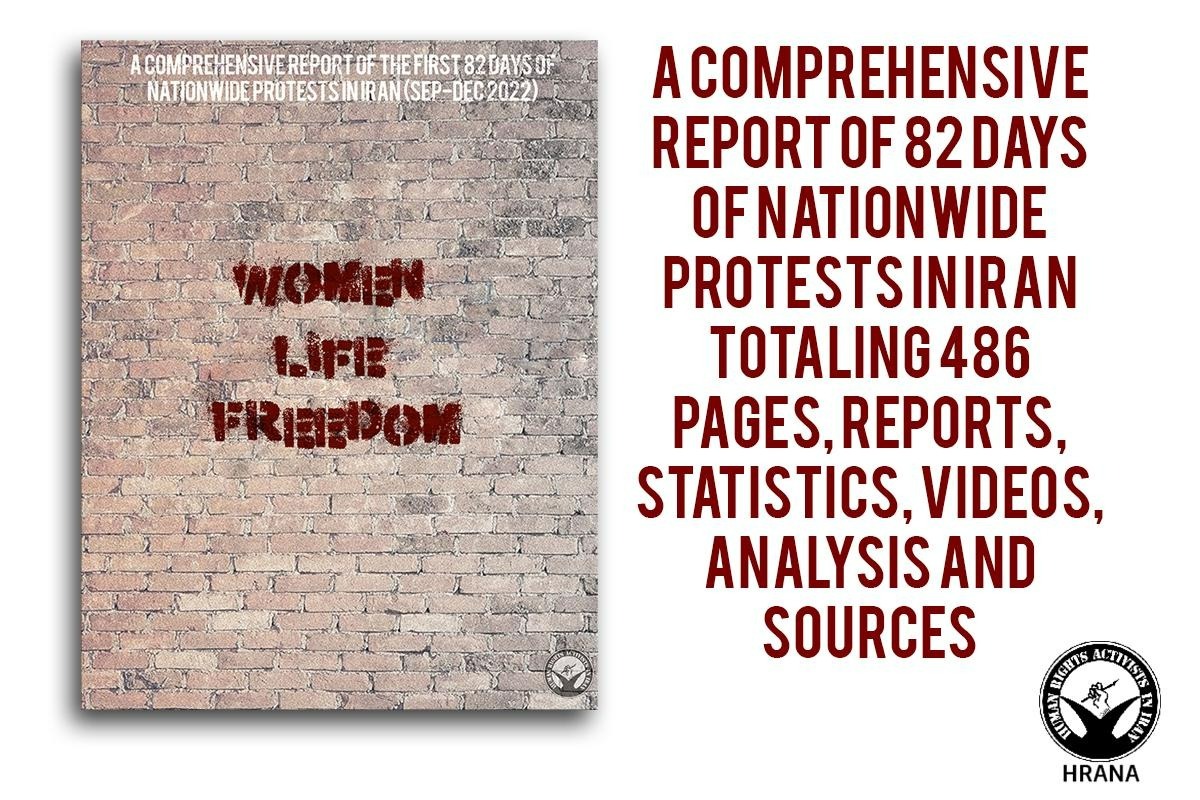
HRANA – Mahsa Amini, a 22-year-old young woman, was arrested by the morality police for the crime of improper hijab. Her arrest and death in detention fueled nationwide protests in Iran. Protesters came to the streets with the central slogan “Women, Life, Freedom” in protest against the performance, laws, and structure of the regime. The following 486-page report is dedicated to the statistical review, analysis, and summary of the first eighty-two days of the ongoing protests (September 17 to December 7, 2022). In this report, in addition to the geographic analysis and the presentation of maps and charts, the identity of 481 deceased, including 68 children and teenagers, an estimated of 18,242 arrested along with the identity of 3,670 arrested citizens, 605 students and 61 journalists or activists in the field of information is compiled. In addition, the report includes a complete collection of 1988 verified video reports by date and topic. The report examines protests across 1115 documented gatherings in all 31 provinces of the country, including 160 cities and 143 universities.
Summary
Mahsa (Zhina) Amini, a young 22-year-old woman from Saqqez, Kurdistan was visiting Tehran, when she was taken into custody on Tuesday, September 13, 2022, by the Morality Police officers at the Haqqani metro station in Tehran. The reason for her arrest: not properly observing the strict Islamic dress code. Mahsa/Zhina was taken to the infamous detention center of Moral Security Police known as Vozara.
Shortly after Mahsa’s arrest, she went into a coma with level three concussion, and her partially alive body was transferred to the intensive care unit of Kasra Hospital. Given the track record of the police and Guidance Patrols in mistreating the arrestees and similar previous incidents, with the believe that Mahsa was beaten during the arrest people were outraged.
Download full report in PDF format
Unpersuasive explanations given by the Central Command of the Islamic Republic Police Force (FARAJA) in defense of its actions regarding the death of Mahsa, the past performance of the police force, along with widespread dissatisfaction with the existence of a body called the Moral Security Police, fueled widespread protests in Iran.
The widespread protests sparked at the time Mahsa Amini was announced dead in front of Kasra Hospital on Argentina Street in Tehran, and then quickly spread to the streets despite the intimidating presence of Iran’s security forces. The protests intensified after Mahsa’s burial in a Saqqez cemetery. To the extent that after eighty-two days of nationwide protests between September 17, 2022, to December 7, 2022, they have spread to Iran’s all 31 provinces, 160 cities, and 143 major universities.
The protests did not stay limited to Mahsa’s death, it rather, quickly targeted the Iranian government’s political and ideological foundations. These protests were violently quashed by the anti-riot police and Iran’s militia force (Basij). teargas, pellets, and live ammunition were used in the repression of protestors. This widespread crackdown has led to the death of dozens of people and the wounding of hundreds of protestors.
Despite sever communication restrictions imposed by the Islamic Republic, this report attempts to give a clearer picture of the first 82 days of the protests between September 17, to December 7, 2022. It’s worth mentioning at the time of this report the protests are still ongoing in various forms.
On November 1, related to nationwide protests since the death of Mahsa Amini, security forces arrested six students at Shiraz University of Medical Sciences and took them to an undisclosed location.
According to HRANA, the news agency of Human Rights Activists, on November 1, 2022, six students were arrested by security forces in Shiraz.
HRANA has identified these students as Amir-Mohammad Mir-Jalili, Hamid-Reza Safari, Mohammad-Mehdi Nazari, Ali Giasipour, Mohamad Rajabi and Farzin Ahmadi.
The students’ whereabouts are unknown as of this writing.
On November 2, security forces arrested Astareh (Maryam) Ansari, attorney at law, in Shiraz and took her to an unidentified location.
According to HRANA, the news agency of Human Rights Activists, on November 2, 2022, lawyer Astareh Ansari was arrested in Shiraz.
Ansari was arrested in front of the Shiraz Bar association building. The reason for this arrest, the charges and her whereabouts are still unknown.
On the same day, four other lawyers, Ghodsiey Ghodsbin, Alireza Zare, Mehdi Safari and Mohammad Hadi Jafarpour, and the day before, three others, Nazanin Salari, Bahar Sahraeian and Mahmood Taravat were arrested in Shiraz.
According to the latest available data gathered by HRANA, over 14100 people have been arrested during the nationwide protests since Mahsa Amini’s death. For more details and statistics on the nationwide protest across Iran, read HRANA’s comprehensive reporthere.
On October 26, security forces arrested at least 15 physicians in a protest in front of the Medical Council in Tehran.
According to HRANA, the news agency of Human Rights Activists, on October 26, the police and security forces cracked down on physicians’ protest gathering in Tehran and arrested at least 15 physicians.
Yesterday, on the 40th day of Mahsa Amini’s death, several physicians joined the nationwide protests and held a demonstration before Medical Council in Tehran.
Also, last Monday, October 24, physician Mehran Fereidooni, working in forensics, was arrested in Shiraz. He had previously announced, “Medical Council’s physicians do not verify what the regime officials have mentioned as the cause of Mahsa’s Amini death.”
On October 26, 2022, security forces arrested Baha’i citizen Leily Karami at her house in Shiraz and transferred her to a detention facility known as House No 100. The agents searched her home and confiscated some of her personal belongings.
According to HRANA, the news agency of Human Rights Activists, Baha’i citizen Leily Karami was arrested at her house in Shiraz.
The reason for her arrest and the charge is still unknown.
The Chief Justice of Zanjan Province announced that 119 people arrested during the nationwide protests were indicted.
According to HRANA, the news agency of Human Rights Activists, quoting IRNA, the Chief Justice of Zanjan Province announced the indictment against 119 protestors in this province.
Esmail Sadeghi commented: so far, 279 legal cases have been opened against 325 individuals across the province courthouses. Of these cases, 137 (47%) have been reviewed, and 119 people were indicted.
According to the latest available data gathered by HRANA, over 13500 people have been arrested during the nationwide protests. For more details and statistics on the nationwide protest across Iran, read HRANA’s comprehensive report here.
Iranian officials fail to use non-violent means before resorting to the use of force or firearms
SPREADING JUSTICE– As nationwide protests continue across Iran, Spreading Justice continues to monitor the use of violence namely lethal force against protestors. Despite the claims of authorities, there is concrete evidence pointing to the use of excessive and lethal force against protestors.
The presence of the FARAJA force is prominent; indeed, these special units are much more visible in the current unrest than in previous instances. In addition to the FARAJA, the Imam Ali Security Battalions, affiliated with the Basij Forces, under the command of the IRGC ground forces are playing a key role in the suppression of unarmed protestors.
Spreading Justice has collected evidence which shows the use of lethal weapons by the above forces. In addition to anti-riot equipment such as tear gas, pepper spray, shockers, and batons, the repressive forces have used a variety of prohibited weapons against civilians. The report released today documents a series of reports analyzed by Spreading Justice pointing to the overwhelming conclusion that there has been ongoing use of lethal weapons against protestors
Download the full report in PDF version
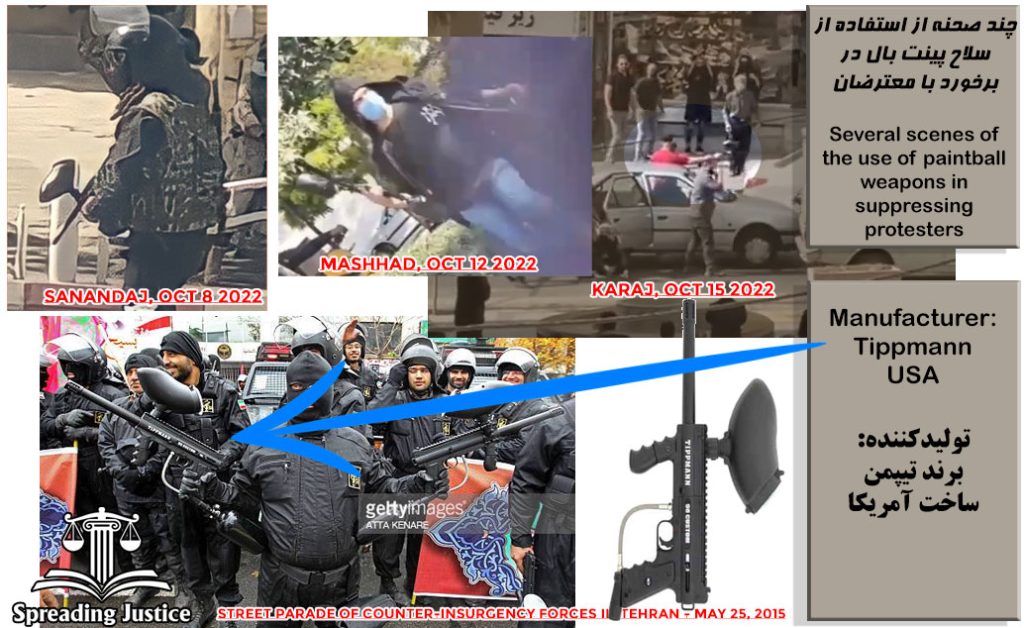
Paintball Guns
The paintball gun, which can be bought and sold in the market, is designed as a weapon for playing or using in sport clubs. This gun, which is mainly made of aluminum, works with various gases, including CO2 gas, compressed air, or nitrogen.
The caliber of this weapon is 0.68, it has a range of approximately 45 meters, and it can hold up to 200 bullets per load and operate semi-automatically.
Paintball guns are not considered lethal weapons in general, however their use by law enforcement against protesters specially targeting of their face and upper body is prohibited. Several reports have been submitted to Spreading Justice, showing that FARAJA units use this weapon to target the faces of protesters, which in some cases have caused injury, especially to the eye. Spreading Justice has documented the dangerous use of this weapon in various cities including Tehran, Mashhad, Rasht, Karaj and Sanandaj.
Shotguns
A shotgun is a type of gun that has a groove-less barrel and fires many spherical pallets at the target in each shot. This type of gun is usually used in hunting and sports and sometimes in war and for police forces. Shotguns range usually does not exceed 100 meters. Most two-barrel guns fall under this division of firearms. A shotgun cartridge usually has a cardboard or plastic casing called shotshell, and its size is expressed by a number that is sometimes called caliber in Farsi, analogously to bullet guns.
Shotguns usually exist in the form of long barreled or waist guns, but evidence found so far indicates that the only ones used in facing protesters are long-barreled types.
Shotguns have been systematically used in various cities by plain clothes or uniformed forces against protestors in recent protests, despite being prohibited and potentially its use being considered unlawful. OHCHR indicates that use of projectile weapons is unlawful under certain circumstances. The use of shotguns in recent protests against the protesters fails at least 3 of the requirements for the use of this weapon, in addition to having been used on unarmed peaceful protestors, shot guns have been used unlawfully because (1) multiple pallets were fired at the same time which means it cannot comply with the principles of necessity and proportionality. (2) in some cases, were used in a very short distance, (3) they were targeted at the face and neck of protestors.
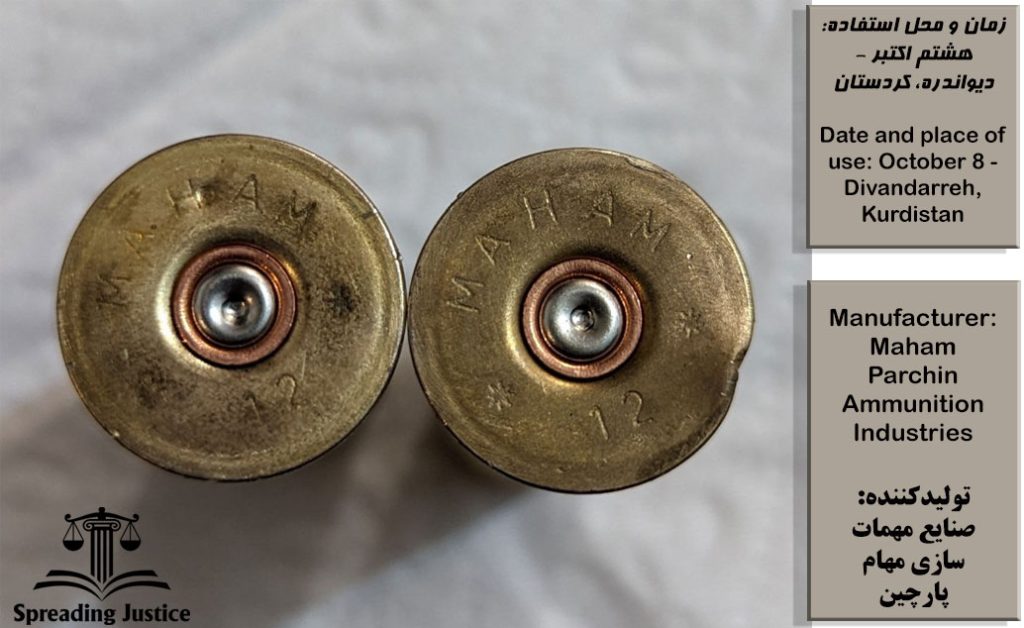
According to the documents collected by the Spreading Justice, most of the shells used in the recent protests were 12mm pallets, which usually hold 9 bullets and can be deadly if used at less than 40 meters.
After studying the forensic documents and speaking to eyewitnesses, Spreading Justice confirms that the FARAJA forces used a shotgun was the weapon used to kill Mohammad-Javad Zahedi in the city of Sari.
Spreading Justice has talked to at least three doctors who have treated the injured in recent incidents. According to the testimony of these doctors, more than 80 patients were wounded by pallets from shotguns. It should be noted that this large number is based on the testimony of only three doctors in the cities of Tehran, Rasht and Karaj.
According to testimonies and reliable video documentation, the pallets did not only hit the lower body of the protestors, but they were found in various parts of the body including the face and torso. This shows that contrary to the statements of law enforcement officials, the forces present at the scene have used this weapon, which can be deadly, by firing indiscriminately at the protesters.
In addition to unbranded ammunition, Spreading Justice has analyzed pictures of used shotshells, which belong to the Maham company. Maham is a subsidiary of Iran’s Ministry of Defense.
Assault rifles
Based on reports received by Spreading Justice, the weapons of war used to suppress protestors were mainly one of the below:
Kalashnikova
Heckler & Koch G3
Steyr HS .50
Spreading Justice has received information on the use of Styr HS .50, however has not been able to confirm its use and is in the process of examining and monitoring for additional evidence on the use of this weapon, therefore the details of use of this weapon is not discussed in this report and will be discussed in the future reports.
Kalashnikova (known as: Kalash or AK-47) is an assault rifle that operates with gas and is chambered for 7.62 x 39mm cartridge. The effective firing range for an AK-47 is between 300 to 400m and its maximum range is 2000m. The standard magazine capacities of this weapon are 30 or 75 rounds drum.
Another weapon that falls under this category is Heckler & Koch G3. This weapon has caliber of 7.62 and 51mm bullets. Its effective firing range is 200 to 400m and its standard magazine capacity is 30 as well as up to 100 round drum magazines.
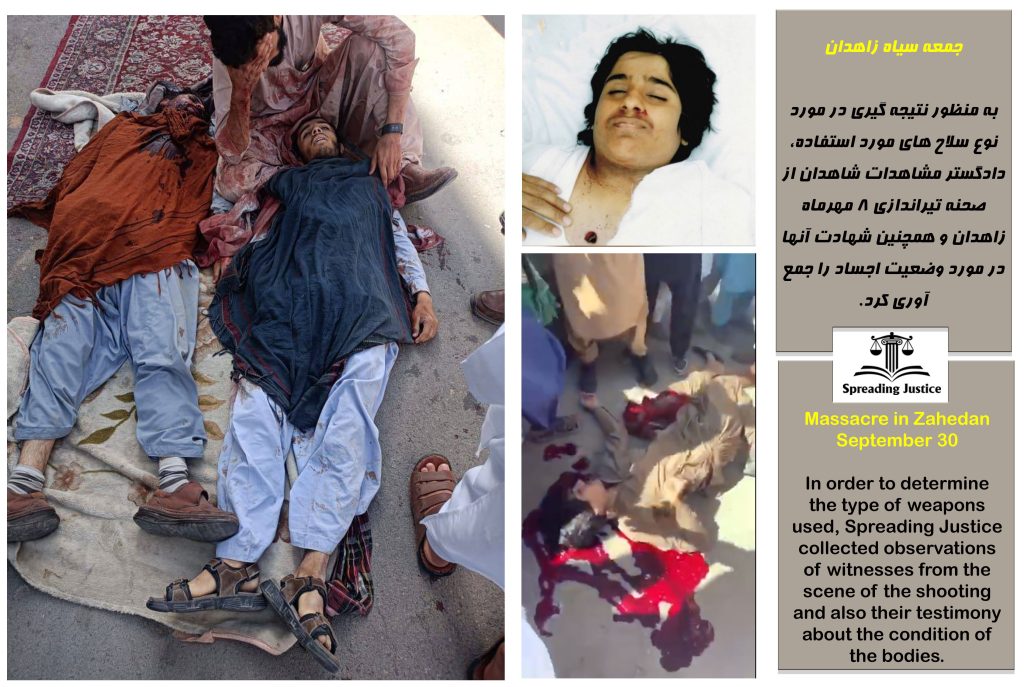
Although these weapons are being used less than in previous instances, they were most documented in the massacre of Zahedan that came to be known as bloody Friday of Zahedan, and the use of Kalashnikova in the deadly attacks on Sanandaj.
According to the opinion of the doctors consulted by Spreading Justice, the effects of this weapon can be seen on the bodies of some victims, including Omid Sarani and Matin Ghanbarzehi.
As mentioned, the death of about 90 Baloch protesters in the event of Black Friday in Zahedan are considered the most concrete evidence of the use of these weapons against the protesters.
Considering the extent of protests in 114 cities and 79 universities, Spreading Justice cannot consider the use of these weapons as dominant way of suppressing the protestors in recent protests.
Handguns
There are many types of handguns, but according to Spreading Justice in consultation with experts, the most common type available to the FARAJA forces is the German Sig Sauer, which is known as Zoaf in Iran.
This 9mm semi-automatic weapon is armed with direct gas pressure and its barrel is air-cooled. This weapon is used in short distances and its magazine usually holds 8 bullets.
There are reports of the use of revolvers and various Glock or Beretta by the security and military forces, however Spreading Justice has not been able to independently confirm their use in the recent protests, we continue to monitor and examine evidence and will update our future reports on the use of these lethal weapons in our future reports.
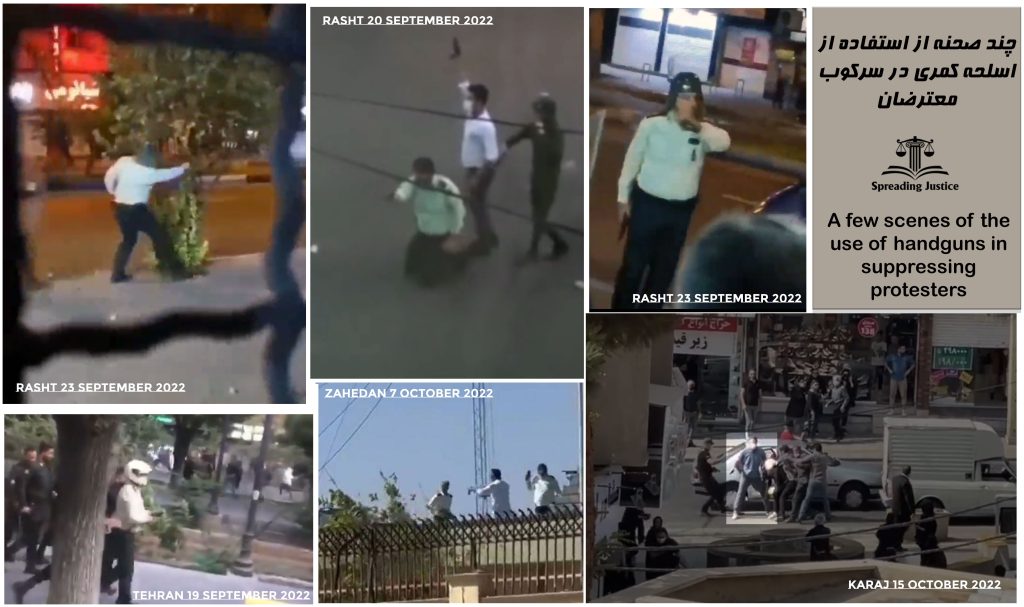
By examining the available evidence, Spreading Justice can confirm that this lethal weapon has been used by FARAJA uniformed officers in at least four locations in Zahedan, Karaj, Rasht, and Tehran.
However, from Spreading Justice examination of reports and evidence it is apparent that the use of handguns has not been in a systematic manner.
Spreading Justice continues its investigation and evidence gathering related to the use of weapons to suppress protestors. Official claims that the forces at the scene were not equipped with lethal weapons is false. Spreading Justice will continue its monitoring of the deployment of lethal force against protestors by FARAJA and other forces.
For media inquiries, please contact HRA Senior Advocacy Coordinator Skylar Thompson at [email protected]










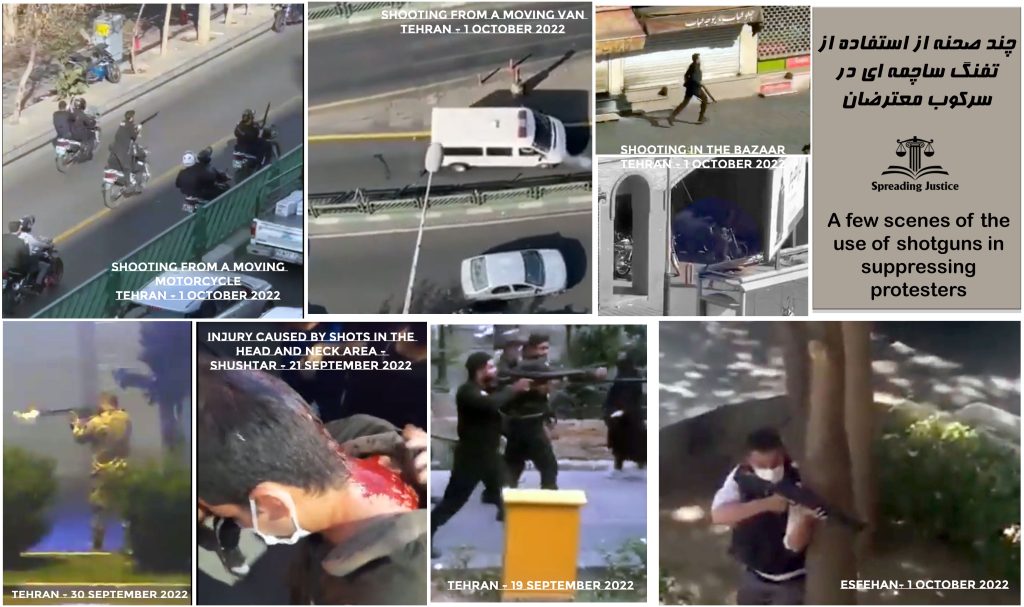 Shotguns have been systematically used in various cities by plain clothes or uniformed forces against protestors in recent protests, despite being prohibited and potentially its use being considered unlawful. OHCHR indicates that use of projectile weapons is unlawful under certain circumstances. The use of shotguns in recent protests against the protesters fails at least 3 of the requirements for the use of this weapon, in addition to having been used on unarmed peaceful protestors, shot guns have been used unlawfully because (1) multiple pallets were fired at the same time which means it cannot comply with the principles of necessity and proportionality. (2) in some cases, were used in a very short distance, (3) they were targeted at the face and neck of protestors.
 After studying the forensic documents and speaking to eyewitnesses, Spreading Justice confirms that the FARAJA forces used a shotgun was the weapon used to kill Mohammad-Javad Zahedi in the city of Sari.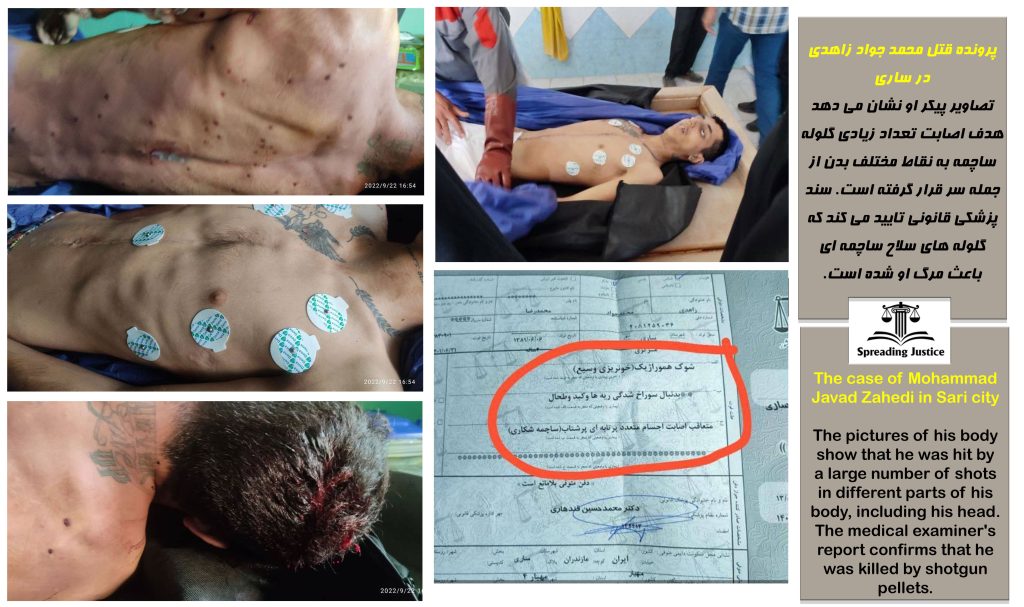
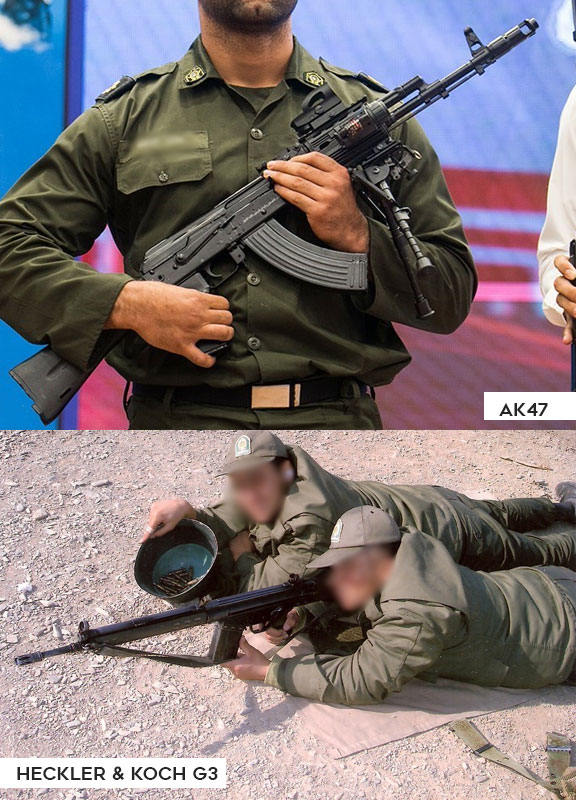 Kalashnikova (known as: Kalash or AK-47) is an assault rifle that operates with gas and is chambered for 7.62 x 39mm cartridge. The effective firing range for an AK-47 is between 300 to 400m and its maximum range is 2000m. The standard magazine capacities of this weapon are 30 or 75 rounds drum.