Detailed Report on the Sixth Day of Protests: Violence by Security Forces and an Increase in the Arrest of Protesters

Protests and strikes by shopkeepers and citizens in various cities across Iran entered their sixth day today. Over the past six days, at least 113 locations across the country, in 46 cities spanning 22 provinces, have witnessed protests. During these protests, dozens of people were arrested and at least eight protesters lost their lives.

HRANA – Protests and strikes by shopkeepers and citizens in various cities across Iran entered their sixth day today. Over the past six days, at least 113 locations across the country, in 46 cities spanning 22 provinces, have witnessed protests. During these protests, dozens of people were arrested and at least eight protesters lost their lives.

The widespread protests that began on Monday, December 29, with gatherings and strikes by bazaar merchants in Tehran continued today, Friday, January 2, for a sixth consecutive day. The protests have been accompanied in some cities by an intensified security presence, violence, and arrests of citizens. Demonstrations persisted in cities including Neyshabur, Sabzevar, Esfarayen, Mashhad, Hamedan, Fardis, Gohardasht, Khorramabad, Qazvin, Tehran, Fuladshahr, Zahedan, Marvdasht, Parand, Hafshejan, Joneqan, Yasuj, and Qom. Reports were also published today indicating the use of violence by security and law enforcement forces. As protests continued, the scope of arrests expanded, with reports collected of dozens of protesting citizens being detained.

Background to the Protests

The new wave of protests has emerged amid unprecedented economic pressure on various segments of society, alongside simultaneous signs of structural erosion in the country’s livelihood system. The rapid rise in foreign currency prices, chronic market instability, and the continued devaluation of the national currency have made the economic outlook extremely uncertain for citizens and trade activists.

In the days leading up to the protests, the exchange rate surpassed 140,000 tomans, while the capital market experienced a significant outflow of capital and declines in indices. According to analysts, these developments reflect a large-scale shift of capital toward lower-risk assets such as foreign currency and gold, and signal declining public confidence in economic policies. The direct consequences have included the closure or partial shutdown of trade units, the inability of small businesses to continue operating, and the expansion of protests and strikes in cities across the country.

Geography of the Protests

Based on collected information, gatherings and protests on the sixth day were reported in 17 cities across 13 provinces. Protests continued in cities including Sabzevar, Esfarayen, Neyshabur, Mashhad, Hafshejan, Joneqan, Hamedan, Fardis, Tehran, Parand, Gohardasht, Zahedan, Marvdasht, Fooladshahr, Yasuj, Qazvin, and Qom.

In Zahedan, protesting citizens took to the streets after Friday prayers and chanted protest slogans. These gatherings mainly took place on University Street and Khayyam Street.

Marvdasht also witnessed protest gatherings today. In the morning, during the burial ceremony of one of those killed in the protests, citizens chanted protest slogans, and several hours later, protest gatherings formed on Enghelab Street in the city.

Meanwhile, a video from the burial ceremony of Dariush Ansari Bakhtiarvand in Fuladshahr has been published, showing a large turnout of citizens. This protesting citizen was shot by law enforcement–security forces on Wednesday evening, December 31, after participating in popular protests, and lost his life.

According to verified reports up to the time of publication, a total of 113 protests have been recorded over the past six days in 46 cities across 22 provinces. Fifteen student gatherings at 13 universities are also included in this figure.
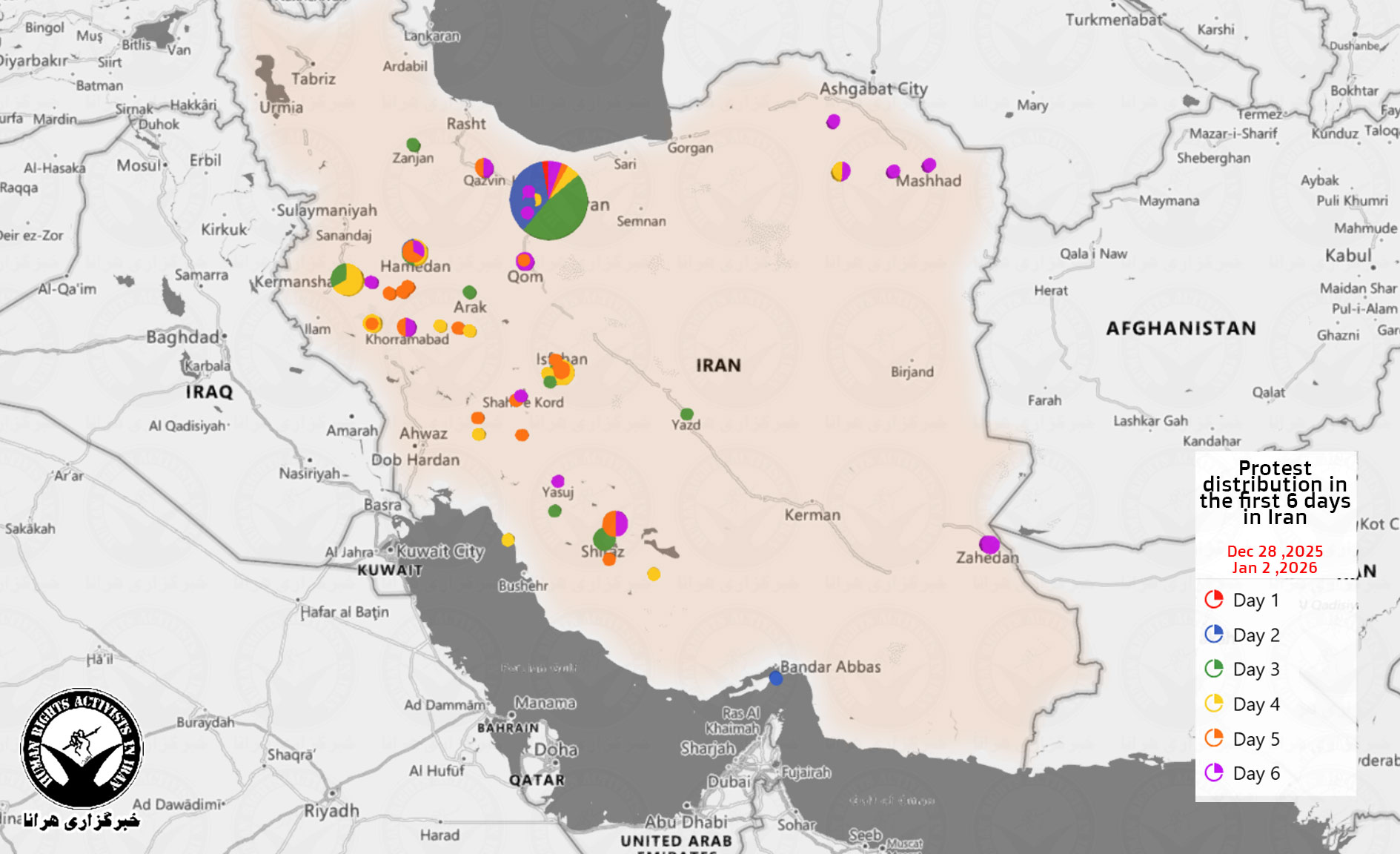
Protest distribution day 6

Methods of Protest and Slogans

Based on reviews of videos and verified reports, the slogans chanted were largely centered on livelihood, economic, and political demands rooted in citizens’ fundamental rights. These slogans included criticism of the power structure, objections to restrictions on individual and social freedoms, demands for justice, and opposition to the prevailing economic and living conditions.

At the same time, in some gatherings, slogans with more diverse themes were also heard, reflecting the heterogeneous range of views and tendencies among protesters. Within the framework of its human rights mission, HRANA focuses its reporting on slogans and demands that are directly related to violations of, or demands for, human rights, fundamental freedoms, and civil rights.

On the sixth day of protests, scenes of dissent extended to cemeteries, where citizens chanted protest slogans during the burial ceremonies of two individuals killed in the protests. In the streets as well, protesting citizens held gatherings while chanting slogans.

The persistence and repetition of these slogans across different cities indicate an overlap between labor, livelihood, and political demands within the context of the ongoing protests, and reflect the depth of accumulated grievances in Iranian society.

Conduct of Law Enforcement-Security Forces and Details of Violence

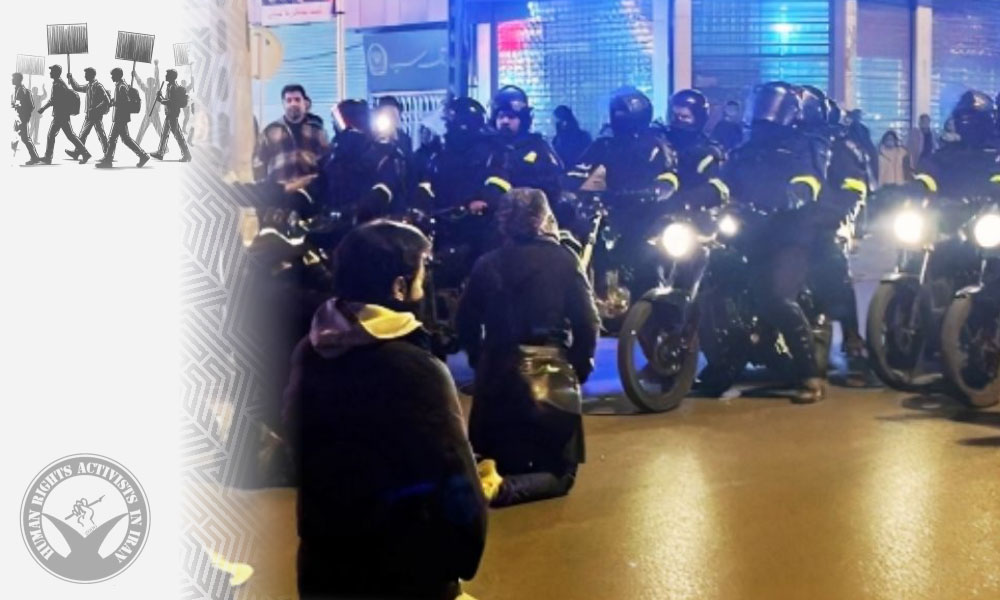
On the sixth day of widespread protests across various Iranian cities, reports and videos indicated the continued securitized atmosphere and the use of repressive measures by law enforcement and security forces to prevent the formation and spread of protest gatherings. In one such case, a video from the city of Qom showed agents using tear gas to disperse citizens. Hours later, another video from the same city was published in which a citizen is seen holding a cartridge casing attributed to a pellet gun used by anti-riot forces, stating that it belonged to pellet “No. 5.”

In Tehran, a video from protests in the Narmak neighborhood shows anti-riot forces using violence in an attempt to arrest a female protester. Field reports also indicate that today, Friday, security forces used violence to arrest a number of protesters during demonstrations in Zahedan.

Continuing acts of violence included the killing of Khodadad Shirvani, a resident of Marvdasht, who was shot by security forces yesterday after participating in popular protests and lost his life. His burial ceremony was held today, Friday, with a large turnout of citizens, during which attendees chanted protest slogans.

At the same time, a protest gathering in Yasuj was also met with suppression by law enforcement and security forces. According to a video published by BBC Persian, agents used tear gas to disperse protesters, and the sound of gunfire can also be heard in the footage. Reports have also emerged of the use of tear gas during nighttime protests in Fardis and Khorramabad.

In the cities of Hafshejan and Joneqan, protest gatherings were likewise accompanied by the presence of law enforcement forces. Mehr News Agency reported that “law enforcement officers, by being present at the scene, took action to manage the gathering.”

Additionally, a video published from protests in Kuhdasht, dating back to Wednesday, December 31, shows a protesting citizen who was seriously injured in the right leg, with those present attempting to stop the bleeding.

It has also been reported that during the nighttime protests on January 1 in Marvdasht, Fars Province, a passing vehicle was targeted by gunfire from security forces. According to the published video, a Pride car entering a main boulevard from a side street, an area filled with anti-riot forces and vehicles, was shot at close range and without prior warning by one of the agents. After the shooting, another agent intervened and instructed the driver to leave the area.

Finally, channels close to security institutions reported today the death of a Basij member during the recent protests in the city of Harsin. The individual was identified as Ali Azizi.

Arrests and Security Pressures

Today, HRANA received reports regarding the transfer of 15 detained women to Evin Prison. These women, who were arrested during the recent protests, are reportedly mostly injured and were therefore transferred to the prison infirmary upon arrival. Their identities are still under investigation.

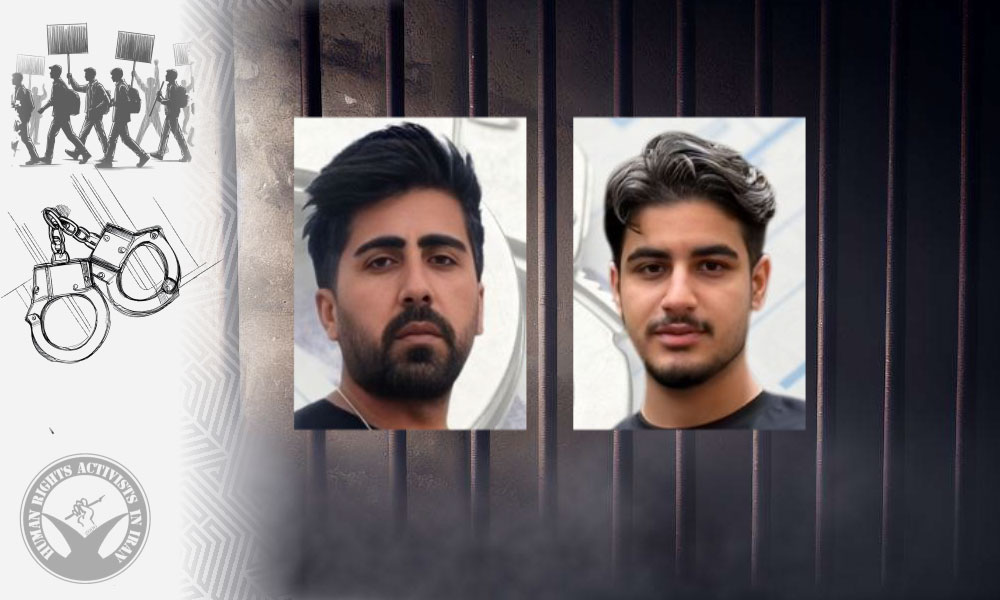
According to additional information received, Fardin Moslemi and Mahan Khoobani, both 16 years old, were arrested by security forces in the cities of Gachsaran and Yasuj and transferred to an unknown location. Fardin Moslemi was arrested in the early hours of today, Friday, January 2, by IRGC Intelligence forces in Gachsaran, while Mahan Khoobani was arrested yesterday in Yasuj.

HRANA has also learned that Misagh Kooch Peydeh and Amir Nodehi, residents of Tehran, as well as Salman Ghodrati, a resident of Bojnord, have been arrested. According to this report, Messrs. Nodehi and Ghodrati were arrested yesterday, Thursday, by security forces.

Meanwhile, the Public and Revolutionary Prosecutor of Izeh announced the arrest of a number of citizens during last night’s protests in the city. Published reports also indicate that today, Friday, security agents arrested at least five individuals during protests by citizens in Zahedan.

In addition, reports have been received of the arrest of at least 16 citizens in the cities of Tehran, Kermanshah, and Ilam. The identities of these individuals have been reported as: Iman Ali-Moradi, Ali Najafi, Mohammad Hasanvand, Bijan Karimian, Mohammad Javad Zarei, Akbar Darvishi, Aref Darvishi, Mohammad Havasi, Sepehr Salehi, Amir Raoufi, Ehsan Maleki, Milad Kiadi, Farzad Shokri, Abolfazl Shadfar, Moein Maleki, and Yazdan Bakhti. These arrests took place on December 31 and January 1.

The chief justices of Lorestan and Isfahan provinces also announced that a number of protesting citizens were arrested in recent days in the counties of Azna, Delfan, and Isfahan.

In the same context, a channel close to security institutions published two separate videos of forced confessions by a detained citizen in Amol. In these videos, whose recording conditions are unclear, a young man with a fully visible face expresses remorse for publishing calls for protests. The same channel also released a video of the arrest of a citizen on January 2 in Khorramabad, claiming that weapons and ammunition were discovered in his possession. According to the report, this arrest was carried out by agents of the Abolfazl Corps of the IRGC in Lorestan Province.

State broadcaster IRIB also released videos containing forced confessions of several citizens, announcing their arrest during protests in Kermanshah. At least four citizens can be seen in these videos. Mehr News Agency likewise published a video of a forced confession by a citizen arrested yesterday on Motahhari Street in Khorramabad; the circumstances under which these videos were recorded remain unknown.

Subsequently, the Public and Revolutionary Prosecutor of Izeh once again announced the arrest of a number of citizens during last night’s protests in the city.

Meanwhile, Tasnim News Agency reported that several protesters were arrested during demonstrations in Qazvin on charges described as belonging to “saboteur elements.” According to the agency, one individual allegedly involved in publishing protest calls online was also arrested.

HRANA has also learned that on December 31 and January 1, a number of citizens in Gorgan were arrested for publishing calls for protests.

The Public and Revolutionary Prosecutor of Hamedan also announced today the arrest of several citizens during protests in the city, without providing details regarding their identities or the exact timing of their arrests.

Ashraf Montazeri, daughter of Ayatollah Montazeri, stated that her daughter and grandchild were arrested during street protests and released after one day on bail.

Fars News Agency also reported the arrest of a citizen in Isfahan, claiming that he “intended to join the gathering with a handgun and carry out anti-security and sabotage actions.” According to the outlet, the arrest took place on Thursday, January 1.

Additionally, media outlets close to security institutions, without naming individuals, reported the arrest of three citizens, including a teenager, in the cities of Isfahan, Khorramabad, and Amol during the ongoing protests.

In the final hours of today, the Public Relations Office of the Rouhollah Corps of the IRGC in Markazi Province announced the arrest of the administrators of two Telegram channels in the cities of Saveh and Arak, claiming that these channels played a role in the “management and direction of protesters.”

Meanwhile, Amirkabir Newsletter reported that Amirhossein Keshavarz, a student activist, was arrested by security forces. According to the report, agents went to his residence today, arrested him, and transferred him to an unknown location.

Reactions

As nationwide protests entered their sixth day, officials of the Islamic Republic and media outlets affiliated with official and security institutions, alongside continued on-the-ground repression, have sought to reinforce a dominant narrative centered on “foreign interference” and “national security,” while sidelining protesters’ demands.

At the political level, Abbas Araghchi, Iran’s foreign minister, reacting to support expressed by Donald Trump for protesters, described the stance as “irresponsible and dangerous,” claiming that such statements target Iran’s sovereignty and that the Islamic Republic’s armed forces are “ready to respond.” At the same time, Mohammad Bagher Ghalibaf, the Speaker of Parliament, and Alireza Salimi, a member of the parliamentary presidium, issued threatening warnings that any “foreign interference” would be met with a “regret-inducing” response.

In this context, Iran’s Supreme National Security Council sent a letter to domestic media outlets, urging them to condemn Trump’s support for protesters and, by drawing a “clear line with the enemy,” refrain from what it described as “raw, emotional, or tension-inducing dissemination.” The council also praised media outlets that it said had “contributed to stability,” reflecting intensified control and guidance of the media narrative on the sixth day of protests.

In the judicial and security sphere, officials such as Saeed Shahvarai, Chief Justice of Lorestan Province, announced the arrest of protesters in cities including Azna and Delfan, without providing transparent details regarding charges or judicial procedures. At the same time, some pro-government religious figures, including Hossein Nouri Hamedani, while implicitly acknowledging economic pressures, sought to reduce the roots of the crisis to “mismanagement” and avoided linking the protests to the political structure.

At the international level, Volker Türk, the United Nations High Commissioner for Human Rights, expressed concern over developments in Iran, stating that reports of violence against protesters are being followed “closely,” and called on Iranian authorities to respect citizens’ fundamental rights, including freedom of expression, peaceful assembly, and association. This position was expressed amid numerous reports of shootings, arrests, and an intense security atmosphere across various Iranian cities.

State-affiliated media, in their coverage of the sixth day, focused on emphasizing external threats, warning the United States and Israel, and promoting the narrative that protests are being directed by “hostile groups”—a narrative that does not align with field evidence or the breadth of protesters’ demands.

Conclusion

The ongoing protests, which began in Tehran’s Grand Bazaar, entered their sixth day with expanded geographic scope, increased public participation, and an intensified presence of security forces. The combination of livelihood and political demands, the rise in arrests, and officials’ efforts to simultaneously contain the crisis through economic and security measures reflect the authorities’ high sensitivity to the continuation of these protests.

HRANA continues to collect, verify, and complete information related to these protests and will publish supplementary reports should the gatherings persist or expand.

Two Citizens, Including a Teenager, Arrested in Gachsaran and Yasuj

HRANA – During protests in the cities of Gachsaran and Yasuj, two citizens, including a teenager, were arrested by security forces and transferred to an unknown location.

Their identities have been confirmed by HRANA as Fardin Moslemi and Mahan Khoobani, 16 years old, from Yasuj.

Based on information received by HRANA, Mr. Fardin Moslemi was arrested in the early hours of Friday, January 2, 2026, by IRGC Intelligence forces in the city of Gachsaran. Mahan Khoobani was also arrested yesterday in Yasuj by security agents.

As of now, there is no information regarding the whereabouts of these protesting citizens.

It is worth noting that Fardin Moslemi Asl, a resident of Dehdasht County, had previously been summoned on December 13, 2025, to Branch Three of the Investigative Prosecutor’s Office of Boyer-Ahmad County.

It should also be noted that gatherings and strikes by shopkeepers and bazaar merchants, which began in Tehran on Sunday, December 28, expanded beyond bazaars and commercial centers starting Tuesday, December 30, 2025. With the participation of students, citizens, and various social groups, these protests have become one of the most widespread demonstrations in recent years. For more information, readers may refer to HRANA’s detailed report on the fifth day of protests, published late last night.

At Least 17 Prisoners Executed in Iranian Prisons Over Two Days

HRANA – Over the past two days, HRANA has reported the execution of 17 prisoners in various prisons across Iran. This report provides details of these executions:

Saturday, December 20:

On this day, HRANA reported the executions of the following individuals:

Yashar Tehrani Moghadam, on a charge of murder, at Karaj Central Prison
Kian Papi, on a charge of murder, at Aligudarz Prison
Behzad Hosseini Rad, on a charge of murder, at Kermanshah Prison
Yarhossein Hassanvand, on a charge of murder, at Khorramabad Prison
Mohammad Javad Kalani, on a charge of murder, at Nahavand Prison
Hessam Nouzari, on a charge of murder, at Ardabil Prison
Moslem Salimi, on drug-related charges, at Hamedan Prison
One prisoner of unknown identity, on a charge of murder, at Dezful Prison

Sunday, December 21:

Fariborz Ghasemi, on a charge of murder, at Yasuj Prison
Reza Dastar, on drug-related charges, at Bandar Abbas Prison
Kazem Sourian, on a charge of murder, at Qom Prison
Vahid Pazouki, on drug-related charges, at Semnan Prison
Ali Mohammad Koushki, on a charge of murder, at Borujerd Prison
Amir Mohammad Jadidi, on a charge of murder, at Qazvin Prison
Fardin Khani, on a charge of murder, at Arak Prison

The death sentences of two other prisoners were also carried out on murder charges at Tabriz Prison. The identity of one of them has been confirmed by HRANA as Ebrahim Mashayekhi.

As of the time of this report, the executions of these prisoners have not been officially announced by prison authorities or relevant institutions.

From the beginning of this year until the end of November, 2025, the Iranian regime has executed 1,594 people, marking an unprecedented increase compared to previous years.

29 Prisoners Executed in Multiple Prisons Across Iran

HRANA – In recent days, the death sentences of dozens of other prisoners have been carried out in various prisons across Iran on charges of murder and drug-related offenses. This report details these executions:

Monday, December 8:

Esfandiar Razaqi, on a charge of murder, in Esfarayen Prison
Sattar Zahedifar, on drug-related charges, in Gonabad Prison

The Iran Human Rights Organization also reported the execution of four prisoners on drug-related charges in Dastgerd Prison in Isfahan. In addition to the execution of Mohammadbaqer Souri, which HRANA had previously reported, three other prisoners—identified as Shahram Mirzadeh, Fardin Rezaei (37 years old), and Habib Faridi (approximately 30 years old)—were hanged in this prison.

Tuesday, December 9:

Mojtaba Dabir, on a charge of murder, in Nowshahr Prison, Mazandaran Province
Majid Nazaran, on a charge of murder, in Quchan Prison, Razavi Khorasan Province
Diako Farouqi, on a charge of murder, in Sanandaj Prison, Kurdistan Province

Saturday, December 13:

Gholam Saljouqi, on drug-related charges, in Hamedan Prison, Hamedan Province
Farshid Sagvand, on a charge of murder, in Aligudarz Prison, Lorestan Province
Kaka Morad Jafari, on a charge of murder, in Khorramabad Prison, Lorestan Province
Two prisoners on charges of murder in Kermanshah Prison; HRANA has confirmed the identity of one of them as Aziz Ali Moradi
Hassan Torki, on a charge of murder, in Yasuj Prison
Golmohammadi (first name unknown), on a charge of murder, in Nahavand Prison
Hamzeh Sarlak, on a charge of murder, in Dezful Prison, Khuzestan Province

Sunday, December 14:

Sadegh Abdi, on a charge of murder, in Qazvin Prison
Abolfazl Dana, on a charge of murder, in Ardabil Prison
Ali Eitivand, Kiumars Bahrami, Ehsan Yari, and Mohammad Karimi, on drug-related charges, in the Central Prison of Karaj, Alborz Province
Sultan Morad Aslanpour, on drug-related charges, in Tabriz Prison
Yaser Saki Zadeh, on drug-related charges, in Qom Prison
Mohammad Amin Bakhtiari, on drug-related charges, in Semnan Prison
Mohammad Dinari, on drug-related charges, in Arak Prison, Markazi Province
Farhad Abdouli, on a charge of murder, in Dezful Prison

Additionally, a prisoner with an unknown identity was executed on a charge of murder in Borujerd Prison

As of the time of this report, the executions of these prisoners have not been officially announced by prison authorities or the relevant institutions.

Twelve Prisoners Executed in Iran on Murder and Drug Charges

HRANA- Over the past two days, HRANA has reported the execution of 12 additional prisoners in various prisons across Iran. These prisoners had been sentenced to death on charges of murder or drug-related offenses.

Saturday, November 29
On this day, HRANA reported the executions of Alimorad Shahbazi in Aligudarz Prison, Mohammadkarim Moradi in Dizel Abad Prison in Kermanshah, Iman Mehrabi in Sanandaj Prison, Marvan Jaberi in Dezful Prison, and another prisoner identified only as (first name unknown) Ashtiani in Yasuj Prison. All of these prisoners had been sentenced to death on murder charges.

HRANA also reported that two additional prisoners convicted of murder were executed in Karaj Central Penitentiary; the identity of one of them, Arman Nairi, has been confirmed by HRANA.

Another prisoner, Abolfazl Foroukhi, was executed in Hamedan Prison on drug-related charges.

Sunday, November 30
According to HRANA, Ehsan Nadi was executed on drug-related charges in Arak Prison; Yashar Sadeghi on murder charges in Bukan Prison; Hossein Rashidian on murder charges in Saveh Prison; and Kazem Mo’tamedi on murder charges in Dezful Prison.

As of the time of this report, the executions have not been announced by prison officials or responsible authorities.

From the beginning of this year until the end of November, 2025, the Iranian regime has executed 1,594 people, marking an unprecedented increase compared to previous years.

Subscribe to Our Newsletter

Now is definitely not the time to stop reading!

Report on the Execution of 36 Prisoners in Various Prisons Across Iran

HRANA – In recent days, a broad wave of executions has continued across Iran, with dozens of prisoners, mostly charged with murder or drug-related offenses, hanged in various prisons throughout the country.

November 16:
According to Iran Human Rights, two prisoners, Sajjad Habibi from Fardis, Karaj, and Mohammadreza Besharat from Tehran, were executed in Qazvin Prison. According to the report, Sajjad Habibi had been arrested about four years ago on charges of intentional murder following a street altercation and was sentenced to death by the Criminal Court. Mohammadreza Besharat, 27, had also been arrested about six years ago on charges of intentional murder and sentenced to death.

Monday, November 17:
According to HRANA, a prisoner of Afghan nationality was hanged in Ferdows Prison on drug-related charges.

Tuesday, November 18:
On this day, HRANA reported that the death sentence of Heydar Tahmasebi, convicted of murder, was carried out in Mahshahr Prison.

Wednesday, November 19:
HRANA reported the executions of Shahrokh Sattari, convicted of murder, in Ardabil Prison, and Mohammadkarim Bastami, convicted on drug-related charges, in Quchan Prison.
Iran Human Rights also reported the execution of Kianoush Shadman, 29, in Lakan Prison of Rasht; Reza Nosrati, 25, and Mansour Deirin, 36, convicted of murder, in Adelabad Prison of Shiraz; and Hamidreza Pirhadi, 37, convicted of murder, in Borujerd Prison.

Thursday, November 20:
HRANA reported the execution of Mahan Sheikhi, convicted of murder, in Saveh Prison.
According to Iran Human Rights, Ne’mat Majidzadeh and Mehran Darabian, 27, were executed in Semnan Prison on charges of murder and rape, respectively; Mobin Ramazani from Yazd and Hassan Shokat, 43, were executed in Yazd Prison on drug-related charges; and Mozaffar Abdolvand, 30, was executed on murder charges in Dorud Prison.

Saturday, November 22:
HRANA reported the execution of Mohammad Tajik, an Afghan national, convicted of murder, in Taybad Prison.
HRANA also reported that on the same day, Sasan Misaghi (murder) in Yasuj Prison, Jassem Aghaei (murder) in Karaj Central Penitentiary, Rastin Baharvand (murder) in Khorramabad Prison, Peyman Alizadeh (drug-related offenses) in Bandar Abbas Prison, and Yaser Abdoli and Yaroli Haseli (drug-related offenses) in Dizelabad Prison in Kermanshah were executed.
HRANA further reported the execution of two additional prisoners on drug-related charges in Hamedan Prison. Details, including confirmation of the prisoners’ identities, are still under investigation by HRANA.
On the same day, Sari Prison witnessed the execution of two prisoners convicted of murder. Iran Human Rights confirmed the identity of one of them as Hooshang Hashemzadeh, 34, and HRANA confirmed the second as Amir Moradi.

Sunday, November 23:
HRANA reported the following executions:

Ayoub Zeidi, convicted of murder, in Tabriz Prison
Mousa Golpayegani, drug-related charges, in Semnan Prison
Mohammad Hossein Akbari, murder, in Dezful Prison
Amir Nosrat Piriyan, drug-related charges, in Bam Prison
Mahmoud Ali Soltanabadi and (first name unknown) Maleki, murder, in Qom Prison
Three prisoners on drug-related charges in Arak Prison, HRANA has confirmed the identity of one, Mirza Janalizadeh.

At the time of this report, the executions had not been announced by prison officials or the relevant authorities.

Kourosh Jalil Arrested and Transferred to Prison to Serve His Sentence

HRANA – Kourosh Jalil, a resident of Yasuj, was arrested and transferred to the city’s prison to begin serving his 15-month prison sentence.

Based on information received by HRANA, on Friday, November 21, security forces entered Mr. Jalil’s home, arrested him, and transferred him to the Yasuj Prosecutor’s Office. He was then taken to the city’s prison to begin serving his sentence.

In August, Mr. Jalil was sentenced by Branch 1 of the Yasuj Revolutionary Court to two years, one month, and one day in prison. This included 10 months for propaganda against the regime and 15 months and one day for insulting the Supreme Leader and the founder of the Islamic Republic. Since he did not appeal the ruling, the verdict became final and enforceable. Under Article 134 of the Islamic Penal Code, the most severe punishment, 15 months and one day, will be applied.

In May of this year, Branch 1 of the Public and Revolutionary Prosecutor’s Office of Boyer-Ahmad issued an indictment against Mr. Jalil on charges of propaganda against the regime and spreading falsehoods. His hearing, along with two other citizens, had previously been held at the same branch.

In December of 2024, in another case, Kourosh Jalil was sentenced to three years in prison on charges of insulting the founder of the Islamic Republic, unlawful assembly, insulting Islamic sanctities, insulting the Supreme Leader, and propaganda against the regime. This sentence had been suspended for one year.

Kourosh Jalil had been released on bail in July 2024 after being arrested the previous month. On that same day, his sentence of a monetary fine was enforced following several hours of detention.

HRANA’s Report on the Execution of 31 Prisoners in Recent Days

HRANA – In recent days, authorities in several prisons across Iran have carried out the execution of dozens of inmates on drug-related and murder charges. The pace of executions this year has been unprecedented compared to previous years.

HRANA has documented the following executions in recent days:

Tuesday, November 11

Reza Geraei, on drug-related charges, in Behbahan Prison

Yaqub Dachi, 28, on murder charges, in Ilam Prison

Wednesday, November 12

Abbas Beigi, on murder charges, in Yasuj Prison

Saber Fallah, 33, on murder charges stemming from a street altercation, in Qom Prison

Thursday, November 13

Qomri Abbaszadeh, 29, and Iraj Aghaei, 30, on murder and drug-related charges respectively, in Sari Prison

Saturday, November 15

Nour Mohammad Rahmati, on drug-related charges, in Aligudarz Prison

Yar Morad Hassanvand, on murder charges, in Khorramabad Prison

Two prisoners executed in Dizelabad Prison in Kermanshah on murder charges; HRANA has confirmed the identity of one of them as Kamyar Fathi

Jaber Saki and Jahan Rasouli, on murder and drug-related charges respectively, in Dezful Prison

Sunday, November 16

Seyed Ali Hashemi of Karaj, on drug-related charges, in Salmas Prison

(First name unknown) Yeganeh, on drug-related charges, in Bam Prison

Habib Ezzati, on murder charges, in Sanandaj Prison

Mohammad Amin Safari, on murder charges, in Bukan Prison

Yasin Esfandiari, on drug-related charges, in Semnan Prison

An unidentified prisoner, on murder charges, in Nahavand Prison

Shokat Veisi (female), on drug-related charges, in Damghan Prison

Amin Shokarkhodaei, on murder charges, in Arak Prison

Mosib Khalavand, on drug-related charges, in Bandar Abbas Prison

Monday, November 17

Reza Kamayi, on murder charges, in Sepidar Prison of Ahvaz

Alireza Keshavarz, on murder charges, in Sabzevar Prison

Amir Farkhnezhad, on drug-related charges, in Zanjan Prison

Behzad Hasani, on murder charges, in Gorgan Prison

Two prisoners previously convicted on drug-related charges in Taybad Prison; HRANA has verified the identity of one of them as Javad Sattari

 Four prisoners were executed in Vakilabad Prison in Mashhad on drug-related charges. HRANA has confirmed the identities of two of them as Shamseddin (surname unknown), an Afghan national, and Alimardan Barani.

As of the time of this report, prison authorities and responsible institutions have not publicly announced these executions.

From the beginning of this year until the end of October, the Iranian regime has executed 1,286 people, marking an unprecedented increase compared to previous years.

Ongoing Detention and Uncertainty for Three Citizens in Yasuj Prison

HRANA – Mohammad-Ali Mohammad-Hosseini, Nima Hasanpour, and Sirus Akram-Kish, three residents of Yasuj, remain in detention at the city’s prison more than two weeks after their arrest, without clarity on their legal status.

According to information received by HRANA, the three were arrested in the mid-October by agents of the Yasuj office of the Ministry of Intelligence. Since then, they have been held without charge or trial and, by order of the investigating judge of Yasuj Branch 3, have been denied access to legal counsel and family visits.

HRANA has learned that Mohammad-Hosseini suffers from autoimmune disease and diabetes, and the lack of information about his condition has heightened his family’s concerns.

The charge of “acting against national security” has been brought against these citizens.

Mohammadhosseini, aged 45, along with Hasanpour and Akram-Kish, both around 40 years old, are residents of Yasuj County.

Drug-Related Crimes: Two Prisoners Executed in Yasuj Prison

HRANA – At dawn yesterday, October 14, the death sentences of two prisoners previously convicted on charges related to drug offenses were carried out in Yasuj Prison.

HRANA has been able to confirm their identity  as Allahkaram Ghasemi and Ebrahim Delaram. Based on information obtained by HRANA, the prisoners had been arrested on charges related to drug offenses and subsequently sentenced to death by the Revolutionary Court.

As of the time of this report, the execution of these prisoners has not been announced by prison officials or state media.

In 2024, according to 812 reports compiled by HRANA, the Iranian regime executed 930 individuals in its prisons, marking the highest number of executions in the past 12 years. Despite the scale of these executions, prison officials and other relevant authorities publicly acknowledged only 6% of them, highlighting the regime’s lack of transparency and accountability.