Identity Confirmed for 9 Citizens Arrested During Nationwide Protests

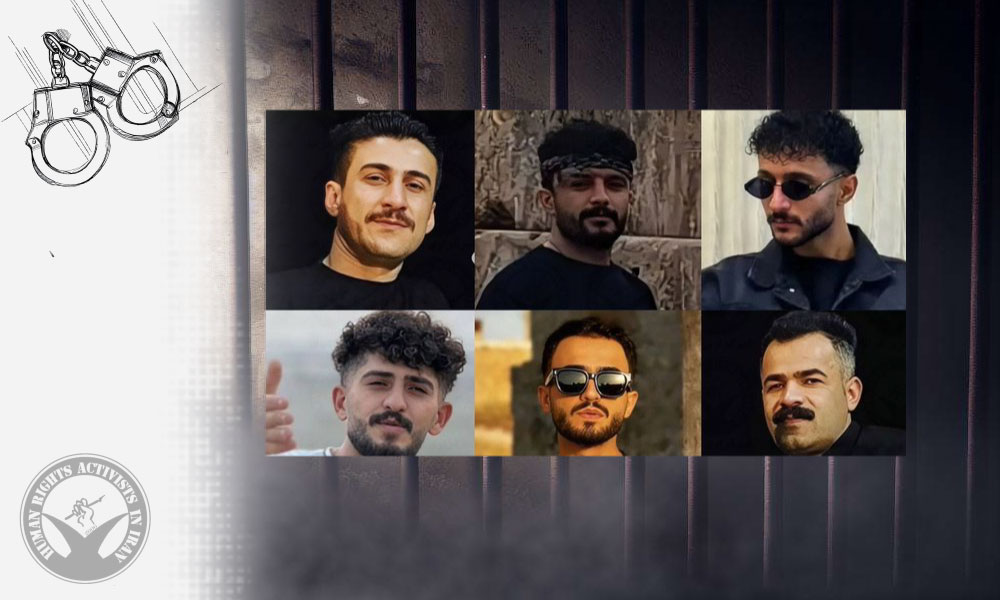
HRANA – In recent days, nine citizens identified as Dolaram Kazemi, Vahid Shadman, Bardia Darvishi, Ali Shah Shirmohammadpour, Salam Aref Khanlari, Navid Najafi, Behnam Bolandbakht, Armin Pirani, and Ali Ahmadi were arrested by security forces in the cities of Gilan-e Gharb, Qasr-e Shirin, Darreh Shahr, and Abdanan.

According to Kurdpa, the arrests took place between January 6 and January 8, 2026.

Based on the report:

  • On January 6, Dolaram Kazemi was arrested in Gilan-e Gharb, and Salam Aref Khanlari in Darreh Shahr.

  • On January 7, Bardia Darvishi and Behnam Bolandbakht were arrested in Gilan-e Gharb.

  • On January 8, Vahid Shadman was arrested in Qasr-e Shirin; Ali Shah Shirmohammadpour and Navid Najafi in Gilan-e Gharb; and Armin Pirani and Ali Ahmadi in Abdanan.

As of the time of this report, no information has been obtained regarding the charges against these individuals or their place of detention.

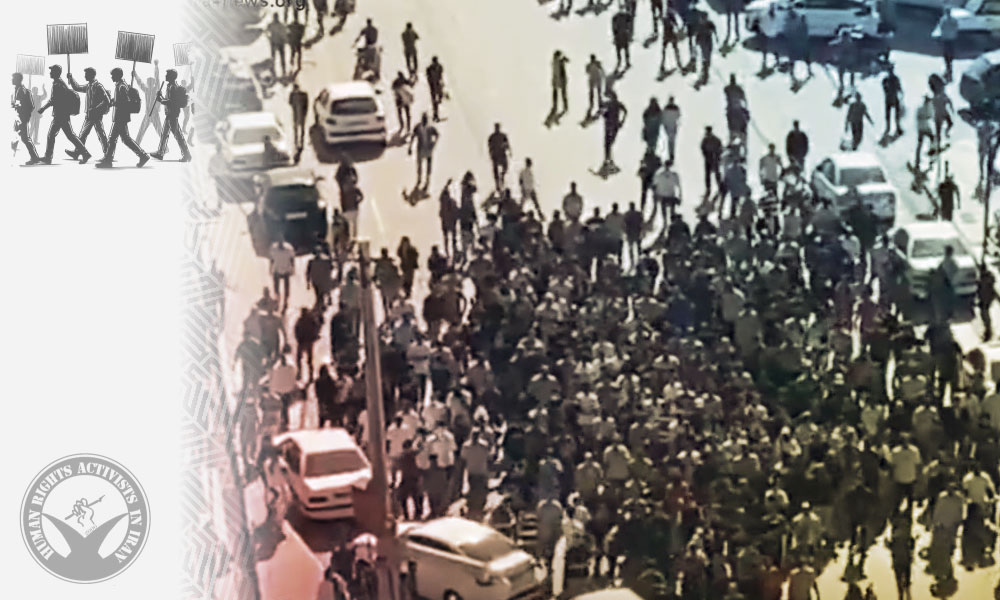
It is worth noting that protests and strikes by shopkeepers and merchants began in Tehran on Sunday, December 28, 2025, and after two days expanded beyond bazaars and commercial centers. With the participation of students, citizens, and various social groups, these protests have become one of the most widespread demonstrations in recent years. For further information, readers may refer to HRANA’s detailed report on the twelfth day of the protests, published last night.

A Report on the Twelfth Day of Nationwide Protests in Iran: Widespread Strikes, Internet Shutdown, and Surge in Arrests

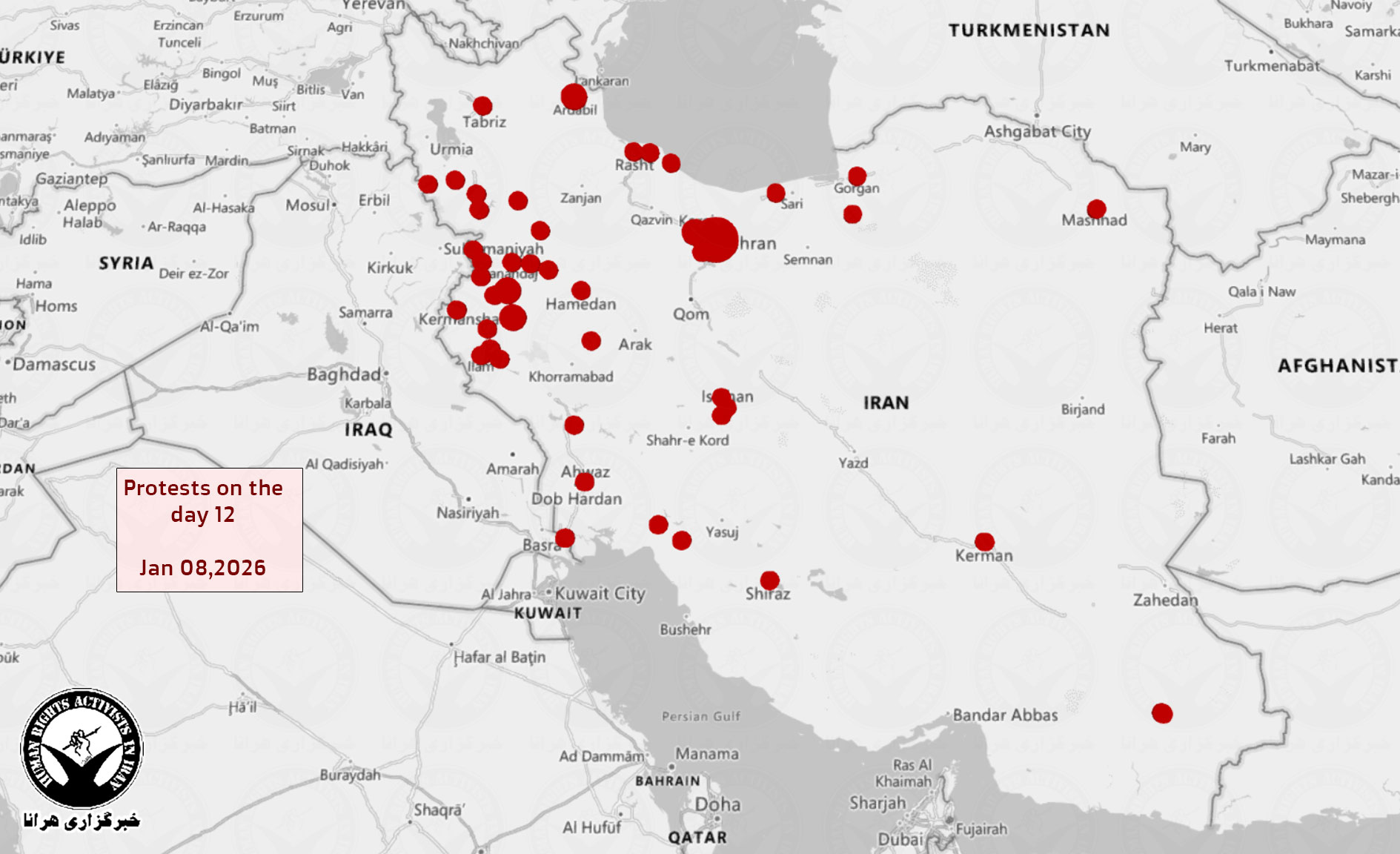
HRANA – Nationwide protests in Iran continued on their twelfth day, Thursday, January 8, 2026, according to reports collected by HRANA. Demonstrations and protest actions were recorded in at least 46 cities across 21 provinces. At the same time, a wave of strikes and market closures was reported, particularly in Kurdish regions, with dozens of cities in Kurdistan, West Azerbaijan, Kermanshah, and Ilam provinces joining the strikes.

On the twelfth day of the nationwide protests, at least 60 additional arrests were recorded. This brings the total number of detainees over the past 12 days to more than 2,277 individuals. Among those arrested, at least 166 were under the age of 18 and 48 were university students. During the same period, 45 cases of forced confessions were broadcast by state media.

Alongside these developments, reports indicated a nationwide internet shutdown on the twelfth night of protests, as well as targeted disruptions to infrastructure, including a sharp drop in IPv6 connectivity. These measures led to widespread disruptions in mobile internet access, internet-based calls, and the functioning of circumvention tools. The death toll from the past 12 days of protests has reached 42 people, including five minors under 18 and eight security personnel or officers.

Background of the Protests

The current protests began on December 28, 2025, amid accumulated social and economic grievances, and gradually expanded from trade- and market-based demands to street protests, later spreading into university spaces. Continued economic pressure, declining purchasing power, and a sense that public demands are being ignored, alongside a deep lack of trust in official accountability mechanisms, have been described as the main drivers behind this wave of unrest.

In the following days, the pattern of protests shifted from scattered gatherings to a network of demonstrations, nighttime chants, and market strikes. By the twelfth day, widespread strikes and shop closures, alongside street protests, had emerged as one of the most prominent features. At the same time, the increased presence of security forces and intensified crackdowns, including mass arrests, the airing of forced confessions, and restrictions on communications (internet shutdowns or signal disruptions), have pushed much of the situation into an environment marked by information disruption and competing narratives.

In parallel, reported slogans indicate that demands have not remained confined to economic issues. In many locations, they have evolved into political protests and structural criticism. Within this context, the twelfth day of protests can be seen as a continuation of a phase in which the street, the bazaar, and civil actions have operated simultaneously and in a complementary manner, while the government has sought to contain both the scope of the protests and their public reflection through a combination of on-the-ground control, judicial and security pressure, and communication restrictions.

Nationwide protests Day 12

Geographic Scope and Key Focal Points of the Protests

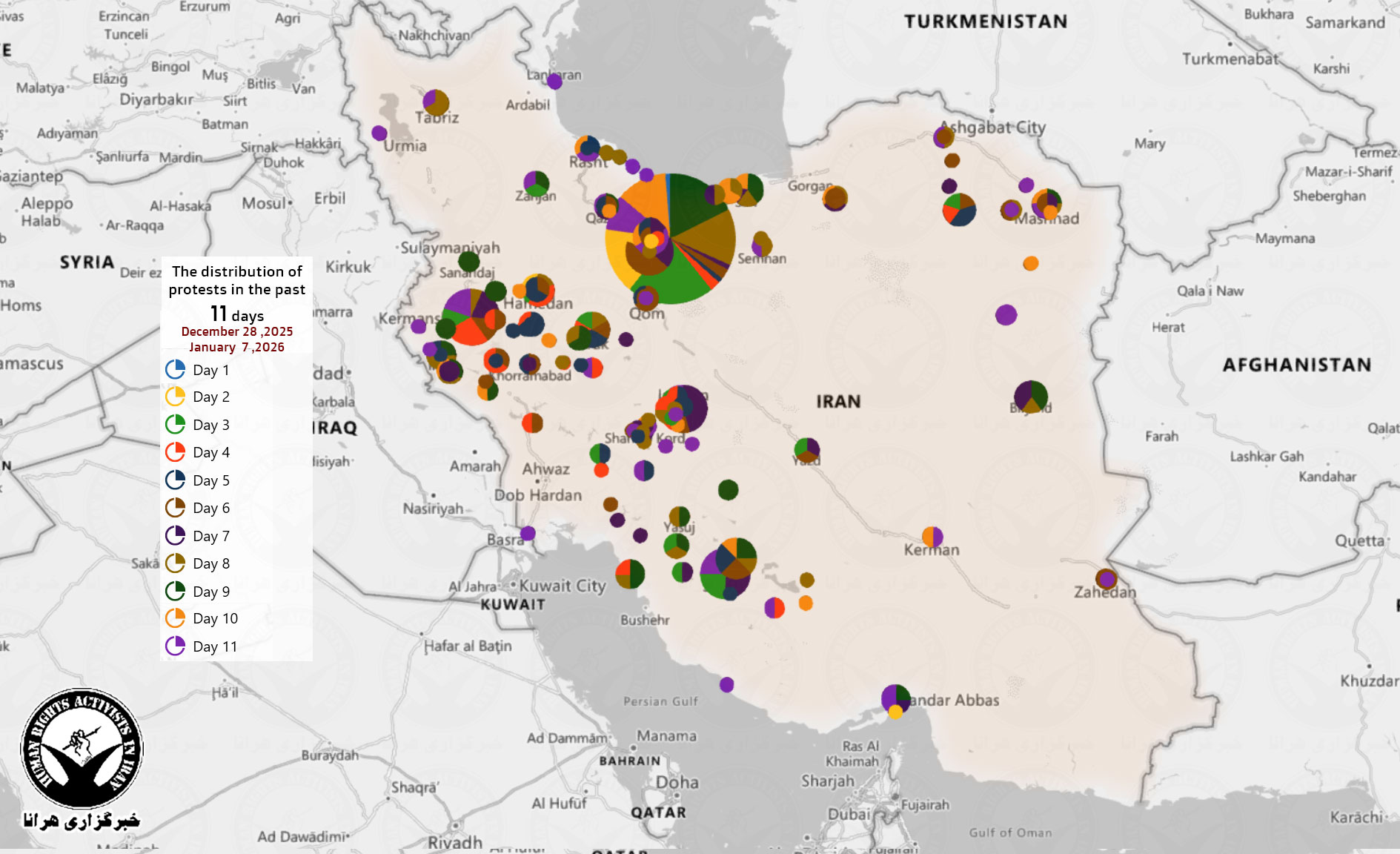
Reports collected from various sources indicate that on the twelfth day of the protests, demonstrations and protest activities continued in at least 46 cities across 21 provinces.

In Tehran, numerous locations were reported as sites of street presence and scattered gatherings by protesters. These included Aryashahr and Sadeghieh, Narmak, Valiasr, Keshavarz Boulevard, Yousef Abad, Azadi Street (Eskandari intersection), Tehranpars, Nazi Abad, Sattarkhan, Haft-Hoz, Gheytariyeh, Vanak, Punak (from Esfahani Square to Marzdaran), Kashani Boulevard, Taleghani Square, and Shahrak-e Azadi. In addition, reports were published of nighttime chanting from inside homes in the Heravi area, as well as neighborhood-based protests in Saadat Abad and Jannat Abad. Some reports also referred to street gatherings in Islamshahr.

Furthermore, HRANA received reports of shop closures and strikes in the Tehran Grand Bazaar and central districts of the city, coinciding with the concentration of security forces around Sabzeh Meydan, Amir Kabir Street, and along the metro route from 15 Khordad Station to the Naser Khosrow–Sabzeh Meydan intersection.

In a number of cities, reports were published of internet or electricity disruptions, as well as the sound of gunfire being heard.

According to the compilation of reports received by HRANA, gatherings and protests on the twelfth day took place in cities including Sanandaj, Kermanshah, Marivan, Kamyaran, Ravansar, Sarpol-e Zahab, Saqqez, Mahabad, Paveh, Hamedan, Bukan, Isfahan, Bijar, Dehgolan, Piranshahr, Eslamabad-e Gharb, Ardabil, Ilam, Takab, Sarableh, Sarvabad, Qorveh, Lumar, Pir Bakran, Borujerd, Kerman, Kalachay, Shiraz, Abadan, Astaneh Ashrafieh, Tehran, Gachsaran, Behbahan, Tabriz, Islamshahr, Mashhad, Karaj, Babol, Dezful, Shahin Shahr, Gorgan, Ahvaz, Rasht, Damghan, Iranshahr, and Robat Karim.
Fatalities and Victims of the Protests

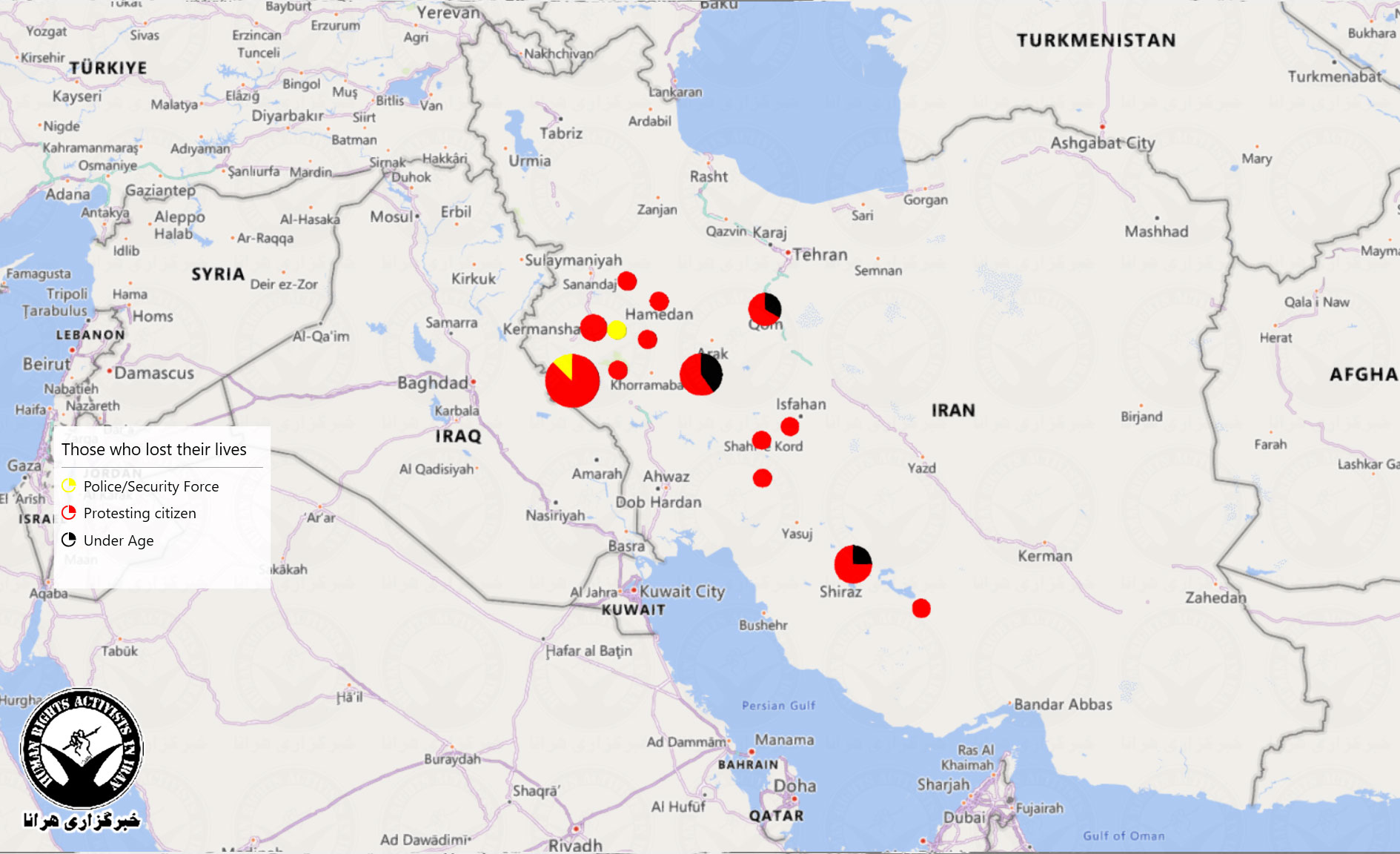
According to updated data, by the end of the twelfth day of the protests, at least 42 people had lost their lives. This figure includes:

β€’ 29 protesting civilians
β€’ 8 security–military forces
β€’ 5 children and adolescents (under 18 years old)

The presence of children among those killed has once again highlighted serious concerns regarding how security forces are confronting the protests and whether the principle of proportionality in the use of force is being observed.

In addition to those killed, numerous reports have been published regarding citizens injured during street clashes and security operations. However, due to limited access to field information and ongoing communication disruptions, the exact number of injured individuals is still being compiled.

Universities and the Role of Students

Based on aggregated data, 34 universities have so far been involved in the protests, with a total of 46 gatherings held on university campuses. Nevertheless, no reports of demonstrations at universities were received today.

In terms of security responses, collected data indicate that over the past 12 days, at least 48 students have been arrested. Alongside this broader trend, notable developments in the university sphere today include the following:

β€’ Amirkabir University of Technology: It was reported that end-of-term exams have been postponed for one week, citing the β€œcurrent special circumstances.”
β€’ Ministry of Health: An official source claimed that β€œonly one medical sciences student” has been arrested, and that this arrest occurred β€œoutside the university environment.”
β€’ University of Tehran: The university’s Student Council reported the arrest of Parsa Ghobakhloo, an undergraduate student of electrical engineering, by security forces, stating that his whereabouts are unknown and that the detaining authority has not been identified.

Forms of Protest and Slogans

On the twelfth day of protests, forms of protest action remained diverse. Street gatherings and visible protest presence in urban centers, alongside strikes and market closures in a number of cities, were among the most prominent expressions of dissent. The continuation of this pattern,particularly during nighttime hours and under conditions where internet disruptions or outages and power blackouts were reported in some areas, indicates that the protests have not been confined to a single fixed form, but continue to reproduce themselves through varied methods.

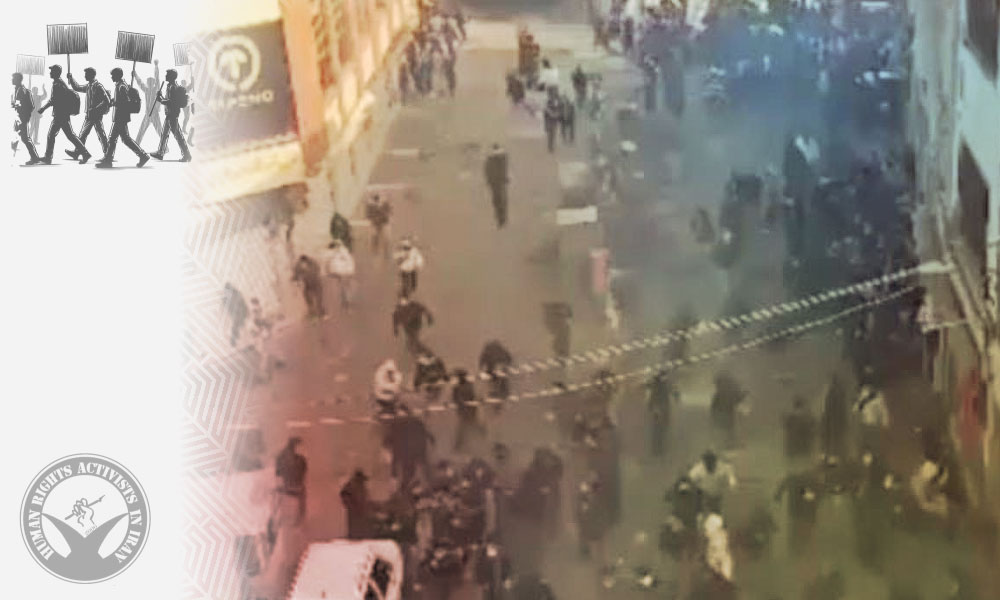
At the ground level, reports point to a combination of scattered and decentralized actions, including neighborhood-based protests, temporary blockages of certain routes and disruptions to traffic, as well as the use of symbolic and low-cost methods to express dissent. At the same time, in several cities, security forces were reported to have used tools such as tear gas to disperse gatherings, and in some areas, the sound of gunfire further intensified the security pressure surrounding the protests.

In terms of content, the slogans and messages raised can largely be categorized into two main themes: some reflect livelihood-related grievances and economic pressures, while others relate to structural and political criticism of governance, the lack of accountability of official institutions, opposition to state repression and violence, and demands for regime change. This simultaneity suggests that, in the minds of protesters, the economic crisis and the crisis of governance are understood as two interconnected aspects of the same underlying problem.

Arrests and Intensified Security Crackdowns

According to collected data, at least 60 additional arrests were reported or confirmed today. As a result, the total number of detainees over the past 12 days has risen to more than 2,277 people. However, due to limited access to field information and incomplete reporting from some areas, the actual number of arrests is likely significantly higher. During the same period, it has also been reported that 45 cases of forced confessions by detainees have been broadcast. Among those arrested, at least 48 are students and 166 are under the age of 18.

Alongside the increase in arrests, signs of escalated on-the-ground repression have been reported in several cities. Reports from Kermanshah indicate the violent arrest of protesters by plainclothes agents. In Behbahan and Ardabil, witnesses have also reported gunfire by security forces.

In addition to street-level crackdowns, a number of official and governmental actions and positions point to an expansion of security and judicial repression. Among these, security bodies in Azna (Lorestan Province) claimed to have arrested an β€œorganized network,” attributing it to monarchist groups, and alleged that the network was involved in the β€œrecruitment of young women” and the β€œdistribution of Lion and Sun flags and promotional materials.” In Tehran, the judiciary announced the opening of cases against β€œcertain individuals” as well as β€œbrands and shops” on charges of direct or indirect support for protest calls. At the same time, reports cited an order by the Tehran prosecutor to monitor cyberspace and identify individuals or cases deemed to be in violation.

At the field level, reports have emerged of widespread use of tear gas, including in Shahin Villa (Karaj), Ghaemshahr, Khorramabad, and Maragheh, as well as gunfire in several cities. These include aerial gunfire in Bijar, reports of repeated gunshots in Khorramabad, and heavy gunfire in Behbahan. In Gohardasht, Karaj, severe communication disruptions and signal outages were also reported simultaneously with clashes.

Summonses and Security Pressure Beyond the Streets

Alongside street-level repression, reports from the twelfth day indicate an expansion of security and surveillance pressures beyond public demonstrations. These pressures range from media threats and psychological operations to judicial tools, phone calls, text messages, and informal summonses. Their stated aim has been described as controlling narratives, preventing the continuation of protests, and monitoring professional, labor, and media circles.

Within this framework, Tasnim News Agency (close to security institutions) published a threatening video attributed to the FARAJA Intelligence Organization, claiming that β€œindividuals chanting slogans from inside their homes” had been identified, warned, and would be arrested β€œif necessary.” In a statement attributed to the same body, it was emphasized that β€œall activities are under intelligence surveillance” and that action against chanting from homes would continue.

At the same time, in the economic and trade sphere, reports indicate that The Ministry of Intelligence’s detention facility contacted some shopkeepers and threatened them to reopen their businesses.

In the realm of judicial pressure and digital surveillance, the opening of cases against certain individuals and brands or shops in Tehran has been cited as another example of repression outside the streets, an approach linked to monitoring cyberspace and efforts to curb direct or indirect support for protest calls.

Regarding narrative control and restrictions on content production, it has been reported that some protesters, civil activists, and journalists have been threatened or informally summoned through anonymous phone calls and text messages, warning them against taking positions or producing content related to the protests.

At the international level, in relation to the domestic media environment, the Committee to Protect Journalists (CPJ) has condemned the actions of security institutions in summoning and threatening journalists. The organization stated that following remarks by Ali Khamenei regarding repression, journalists were contacted and summoned to security bodies, including the IRGC.

Internet Disruptions and Communication Restrictions

On the twelfth night of the protests, it was reported that the internet was shut down nationwide, a situation that NetBlocks also confirmed as a widespread internet outage. In follow-up reports, NetBlocks warned that Tehran and several other cities were entering a state of β€œdigital blackout,” and also reported a complete internet shutdown in Kermanshah Province. Within this framework, it was reported that on Thursday, January 8, disruptions, severe slowdowns, and repeated outages continued in a large number of cities.

At the same time, published technical data indicate a pattern of targeted disruption of IPv6. According to reports, Filterban announced that a significant portion of IPv6 connections went offline around 15:19 Tehran time, with the timing pattern suggesting a coordinated action. In the same vein, Cloudflare Radar reported that the volume of IPv6 addresses dropped by approximately 98.5%, and the share of IPv6 traffic fell from around 12% to about 1.8%. It was further emphasized that disruption of this protocol can directly affect mobile internet, modern browsers, applications, internet-based calls, and even the functioning of a significant number of VPNs and circumvention tools. According to these reports, some VPNs either failed to connect or effectively stopped working.

At the field level, and based on specific reports received for January 8, communication restrictions were reported in several cities as follows:

β€’ Bijar (Imam Boulevard): Intermittent internet connectivity.
β€’ Khorramabad: Reports of internet shutdown and inability to send videos.
β€’ Neyshabur: Reports of a complete internet shutdown, with only text messages being sent with great difficulty.
β€’ Karaj (Gohardasht): Initially a complete internet shutdown in the early evening hours; later, mobile phone signal was cut to the extent that calls and SMS stopped working, with reports indicating that only landline phones remained usable.
β€’ Amol: In addition to communication disruptions, reports of power outages on main streets were raised, which as an environmental restriction further complicated communication and field coverage.

Strikes and Labor Protests

On the twelfth day of protests, alongside street demonstrations, an unprecedented expansion of strikes and market closures was reported. This pattern took shape from the early days, beginning with the protests on December 28 and reports of gatherings or protests by some shopkeepers in the Tehran Grand Bazaar, and then rapidly spread to numerous cities. On this day, strikes in many areas took the form of shop closures, market shutdowns, and merchants joining street protests.

Kurdish Regions and Kurdistan

Reports indicate widespread strikes in Kurdish- and Lur-inhabited areas, with dozens of cities across four provinces, Kurdistan, West Azerbaijan, Kermanshah, and Ilam, joining the strikes. At the city level, strikes by shopkeepers were reported in cities such as Sanandaj, Bukan, Kamyaran, Dehgolan, Saqqez, Qorveh, Paveh, Sarvabad, Ravansar, Eslamabad-e Gharb, Sarpol-e Zahab, and Kerend-e Gharb.

Tehran and the Bazaar Axis

In Tehran, reports point to the continued closure and stagnation of several markets and commercial centers, alongside the heavy deployment of security forces in parts of the city’s central and commercial districts. Some reports identified routes and locations such as Sabzeh Meydan, Amir Kabir Street, and the entrance of the 15 Khordad metro station up to the Naser Khosrow–Sabzeh Meydan intersection as focal points of security presenceβ€”conditions that, according to sources, could affect citizens’ movement and the normal functioning of the markets.

Cities and Markets Reported on Strike (Selected Examples)

In addition to Kurdish regions and Tehran, strikes and shop closures of varying scope were also reported in a range of other cities, including Arak, Hamedan, Khorramabad, Abyek (Qazvin), Borujerd, Qazvin, Isfahan, Ardabil, Bandar Abbas, Bandar Deylam (Bushehr), Shiraz, Khomeini Shahr, Karaj, Shahreza, Nurabad-e Mamasani, Kazerun, Tabriz, Urmia, and Zanjan.

International Reactions

As the protests continued, a number of international officials and figures responded to developments in Iran. Donald Trump warned on several occasions that if the Iranian government β€œstarts killing people like it did in the past,” it would face a β€œsevere blow,” and he emphasized the β€œvalue of freedom” in his remarks. Additionally, quoting a White House official (Wednesday, January 7), it was stated that the U.S. president had explicitly said that if the Iranian government shoots peaceful protesters or severely beats them, it will face a β€œsevere blow,” describing this as a β€œpromise.”

In the same context, J.D. Vance stated that β€œwe stand with anyone who peacefully protests for their rights.” The House Foreign Affairs Committee of the U.S. House of Representatives (majority) also warned that if Tehran violently kills peaceful protesters, β€œjustice will be swiftly served.”

The U.S. Department of State (including its Persian-language account) issued a travel advisory stating that Iran remains at Level 4 – Do Not Travel, urging U.S. citizens to β€œunder no circumstances” travel to Iran. The advisory cited risks such as terrorism, unrest, kidnapping, and wrongful detention. It has also been reported that Australia has urged its citizens to leave Iran.

In Europe, Roberta Metsola, President of the European Parliament, expressed solidarity with protesters and, referring to reports of β€œ30 killed,” emphasized that threats, prison, and tear gas cannot suppress the desire for freedom. Hannah Neumann (Chair of the European Parliament’s Iran delegation) also stated that people have returned to the streets and may face bullets, but for many, β€œsilence is more dangerous,” stressing the need to β€œshine a light” on events in Iran.

Meanwhile, Canada’s foreign minister expressed support for the right to protest and voiced concern over repression and violent crackdowns. Germany’s foreign minister (Johann Wadephul) condemned the β€œexcessive use of violence against protesters” and emphasized the right to peaceful protest and Iran’s obligation to uphold its international commitments.

Domestic (Governmental) Reactions

In response to the continuation of protests, a range of official and media positions were released at the level of the government, security–judicial institutions, and media close to the authorities. A significant portion of these responses focused on securitizing the protests and attributing them to foreign interference.

At the diplomatic level, Iran’s Ministry of Foreign Affairs described the support and positions of senior U.S. officials as β€œinterventionist and deceptive,” claiming that the United States is pursuing a range of tools including psychological warfare, media operations, the spread of disinformation, threats, and incitement to violence. In the same framework, Abbas Araghchi emphasized that β€œIran’s internal issues concern no one but the Iranian people,” framing the protests as β€œdomestic affairs.” Along these lines, some official statements sought to portray the protests as purely economic demands, while simultaneously attributing part of the problems to U.S. sanctions.

In the media and propaganda sphere, the newspaper Kayhan, using labels such as β€œMossad and ISIS agents,” attempted to portray protesters as a security threat, while also speaking of β€œharsh” judicial and security crackdown as the path forward. The repeated official dichotomy of β€œprotest” versus β€œriot” was also highlighted in various statements as a red line in government discourse.

At the parliamentary and security-institution level, reports emerged of a closed-door parliamentary session attended by the government and security/law enforcement bodies, during which it was said that β€œstatistics, charts, and provincial maps” of the protest situation were presented. In the narratives of some lawmakers, concepts such as β€œhybrid warfare” and β€œbehind-the-scenes enemy planning” were emphasized, and it was claimed that the government had been β€œtasked with engaging in dialogue with the people and calming them.” It was also reported that one MP (Mohammad Bayat) claimed that β€œthe use of weapons has occurred only in cases where the country was harmed”, a claim described as being in contradiction with field accounts and human rights reports, particularly regarding gunfire.

In statements by the government and the judiciary, Masoud Pezeshkian called on security forces to refrain from β€œtargeting protesters,” while the government spokesperson used emotional language to describe the pain of β€œevery drop of blood being spilled.” The head of the judiciary, addressing merchants’ strikes, described them as β€œdefenders of the system” and sought to avoid framing strikes or discontent as opposition to the authorities. At the same time, in certain judicial-security measures, emphasis was placed on monitoring cyberspace and confronting the symbolic economy of protest, including opening cases against β€œbrands or shops” and β€œpublic figures”, as tools to curb protest calls and indirect support.

Regarding the official narrative on casualties and security, the judiciary-affiliated outlet Mizan reported the killing of a police officer in Malard. In another reaction, the Ministry of Health claimed that arrests in university environments had been very limited and that only β€œone medical sciences student” had been arrested, and that this arrest had occurred β€œoutside the university environment.”

Domestic Reactions (Civil Society, Labour Groups, and Public Figures)

As the protests continued, a series of statements by professional and civil groups, along with positions taken by critical cultural, sports, and political figures, were published. A shared theme across many of these responses was the condemnation of repression, an emphasis on the right to protest, and solidarity with protesters.

Statements and Organizations

In the field of arts and culture, 184 Iranian filmmakers issued a statement condemning the crackdown on protests, emphasizing that shooting unarmed people constitutes a β€œcrime against the right to life,” and affirming their support for freedom of expression. The Iran Cinema House also stated in a separate declaration that people find no avenue other than the streets to voice their protests, describing violence against protesters as illegitimate, unlawful, and irrational.

Today, child rights organizations likewise condemned violence against children and called for the release of detained children and adolescents.

Regarding labor and professional protests, widespread strikes and shop closures were reported in Kurdish regions. These strikes were mainly documented in cities such as Ilam, Kermanshah, Sanandaj, Marivan, Saqqez, Mahabad, Bukan, Oshnavieh, and Sardasht.

Public Figures

Among well-known figures, a range of supportive and critical positions were expressed. Mohsen Makhmalbaf, in a supportive text, emphasized national solidarity and criticized individual dictatorship. Mohammad Fazeli proposed a β€œdemocratic bargain with the people” as a path forward. Parsa Pirouzfar, by raising a critical question about the β€œlimits of humiliating and crushing people’s bodies and spirits,” reacted to the atmosphere of repression.

Among sports figures, Voria Ghafouri expressed solidarity and announced that he would close his cafΓ© for today and tomorrow. Hamid Derakhshan, Mehdi Ghaedi, Mostafa Mastour, Alireza Faghani, and Rasoul Khadem also voiced support for the protests through messages or videos.

At the political and social level, Shirin Ebadi stressed solidarity and described the protests and strikes as unprecedented and nationwide. Azar Mansouri condemned the β€œrepressive approach” toward protesters, described the situation as a β€œcrisis of governance,” and called for the release of detainees, especially women, youth, adolescents, and students. Zahra Rahnavard, in a message using mournful language, referred to the β€œyoung lives cut down,” reiterated the slogan β€œDo not be afraid… we are all together,” and emphasized the transition to democracy.

In addition, references were made to positions and controversies surrounding Ali Daei, whose criticism of government performance and the economic situation, including remarks such as β€œeggs becoming a luxury item”, was met with reactions and media attacks. Mojtaba Mehrami also made statements expressing support for Mohammad Reza Shah and a positive view of the Pahlavi era.

Arrests

Individual Arrests with Confirmed Identities

  1. 1. Issa Foroughi – City of arrest: Dehdasht (Kohgiluyeh and Boyer-Ahmad Province), Gachi village – Place of detention: Unknown – Current status: Detained – Source: HRANA

  2. 2. Jaber Foroughi – City of arrest: Dehdasht (Kohgiluyeh and Boyer-Ahmad Province), Gachi village – Place of detention: Unknown – Current status: Detained – Source: HRANA

  3. 3. Iman Foroughi – City of arrest: Dehdasht (Kohgiluyeh and Boyer-Ahmad Province), Gachi village – Place of detention: Unknown – Current status: Detained – Source: HRANA

  4. 4. Jamal Askari – City of arrest: Dehdasht (Kohgiluyeh and Boyer-Ahmad Province), Gachi village – Place of detention: Unknown – Current status: Detained – Source: HRANA

  5. 5. Asghar Vahdat – City of arrest: Dehdasht (Kohgiluyeh and Boyer-Ahmad Province), Gachi village – Place of detention: Unknown – Current status: Detained – Source: HRANA

  6. 6. Pouya Barati – City of arrest: Dehdasht (Kohgiluyeh and Boyer-Ahmad Province), Gachi village – Place of detention: Unknown – Current status: Detained – Source: HRANA

  7. 7. Reza Moradi – City of arrest: Songhor (Kermanshah Province) – Place of detention: Unknown – Current status: Detained – Source: Kurdpa

  8. 8. Mostafa Golzar – City of arrest: Songhor (Kermanshah Province) – Place of detention: Unknown – Current status: Detained – Source: Kurdpa

  9. 9. Mohsen Kamyab – City of arrest: Songhor (Kermanshah Province) – Place of detention: Unknown – Current status: Detained – Source: Kurdpa

  10. 10. Mohammad Seyfouri – City of arrest: Songhor (Kermanshah Province) – Place of detention: Unknown – Current status: Detained – Source: Kurdpa

  11. 11. Ebrahim Pishvaei – City of arrest: Songhor (Kermanshah Province) – Place of detention: Unknown – Current status: Detained – Source: Kurdpa

  12. 12. Morteza Sarhadi – City of arrest: Songhor (Kermanshah Province) – Place of detention: Unknown – Current status: Detained – Source: Kurdpa

  13. 13. Amir Mozaheri – City of arrest: Songhor (Kermanshah Province) – Place of detention: Unknown – Current status: Detained – Source: Kurdpa

  14. 14. Ahad Seyfouri – City of arrest: Songhor (Kermanshah Province) – Place of detention: Unknown – Current status: Detained – Source: Kurdpa

  15. 15. Arman Masoudi – City of arrest: Songhor (Kermanshah Province) – Place of detention: Unknown – Current status: Detained – Source: Kurdpa

  16. 16. Setareh Farghei – City of arrest: Songhor (Kermanshah Province) – Place of detention: Unknown – Current status: Detained – Source: Kurdpa

  17. 17. Fariborz Abbasi – City of arrest: Songhor (Kermanshah Province) – Place of detention: Unknown – Current status: Detained – Source: Kurdpa

  18. 18. Yazdan Faalehgari – City of arrest: Songhor (Kermanshah Province) – Place of detention: Unknown – Current status: Detained – Source: Kurdpa

  19. 19. Kamal Mahdavi – City of arrest: Harsin (Kermanshah Province) – Place of detention: Unknown – Current status: Detained – Source: Kurdpa

  20. 20. Hassan Rostami Namdari – City of arrest: Kermanshah – Place of detention: Unknown – Current status: Detained – Source: Kurdpa

  21. 21. Pouria Bamkhasht – City of arrest: Kermanshah – Place of detention: Unknown – Current status: Detained – Source: Kurdpa – Notable point: Student

  22. 22. Mahan Dabiripour – City of arrest: Kermanshah – Place of detention: Unknown – Current status: Detained – Source: Kurdpa

  23. 23. Fatemeh Hataminejad – City of arrest: Sabzevar (Razavi Khorasan Province) – Place of detention: Unknown – Current status: Detained – Source: HRANA

  24. 24. Ahmadreza Farhadi Topkanlou – City of arrest: Sabzevar (Razavi Khorasan Province) – Place of detention: Unknown – Current status: Detained – Source: HRANA

  25. 25. Mahsa Basir Tavana – City of arrest: Rasht (Gilan Province) – Place of detention: Unknown – Current status: Released – Source: HRANA

  26. 26. Parsa Ghobakhloo – City of arrest: Tehran – Place of detention: Unknown – Current status: Detained – Source: Amirkabir Newsletter – Notable point: Student

  27. 27. Pezhman Parsa – City of arrest: Shiraz (Fars Province), Yaghtin Street – Place of detention: Unknown – Current status: Detained – Source: HRANA

  28. 28. Moslem Kamyab – City of arrest: Songhor (Kermanshah Province) – Place of detention: Songhor Prison – Current status: Detained – Source: HRANA

  29. 29. Amirhossein Takbaz – City of arrest: Karaj (Alborz Province) – Place of detention: Unknown – Current status: Detained – Source: HRANA

  30. 30. Asad Abedi – City of arrest: Yasuj (Kohgiluyeh and Boyer-Ahmad Province) – Place of detention: Unknown – Current status: Detained – Source: HRANA

  31. 31. Hamidreza Esmailpour – City of arrest: Bojnord (North Khorasan Province) – Place of detention: Unknown – Current status: Detained – Source: Baluch Activists Campaign

  32. 32. Sina Mohammadi – City of arrest: Dezful (Khuzestan Province) – Place of detention: Unknown – Current status: Detained – Source: HRANA

  33. 33. Amirparsa Neshat – City of arrest: Tehran, Shahrak-e Gharb – Place of detention: Unknown – Current status: Detained – Source: HRANA

  34. 34. Nasser Toghiri – City of arrest: Hamedan – Place of detention: The Ministry of Intelligence’s detention facility (Hamedan) – Current status: Detained – Source: HRANA – Notable point: Activist

  35. 35. Hassan Mohammadi Saghai – City of arrest: Behbahan (Khuzestan Province) – Place of detention: Unknown – Current status: Released – Source: HRANA

  36. 36. Sadrallah Mohammadi Saghai – City of arrest: Behbahan (Khuzestan Province) – Place of detention: Unknown – Current status: Released – Source: HRANA

Group or Unidentified Arrests

  1. 1. One citizen – City of arrest: Borujerd (Lorestan Province) – Place of detention: Unknown – Current status: Detained

  2. 2. Two citizens – City of arrest: Malard (Tehran Province) – Place of detention: Unknown – Current status: Detained – Notable point: Forced confessions

  3. 3. one citizen – City of arrest: Nurabad (Lorestan Province) – Place of detention: Unknown – Current status: Detained

  4. 4. ninw citizens – City of arrest: Mehriz (Yazd Province) – Place of detention: Unknown – Current status: Detained

  5. 5. onw citizen – City of arrest: Unknown – Place of detention: Unknown – Current status: Detained – Notable point: Forced confessions

  6. 6. one citizen – City of arrest: Baharestan (Tehran Province), Sabz Dasht – Place of detention: Unknown – Current status: Detained – Notable point: Under 18, forced confessions

  7. 7. onw citizen – City of arrest: Unknown – Place of detention: Unknown – Current status: Unknown

  8. 8. onw citizen – City of arrest: Azna (Lorestan Province) – Place of detention: Unknown – Current status: Detained

  9. 9. one citizen – City of arrest: Jahrom (Fars Province) – Place of detention: Unknown – Current status: Detained

  10. 10. one citizen – City of arrest: Mashhad (Razavi Khorasan Province) – Place of detention: Unknown – Current status: Detained

In Conclusion

Overall, the twelfth day of the protests was marked by the simultaneous convergence of three prominent trends: the continuation of scattered gatherings in numerous cities, the expansion of labor and professional strikes, particularly in Kurdish regions, and the intensification of security pressure accompanied by a new wave of arrests. Alongside these developments, widespread communication disruptions and a nationwide internet shutdown on the twelfth night further constrained the flow of information and intensified the battle over narratives. This combination indicates that, despite repression and restrictions, the protests continue to retain the capacity to regenerate and adapt, both in the streets and within the urban economy.

Nationwide Protests: Three Citizens Arrested in Torbat-e Heydariyeh

HRANA – A few hours ago, during public protests in Torbat-e Heydariyeh County, three citizens identified as Sara Askarian, Mahdiar Yaghubi, and Ali Zangeneh were arrested.

The identities of these individuals, 22-year-old Sara Askarian, Mahdiar Yaghubi, and Ali Zangeneh, have been confirmed by HRANA. They were arrested a few hours ago during protests by citizens in Torbat-e Heydariyeh.
As of the time of this report, no information has been obtained regarding their place of detention or the charges brought against them.

It should be noted that gatherings and strikes by shopkeepers and bazaar merchants began in Tehran on Sunday, December 28, 2025, and after two days extended beyond bazaars and commercial centers. With the participation of students, citizens, and various social groups, these protests have become one of the most widespread demonstrations in recent years. For more information, you may refer to HRANA’s detailed report on the eleventh day, published last night.

Eight Prisoners Executed in Prisons Across Iran

HRANA –Β In recent days, the death sentences of at least eight prisoners, previously convicted on charges related to drug offenses and murder, were carried out in the prisons of Bojnurd, Sari, Taybad, Mahshahr, Ferdows, Behbahan, and Bukan.

The identities of seven of these prisoners, Ramin Navazi, Shahram Aghcheli, Nemat Gholami, Sharif Hadavi, Majid Madadi, Abdollah Dashti, and Ali-Bakhsh Khanmohammadi, have been confirmed by HRANA.

Based on information received by HRANA, today, January 8, Ramin Navazi, convicted of drug-related charges, was executed in Bojnurd Prison. The death sentence of Shahram Aghcheli, convicted of murder, was carried out in Sari Prison. In Taybad Prison, two prisoners, both sentenced to death on drug-related charges, were executed; the identity of one of them, Nemat Gholami, has been confirmed by HRANA.

Meanwhile, on Wednesday, January 7, the death sentence of Sharif Hadavi, convicted of murder, was carried out in Mahshahr Prison. On Tuesday, January 6, 2026, Majid Madadi, also convicted of murder, was executed in Ferdows Prison. On the same day, Abdollah Dashti was executed on murder charges in Behbahan Prison.

Additionally, on Monday, January 5, 2026, Ali-Bakhsh Khanmohammadi, convicted of murder, was hanged in Bukan Prison.

Further details, including the identification of one of the prisoners, are still under review by HRANA.

As of the time of this report, the executions of these prisoners have not been officially announced by prison authorities or relevant institutions.

According to HRA’s annual report, at least 2,063 people were executed in Iran during 2025. Based on this report, executions increased by 119% compared to 2024.

Identification of Six Citizens Arrested During Protests in Dehdasht

HRANA –During the protests in Dehdasht, security forces arrested six residents of the city.

The identities of these protesting citizens have been confirmed by HRANA as Issa Foroughi, Jaber Foroughi, Iman Foroughi, Jamal Askari, Asghar Vahdat, and Pouria Barati, all residents of Dehdasht.

Based on information received by HRANA, Issa Foroughi, Jaber Foroughi, Iman Foroughi, Jamal Askari, and Asghar Vahdat were arrested by security forces following nationwide protests in the village of Gachi. These arrests took place amid clashes between protesters and security forces and were accompanied by gunfire. During these confrontations, security forces caused serious damage to the individuals’ vehicle. The sixth arrestee, Pouria Barati, was arrested in connection with the same protests in Dehdasht County.

As of the time of this report, no information has been obtained regarding the charges against these individuals or their place of detention.

It is worth noting that gatherings and strikes by shopkeepers and bazaar merchants began in Tehran on Sunday, December 28, 2025, and after two days spread beyond bazaars and commercial centers. With students, citizens, and various social groups joining, these protests have become one of the most widespread demonstrations in recent years. For more information, you can refer to HRANA’s detailed report on the eleventh day, which was published last night.

Subscribe to Our Newsletter

Now is definitely not the time to stop reading!

From the Streets to Universities: Iran’s Protests Enter Their Eleventh Day

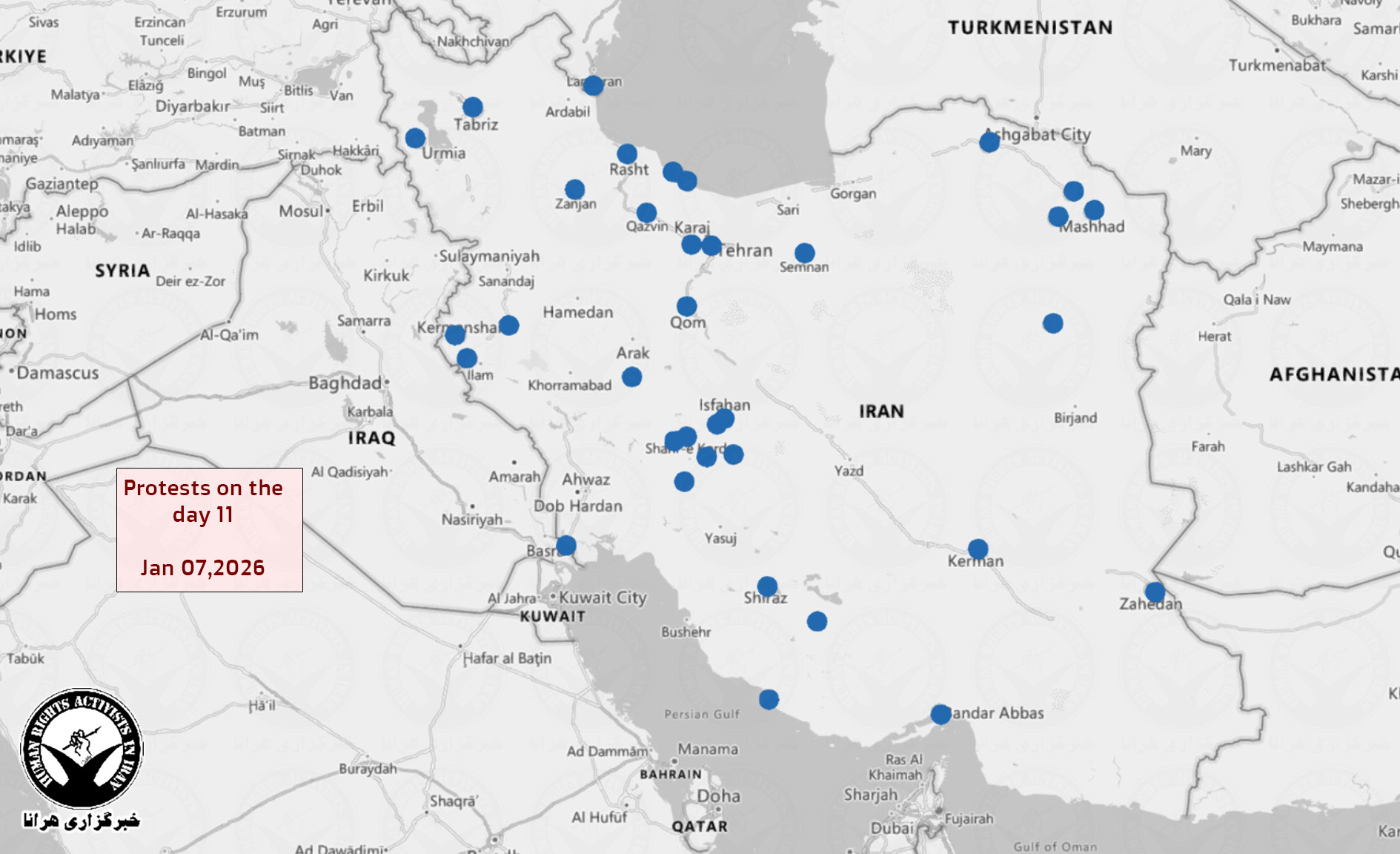
HRANA –The eleventh day of nationwide protests in Iran, on Wednesday, January 7, 2026, unfolded amid heightened security measures and ongoing arrests. Despite these pressures, demonstrations continued across multiple parts of the country. At least 37 cities witnessed protests in the form of street gatherings, protest actions, or labor strikes, spanning 24 provinces, a scale that underscores the sustained nationwide character of the unrest.

At the same time, 10 universities joined the protest movement, highlighting the continued and active role of academic institutions. With the inclusion of data from the eleventh day, a total of 348 protest sites, including 45 universities across 111 cities in 31 provinces, have experienced protests over the past eleven days.

Protests in Iran have now entered their eleventh day. The geographic scope of the recent unrest has made it one of the most widespread protest waves in recent years in terms of spatial distribution.

Background of the Protests

The protests on the eleventh day emerged against a backdrop in which the economic crisis and livelihood instability have gone beyond the stage of warning. Rapidly rising prices, the continuous devaluation of the national currency, and the inability of a large segment of society to meet basic needs have turned economic pressure into a daily reality for millions of citizens. Under such conditions, protest is no longer merely an emotional reaction to an isolated event, but rather a reflection of the long-term erosion of public trust in economic and administrative policies.

On the eleventh day, the simultaneous presence of street protests, active participation by universities, and signs of labor-related discontent demonstrated that the scope of protests has expanded beyond livelihood demands and now reflects deeper dissatisfaction with governance practices, the lack of accountability, and the closure of legal avenues for protest. The persistence of demonstrations, despite widespread arrests and security pressure, indicates that a significant portion of society now views the cost of protest as lower than the cost of silence and inaction.

nationwide protests Day 11

Geographic Scope and Focal Points of the Protests

According to recorded data, protests on the eleventh day took place in 37 cities across 24 provinces. These figures indicate an increase in the number of protesting cities compared to previous days. Provincial dispersion has remained high, reflecting the diffuse nature of the protests rather than their concentration in a few specific locations.

From a cumulative perspective, over the past eleven days, at least 111 cities in 31 provinces have witnessed protests at least once. This breadth demonstrates that the protests are not confined to specific ethnic or economic regions; rather, they have emerged across diverse urban and provincial contexts and continue in a networked and sustained manner.

Cities including Gonabad, Isfahan, Shahrza, Tehran, Shiraz, Falavarjan, Bandar Abbas, Zanjan, Kermanshah, Qazvin, Qom, Bojnord, Semnan, Nishapur, Mashhad, Kerman, Lordegan, Pordanjan, Fasa, Chaboksar, Asaluyeh, Tabriz, Rasht, Karaj, Abadan, Borujen, Urmia, Shahrekord, Gilangharb, Zahedan, Fardis, Astara, Aligudarz, Holeylan, Tonekabon, Chenaran, and Gorgan were among those where protests were reported today.

Universities and the Role of Students

On the eleventh day, 10 universities were reported as active protest sites. With these cases included, the total number of universities that have witnessed protests over the past eleven days has reached 35. The continued presence of universities in this wave of protests highlights the persistence of student discontent and the role of universities as spaces for the production and reproduction of protest.

Alongside their sectoral and educational demands, students have increasingly reacted to broader economic and political issues. This trend has strengthened the connection between campus-based and street protests, preventing the isolation of dissent within a single sphere.

Forms of Protest and Slogans

On the eleventh day of protests, methods of protest action remained diverse. Street gatherings, protest presence in urban centers, and protest activities within universities were among the main forms of expression. This diversity indicates that, despite security pressure, the protests have not been confined to a single, easily controllable pattern and continue to reproduce themselves in various forms.

The slogans and messages voiced during the gatherings continued to combine livelihood demands with structural criticism. Rising prices, declining purchasing power, and economic pressure formed the core of many slogans, alongside chants criticizing inefficiency, the lack of responsiveness to public demands, and the overall state of governance. This simultaneity suggests that, in the minds of protesters, the economic crisis and the governance crisis are understood as two facets of a single issue.

Arrests and Intensification of Security Measures

The eleventh day of protests was accompanied by the continuation and consolidation of the authorities’ security-oriented approach. According to aggregated data, a total of 2,217 people have been arrested or identified over the past eleven days. Of these, 558 were individual arrests, while 1,659 were recorded as group arrests or cases without confirmed identities, an approach that reflects security forces’ efforts to exert on-the-ground control through large-scale operations with limited transparency.

On the eleventh day alone, at least 140 people were arrested or identified. Although this figure represents a decrease compared to the tenth day, it still reflects a high level of security intervention and indicates that, despite a relative stabilization in the number of gatherings, the policy of preemptive suppression of protesters continues.

Reports indicate that some of these arrests were carried out not only at protest sites but also through summonses, on-the-ground identification, and follow-up actions, an approach aimed not merely at dispersing gatherings, but at exerting psychological pressure and long-term deterrence.

Arrests of Children, Adolescents, and Students

One of the most concerning features of the current wave of protests is the substantial number of individuals under the age of 18 among those arrested. According to recorded data, 165 detainees over the past eleven days were minors. This figure underscores both the active participation of adolescents and school students in the protests and the intensity of the security forces’ crackdown on this age group.

In addition, 46 students have been arrested during the eleven days of protests. The simultaneous arrest of students alongside the continuation of campus protests indicates that universities remain among the most sensitive centers of dissent and continue to be closely monitored and pressured by security institutions.

Alongside these cases, 40 televised confessions by detained protesters have been broadcast so far. Human rights observers view the continued airing of these confessions, typically recorded under detention and without free access to legal counsel, as a tool for instilling public fear and legitimizing the suppression of protests.

Fatalities and Victims of the Protests

Based on available data, 38 people have lost their lives over the eleven days of protests. This figure includes:

β€’ 29 protesting civilians
β€’ 4 law enforcement-security personnel
β€’ 5 protesters under the age of 18

The presence of children among those killed once again raises serious concerns about the manner in which security forces have responded to the protests and whether the principle of proportionality in the use of force has been observed.

In addition to the fatalities, numerous reports have emerged of citizens being injured during street clashes and security operations. However, due to limited access to field information, the exact number of injured individuals is still being compiled.

Summonses and Security Pressure Beyond the Streets

On the eleventh day, security pressure was not limited to the streets. Reports indicate that a number of citizens were summoned to security institutions. Among them was Keyumars Amiri Kolehjoei, known as Lak-Amir, a Lak poet and journalist from Kermanshah province, who was summoned to security bodies on that day.

Such summonses, often carried out without formally announcing charges, are considered part of a strategy of covert pressure aimed at containing influential cultural, media, and social voices. The objective of this approach is seen as limiting independent narratives of the protests and constraining the space for free reporting and expression.

Internet Disruptions and Communication Restrictions

As protests continued on the eleventh day, reports emerged of internet disruptions in several Iranian cities. These disruptions were mainly reported in the form of reduced speeds, unstable connections, and temporary interruptions in access to online services.

An examination of the pattern of these restrictions indicates that internet disruptions were implemented in a targeted and localized manner, often occurring in cities that witnessed protest gatherings or university activities. This approach has also been observed during previous waves of protests and is typically employed to limit coordination, information-sharing, and the dissemination of protest footage.

Nevertheless, the continued flow of news and the publication of reports from inside the country suggest that, despite causing disruptions, these restrictions have not been able to completely halt the circulation of information.

Reactions

Domestic Reactions (Governmental)

Following statements by Donald Trump and Benjamin Netanyahu regarding the protests in Iran, the Secretariat of the Supreme Defense Council of the Islamic Republic issued a statement describing the rhetoric and threats as β€œbeyond mere verbal positioning” and characterizing them as part of β€œhostile behavior.” The statement emphasized that any aggression or continuation of hostile actions would be met with a β€œproportionate, decisive, and determining response,” placing responsibility for the consequences on those designing and issuing the threats. In this context, officials also sought to elevate the issue from the level of β€œpolitical commentary” to that of a β€œsecurity cost,” highlighting regional consequences in an effort to send a deterrent message.

At the same time, following the positions taken by Donald Trump and Benjamin Netanyahu and the release of the statement by the Supreme Defense Council Secretariat, some figures close to the official power structure adopted even harsher rhetoric. Among them:

Ali Larijani, in a message, condemned what he described as U.S. interference in an β€œinternal matter” and issued warnings, in a threatening tone, about the consequences of adventurism.

Mohammad Bagher Ghalibaf explicitly spoke of β€œthreatening American centers and forces” in the region and sought to convey the message that any action or escalation of intervention would be met with a β€œresponse.”

Such positions may indicate an attempt by the authorities to reframe the protests from a socio-economic crisis into a national security issueβ€”shifting the narrative focus from β€œstreet demands” to a β€œconfrontation with foreign intervention.”

Domestic Reactions (Civil, Labor, and Public Figures)

On the other hand, reactions were not limited to politicians and security officials. According to reports, associations in the field of visual arts, including organizations of painters, graphic designers, photographers, sculptors, and ceramic artists, issued a joint statement condemning the suppression of protests. Referring to economic and political pressures and widespread social despair, the statement emphasized that β€œany violence and repression against the people’s right to protest” is condemned.

Additionally, 555 teacher union activists issued a similar letter declaring their solidarity with the protesters and their demands.

The significance of these reactions on the eleventh day lies in the fact that they demonstrate how professional and cultural sectors are increasingly aligning themselves with the protest narrative.

After several days of silence, Amirhossein Ghiasi (blogger and media figure) issued a clear statement declaring that he, too, is a protester. He described his silence as the result of psychological pressure, family concerns, and an inability to express what he described as what was β€œin his heart.” The entry of public figures into explicit positions is considered, from a newsworthiness perspective, an important indicator for measuring the expansion of social sympathy with the protests.

Arrests

Individual Arrests with Confirmed Identities

  1. 1. Shahab Barati – Place of arrest: Mashhad (Razavi Khorasan province) – Place of detention: Unknown – Current status: Detained – Source: HRANA

  2. 2. Davoud Hosseinpour – Place of arrest: Lordegan (Chaharmahal and Bakhtiari province) – Place of detention: Unknown – Current status: Detained – Source: HRANA

  3. 3. Rouhollah Khaledi – Place of arrest: Lordegan (Chaharmahal and Bakhtiari province) – Place of detention: Unknown – Current status: Detained – Source: HRANA

  4. 4. Abolfazl Aghaei – Place of arrest: Khorramabad (Lorestan province) – Place of detention: Unknown – Current status: Detained – Source: HRANA. Notable point: Under 18 years old

  5. 5. Ara Salahi – Place of arrest: Rasht (Gilan province) – Place of detention: Unknown – Current status: Detained – Source: HRANA

  6. 6. Mikaeil Mansouri – Place of arrest: Yasuj (Kohgiluyeh and Boyer-Ahmad province) – Place of detention: Unknown – Current status: Detained – Source: HRANA

  7. 7. Sara Rahmati – Place of arrest: Yasuj – Place of detention: Unknown – Current status: Detained – Source: HRANA

  8. 8. Shayan Parmokhber – Place of arrest: Yasuj – Place of detention: Unknown – Current status: Detained – Source: HRANA

  9. 9. Elaheh Hosseinnejad – Place of arrest: Yasuj – Place of detention: Unknown – Current status: Detained – Source: HRANA

  10. 10. Omid Khodarahmi – Place of arrest: Yasuj – Place of detention: Unknown – Current status: Detained – Source: HRANA

  11. 11. Ashkan Rasouli – Place of arrest: Yasuj – Place of detention: Unknown – Current status: Detained – Source: HRANA

  12. 12. Meraj Abbasnejad – Place of arrest: Yasuj – Place of detention: Unknown – Current status: Detained – Source: HRANA

  13. 13. Ali Akbar Ahmadzadeh – Place of arrest: Yasuj – Place of detention: Unknown – Current status: Detained – Source: HRANA

  14. 14. Peyman Azarzadeh – Place of arrest: Yasuj – Place of detention: Unknown – Current status: Detained – Source: HRANA

  15. 15. Mani Armaghanizadeh – Place of arrest: Yasuj – Place of detention: Unknown – Current status: Detained – Source: HRANA

  16. 16. Hossein Haghighi – Place of arrest: Yasuj – Place of detention: Unknown – Current status: Detained – Source: HRANA

  17. 17. Moslem Parzadar – Place of arrest: Yasuj – Place of detention: Unknown – Current status: Detained – Source: HRANA

  18. 18. Ahmad Abdollahpour – Place of arrest: Yasuj – Place of detention: Unknown – Current status: Detained – Source: HRANA

  19. 19. Parsa Akbar – Place of arrest: Yasuj – Place of detention: Unknown – Current status: Detained – Source: HRANA

  20. 20. Kiarash Ansari – Place of arrest: Yasuj – Place of detention: Unknown – Current status: Detained – Source: HRANA

  21. 21. Shahla Ansarian – Place of arrest: Yasuj – Place of detention: Unknown – Current status: Detained – Source: HRANA

  22. 22. Elham Siavoshi – Place of arrest: Yasuj – Place of detention: Unknown – Current status: Detained – Source: HRANA

  23. 23. Razieh Khahesh – Place of arrest: Yasuj – Place of detention: Unknown – Current status: Detained – Source: HRANA

  24. 24. Reza Mansourian – Place of arrest: Behbahan (Khuzestan province) – Current status: Released – Source: HRANA

  25. 25. Hossein Afrasiabi – Place of arrest: Behbahan – Current status: Released – Source: HRANA

  26. 26. Ali Alinejad – Place of arrest: Behbahan – Current status: Released – Source: HRANA

  27. 27. Ahmad Akhash – Place of arrest: Behbahan – Current status: Released – Source: HRANA

  28. 28. Abbas Ahmadi – Place of arrest: Behbahan – Current status: Released – Source: HRANA

  29. 29. Abolfazl Ahmadi – Place of arrest: Behbahan – Current status: Released – Source: HRANA

  30. 30. Abolfazl Tayebi – Place of arrest: Behbahan – Current status: Released – Source: HRANA

  31. 31. Abolfazl Safari – Place of arrest: Behbahan – Current status: Released – Source: HRANA

  32. 32. Maziar Karami – Place of arrest: Behbahan – Current status: Released – Source: HRANA

  33. 33. Ali Afrasiabi – Place of arrest: Behbahan – Place of detention: Unknown – Current status: Detained – Source: HRANA

  34. 34. Parsa Ghasemi – Place of arrest: Behbahan – Place of detention: Unknown – Current status: Detained – Source: HRANA

  35. 35. Majid Zamenpisheh – Place of arrest: Behbahan – Place of detention: Unknown – Current status: Detained – Source: HRANA

  36. 36. Mohammad Shokri – Place of arrest: Behbahan – Place of detention: Unknown – Current status: Detained – Source: HRANA

  37. 37. Unidentified individual – Place of arrest: Baharestan (Tehran province) – Place of detention: Unknown – Current status: Detained – Source: Iran International

  1. 38. Hamid Rahmati – Place of arrest: Tehran – Place of detention: Randan, Shahrza – Current status: Detained – Source: Coordination Council of Iranian Teachers’ Trade Associations. Notable point: Teacher

  1. 39. Abolfazl Rahimi-Shad – Place of arrest: Tehran – Place of detention: Unknown – Current status: Detained – Source: Coordination Council of Iranian Teachers’ Trade Associations. Notable point: Teacher

  1. 40. Milad Kakavand – Place of arrest: Tehran – Place of detention: Unknown – Current status: Detained – Source: Amir Kabir Newsletter. Notable point: Student

  1. 41. Javad Pashaei – Place of arrest: Unknown – Place of detention: Unknown – Current status: Detained – Source: Kurdpa

  2. 42. Reza Nazarali – Place of arrest: Unknown – Place of detention: Unknown – Current status: Detained – Source: Kurdpa

  3. 43. Unidentified individual – Place of arrest: Najafabad (Isfahan province) – Place of detention: Unknown – Current status: Detained – Source: Fars News Agency. Notable point: Forced confessions broadcast

  1. 44. Raham Darvishi – Place of arrest: Aligudarz (Lorestan province) – Place of detention: Unknown – Current status: Detained – Source: Coordination Council of Iranian Teachers’ Trade Associations. Notable point: Under 18

  1. 45. Benyamin Mousavi – Place of arrest: Izeh (Khuzestan province) – Place of detention: Unknown – Current status: Detained – Source: Coordination Council of Iranian Teachers’ Trade Associations. Notable point: Under 18

  1. 46. Mojtaba Jouyi – Place of arrest: Shushtar – Place of detention: Unknown – Current status: Detained – Source: Coordination Council of Iranian Teachers’ Trade Associations. Notable point: Under 18

  1. 47. Mahan Soleimani – Place of arrest: Shushtar – Place of detention: Unknown – Current status: Detained – Source: Coordination Council of Iranian Teachers’ Trade Associations. Notable point: Under 18

  1. 48. Mohammad Mehdi Yeganeh – Place of arrest: Tehran – Place of detention: Transferred to Qezel Hesar Prison, Karaj – Current status: Detained – Source: Coordination Council of Iranian Teachers’ Trade Associations. Notable point: Under 18

  1. 49. Amirsam Houshyar – Place of arrest: Tehran – Place of detention: Unknown – Current status: Detained – Source: Coordination Council of Iranian Teachers’ Trade Associations

  2. 50. Sonia Zolfaghari – Place of arrest: Bojnord (North Khorasan province) – Place of detention: Unknown – Current status: Detained – Source: Coordination Council of Iranian Teachers’ Trade Associations

  3. 51. Ebrahim Baba-Ahmadi – Place of arrest: Shushtar – Place of detention: Unknown – Current status: Detained – Source: Coordination Council of Iranian Teachers’ Trade Associations

  4. 52. Foad Nikpey – Place of arrest: Marivan (Kurdistan province) – Place of detention: Unknown – Current status: Detained – Source: Coordination Council of Iranian Teachers’ Trade Associations. Notable point: Under 18

  1. 53. Saman Nikpendar – Place of arrest: Sabzevar (Razavi Khorasan province) – Place of detention: Unknown – Current status: Detained – Source: Coordination Council of Iranian Teachers’ Trade Associations. Notable point: Under 18

  1. 54. Raman Eghbali – Place of arrest: Sanandaj (Kurdistan province) – Place of detention: Unknown – Current status: Detained – Source: Coordination Council of Iranian Teachers’ Trade Associations. Notable point: Under 18

  1. 55. Alireza Besatzadeh – Place of arrest: Sarpol-e Zahab (Kermanshah province) – Place of detention: Unknown – Current status: Detained – Source: Kolbar News

  2. 56. Amirreza Soleimani – Place of arrest: Tehran – Place of detention: Unknown – Current status: Detained – Source: Kolbar News. Notable point: Under 18

Group Arrests or Arrests Without Identity Confirmation

  1. 1. 60 citizens – Place of arrest: Varamin (Tehran province) – Place of detention: Unknown – Current status: Detained

  2. 2. Four citizens – Place of arrest: Galikesh (Golestan province) – Place of detention: Unknown – Current status: Detained

  3. 3. Ten citizens – Place of arrest: Unknown – Place of detention: Unknown – Current status: Released

  4. 4. Three citizens – Province of arrest: Fars – Place of detention: Unknown – Current status: Released. Notable point: Under 18 years of age

  5. 5. Two citizens – Place of arrest: Baharestan (Tehran province) – Place of detention: Unknown – Current status: Detained. Notable point: Forced confessions broadcast

Conclusion

The eleventh day of nationwide protests can be described as a day marked by the continuation of demonstrations alongside the consolidation of repression. Although the number of protesting cities has declined compared to some peak days, the wide provincial dispersion, the continued presence of universities, the high number of arrests, and the ongoing security summonses indicate that the protests have entered a phase that is attritional yet sustained.

The combination of economic crisis, livelihood pressure, widespread security crackdowns, and communication restrictions does not point to an imminent de-escalation of the protests. In this context, the unrest is continuing not in an explosive manner, but as a prolonged and multilayered conditionβ€”one whose consequences will be felt beyond the streets, across social, cultural, and political spheres.

19 Individuals Arrested by Security Forces in Yasuj

HRANA – 19 citizens have been arrested by security forces in Yasuj during the nationwide protests.

HRANA has confirmed the identities of those arrested as Mikaeil Mansouri, Sara Rahmati, Shayan Parmokhber, Elaheh Hosseinnejad, Omid Khodarahmi, Ashkan Rasouli, Meraj Abbasnejad, Ali Akbar Ahmadzadeh, Peyman Azarzadeh, Mani Armaghanizadeh, Hossein Haghighi, Moslem Parzadar, Ahmad Abdollahpour, Parsa Akbar, Kiarash Ansari, Shahla Ansarian, Elham Siavoshi, Zahra Darfarin, and Razieh Khahesh.

The arrests took place during the nationwide protests and were carried out by security forces in Yasuj County.

As of the time of this report, no information has been obtained regarding their place of detention or the charges brought against them.

Gatherings and strikes by shopkeepers and bazaar merchants began in Tehran on Sunday, December 28, 2024, and after two days expanded beyond bazaars and commercial centers. With the participation of students, citizens, and various social groups, these protests have become one of the most widespread movements in recent years. For more information, readers may refer to HRANA’s detailed report on the tenth day of protests, published last night.

At Least 11 Prisoners, Including One Woman, Executed in Iranian Prisons

HRANA –Β Today, January 7, 2025, the death sentences of 10 prisoners who had previously been sentenced to death on charges related to drug-related offenses and murder were carried out in the prisons of Shiraz, Kashmar, Shahrekord, Bushehr, Mashhad, Chabahar, Damghan, Malayer, and Sabzevar. Separately, at dawn yesterday, another prisoner was executed in Mahabad Prison.

HRANA has confirmed the identities of nine of those executed at dawn today, Wednesday, January 7:

β€’ Sobhan Yeganeh on drug-related charges in Shiraz Prison,
β€’ Khodamorad Hemmati on drug-related charges in Kashmar Prison,
β€’ Behzad Alipour on murder charges in Shahrekord Prison,
β€’ Davoud Bagherzadeh on murder charges in Bushehr Prison,
β€’ Soheila Azizi, along with another prisoner, on drug-related charges in Mashhad Prison
β€’ Mosib Chamani on murder charges in Chabahar Prison,
β€’ Bahman Yarbeygi on murder charges in Damghan Prison
β€’ Bagher Bazvand on drug-related charges in Malayer Prison
β€’ Almas Mehdi-Nejad on drug-related charges in Sabzevar Prison
Additionally, at dawn yesterday, a prisoner identified as Rouhollah Aghapour was executed on murder chargesΒ  in Mahabad Prison.

Further details, including confirmation of the identity of the other executed prisoner, are still under investigation by HRANA.

As of the time of this report, the executions have not been officially announced by prison authorities or relevant institutions.

According to HRA’s annual report, in 2025, at least 2,063 people were executed in Iran. Based on this data, executions increased by 119% compared to 2024. In many of these cases, due to secrecy, prisoners were even denied the right to a final visit with their families.

Baha’i Citizen Moein Mohammadi Arrested in Yazd

HRANA News Agency – On Monday, January 5, 2026, Moein Mohammadi, a Baha’i citizen residing in Yazd, was arrested by security forces and transferred to an undisclosed location. The agents searched the residence of this Baha’i citizen and confiscated a number of his personal belongings.

Based on information received by HRANA, Mr. Mohammadi’s arrest took place on Monday, January 5, at his home by security forces. During the search of the residence, agents seized several of his personal items, including electronic devices, books, and documents.

A source informed and close to the family of this Baha’i citizen, while confirming the news to HRANA, stated: β€œMr. Mohammadi’s arrest occurred in front of his 10-year-old child, an incident that has caused significant psychological distress to the child.”

So far, no information has been obtained regarding his place of detention or the charges brought against this Baha’i citizen.

Moein Mohammadi has previously faced convictions due to his religious beliefs.

Over the past decade, the Baha’i community in Iran has been subjected to more security and judicial actions than any other religious minority. HRA’s annual report indicates that during 2025, an average of 62.4% of reports related to religious minorities concerned violations of the civil rights of Baha’is.

Detailed Report on the Tenth Day of Protests: 36 Dead in 285 Demonstrations

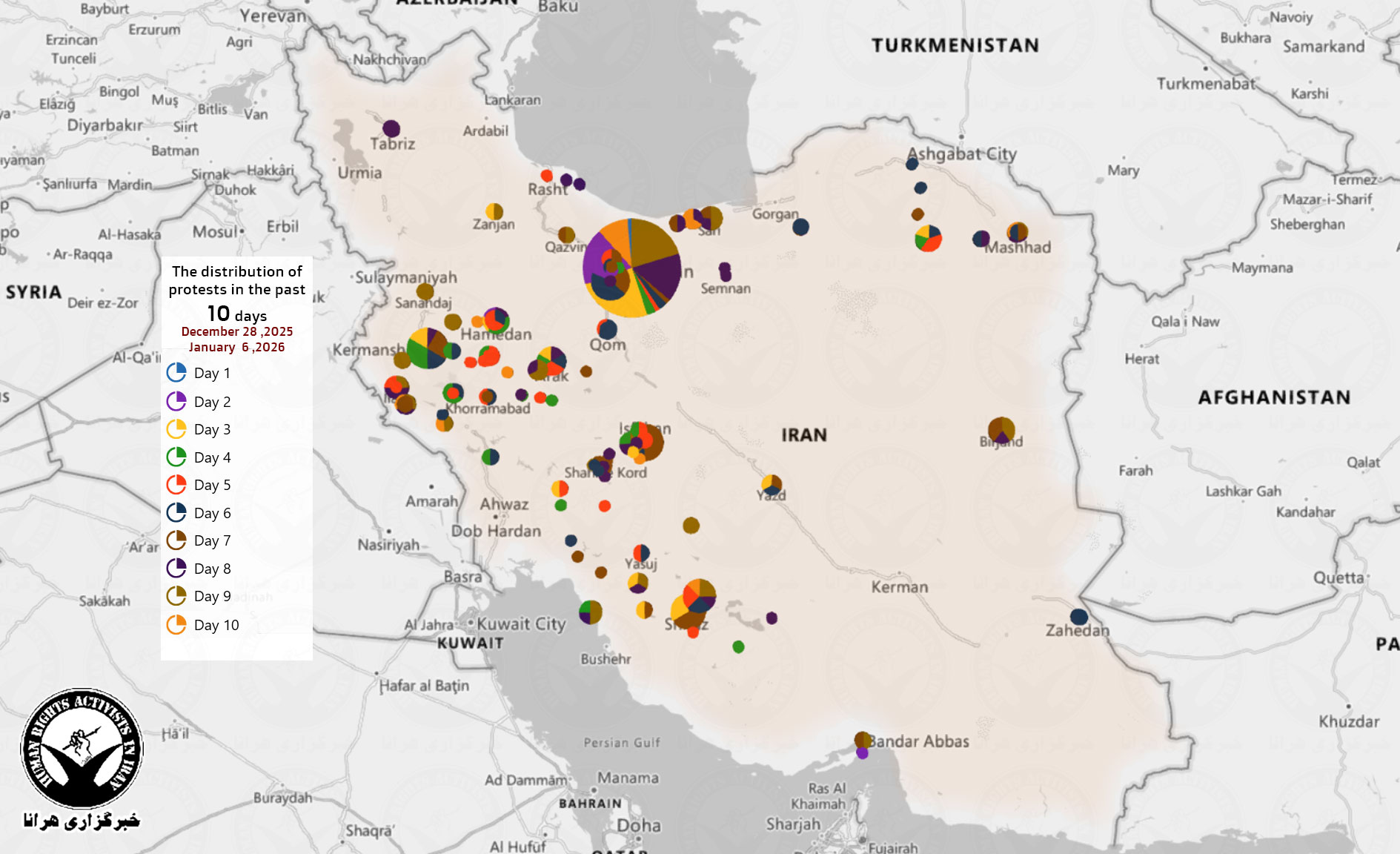
HRANA – Today marked the tenth consecutive day of protests and strikes by citizens across various cities in Iran. Reports indicate that violence by law enforcement and security forces has extended to medical centers as well, with some facilities subjected to intervention and attack. Over the past days, at least 285 locations in 92 cities across 27 provinces have witnessed protest gatherings. During these events, at least 2,076 citizens have been arrested, and at least 36 people have lost their lives, including 34 protesters and two members of security and law enforcement forces.

Protests that initially began with strikes and labor-related gatherings have entered a new phase on their tenth day. Alongside the continuation of some labor actions, reports point to the emergence of street demonstrations, the expansion of strikes by shopkeepers, and student protests at a number of universities. At the same time, there are reports that violence by law enforcement and security forces has extended to medical facilities, including attacks on hospitals.

Background of the Protests

The new wave of protests has emerged at a time when economic pressure on broad segments of society has reached a critical point, and clear signs of disruption to citizens’ daily livelihoods are evident. The continuous rise in exchange rates, chronic market instability, and the steady decline in purchasing power have darkened and destabilized the economic outlook for households and business owners alike, turning financial insecurity into a widespread experience.

In the days leading up to the start of these protests, reports indicated that currency rates had surpassed unprecedented levels, coinciding with a downturn in the capital market and an intensification of capital outflows. Analysts have interpreted this trend as a shift of liquidity toward safer markets such as gold and foreign currency, as well as a sign of declining public confidence in economic policies. The social consequences of this situation have included widespread closures or partial shutdowns of businesses, increasing difficulty for small enterprises to continue operating, and ultimately the spread of protests and strikes in various cities. These demonstrations are seen less as reactions to a single, temporary trigger and more as the result of the long-term accumulation of economic pressures and the ongoing erosion of hope for improvements in economic and social conditions.

Geography of the Protests

Based on updated and consolidated data, over the past 10 days at least 285 locations across Iran have witnessed protests, street gatherings, or labor strikes. These protest activities have been reported in 27 provinces nationwide, and at the same time, 22 universities have seen protest actions by students.

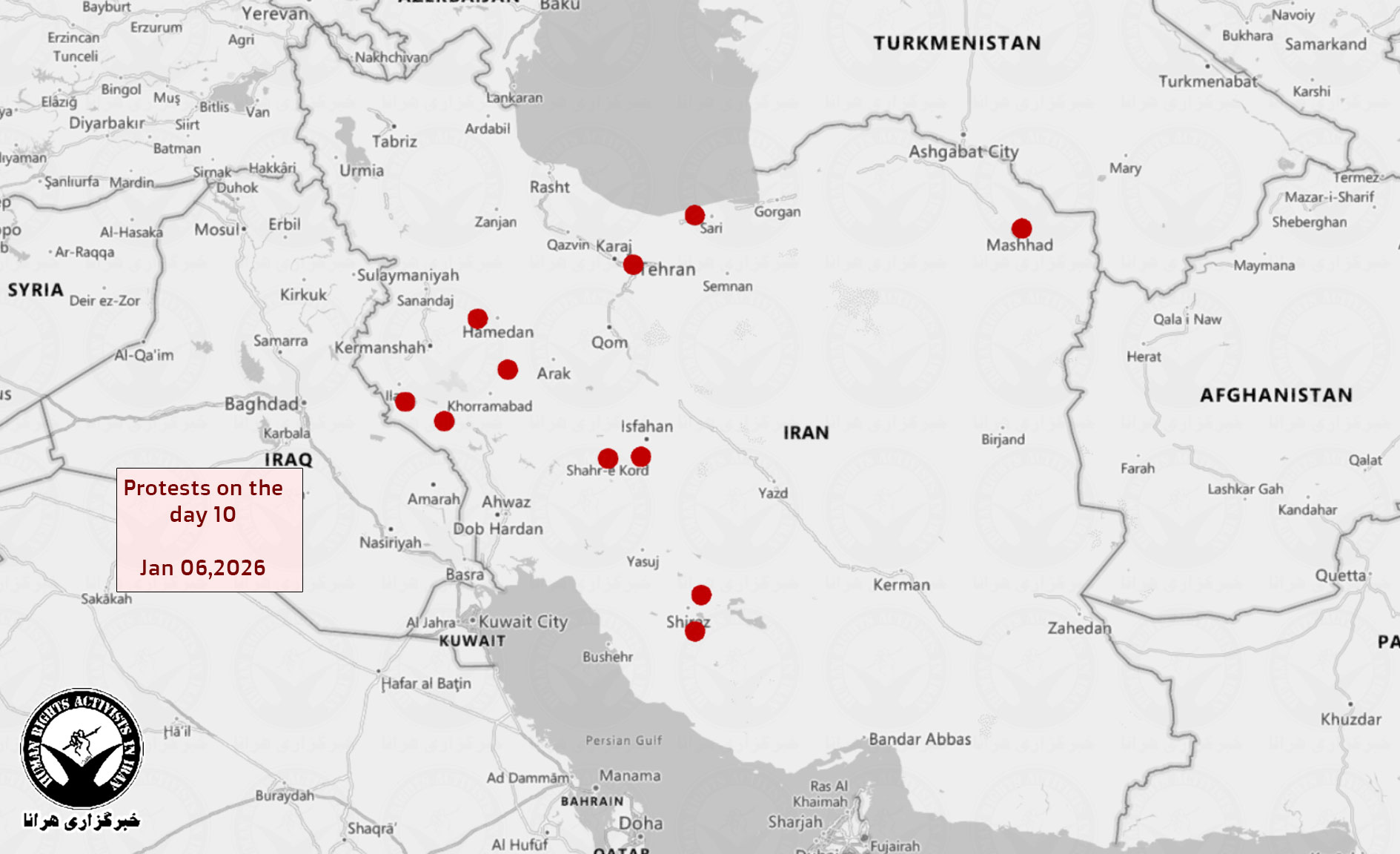
On the tenth day of the protests, demonstrations were held in the cities of Mashhad, Qazvin, Abdanan, Tehran, Shiraz, Bandar Abbas, Zanjan, Ilam, Malekshahi, Shahrekord, Yazdanshahr, Kavar, Asadabad, Babol, Marvdasht, and Borujerd.

One of the most significant protest focal points today in Iran was the demonstrations by bazaar merchants. Today, strikes took place in Tehran’s Grand Bazaar, particularly concentrated in the main corridors, including the gold and currency market, the fabric market, and parts of the footwear and home appliances sections. A considerable number of business units were either fully or partially closed. Reports indicate that this strike emerged spontaneously, without any formal call, and that the main grievances of merchants were sharp currency fluctuations, the surge in gold prices, market stagnation, and the severe decline in purchasing power.

Following the closure of shops, the presence of security and law enforcement forces increased at the entrances to the bazaar and at intersections leading to it, and in some areas the formation of gatherings was prevented. Nevertheless, the strike caused a noticeable disruption to the bazaar’s daily activities and a reduction in customer traffic, and is being assessed as one of the most significant manifestations of the link between street protests and occupational discontent in Tehran.

Forms of Protest and Slogans

A review of verified reports indicates that the protests on the tenth day, similar to previous days, encompassed a wide range of demands. The content of slogans chanted during the gatherings was not limited solely to livelihood and economic issues, but also reflected criticism of governance structures, opposition to restrictions imposed on individual and social freedoms, and demands for justice.

Within the framework of its human rights mandate, HRANA focuses its reporting on slogans and demands that are directly related to violations of, or calls for, human rights, fundamental freedoms, and citizens’ civil rights. The persistence of these demands across various parts of the country points to the depth of public dissatisfaction and the overlap of economic, social, and political grievances within the context of the ongoing protests.

Conduct of Law Enforcement and Security Forces and Details of Violence

On the tenth day of the nationwide protests, reports received by HRANA indicate the continuation of a heavy security atmosphere in various cities across the country. These reports suggest that law enforcement and security forces have continued to use various repressive measures aimed at preventing the formation or expansion of protest gatherings.

Documented instances of the suppression of protests over the past day include the use of pellet guns, deployment of tear gas, and direct attacks on demonstrators.

At the same time, official accounts presented by some local authorities regarding the deaths do not fully align with eyewitness testimonies and unofficial reports. For this reason, details surrounding how these incidents occurred remain under review and subject to further verification.

Deaths and Injuries

According to HRANA’s updated data, at least 36 people have been confirmed killed during the past ten days of protests. Among them were four individuals under the age of 18, as well as two members of security and law enforcement forces. In addition, dozens of cases of injuries among protesting citizens have been recorded so far. According to reports, these injuries were mostly caused by pellet and plastic bullets.

Over the past 24 hours, HRANA has confirmed the identities of Mohammadreza Karami, (Lieutenant) Ehsan Aghajani, and Ali Golfroosh as individuals killed during the protests.

On the same date, Sadegh Parvizadeh, a wildlife photographer and videographer, announced in a video posted on his Instagram page that he had been struck in the face and eye by pellets during the protests. In part of the video, while showing samples of the pellets fired, he stated: β€œThe person who shot me was a teenager under the age of 20. What occupies my mind is that killing a human being was really like hunting prey or a game to him.”

Tasnim News Agency, which is close to security institutions, reported that based on presented statistics, from the beginning of the protests up to last night, around 568 law enforcement personnel and 66 Basij forces were injured. The outlet further claimed that among them, two were injured by live ammunition, 152 by shotgun pellets, and 11 by knife attacks.

Security Forces’ Raids on Medical Centers: Attacks on Imam Khomeini Hospital in Ilam and Sina Hospital in Tehran

Amid developments in the nationwide protests in Iran, reports indicate that security forces have attacked and entered at least two medical centers in the cities of Ilam and Tehran, incidents that have sparked widespread domestic reactions and heightened concerns over violations of the security of medical facilities and patients’ rights.

Imam Khomeini Hospital, Ilam: Tear Gas in a Treatment Facility

According to published videos and reports, on Saturday evening, January 3, security forces surrounded Imam Khomeini Hospital in Ilam and attempted to arrest a number of protesters injured in Malekshahi who had been transferred there for treatment.

Reports indicate that patients’ families and some medical staff opposed the entry of security forces, leading to verbal and physical altercations. Subsequently, images were released showing tear gas being fired inside the hospital grounds and buildings, an action that created emergency conditions in treatment wards and caused alarm among patients and staff. Eyewitnesses stated that several patients experienced breathing difficulties following the dispersal of tear gas.

In response, the Ministry of Health issued a statement announcing that, by order of the Minister of Health, the matter was being examined β€œurgently,” emphasizing the need to safeguard the security of medical centers, patients, and healthcare workers. Additionally, by order of Masoud Pezeshkian, the Minister of Interior was tasked with following up on the incident and submitting a report. Meanwhile, Fars News Agency, which is close to the Islamic Revolutionary Guard Corps, confirmed the presence of security forces at the hospital but claimed that some protesters had used the medical facility β€œto hide.”

Sina Hospital, Tehran: Arrests of the Injured and a Security Atmosphere

Parallel to the events in Ilam, reports published today, Tuesday, January 6, from Tehran indicate that security forces also entered Sina Hospital. According to these reports, a number of protesters injured during demonstrations and transferred to the hospital for treatment were arrested by security forces inside or around the hospital.

Eyewitnesses told media outlets that the presence of security forces on hospital grounds created an atmosphere of fear and disrupted the treatment process, with some families reportedly avoiding medical centers out of fear of arrest.

As of the time of this report, officials have not provided a clear explanation regarding the details of the operation at Sina Hospital.

Arrests

Over the ten days of protests, at least 2,076 protesting citizens have been arrested; however, the actual number of detainees is estimated to be significantly higher.

Of these, 878 individuals were either arrested on the tenth day of protests or had been detained earlier but were confirmed by HRANA today. This includes the transfer of approximately 200 detained women to Kachooie Prison in Karaj and 500 detained men to the Central Prison of Karaj.

Other detained protesters whose identities have been individually confirmed on this day are listed in an appendix at the end of this report.

So far, at least 15 videos of forced confessions by detainees have been broadcast by official media outlets or those close to security institutions, videos for which it remains unclear under what conditions individuals were compelled to confess against themselves.

International Reactions

As nationwide protests continue in Iran and security crackdowns intensify, international reactions and statements have also persisted.

UN Secretary-General AntΓ³nio Guterres expressed concern over recent developments in Iran, stating that he was β€œdeeply saddened” by the killing and injury of protesters and stressing the need to prevent further loss of life. He called on Iranian authorities to respect the rights to freedom of expression, assembly, and peaceful protest, and to allow people to express their grievances peacefully.

The Persian-language account of the U.S. State Department on X, referring to yesterday’s raid by security forces on Imam Khomeini Hospital in Ilam, described the action as a β€œclear crime against humanity” and wrote that hospitals are not battlefields. The statement added that the actions of the Islamic Republic constitute a gross violation of international law and demonstrate a complete disregard for human life.

Amnesty International, condemning the attack by security forces on a hospital in Ilam that was being used to treat or shelter injured protesters, described the incident as a clear violation of international law. The organization emphasized that the attack once again shows how far Iranian authorities are willing to go to suppress protests and silence dissent.

Reaction of Iranian Government Officials

In response to U.S. warnings, Iran’s Ministry of Foreign Affairs described these positions as β€œpsychological warfare” and sought to frame them as part of a media and external pressure campaign.

The most significant focal point of domestic reactions on the tenth day was the release of a video showing security forces raiding Imam Khomeini Hospital in Ilam, an incident highlighted as a sensitive turning point in media coverage. According to accounts, protesters injured in Malekshahi had been transferred to the hospital, after which the facility was surrounded. Security forces attempted to enter and arrest some of the injured but faced resistance from families and medical staff. Subsequently, images emerged showing tear gas being fired inside the hospital building.

In response, the Ministry of Health issued a statement announcing that the matter was under serious review β€œby explicit order of the Minister of Health” and would be pursued β€œwithin the framework of the law,” emphasizing the security of medical centers, patients’ rights, and support for healthcare workers.

At the same time, Masoud Pezeshkian ordered an investigation into the incident, and according to BBC reports, Eskandar Momeni (Minister of Interior) assigned a delegation to follow up and submit a report.

On the political and economic front, Masoud Pezeshkian, speaking at an official ceremony in an unusually candid tone, placed responsibility for the current situation on the governing structure, stating that β€œthe parliament and the government together have brought the country to this point,” and emphasizing that β€œwe are all to blame.” This stance was reflected in coverage of the tenth day as a sign of social pressure and a crisis of governance.

In contrast, media outlets close to the Islamic Revolutionary Guard Corps, including Fars News Agency (as reported by the BBC), confirmed the presence of security forces at the hospital but claimed that protesters had used the hospital as a β€œstronghold”, a narrative aimed at justifying and reframing the security forces’ actions.

Meanwhile, the public and revolutionary prosecutor of Shahrod stated that protesters’ voices should be heard, but warned that those who engage in what he described as β€œrioting” would face the law.

Domestic Reactions (Civil Society, Labor Groups, and Public Figures)

Alongside official reactions, part of the tenth day’s responses included expressions of solidarity from artists, as well as supportive actions abroad.

The Teachers’ Trade Association of Aligudarz issued a statement in support of the recent protests, declaring that the expansion of poverty, corruption, discrimination, special privileges, unemployment, and runaway inflation has pushed society to a point of despair and anger. The statement noted that the loss of hope for the future has turned employment, marriage, and housing into unattainable dreams for young people, creating a generation with nothing left to lose. According to the association, despite all the risks, protesters have courageously put their lives and health on the line to voice their demands in the streets.

Continuing reactions from sports and cultural figures, Mohammad Khakpour, former captain of Iran’s national football team, criticized labeling protesters as β€œrioters,” writing that people crushed by inflation, unemployment, and insecurity cannot be silenced with a label. Ali Ghamsari, a musician and composer, described the protests as stemming from poverty and hardship, emphasizing that they are rooted in concern for the country and a sense of social responsibility. Alireza Haghighi, former national team goalkeeper, also shared a message stating that protesting is not a crimeβ€”the real crime is not listening to the people’s voices.

Ali Daei, a legendary Iranian footballer, criticized the economic situation, saying that the sharp rise in the dollar exchange rate shows officials have become disconnected from the people’s suffering, and stressed that nothing can replace the people of Iran. Pantea Bahram, a theater and film actress, also expressed solidarity with protesting bazaar merchants and announced that she was joining the strikes. Alireza Ghorbani, a traditional music singer, citing the country’s current conditions and the hardships imposed on the people, announced the postponement of his β€œIranam” concert in Tabriz and other upcoming performances, stating that holding concerts at this time does not align with the public mood.

Individually Identified Arrests on the Tenth Day

  1. 1. Amin Yousefi – City of arrest: Ilam – Place of detention: Unknown – Current status: Detained – Source: Kurdpa

  2. 2. Amirhossein Ta’mirkari – City of arrest: Ilam – Place of detention: Unknown – Current status: Detained – Source: Kurdpa

  3. 3. Reza Dousti-Nejad – City of arrest: Ilam – Place of detention: Unknown – Current status: Detained – Source: Kurdpa – Notable detail: 17-year-old minor

  4. 4. Artin Sohrabi – City of arrest: Ilam – Place of detention: Unknown – Current status: Detained – Source: Kurdpa – Notable detail: 17-year-old minor

  5. 5. Amir Ali Abdian – City of arrest: Ilam – Place of detention: Unknown – Current status: Detained – Source: Kurdpa – Notable detail: 16-year-old minor

  6. 6. Firooz Faraji – City of arrest: Ilam – Place of detention: Unknown – Current status: Detained – Source: Kurdpa

  7. 7. Mohammad Sadra Mansouri – City of arrest: Ilam – Place of detention: Unknown – Current status: Detained – Source: Kurdpa

  8. 8. Alireza Paryab – City of arrest: Dehloran – Place of detention: Unknown – Current status: Detained – Source: Kurdpa

  9. 9. Mohammad Amin Mahmoudian – City of arrest: Sarableh – Place of detention: Unknown – Current status: Detained – Source: Kurdpa

  10. 10. Mohammad Amin Mahmoudian – City of arrest: Sarableh – Place of detention: Unknown – Current status: Detained – Source: Kurdpa

  11. 11. Mohammadhossein Moradi – City of arrest: Sarableh – Place of detention: Unknown – Current status: Detained – Source: Kurdpa

  12. 12. Ahmadreza Mohammadian – City of arrest: Karzan – Place of detention: Unknown – Current status: Detained – Source: Kurdpa

  13. 13. Arman Dadfar – City of arrest: Badreh – Place of detention: Unknown – Current status: Detained – Source: Kurdpa

  14. 14. Milad Seyed Moradi – City of arrest: Dehloran – Place of detention: Unknown – Current status: Detained – Source: Kurdpa

  15. 15. Misagh Seyed Moradi – City of arrest: Dehloran – Place of detention: Unknown – Current status: Detained – Source: Kurdpa

  16. 16. Mehdi Hatami – City of arrest: Yasuj – Place of detention: Unknown – Current status: Detained – Source: HRANA

  17. 17. Shahin Yousefi – City of arrest: Yasuj – Place of detention: Unknown – Current status: Detained – Source: HRANA

  18. 18. Ali Ahmadi – City of arrest: Yasuj – Place of detention: Unknown – Current status: Detained – Source: HRANA

  19. 19. Hossein Ahmadi – City of arrest: Yasuj – Place of detention: Unknown – Current status: Detained – Source: HRANA

  20. 20. Afshin Najafi – City of arrest: Yasuj – Place of detention: Unknown – Current status: Detained – Source: HRANA

  21. 21. Ramin Mohammadi – City of arrest: Yasuj – Place of detention: Unknown – Current status: Detained – Source: HRANA

  22. 22. Mohammadreza Heidari – City of arrest: Yasuj – Place of detention: Unknown – Current status: Detained – Source: HRANA – Notable detail: 17-year-old minor

  23. 23. Saha Ilbeigi – City of arrest: Tehran – Place of detention: Unknown – Current status: Detained – Source: Amirkabir Newsletter – Notable detail: Student

  24. 24. Sheida Namjoo – City of arrest: Birjand – Place of detention: The Ministry of Intelligence’s detention facility – Current status: Detained – Source: Amirkabir Newsletter – Notable detail: Student

  25. 25. Zeynab Ivani – City of arrest: Birjand – Place of detention: The Ministry of Intelligence’s detention facility – Current status: Detained – Source: Amirkabir Newsletter – Notable detail: Student

  26. 26. Faizeh Shamaili – City of arrest: Sonqor – Place of detention: Unknown – Current status: Detained – Source: Kurdpa

  27. 27. Javad Estavari – City of arrest: Darreh Shahr – Place of detention: Unknown – Current status: Detained – Source: Kurdpa

  28. 28. Ehsan Vineh – City of arrest: Kermanshah – Place of detention: Unknown – Current status: Detained – Source: HRANA

  29. 29. Abolfazl Dorqaidi – City of arrest: Yasuj – Place of detention: Unknown – Current status: Detained – Source: HRANA

  30. 30. Abolfazl Khoshnood – City of arrest: Yasuj – Place of detention: Unknown – Current status: Detained – Source: HRANA

  31. 31. Abolfazl Rahimi – City of arrest: Yasuj – Place of detention: Unknown – Current status: Detained – Source: HRANA

  32. 32. Abolfazl Sharifi – City of arrest: Yasuj – Place of detention: Unknown – Current status: Detained – Source: HRANA

  33. 33. Abolfazl Oshal – City of arrest: Yasuj – Place of detention: Unknown – Current status: Detained – Source: HRANA

  34. 34. Ahmadreza Khaleghipour – City of arrest: Yasuj – Place of detention: Unknown – Current status: Detained – Source: HRANA

  35. 35. Amin Ezzati – City of arrest: Yasuj – Place of detention: Unknown – Current status: Detained – Source: HRANA

  36. 36. Amir Mohammad Bakhtiari – City of arrest: Yasuj – Place of detention: Unknown – Current status: Detained – Source: HRANA

  37. 37. Amirhossein Rahi – City of arrest: Yasuj – Place of detention: Unknown – Current status: Detained – Source: HRANA

  38. 38. Amirhossein Karimi-Pour – City of arrest: Yasuj – Place of detention: Unknown – Current status: Detained – Source: HRANA

  39. 39. Omid Mohammadpour – City of arrest: Yasuj – Place of detention: Unknown – Current status: Detained – Source: HRANA

  40. 40. Omid Mohammadpour – City of arrest: Yasuj – Place of detention: Unknown – Current status: Detained – Source: HRANA

  41. 41. Arya Samsami – City of arrest: Yasuj – Place of detention: Unknown – Current status: Detained – Source: HRANA

  42. 42. Anahita Hekmatinia – City of arrest: Yasuj – Place of detention: Unknown – Current status: Detained – Source: HRANA

  43. 43. Ainaz Parvaneh – City of arrest: Yasuj – Place of detention: Unknown – Current status: Detained – Source: HRANA

  44. 44. Behnam Armoon – City of arrest: Yasuj – Place of detention: Unknown – Current status: Detained – Source: HRANA

  45. 45. Benyamin Arshadi – City of arrest: Yasuj – Place of detention: Unknown – Current status: Detained – Source: HRANA

  46. 46. Parisa Mousavi – City of arrest: Yasuj – Place of detention: Unknown – Current status: Detained – Source: HRANA

  47. 47. Parichehr Ansari – City of arrest: Yasuj – Place of detention: Unknown – Current status: Detained – Source: HRANA

  48. 48. Hamid Jahanbazian – City of arrest: Yasuj – Place of detention: Unknown – Current status: Detained – Source: HRANA

  49. 49. Hadis Sheybaz – City of arrest: Yasuj – Place of detention: Unknown – Current status: Detained – Source: HRANA

  50. 50. Hossein Aghajani – City of arrest: Yasuj – Place of detention: Unknown – Current status: Detained – Source: HRANA

  51. 51. Hossein Haghigh-Mofrad – City of arrest: Yasuj – Place of detention: Unknown – Current status: Detained – Source: HRANA

  52. 52. Hossein Hosseini – City of arrest: Yasuj – Place of detention: Unknown – Current status: Detained – Source: HRANA

  53. 53. Hossein Khajehyar – City of arrest: Yasuj – Place of detention: Unknown – Current status: Detained – Source: HRANA

  54. 54. Hossein Sousanzadeh – City of arrest: Yasuj – Place of detention: Unknown – Current status: Detained – Source: HRANA

  55. 55. Davoud Zarghami – City of arrest: Yasuj – Place of detention: Unknown – Current status: Detained – Source: HRANA

  56. 56. Diana Moradian – City of arrest: Yasuj – Place of detention: Unknown – Current status: Detained – Source: HRANA

  57. 57. Reza Farhadi Sisakht – City of arrest: Yasuj – Place of detention: Unknown – Current status: Detained – Source: HRANA

  58. 58. Reza Nourian – City of arrest: Yasuj – Place of detention: Unknown – Current status: Detained – Source: HRANA

  59. 59. Reyhaneh Pourkaram – City of arrest: Yasuj – Place of detention: Unknown – Current status: Detained – Source: HRANA

  60. 60. Saman Akbari – City of arrest: Yasuj – Place of detention: Unknown – Current status: Detained – Source: HRANA

  61. 61. Sanaz Davoudi – City of arrest: Yasuj – Place of detention: Unknown – Current status: Detained – Source: HRANA

  62. 62. Setayesh Ansari – City of arrest: Yasuj – Place of detention: Unknown – Current status: Detained – Source: HRANA

  63. 63. Soroush Amini – City of arrest: Yasuj – Place of detention: Unknown – Current status: Detained – Source: HRANA

  64. 64. Samira Karimi-Pour – City of arrest: Yasuj – Place of detention: Unknown – Current status: Detained – Source: HRANA

  65. 65. Sima Sajjadi – City of arrest: Yasuj – Place of detention: Unknown – Current status: Detained – Source: HRANA

  66. 66. Shayan Mohedian – City of arrest: Yasuj – Place of detention: Unknown – Current status: Detained – Source: HRANA

  67. 67. Shahab Asadi – City of arrest: Yasuj – Place of detention: Unknown – Current status: Detained – Source: HRANA

  68. 68. Shahab Parand – City of arrest: Yasuj – Place of detention: Unknown – Current status: Detained – Source: HRANA

  69. 69. Shahram Omrani – City of arrest: Yasuj – Place of detention: Unknown – Current status: Detained – Source: HRANA

  70. 70. Shahreh Nigh-Eghbal – City of arrest: Yasuj – Place of detention: Unknown – Current status: Detained – Source: HRANA

  71. 71. Shima Khorshidian – City of arrest: Yasuj – Place of detention: Unknown – Current status: Detained – Source: HRANA

  72. 72. Sheghayegh Zahedi – City of arrest: Yasuj – Place of detention: Unknown – Current status: Detained – Source: HRANA

  73. 73. Taha Kazemi – City of arrest: Yasuj – Place of detention: Unknown – Current status: Detained – Source: HRANA

  74. 74. Abbas Varestegi – City of arrest: Yasuj – Place of detention: Unknown – Current status: Detained – Source: HRANA

  75. 75. Erfan Bazdan – City of arrest: Yasuj – Place of detention: Unknown – Current status: Detained – Source: HRANA

  76. 76. Ghorfan Rahman-Pour – City of arrest: Yasuj – Place of detention: Unknown – Current status: Detained – Source: HRANA

  77. 77. Ghazal Hamzeh Amaleh – City of arrest: Yasuj – Place of detention: Unknown – Current status: Detained – Source: HRANA

  78. 78. Fatemeh Mousa-Pour – City of arrest: Yasuj – Place of detention: Unknown – Current status: Detained – Source: HRANA

  79. 79. Farzad Foroughi – City of arrest: Yasuj – Place of detention: Unknown – Current status: Detained – Source: HRANA

  80. 80. Farnoush Azar – City of arrest: Yasuj – Place of detention: Unknown – Current status: Detained – Source: HRANA

  81. 81. Farid Alizadeh – City of arrest: Yasuj – Place of detention: Unknown – Current status: Detained – Source: HRANA

  82. 82. Farid Hatami-Pour – City of arrest: Yasuj – Place of detention: Unknown – Current status: Detained – Source: HRANA

  83. 83. Mahan Mahmoudi – City of arrest: Yasuj – Place of detention: Unknown – Current status: Detained – Source: HRANA

  84. 84. Mohammad Abdollah-Pour – City of arrest: Yasuj – Place of detention: Unknown – Current status: Detained – Source: HRANA

  85. 85. Mohammad Ravansalar – City of arrest: Yasuj – Place of detention: Unknown – Current status: Detained – Source: HRANA

  86. 86. Mohammad Mehdi Alipour – City of arrest: Yasuj – Place of detention: Unknown – Current status: Detained – Source: HRANA

  87. 87. Mohammad Hormoz-Pour – City of arrest: Yasuj – Place of detention: Unknown – Current status: Detained – Source: HRANA

  88. 88. Mehrdad Shaban-Nejad – City of arrest: Yasuj – Place of detention: Unknown – Current status: Detained – Source: HRANA

  89. 89. Mahshid Mousa-Pour – City of arrest: Yasuj – Place of detention: Unknown – Current status: Detained – Source: HRANA

  90. 90. Mohaddeseh Mohammadi – City of arrest: Yasuj – Place of detention: Unknown – Current status: Detained – Source: HRANA

  91. 91. Mojgan Forouzan – City of arrest: Yasuj – Place of detention: Unknown – Current status: Detained – Source: HRANA

  92. 92. Milad Karimi – City of arrest: Yasuj – Place of detention: Unknown – Current status: Detained – Source: HRANA

  93. 93. Neda Ahmadi – City of arrest: Yasuj – Place of detention: Unknown – Current status: Detained – Source: HRANA

  94. 94. Yasin Mohammadi – City of arrest: Yasuj – Place of detention: Unknown – Current status: Detained – Source: HRANA

  95. 95. Yalda Pezhvani – City of arrest: Yasuj – Place of detention: Unknown – Current status: Detained – Source: HRANA

  96. 96. Zahra Darfarin – City of arrest: Yasuj – Place of detention: Unknown – Current status: Detained – Source: HRANA

  97. 97. Zohreh Dejman – City of arrest: Yasuj – Place of detention: Unknown – Current status: Detained – Source: HRANA

  98. 98. Alireza Sadeghi – City of arrest: Yasuj – Place of detention: Unknown – Current status: Detained – Source: HRANA

  99. 99. Ali-Asghar Farhadi – City of arrest: Yasuj – Place of detention: Unknown – Current status: Detained – Source: HRANA

  100. 100. Emad Dashtban – City of arrest: Yasuj – Place of detention: Unknown – Current status: Detained – Source: HRANA

  101. 101. Javad Javadpour – City of arrest: Yasuj – Place of detention: Unknown – Current status: Detained – Source: HRANA

  102. 102. Saeid Deil – City of arrest: Yasuj – Place of detention: Unknown – Current status: Detained – Source: HRANA

  103. 103. Sina Dana – City of arrest: Yasuj – Place of detention: Unknown – Current status: Detained – Source: HRANA

  104. 104. Abolfazl Khodadi – City of arrest: Yasuj – Place of detention: Unknown – Current status: Detained – Source: HRANA

  105. 105. Saber Vafaei – City of arrest: Yasuj – Place of detention: Unknown – Current status: Detained – Source: HRANA

  106. 106. Kiarash Afshanandeh – City of arrest: Yasuj – Place of detention: Unknown – Current status: Detained – Source: HRANA

  107. 107. Hamid Dadras – City of arrest: Yasuj – Place of detention: Unknown – Current status: Detained – Source: HRANA

  108. 108. Mehrdad Kamayi – City of arrest: Dehdasht – Place of detention: Unknown – Current status: Detained – Source: HRANA

  109. 109. Sadegh Bazkar – City of arrest: Dehdasht – Place of detention: Unknown – Current status: Detained – Source: HRANA

  110. 110. Mohammad Miri – City of arrest: Gachsaran – Place of detention: Unknown – Current status: Detained – Source: HRANA

  111. 111. Qasem Mahmoudi – City of arrest: Gachsaran – Place of detention: Unknown – Current status: Detained – Source: HRANA

  112. 112. Nazgol Mahmoudi – City of arrest: Gachsaran – Place of detention: Unknown – Current status: Detained – Source: HRANA

  113. 113. Mehraneh Mousavi-Pour – City of arrest: Gachsaran – Place of detention: Unknown – Current status: Detained – Source: HRANA

  114. 114. Kianoush Noshadi – City of arrest: Gachsaran – Place of detention: Unknown – Current status: Detained – Source: HRANA

  115. 115. Maryam Nezha Sobhani – City of arrest: Yazdanshahr – Place of detention: Unknown – Current status: Detained – Source: HRANA – Notable detail: Minor (under 18)

  116. 116. Sogand Soleimani – City of arrest: Yazdanshahr – Place of detention: Unknown – Current status: Detained – Source: HRANA – Notable detail: Minor (under 18)

  117. 117. Negar Ghorbani – City of arrest: Yazdanshahr – Place of detention: Unknown – Current status: Detained – Source: HRANA – Notable detail: Minor (under 18)

  118. 118. Javid Mour – City of arrest: Yazdanshahr – Place of detention: Unknown – Current status: Detained – Source: HRANA – Notable detail: Minor (under 18)

  119. 119. Saeid Soleimani – City of arrest: Yazdanshahr – Place of detention: Unknown – Current status: Detained – Source: HRANA – Notable detail: Minor (under 18)

  120. 120. Pejman Khajouei-Nia – City of arrest: Yazdanshahr – Place of detention: Unknown – Current status: Detained – Source: HRANA – Notable detail: Minor (under 18)

  121. 121. Seyed Kazem Hosseini – City of arrest: Yazdanshahr – Place of detention: Unknown – Current status: Detained – Source: HRANA – Notable detail: Minor (under 18)

  122. 122. Mehri Alghasemi – City of arrest: Yazdanshahr – Place of detention: Unknown – Current status: Detained – Source: HRANA – Notable detail: Minor (under 18)

  123. 123. Amir Mohammad Mansouri – City of arrest: Yazdanshahr – Place of detention: Unknown – Current status: Detained – Source: HRANA – Notable detail: Minor (under 18)

  124. 124. Ali-Asghar Tabouhi – City of arrest: Yazdanshahr – Place of detention: Unknown – Current status: Detained – Source: HRANA – Notable detail: Minor (under 18)

  125. 125. Arsalan Bakhtiarvand – City of arrest: Yazdanshahr – Place of detention: Unknown – Current status: Detained – Source: HRANA – Notable detail: Minor (under 18)

  126. 126. Alireza Mari – City of arrest: Yazdanshahr – Place of detention: Unknown – Current status: Detained – Source: HRANA – Notable detail: Minor (under 18)

  127. 127. Zabihollah Limoochi – City of arrest: Yazdanshahr – Place of detention: Unknown – Current status: Detained – Source: HRANA – Notable detail: Minor (under 18)

  128. 128. Abolfazl Rahimi – City of arrest: Yazdanshahr – Place of detention: Unknown – Current status: Detained – Source: HRANA – Notable detail: Minor (under 18)

  129. 129. Amirhossein Sani – City of arrest: Yazdanshahr – Place of detention: Unknown – Current status: Detained – Source: HRANA – Notable detail: Minor (under 18)

  130. 130. Elaheh Moghaddasi – City of arrest: Yazdanshahr – Place of detention: Unknown – Current status: Detained – Source: HRANA – Notable detail: Minor (under 18)

  131. 131. Amir Abbas Homayouni – City of arrest: Yazdanshahr – Place of detention: Unknown – Current status: Detained – Source: HRANA – Notable detail: Minor (under 18)

  132. 132. Narges Abdollahi – City of arrest: Yazdanshahr – Place of detention: Unknown – Current status: Detained – Source: HRANA – Notable detail: Minor (under 18)

  133. 133. Younes Mari – City of arrest: Yazdanshahr – Place of detention: Unknown – Current status: Detained – Source: HRANA – Notable detail: Minor (under 18)

  134. 134. Mohammad Dousti – City of arrest: Yazdanshahr – Place of detention: Unknown – Current status: Detained – Source: HRANA – Notable detail: Minor (under 18)

  135. 135. Mohammad Javad Dousti – City of arrest: Yazdanshahr – Place of detention: Unknown – Current status: Detained – Source: HRANA – Notable detail: Minor (under 18)

  136. 136. Khadijeh Beigi – City of arrest: Yazdanshahr – Place of detention: Unknown – Current status: Detained – Source: HRANA – Notable detail: Minor (under 18)

  137. 137. Hamidreza Saadati – City of arrest: Mashhad – Place of detention: Unknown – Current status: Detained – Source: HRANA

  138. 138. Morteza Kamel – City of arrest: Mashhad – Place of detention: Unknown – Current status: Detained – Source: HRANA

  139. 139. Mojtaba Fekri – City of arrest: Mashhad – Place of detention: Unknown – Current status: Detained – Source: HRANA

  140. 140. Ehsan Seyfouri – City of arrest: Sonqor – Place of detention: Unknown – Current status: Detained – Source: Kurdpa

  141. 141. Amir Farhadi – City of arrest: Sonqor – Place of detention: Unknown – Current status: Detained – Source: Kurdpa

  142. 142. Mehdi Bagheri – City of arrest: Sonqor – Place of detention: Unknown – Current status: Detained – Source: Kurdpa

  143. 143. Bahar Rafiei – City of arrest: Sonqor – Place of detention: Unknown – Current status: Detained – Source: Kurdpa

  144. 144. Asal Begvand – City of arrest: Sonqor – Place of detention: Unknown – Current status: Detained – Source: Kurdpa

  145. 145. Yasin Hashemian – City of arrest: Sonqor – Place of detention: Unknown – Current status: Detained – Source: Kurdpa

  146. 146. Alireza Abdi – City of arrest: Sonqor – Place of detention: Unknown – Current status: Detained – Source: Kurdpa

  147. 147. Sahar Rezadoust – City of arrest: Zanjan – Place of detention: Unknown – Current status: Detained – Source: Amirkabir Newsletter

  148. 148. Dina Salari – City of arrest: Sonqor – Place of detention: Unknown – Current status: Detained – Source: Kurdpa

  149. 149. Homayoun Eftekhariannia – City of arrest: Tehran – Place of detention: Unknown – Current status: Detained – Source: HRANA

  150. 150. Mohammad Salehi – City of arrest: Hamedan – Place of detention: Unknown – Current status: Detained – Source: HRANA – Notable detail: Student

  151. 151. Raheleh Zardkouhi – City of arrest: Mashhad – Place of detention: Unknown – Current status: Detained – Source: HRANA

  152. 152. Hashem Amini – City of arrest: Mashhad – Place of detention: Unknown – Current status: Detained – Source: HRANA


Collective or Unidentified Arrests on the Tenth Day: Based on Media Reports or HRANA Field Investigations

  1. 1. According to domestic media reports, at least eight citizens were arrested individually or in groups in the cities of Zarqan (Fars Province), Shahrud (Semnan Province), Bushehr, Bojnurd, Dezful, and Baharestan in Tehran Province.

  2. 2. The arrest of 200 women and their transfer to Kachooie Prison in Karaj.

  3. 3. The arrest of 500 individuals and their transfer to the Central Prison of Karaj.

  4. 4. The arrest of 10 individuals in Mazandaran Province.

  5. 5. The arrest of one individual in Tonekabon.

In Conclusion

The ongoing protests, which initially began in Tehran’s Grand Bazaar, have entered their tenth day marked by geographical expansion, increased public participation, and an intensified presence of security forces. The combination of livelihood-related and political demands, the rising number of arrests, and authorities’ efforts to simultaneously contain the crisis through economic and security measures indicate the high level of sensitivity within the ruling establishment regarding the continuation of these protests.

HRANA continues to collect, verify, and complete information related to these protests and will publish supplementary reports should the gatherings persist or expand.