Detailed Report on the Eighth Day of Protests; 222 Locations Across the Country Witness Demonstrations

HRANA- Protests and strikes in various cities across Iran entered their eighth day. An assessment of updated and verified data indicates that despite intensified security measures, increased deployment of law enforcement and security forces, and the continuation of on-the-ground crackdowns in some areas, the geographical spread of the protests has been maintained, and various forms of protest actions continue in different parts of the country. Over the past eight days, at least 222 locations in 78 cities across 26 provinces have witnessed protests. During these events, at least 990 citizens have been arrested, and at least 19 protesters have lost their lives.

Protests that initially began with strikes and labor and trade gatherings have continued into the eighth consecutive day, taking the form of street demonstrations, limited sectoral actions, and student protests at some universities.

Background of the Protests

The protests emerged in a context where economic pressures on broad segments of society have reached a critical stage, and clear signs of disruption in the cycle of daily livelihoods are visible. Repeated surges in exchange rates, prolonged market instability, and the continuous decline in purchasing power have darkened and rendered unpredictable the economic outlook for households and trade activists alike, turning financial insecurity into a widespread experience.

In the days leading up to the start of the protests, reports indicated that exchange rates had crossed new thresholds, alongside a downturn in the capital market and capital outflows. Analysts have interpreted this trend as a shift of liquidity toward safer markets such as gold and foreign currency, and a decline in public trust in economic policies. At the grassroots level, the consequences have included the closure or partial shutdown of trade units, increasing difficulty in sustaining small businesses, and the spread of protest and strike waves in various cities, protests rooted not in a single short-term factor, but in the long-term accumulation of livelihood pressures and the erosion of hope for improved conditions.
Protests Day 8

Geography of the Protests

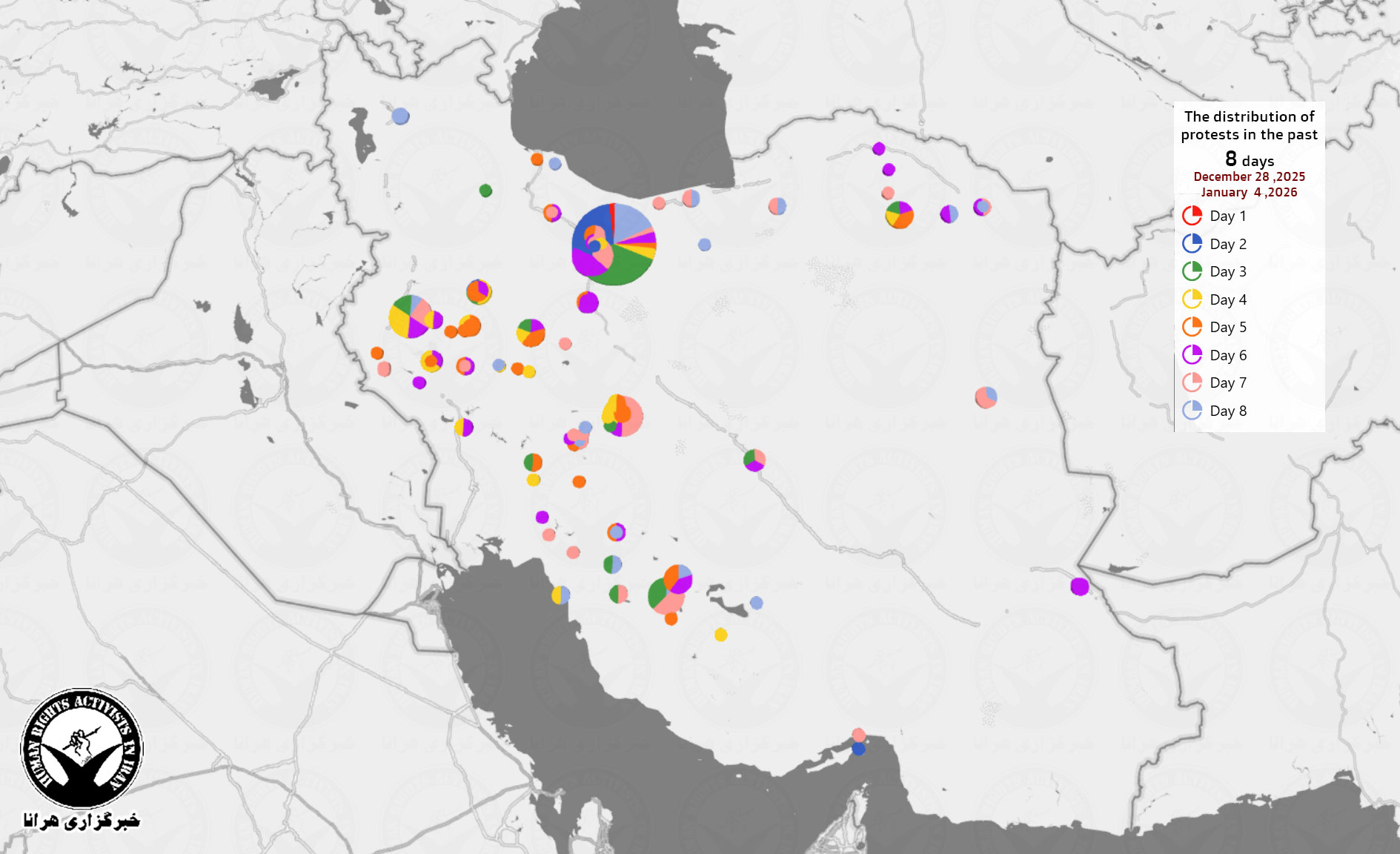
According to updated and aggregated information, over the past eight days at least 222 locations across Iran have witnessed protests, street demonstrations, or labor and trade strikes. These protests have been reported in a total of 26 provinces, and during this period, 17 universities have also seen student protest activities.

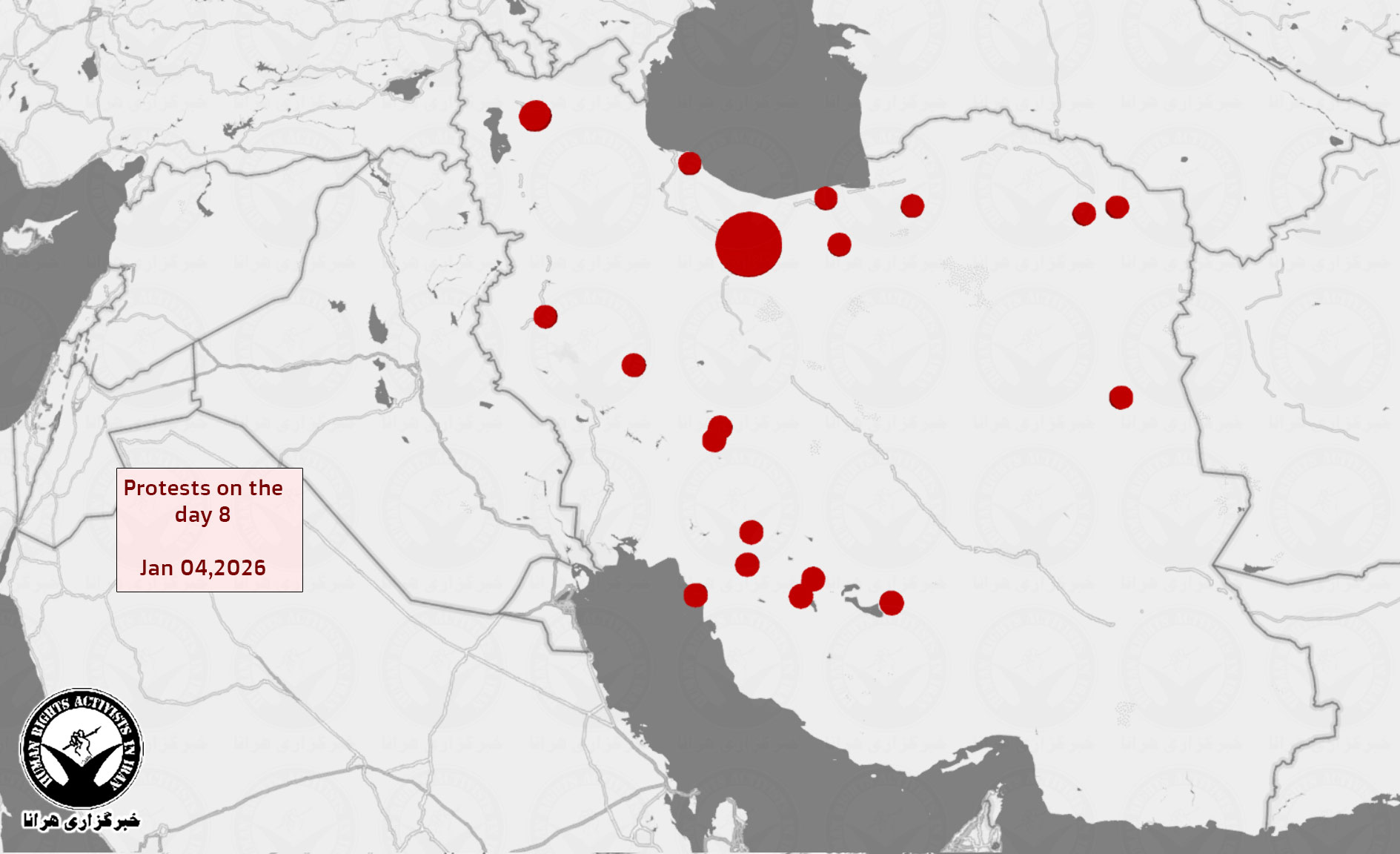
Over the past 24 hours alone, at least 20 cities, including Shiraz, Zarqan, Qazvin, Joveyn, Yazd, Bandar Abbas, Birjand, Behbahan, Karaj, Sureshjan, Sari, Tehran, Gachsaran, Mahallat, Khorramabad, Shahroud, Likak, Hafshejan, Dorud, Marvdasht, Tabriz, Kermanshah, Saman, Yasuj, Nurabad-e Mamasani, Mashhad, Mehdi Shahr (Sangsar), Lahijan, Mashkan, Rudsar, Neyshabur, and Bushehr, have experienced street protests, protest gatherings, labor strikes, student demonstrations, as well as the imposition of heightened security atmospheres in some areas.

An examination of the geographical distribution of the protests shows that these activities have not been limited to major metropolitan centers, but have also encompassed smaller cities and various regions across the country, indicating the horizontal spread of the protests and the participation of diverse social groups in this wave of dissent.
Protests map- Only Day 8

Forms of Protest and Slogans

A review of verified videos and reports shows that the eighth day of protests, similar to previous days, lacked a single unifying محور and encompassed a wide range of demands. Slogans chanted at gatherings ranged from livelihood and economic grievances to criticism of governance practices, restrictions on individual and social freedoms, and calls for justice.

Within the framework of its human rights mandate, HRANA focuses its reporting on slogans and demands that are directly related to violations of, or calls for, human rights, fundamental freedoms, and civil rights. The persistence of these demands across different parts of the country reflects the depth of public discontent and the overlap of economic, social, and political grievances within the current protest movement.

Conduct of Law Enforcement-Security Forces and Details of Violence

On the eighth day of nationwide protests, reports and published videos continued to point to a prevailing security atmosphere and the use of repressive measures by law enforcement and security forces to prevent the formation or spread of protest gatherings. Images released from various cities show violent crackdown, gunfire, the use of tear gas, and the arrest of protesters.

Meanwhile, state broadcaster IRIB aired a video of a forced confession by a citizen accused of setting fire to one of the agents—footage whose recording conditions remain unclear.

In addition, official accounts provided by local authorities regarding some of the fatalities have been met with skepticism by eyewitnesses and contradicted by unofficial reports. Details surrounding these deaths remain under review and subject to further verification.

Fatalities and Injuries

According to updated information from HRANA, the deaths of at least 20 people during the eight days of protests have been confirmed. One of the deceased was affiliated with law enforcement-security forces. At least 51 cases of citizen injuries have also been recorded so far, most of them resulting from pellet and plastic bullets.

Supplementing reports from previous days, new field investigations by this human rights organization confirm the deaths of Reza Azimzadeh, Mehdi Emami-Pour, Latif Karimi, Soroush Soleimani, Rasoul Kadiourian, Reza Kadiourian, Hossein Rabiei, and Amir Mohammad Kouhkan.

HRANA has also received concerning reports of the beating of Nasser Rezaei Ahangarany, a lawyer, by security forces on Saturday evening, January 3, during protests in Khorramabad.

Separately, Kurdpa News Agency, which covers developments in Kurdish regions, reported that at least 30 people were injured during protests in Malekshahi the previous day.

Arrests

Over the past eight days of protests, at least 990 protesting citizens have been arrested, although the actual number of detainees is estimated to be significantly higher.

Individual arrests with confirmed identities on the eighth day:

  1. 1. Full name: Salman Mardani
    Place of arrest: Dehloran
    Date of arrest: January 3, 2026
    Current status: Detained

  2. 2. Full name: Pouria Aliyari, student
    Place of arrest: Esfarayen
    Date of arrest: January 3, 2026
    Current status: Detained

  3. 3. Full name: Parsa Loghmani, student
    Place of arrest: Babol
    Date of arrest: January 3, 2026
    Current status: Released

  4. 4. Full name: Erfan Dehghani Iraj
    Place of arrest: Tehran
    Date of arrest: January 3, 2026
    Current status: Released

  5. 5. Full name: Asghar Shakeri
    Place of arrest: Mashhad
    Date of arrest: December 31, 2025
    Current status: Detained

  6. 6. Full name: Fariba Hosseini
    Place of arrest: Shiraz
    Date of arrest: January 3, 2026
    Current status: Detained

  7. 7. Full name: Javad Soltani Kalateh
    Place of arrest: Sabzevar
    Date of arrest: January 2, 2026
    Current status: Detained

  8. 8. Full name: Abolfazl Imani, 17-year-old minor
    Place of arrest: Sabzevar
    Date of arrest: January 2, 2026
    Current status: Detained

  9. 9. Full name: Saeed Shiei, 17-year-old minor
    Place of arrest: Sabzevar
    Date of arrest: January 2, 2026
    Current status: Detained

  10. 10. Full name: Jalal Lotfi
    Place of arrest: Sabzevar
    Date of arrest: January 3, 2026
    Current status: Detained

  11. 11. Full name: Ali Amanabadi
    Place of arrest: Neyshabur
    Date of arrest: January 3, 2026
    Current status: Detained

  12. 12. Full name: Zahra Izadi Nia
    Place of arrest: Yasuj
    Date of arrest: January 2, 2026
    Current status: Detained

  13. 13. Full name: Hasti Ghorbani, 16-year-old minor
    Place of arrest: Mashhad
    Date of arrest: Unknown
    Current status: Detained

  14. 14. Full name: Alireza Yazdani
    Place of arrest: Tehran
    Date of arrest: January 2, 2026
    Current status: Detained

  15. 15. Full name: Mahan Mohammadi
    Place of arrest: Tehran
    Date of arrest: January 2, 2026
    Current status: Detained

  16. 16. Full name: Sajad Ravad
    Place of arrest: Behbahan
    Date of arrest: January 4, 2026
    Current status: Detained

  17. 17. Full name: Shahrokh Shojaei
    Place of arrest: Behbahan
    Date of arrest: January 3, 2026
    Current status: Detained

  18. 18. Full name: Abolfazl Tayebi
    Place of arrest: Behbahan
    Date of arrest: January 1, 2026
    Current status: Detained

  19. 19. Full name: Sina Dehdashti, 16-year-old minor
    Place of arrest: Behbahan
    Date of arrest: January 1, 2026
    Current status: Detained

  20. 20. Full name: Artin Estadayan, 16-year-old minor
    Place of arrest: Behbahan
    Date of arrest: January 1, 2026
    Current status: Released after submission of a salary slip

  21. 21. Full name: Saber Vafaian-Nejad, 15-year-old minor
    Place of arrest: Behbahan
    Date of arrest: January 1, 2026
    Current status: Detained

  22. 22. Full name: Maryam Zarei
    Place of arrest: Yazd
    Date of arrest: Recent days
    Current status: Detained

  23. 23. Full name: Sara Nosrati, 17-year-old minor
    Place of arrest: Yazd
    Date of arrest: Recent days
    Current status: Detained

  24. 24. Full name: Reyhaneh Zarei
    Place of arrest: Yazd
    Date of arrest: Recent days
    Current status: Detained

  25. 25. Full name: Farzaneh Golestani
    Place of arrest: Yazd
    Date of arrest: Recent days
    Current status: Detained

  26. 26. Full name: Ahmadreza Khosravi, minor
    Place of arrest: Shushtar
    Date of arrest: January 3, 2026
    Current status: Detained

  27. 27. Full name: Emad Ghorbani, minor
    Place of arrest: Shushtar
    Date of arrest: January 3, 2026
    Current status: Detained

  28. 28. Full name: Sajad Khorshidi
    Place of arrest: Ilam
    Date of arrest: January 3, 2026
    Current status: Detained

  29. 29. Full name: Abolfazl Saki
    Place of arrest: Ilam
    Date of arrest: January 3, 2026
    Current status: Detained

  30. 30. Full name: Alireza Momeni
    Place of arrest: Ilam
    Date of arrest: January 3, 2026
    Current status: Detained

  31. 31. Full name: Alireza Momeni, student
    Place of arrest: Ilam
    Date of arrest: January 4, 2026
    Current status: Detained

  32. 32. Full name: Faizeh Rashidi
    Place of arrest: Badreh
    Date of arrest: January 3, 2026
    Current status: Detained

  33. 33. Full name: Siroos Azarmehr
    Place of arrest: Isfahan
    Date of arrest: Recent days
    Current status: Detained

  34. 34. Full name: Saman Shahamat
    Place of arrest: Isfahan
    Date of arrest: Recent days
    Current status: Detained

  35. 35. Full name: Payam Aminzadeh
    Place of arrest: Isfahan
    Date of arrest: Recent days
    Current status: Detained

  36. 36. Full name: Siroos Javidy
    Place of arrest: Isfahan
    Date of arrest: Recent days
    Current status: Detained

  37. 37. Full name: Fatemeh Zarei
    Place of arrest: Mashhad
    Date of arrest: January 2, 2026
    Current status: Detained

  38. 38. Full name: Elaheh Khazaei
    Place of arrest: Shahriar
    Date of arrest: Recent days
    Current status: Detained

  39. 39. Full name: Setayesh Khazaei
    Place of arrest: Shahriar
    Date of arrest: Recent days
    Current status: Detained

  40. 40. Full name: Nazanin Khazaei
    Place of arrest: Shahriar
    Date of arrest: Recent days
    Current status: Detained

  41. 41. Full name: Mehdi Hasanpour
    Place of arrest: Neqab
    Date of arrest: January 4, 2026
    Current status: Detained

  42. 42. Full name: Negar (Aram) Iranmanesh
    Place of arrest: Yasuj
    Date of arrest: January 4, 2026
    Current status: Detained

  43. 43. Full name: Pouya Naderi
    Place of arrest: Abdanan
    Date of arrest: January 3, 2026
    Current status: Detained

  44. 44. Full name: Abdollah Ahmadi
    Place of arrest: Abdanan
    Date of arrest: January 4, 2026
    Current status: Detained

  45. 45. Full name: Mehdi Sheikhi
    Place of arrest: Abdanan
    Date of arrest: January 4, 2026
    Current status: Detained

  46. 46. Full name: Amir Eisa Zadeh
    Place of arrest: Darreh Shahr
    Date of arrest: January 3, 2026
    Current status: Detained

  47. 47. Full name: Mohammad Bashir Hashemian
    Place of arrest: Darreh Shahr
    Date of arrest: January 3, 2026
    Current status: Detained

  48. 48. Full name: Mehdi Hashemian
    Place of arrest: Darreh Shahr
    Date of arrest: January 3, 2026
    Current status: Detained

  49. 49. Full name: Ahmad Hasanvand Amouzadeh
    Place of arrest: Darreh Shahr
    Date of arrest: January 3, 2026
    Current status: Detained

  50. 50. Full name: Bahador Amouzadeh
    Place of arrest: Darreh Shahr
    Date of arrest: January 3, 2026
    Current status: Detained

  51. 51. Full name: Ahmad Haqnazari
    Place of arrest: Sarableh
    Date of arrest: January 2, 2026
    Current status: Detained

  52. 52. Full name: Reza Bagheri Nejad
    Place of arrest: Sarableh
    Date of arrest: January 2, 2026
    Current status: Detained

  53. 53. Full name: Shahin Qasr Beigi
    Place of arrest: Sarableh
    Date of arrest: January 4, 2026
    Current status: Detained

  54. 54. Full name: Salal Sadeghi
    Place of arrest: Shabab
    Date of arrest: January 3, 2026
    Current status: Detained

  55. 55. Full name: Iraj Rostami Mehr
    Place of arrest: Shabab
    Date of arrest: January 3, 2026
    Current status: Detained

  56. 56. Full name: Samyar Motallebi, student
    Place of arrest: Tehran
    Date of arrest: Recent days
    Current status: Detained

  57. 57. Full name: Ramin Pourasal, student
    Place of arrest: Tehran
    Date of arrest: Recent days
    Current status: Detained

  58. 58. Full name: Ehsan Masoudi, student
    Place of arrest: Tehran
    Date of arrest: Recent days
    Current status: Detained

  59. 59. Full name: Meysam Behzadi
    Place of arrest: Kermanshah
    Date of arrest: January 3, 2026
    Current status: Detained

  60. 60. Full name: Ehsan Hayati
    Place of arrest: Kermanshah
    Date of arrest: January 1, 2026
    Current status: Detained

  61. 61. Full name: Mohammad Ziyadi
    Place of arrest: Kermanshah
    Date of arrest: January 3, 2026
    Current status: Detained

  62. 62. Full name: Rahim Mohammadvali
    Place of arrest: Hersin
    Date of arrest: January 2, 2026
    Current status: Detained

  63. 63. Full name: Ali Cheraghi
    Place of arrest: Hersin
    Date of arrest: January 2, 2026
    Current status: Detained

  64. 64. Full name: Milad Alibeygi
    Place of arrest: Hersin
    Date of arrest: January 2, 2026
    Current status: Detained

  65. 65. Full name: Saeed Darvishi
    Place of arrest: Eslamabad-e Gharb
    Date of arrest: January 3, 2026
    Current status: Detained

  66. 66. Full name: Yousef Salkhordeh
    Place of arrest: Gilan-e Gharb
    Date of arrest: January 3, 2026
    Current status: Detained

  67. 67. Full name: Delaram Kazemi
    Place of arrest: Gilan-e Gharb
    Date of arrest: January 2, 2026
    Current status: Released

Group Arrests or Arrests Without Confirmed Identities (Eighth Day)

  • • Arrest of several individuals in Yazd, detained for activity on social media

  • • Arrest of one individual in Marlik, Malard,  presented as a “leader of the protests”

  • • Arrest of one individual in Shiraz’s Maali Abad neighborhood, detained after being beaten by security forces

  • • Arrest of four citizens in Qazvin,  described as “instigators of the protests”

  • • Arrest of several protesters in Zanjan, labeled as “agents of unrest”

  • • Arrest of 71 individuals, including one woman, in Yazd over recent days

  • • Arrest of 30 individuals on the previous night in Jafarabad neighborhood, Kermanshah

  • • Arrest of 150 individuals in Isfahan and their transfer to the city’s prison

  • • Arrest of 24 individuals in Shiraz and their transfer to Adelabad Prison

  • • Arrest of three individuals in Shiraz and Tehran

  • • Arrest of one individual in Rezvanshahr

  • • Arrest of 30 individuals in Behbahan


International Reactions

The escalation of violence and repression in Iran has also sparked international concern. In a statement quoted from its spokesperson, the European Union’s External Action Service expressed concern over violence against Iranian protesters and called on Iran’s security forces to exercise restraint in dealing with participants in peaceful demonstrations. The statement described the protests as “reflecting the demands of many Iranians” and emphasized that developments across Iran are being closely monitored. It further stated: “We are concerned by reports of deaths and injuries and call on Iranian security forces to show maximum restraint in responding to peaceful protests. Authorities have acknowledged socio-economic challenges, and addressing these challenges must take place through inclusive dialogue, not violence.”

A diplomatic source at France’s Ministry of Foreign Affairs, expressing regret over the killing of protesters, called for full transparency and for Iran to respect its international commitments.

Amnesty International Australia called for an immediate halt to violence, the release of political prisoners, an end to executions, and a stop to the use of lethal weapons against protesters.

The Association of Families of Flight PS752 Victims, in a statement published on Friday, January 3, declared solidarity with protesters in Iran and called for an immediate end to the violent suppression of protests, accountability regarding those killed, injured, and detained, and respect for the right to protest and freedom of expression.

Domestic (Governmental) Reactions

Today, the commander of Iran’s national police (FARAJA) announced that what he described as “targeted arrests of leaders” had begun over the past two nights. Ahmadreza Radan claimed that those arrested were accused of inciting citizens and receiving foreign currency in exchange for their actions.

Meanwhile, official media and channels affiliated with security institutions continue to describe protests in various cities as “riots,” accusing protesters of ties to foreign actors and opposition groups. This narrative, presented without clear evidence, seeks to deny the livelihood-based and protest-driven nature of citizens’ demands and attribute the protests to external interference.

Mohammad Ja’far Montazeri, head of Iran’s Supreme Court, said the recent protests were unrelated to the will of the people and dismissed threats by U.S. President Donald Trump regarding support for the Iranian people as ineffective. Alaeddin Boroujerdi, a member of parliament’s National Security Commission, warned the United States that any action would result in its regional interests being targeted. Qassem Ravanbakhsh, a member of parliament from Qom, described Trump’s support for protesters as foreign interference and rejected it. In contrast, Ahmad Naderi, a member of parliament’s presidium, assessed the protests as stemming from runaway inflation and economic mismanagement by the government. At the same time, the police commander of Yazd Province reported the identification and arrest of administrators of several social media pages linked to the protests.

The Iran Reform Front reacted to the recent protests, stating that the government’s approach of avoiding violence and listening to protesters’ voices is a positive—though insufficient—step toward rebuilding public trust. It emphasized that the protests in Iran have entirely domestic roots and can only be pursued through peaceful means.

Ali Rabiei, the president’s social affairs aide, said in response to the protests: “Iran today stands at one of the most complex junctures in its history, a moment shaped not only by external pressures, but by the accumulation of economic imbalances, erosion of social capital, and policy mistakes over past decades.”

Finally, the Workers’ House of Iran, in a statement reacting to the protests, declared that the people of Iran have the right to protest their livelihood and economic conditions, and that this right is legitimate, legal, and social. It added that workers across the country have repeatedly raised their demands in professional and peaceful ways.

Domestic Reactions (Civil Society, Trade Groups, and Public Figures)

The Kermanshah Bar Association, in a statement responding to the popular protests, described the purpose of governments and political, administrative, and military institutions as “serving the interests of the people” in areas such as the economy, security, healthcare, and education. It emphasized that despite nearly five decades since the revolution, the Islamic Republic has failed to achieve a large portion of these objectives. The statement said that Iran has, over these years, become a “poor and isolated” country, and that the “widespread poverty and misery of the people,” alongside the “expansion of corruption,” are clear signs of the inefficiency of the governing system. The Hersin Teachers’ Association also issued a statement supporting the protests, declaring that under current conditions, no option remains other than street protests.

Separately, the Hersin Teachers’ Association reiterated its support for the protests, stating that there is no alternative but to take to the streets.

Labor organizations, retirees’ groups, and social associations, in a joint reaction to the protests, said in a statement that runaway inflation has broken the backs of the majority of the population. Wages and salaries that fall below the poverty line and the cost-of-living basket, privatization, repression, imprisonment, executions, and war-driven policies have pushed people’s lives to the brink of collapse. Society has reached a boiling point, and nationwide protests are a direct reflection of this critical situation.

The Islam Abad-e Gharb Teachers’ Association, expressing support for the protests, stated that given the livelihood problems facing working and retired teachers and various segments of society under the current dire economic conditions, it fully supports the rightful protests of different social groups across the country and will stand alongside them.

A number of male and female athletes, including members of national teams and club teams, also voiced their support for the popular protests through public messages.

Conclusion

The ongoing protests, which began at Tehran’s bazaar, have entered their eighth day marked by geographical expansion, increased public participation, and an intensified presence of security forces. The combination of livelihood and political demands, rising arrests, and authorities’ attempts to simultaneously manage the crisis through economic and security measures highlight the state’s heightened sensitivity to the continuation of these protests.

HRANA continues to collect, verify, and complete information related to these protests and will publish follow-up reports should the demonstrations continue or expand.

At Least 17 Prisoners Executed in Iranian Prisons Over Two Days

HRANA – Over the past two days, HRANA has reported the execution of 17 prisoners in various prisons across Iran. This report provides details of these executions:

Saturday, December 20:

On this day, HRANA reported the executions of the following individuals:

• Yashar Tehrani Moghadam, on a charge of murder, at Karaj Central Prison
• Kian Papi, on a charge of murder, at Aligudarz Prison
• Behzad Hosseini Rad, on a charge of murder, at Kermanshah Prison
• Yarhossein Hassanvand, on a charge of murder, at Khorramabad Prison
• Mohammad Javad Kalani, on a charge of murder, at Nahavand Prison
• Hessam Nouzari, on a charge of murder, at Ardabil Prison
• Moslem Salimi, on drug-related charges, at Hamedan Prison
• One prisoner of unknown identity, on a charge of murder, at Dezful Prison

Sunday, December 21:

• Fariborz Ghasemi, on a charge of murder, at Yasuj Prison
• Reza Dastar, on drug-related charges, at Bandar Abbas Prison
• Kazem Sourian, on a charge of murder, at Qom Prison
•Vahid Pazouki, on drug-related charges, at Semnan Prison
• Ali Mohammad Koushki, on a charge of murder, at Borujerd Prison
• Amir Mohammad Jadidi, on a charge of murder, at Qazvin Prison
• Fardin Khani, on a charge of murder, at Arak Prison

The death sentences of two other prisoners were also carried out on murder charges at Tabriz Prison. The identity of one of them has been confirmed by HRANA as Ebrahim Mashayekhi.

As of the time of this report, the executions of these prisoners have not been officially announced by prison authorities or relevant institutions.

From the beginning of this year until the end of November, 2025, the Iranian regime has executed 1,594 people, marking an unprecedented increase compared to previous years.

HRANA’s Report on the Execution of 31 Prisoners in Recent Days

HRANA – In recent days, authorities in several prisons across Iran have carried out the execution of dozens of inmates on drug-related and murder charges. The pace of executions this year has been unprecedented compared to previous years.

HRANA has documented the following executions in recent days:

Tuesday, November 11

• Reza Geraei, on drug-related charges, in Behbahan Prison

• Yaqub Dachi, 28, on murder charges, in Ilam Prison

Wednesday, November 12

• Abbas Beigi, on murder charges, in Yasuj Prison

• Saber Fallah, 33, on murder charges stemming from a street altercation, in Qom Prison

Thursday, November 13

• Qomri Abbaszadeh, 29, and Iraj Aghaei, 30, on murder and drug-related charges respectively, in Sari Prison

Saturday, November 15

• Nour Mohammad Rahmati, on drug-related charges, in Aligudarz Prison

• Yar Morad Hassanvand, on murder charges, in Khorramabad Prison

• Two prisoners executed in Dizelabad Prison in Kermanshah on murder charges; HRANA has confirmed the identity of one of them as Kamyar Fathi

•Jaber Saki and Jahan Rasouli, on murder and drug-related charges respectively, in Dezful Prison

Sunday, November 16

• Seyed Ali Hashemi of Karaj, on drug-related charges, in Salmas Prison

• (First name unknown) Yeganeh, on drug-related charges, in Bam Prison

• Habib Ezzati, on murder charges, in Sanandaj Prison

• Mohammad Amin Safari, on murder charges, in Bukan Prison

• Yasin Esfandiari, on drug-related charges, in Semnan Prison

• An unidentified prisoner, on murder charges, in Nahavand Prison

• Shokat Veisi (female), on drug-related charges, in Damghan Prison

• Amin Shokarkhodaei, on murder charges, in Arak Prison

• Mosib Khalavand, on drug-related charges, in Bandar Abbas Prison

Monday, November 17

• Reza Kamayi, on murder charges, in Sepidar Prison of Ahvaz

• Alireza Keshavarz, on murder charges, in Sabzevar Prison

• Amir Farkhnezhad, on drug-related charges, in Zanjan Prison

• Behzad Hasani, on murder charges, in Gorgan Prison

• Two prisoners previously convicted on drug-related charges in Taybad Prison; HRANA has verified the identity of one of them as Javad Sattari

•
 Four prisoners were executed in Vakilabad Prison in Mashhad on drug-related charges. HRANA has confirmed the identities of two of them as Shamseddin (surname unknown), an Afghan national, and Alimardan Barani.

As of the time of this report, prison authorities and responsible institutions have not publicly announced these executions.

From the beginning of this year until the end of October, the Iranian regime has executed 1,286 people, marking an unprecedented increase compared to previous years.

Following Acquittal on Espionage Charges, Lennart Monterlos Released

HRANA – Lennart Monterlos (Lennart Christian Jean-Pierre Monterlos), a German national who also holds French citizenship, has been released following his acquittal by the Bandar Abbas Revolutionary Court. He had been arrested on charges of “espionage” during the 12-day conflict between Israel and Iran.

French President Emmanuel Macron announced the news today, stating: “Our compatriot, Lennart Monterlos, has finally been freed. He had been detained in Iran since June 16. The people of France share in the relief and happiness of him and his family. I thank everyone who worked for his release.”

President Macron also referred to the continued detention of Cécile Kohler and her husband Jacques Paris, two members of the French teachers’ and education union, calling their detention in Iran arbitrary and urging their immediate release.

ISNA News Agency, citing sources close to Monterlos’s case, reported that he is expected to return to France on Thursday.

On Monday, October 6, Mojtaba Ghahremani, the head of the Hormozgan Provincial Judiciary, announced that the Bandar Abbas Revolutionary Court had acquitted this German-French citizen of espionage charges.

Ghahremani stated: “Despite an indictment issued by the prosecutor’s office, the Revolutionary Court – based on legal principles and in light of doubts regarding the alleged offense -issued a verdict of acquittal. However, under the law, the prosecutor has the right to appeal the ruling.”

During that conflict, a German-language news outlet covering France and global affairs reported that Monterlus, an 18-year-old French national, had traveled to Iran by bicycle and had gone missing on June 16. Shortly thereafter, Iran’s Foreign Minister Abbas Araghchi confirmed in an interview with a French publication that this citizen had been arrested in Iran.

Drug-Related Charges: Six Afghan Nationals Executed in Bandar Abbas Prison

HRANA– At dawn today, the death sentences of six prisoners previously convicted on drug-related charges were carried out in Bandar Abbas Prison.

According to HRANA, citing Haal Vsh, at dawn on Tuesday, August 19, six Afghan nationals were executed in Bandar Abbas Prison.

The identities of three of the executed prisoners have been reported as:

• Allah-Nazar Tajik, approximately 30 years old, father of one child
• Abdolraouf Noorzahi, approximately 50 years old, father of six children
• Abdolrahman Eshaqzahi, approximately 50 years old, and father of seven children

According to the report, all six prisoners had previously been arrested on drug-related charges and later sentenced to death by the Revolutionary Court.

They had been transferred to solitary confinement in Bandar Abbas Prison on August 17 in preparation for their executions. The identities of the other three prisoners have not yet been established.

As of the time of this report, prison authorities and judicial officials have not announced these executions.

According to HRANA’s report, in 2024, over 52 percent of executed prisoners had been convicted on drug-related charges. Over the past ten years, individuals convicted of drug trafficking have accounted for 40 percent of all executions. Unfortunately, HRANA’s statistics show no progress in reducing executions for drug-related offenses.

Subscribe to Our Newsletter

Now is definitely not the time to stop reading!

International Workers’ Day: A Year in Review of Iranian Workers’ Conditions

HRANA News Agency – Published on the occasion of International Workers’ Day, this report aims to highlight the challenges Iranian workers face, including lack of legal protection, labor rights violations, low wages, unpaid salaries, and unsafe working conditions.

According to HRA’s Department of Statistics and Publications, an analysis of labor-related reports from May 1, 2024, to April 27, 2025, reveals that at least 18,354 workers were reported killed or injured in workplace incidents, as documented by media outlets and organizations active in labor rights.

At least 16,273 workers were injured in workplace accidents over the past year. In one official nationwide and provincial report, authorities reported 16,000 injured, in addition to 273 other reports collected and disseminated by civil or labor organizations.

At least 2,081 workers also lost their lives in workplace accidents during this period. Authorities and relevant organizations reported in an official report the death of 2,000 workers, while independent bodies documented an additional 81 worker deaths not mentioned by officials.

Workers experienced a tragic year during the reporting period. Notably, on the evening of September 21, 2024, a massive explosion occurred at the Madanjo coal mine in Tabas, South Khorasan Province—one of the deadliest mining accidents in Iran’s history. The incident was caused by a sudden release of methane gas in Block C of the mine, which triggered an explosion and the spread of toxic gases into Block B. At the time, 69 workers were present in the two blocks. The blast claimed the lives of 52 workers and injured more than 20 others. Official reports cited inadequate ventilation, the absence of accurate gas sensors, and poor safety oversight as the main causes of the disaster.

The latest in a series of tragic incidents was the explosion at Shahid Rajaee Port in Bandar Abbas. Labor activists reported the death of 46 workers, including three female workers at the time of this writing. Moreover, more than 1,242 injuries were reported by official media, though it remains unclear how many of them were workers. Nevertheless, the head of the Bandar Abbas Workers’ Retirees Association emphasized that most of the victims were workers. This human tragedy, occurring on the eve of the International Day for Safety and Health at Work, highlights that neglecting workplace safety not only endangers thousands of workers’ lives but also inflicts irreparable human and economic damages on society. This reality underscores the importance of more serious enforcement of laws and continuous oversight of compliance with safety principles in work environments.

Despite the significant figures cited above, it is important to note that the majority of workplace incidents go unreported in the media due to the lack of transparency from responsible institutions and officials. Most Iranian workers face unsafe working conditions, with little job security and insufficient insurance coverage. A shortage of labor inspectors and weak safety infrastructure continue to hinder both the documentation and prevention of workplace accidents.

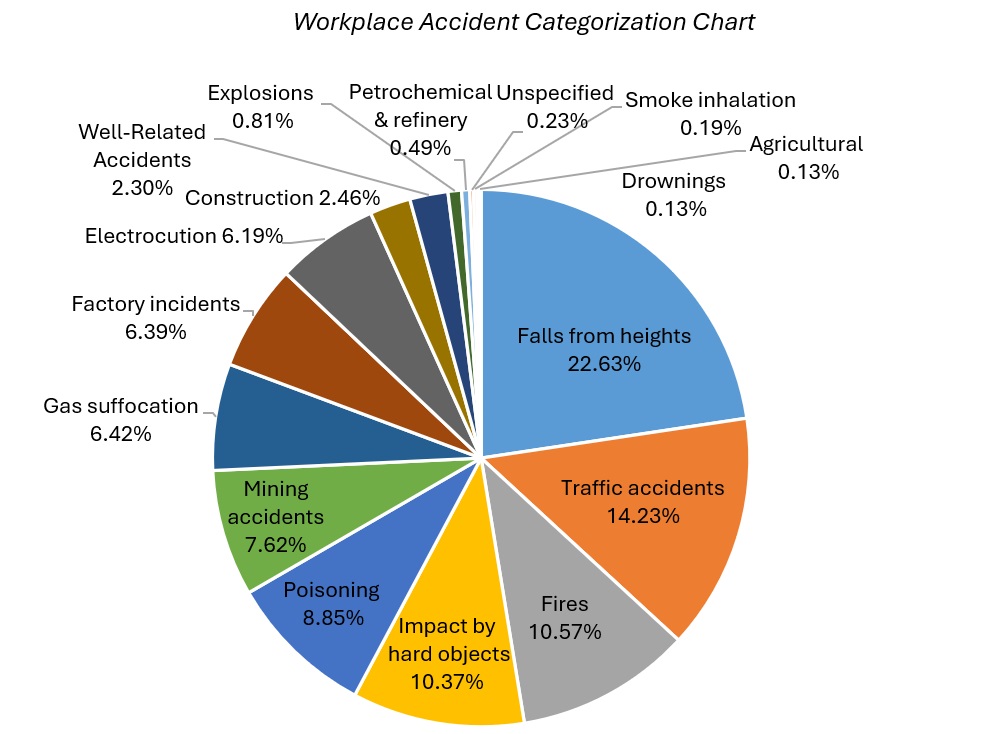
According to the reports compiled by the statistics department of this organization, the distribution of workplace incidents is as follows: 22.63% due to falls from height, 14.23% due to traffic accidents, 10.57% due to fires, 10.37% due to being struck by a hard object, 8.85% due to poisoning, 7.62% due to mining accidents, 6.42% due to gas inhalation, 6.39% due to factory incidents, 6.19% due to electrocution, 2.46% due to construction accidents, 2.30% due to well accidents, 0.81% due to explosions, 0.49% related to petrochemical and refinery incidents, 0.23% unknown causes, 0.19% due to smoke inhalation, 0.13% due to agricultural incidents, and 0.13% due to drowning.

Workplace Accident Categorization Chart

Additionally, based on the statistics gathered by the Statistics Center of Human Rights Activists, at least 1,233 months of wage arrears have been recorded across 92 industrial and service units.

According to the reports compiled by this organization’s statistics department, 72.19% of wage arrears are related to governmental organizations, 14.64% to private organizations, 8.80% are unknown, and 4.36% pertain to the energy industry.

It should be noted that a large portion of the published reports on wage arrears did not specify the number of workers involved, which is a major factor preventing accurate statistics on the number of workers claiming unpaid wages.

While estimates suggest a high level of protests within the labor community, over the past year, a total of only 738 labor protests and 1,145 union protests were reported by media or civil organizations. union protests decreased by 20%, while labor protests increased by 72%.

Among the most significant events in Iran over the past year are the protests by workers at Haft Tappeh Sugarcane Company, farmers, miners at the Western Yurt Winter Mine, workers at South Pars Gas Complex, as well as union protests by teachers, retirees, and Social Security pensioners.

Over the past 12 months, various cities across Iran witnessed different forms of protest movements by workers. A wide range of workers took to the streets due to non-payment of monthly wages and neglect of their insurance demands. Some workers protested after not receiving up to 30 months of wages. Consequently, 1,373 labor strikes and 69 union strikes took place. Labor strikes increased by 1,315% and union strikes by 86%.

Over the past year, the scale of organized demands by various sectors of the working class has been unprecedented. However, repression, deliberate disruption, non-recognition of independent labor unions and associations, the imprisonment and sentencing of several labor activists, and systematic obstruction of the right to protest have contributed to the fragmentation and disorganization of some labor protests and gatherings.

Labor unions, in their conventional international sense, do not exist in Iran. Independent organizations such as the Syndicate of Workers of Tehran and Suburbs Bus Company, the Haft Tappeh Sugarcane Workers’ Syndicate, the Coordinating Council of Teachers’ Unions, and the Free Workers’ Union face accusations of security and political offenses.

Many workers have been arrested or convicted on charges such as organizing peaceful gatherings and protesting low wages.

Over the past 12 months, at least 13 workers and labor activists have been arrested. Notable among these arrests are at least three workers from Barez Tire Factory in Kerman and four workers from Asfalt Toos Company.

It is also worth mentioning that Ebrahim Madadi, Nahid Khodajoo, Anisha Asadollahi, Nasrin Javadi, Yadi Bahari, and Mehran Raouf are among the prominent labor activists currently imprisoned along with union activists such as Asghar Amirzadegan.

Esmaeil Gerami

Ebrahim Madadi

Nahid Khodajoo

Anisha Asadollahi

Nasrin Javadi

Yadi Bahari

Mehran Raoof

Asghar Amirzadegan

Furthermore, there have been sentences against 10 labor activists and workers totaling 340 months of discretionary imprisonment, 5 cases of self-immolation, 5 cases of suicide, interrogation of 7 individuals by security bodies, 5 cases of sentence execution, 1 home search, summoning of 14 individuals to judicial and security authorities, 11 factory closures, 4,424 cases of dismissal and layoffs, 585 cases of unemployment, 1,024,872 cases of workers lacking work insurance, and 5,105 cases of workers left in limbo regarding their employment status.

In the unions and guilds sector, there have been a total of 27 arrests of union activists, 804 months of discretionary imprisonment, 92 months of suspended imprisonment, 29 lashes, 577.4 million tomans in fines, 168 months of exile for 72 union activists, 3 travel bans, 18 court trials, 118 summonses to judicial-security authorities, 315 place closures, 11 cases of dismissals and layoffs, at least 165 months of wage arrears, 3 cases of forced retirement, 3 home searches, 5 sentence executions, and 5 cases of assault reported.

Over the past year, active and retired teachers and educators across various cities and provinces of the country staged protests and strikes to demand their unmet claims. Accordingly, 98 protests and 2 strikes have been recorded. It is noteworthy that in the past year, there have been 14 arrests, 56 summons, 16 court trials, at least 11 months of delayed salaries, 8 cases of dismissal and prohibition from teaching, and 3 cases of forced retirement among teachers. Additionally, 69 teachers and activists in this sector have been sentenced to a total of 780 months of discretionary imprisonment, 92 months of suspended imprisonment, 29 lashes, 3 cases of deprivation of social rights, and 537.4 million tomans in fines.

The Executive Secretary of the Khorasan Razavi Workers’ House identified the wide gap between wages and living costs as the most significant problem for workers and retirees, stating that despite wage adjustments based on inflation rates, the rapid rise in prices has further reduced the purchasing power of these groups. Seyed Hossein Rasouli added that, given the steep inflation in basic goods in recent months, the wages received by workers and retirees only cover about two weeks of their monthly expenses. He criticized the government, as the country’s largest employer, for not considering workers’ satisfaction and welfare in its calculations.

Meanwhile, Mohammad Chakoshian, Deputy Minister of Cooperatives, Labor, and Social Welfare, in response to the Chamber of Commerce’s announcement regarding a “10% wage reduction for workers with Friday closures,” claimed: “This cannot be implemented because it is illegal, and no one can reduce a worker’s salary against labor laws; if such a violation occurs, it must be stopped.”

According to a report by the National Research Center, occupational accidents are the second leading cause of death in the country, with miners suffering the most due to the lack of safety systems and weak oversight. The rising death toll due to officials’ neglect of workplace safety is a clear example of the violation of workers’ human rights.

Furthermore, the Executive Secretary of the Saveh Workers’ House pointed out the harsh living conditions for workers and retirees, attributing the main cause to behind-the-scenes collusion among parliament members, government officials, and their economic team, whose promises were imposed on workers’ representatives in the Supreme Labor Council.

Additionally, a member of the Parliament’s Commission for Internal Affairs and Councils highlighted the problems faced by workers at Esfandeh Copper Mines in Arzooieh County, stating: “These miners work hundreds of meters underground for a monthly income of 10 to 12 million tomans, which is unjust.” Yasser Soleimani further noted: “Workers at one of the copper mines in this region must travel three hours daily on dirt roads to reach their workplace and return.”

Moreover, the President of the Association of Trade Unions of East Azerbaijan Province stated that some employers, to evade the 4% insurance premium for hazardous jobs, dismiss workers before they reach 20 years of service to prevent them from qualifying for early retirement benefits. Others avoid past debts by changing the factory name and registering a new workshop code. Saeed Fattahi added that the issuance of Directive 1777 by the Social Security Organization has exacerbated problems for workers in hazardous jobs.

Additionally, the Vice President of the Supreme Council of Islamic Labor Councils announced that 70% of workers covered by labor law, despite the minimum wage increase this year, still face a livelihood deficit of around eight million tomans compared to the actual cost of living. Ali Khodaei attributed this situation to unrealistic wage-setting policies, government neglect of the industrial sector, migration of skilled labor, and workers turning to precarious jobs.

According to the recent resolution of the Supreme Labor Council, workers’ housing allowance has remained unchanged at 900,000 tomans for the second consecutive year. This is despite the latest data from Iran’s Statistical Center, which shows that annual housing sector inflation has reached 40.8%. The lack of an increase in this allowance comes at a time when the value of the dollar has risen by 60% since the beginning of the year and the general inflation rate has reached 32% by the end of February. This glaring gap between the meager wage increases and rampant inflation has turned housing costs into a serious crisis for workers.

It is worth mentioning that Ali-Asghar Nakhai Rad, a member of Parliament, stated that workers’ purchasing power has decreased by 40% compared to the past. In recent years, workers’ wages have lagged behind inflation, and now we are facing an accumulation of this gap. He emphasized that, considering the possibility of higher inflation next year, the wage increase for workers in 2025 must exceed the inflation rate announced by the Central Bank.

The ILNA news agency reported that the heavy debt of the Social Security Organization to medical centers and pharmacies has deprived insured individuals of healthcare services. Esmaeili, Acting Director of Social Security’s Healthcare Management in Markazi Province, stated that employers’ debts to Social Security amount to 1.14 quadrillion tomans, which is six times the amount Social Security owes to medical centers. Khosrow Ranjbar, a retirees’ rights activist, also criticized this situation, stressing that workers and retirees have been deprived of medical care due to managers’ irresponsibility and employers’ profiteering, even though insurance premiums have been deducted from their wages but not paid to Social Security.

Other demands of the labor community include the prohibition of child labor and the provision of free education for children, the establishment of the highest safety standards in work environments, and the elimination of discriminatory laws against women and migrant workers.

Despite Iranian women workers being described as the cheapest labor force in the country, their employment situation is worse than that of men, and they enjoy fewer legal protections, rights, and benefits. Moreover, women workers have less bargaining power compared to their male colleagues. Production and industrial units are less inclined to hire married women, and in some cases, single women are employed under the condition that they do not marry or become pregnant.

The situation of female workers in small workshops is even worse. Women make up half of the workers in brick kilns, where they work under extremely harsh conditions.

In Iran, Workers’ Day arrives amid continued privatization of factories and state-owned companies without considering the long-term interests of workers, a situation that has led to widespread labor protests.

World Day for Safety and Health at Work: HRANA’s Annual Report on Workplace Safety and Accidents in Iran

HRANA News Agency – On the occasion of the World Day for Safety and Health at Work, Human Rights Activists in Iran (HRA) has published a report examining workplace accidents linked to unsafe environments and hazardous working conditions in Iran between May 2, 2024, and April 27, 2025.

According to data compiled by HRA’s Department of Statistics and Publications, during this period at least 2,079 workers lost their lives and at least 16,273 others were injured due to workplace accidents resulting from inadequate safety measures.

The World Day for Safety and Health at Work, established by the International Labour Organization (ILO) in 2003, aims to raise global awareness of workplace safety and health, promoting accident and disease prevention in occupational settings. Since 1996, labor unions worldwide have also observed April 28 as International Workers’ Memorial Day, honoring workers who have lost their lives on the job.

HRA’s report highlights that the reported deaths and injuries were collected from media outlets and organizations monitoring labor rights across Iran. Among the most devastating incidents was the explosion at Shahid Rajaee Port in Bandar Abbas, where 46 workers, including three women, had been killed as of the time of this writing. Official reports recorded over 1,242 injuries, although it remains unclear how many of those injured were workers. According to the head of the Bandar Abbas Workers’ Retirees Association, the majority of the victims were indeed laborers.

This tragedy, occurring just before the World Day for Safety and Health at Work, underscores the importance of stricter implementation of laws and continuous monitoring of compliance with safety principles in work environments.

The report also provides a breakdown of the causes of workplace accidents:

Falls from heights accounted for 22.63% of incidents,
Traffic accidents 14.23%,
Fires 10.57%,
Being struck by hard objects 10.37%,
Poisoning 8.85%,
Mining accidents 7.62%,
Gas suffocation 6.42%,
Factory incidents 6.39%,
Electrocution 6.19%,
Construction accidents 2.46%,
Well-related accidents 2.30%,
Explosions 0.81%,
Petrochemical and refinery incidents 0.49%,
Unspecified causes 0.23%,
Smoke inhalation 0.19%,
Agricultural accidents 0.13%,
Drownings 0.13%.

Workplace Accident Categorization Chart

Iran ranks 102nd in the world regarding the observance of workplace safety standards, which is considered a very low ranking. HRA’s findings reflect the urgent need for improved occupational safety standards and continuous oversight to protect workers’ lives across Iran.

Two Prisoners Executed in Bandar Abbas and Kerman Prisons

HRANA News Agency – At dawn today, Tuesday, April 15, the death sentences of two prisoners previously convicted on drug-related charges were carried out in the prisons of Bandar Abbas and Kerman.

According to the report by Haal Vsh, at dawn today, Tuesday, April 15, 2025, a prisoner identified as Abubakr Shahbakhsh, aged about 35,a resident of a village in Zahedan, was executed in Kerman Prison. Mr. Shahbakhsh was arrested in 2021 on drug-related charges in Kerman and later sentenced to death by the Revolutionary Court.

Also this morning, the execution of another prisoner identified as Ayoub Berniaei (Sarhadi), 37 years old, father of two children, and a resident of Rameshk in Kerman Province, was carried out in Bandar Abbas Prison. Mr. Berniaei was arrested in 2021 on drug-related charges in Bandar Khamir and later sentenced to death by the Revolutionary Court. He had also been transferred to solitary confinement on Saturday, April 12, in preparation for the execution. Prior to the execution, he had a final visit with his family.

As of the time of this report, the executions have not been officially announced by prison authorities or relevant institutions.

According to data compiled by HRANA, 52.69% of all executions in Iran in 2024 were related to drug-related charges. Notably, only 6% of the executions were officially announced, highlighting a significant lack of transparency. For a detailed analysis of these executions and the associated statistics, see HRANA’s full report.

17-Year-Old Teenager Arrested by Security Forces in Bandar Abbas

HRANA News Agency – Yesterday, February 5, security forces in Bandar Abbas arrested 17-year-old Khaled Kashani and transferred him to an undisclosed location.

Haal Vsh identified him as Khaled Kashani, 17, originally from Zahedan.

As he was spending time by the beach with a friend, security forces pursued him, fired warning shots, and forced him to stop. Without presenting a judicial warrant, they violently apprehended him, forced him into a vehicle, and took him to an unknown location.

According to the report, Kashani’s friend, who managed to escape, informed his family of the arrest. Despite their efforts to locate him by visiting local police stations, authorities have provided no information about his whereabouts or condition.

The reasons for his arrest and the charges against him remain unknown.

In 2024, HRANA documented the detention of 34 individuals under the age of 18 by security forces in Iran.
For detailed statistics and further insights into children’s rights violations, read HRANA’s 2024 Annual Report.

Hassan Abbasi and Farshid Ma’naie Indicted

The Fourth Branch of the Public and Revolutionary Prosecutor’s Office in Bandar Abbas has issued arrest warrants for Hassan Abbasi, a journalist, and Farshid Ma’naie, the CEO of the Hormozgan Spinal Cord Injury Association.

Abbasi revealed that the Prosecutor’s Office found both him and Ma’naie guilty of “making false statements and spreading misinformation.” In 2022, the Bandar Abbas Prosecutor initiated legal action against them over their criticism of the judiciary.

Additionally, Abbasi faces further complaints from multiple entities, including the Welfare Organization, the Governor’s Office, the General Department of Cooperatives, Labor, and Social Welfare, as well as the Hormozgan Chamber of Commerce, Industries, Mines, and Agriculture.

Recently, Abbasi received a summons from the prosecutor’s office for his final defense on charges of “disturbing public order, defamation, insulting officials and agents, and spreading false information.” He was called to present his defense before the court.

On May 21, 2024, security forces detained Abbasi in Bandar Abbas. However, he was released after several hours.

Abbasi has a history of arrests and legal challenges due to his professional activities. He is currently an editorial board member of Tabnak, a news website, and a member of the Tehran Journalists Association, with past collaborations including work with Mehr News Agency.