HRANA’s Daily Review of Protests in Iran

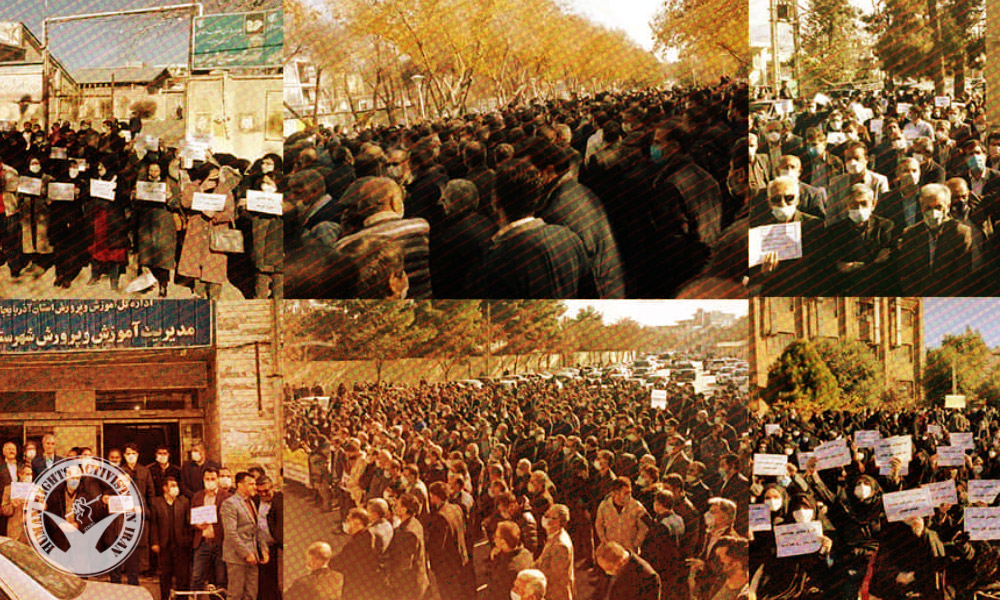
On Saturday, July 16, 2022, at least 27 protests took place in Iran

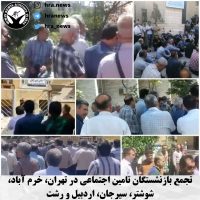
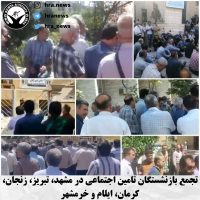
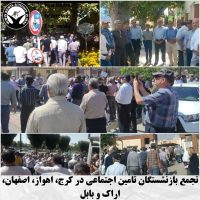
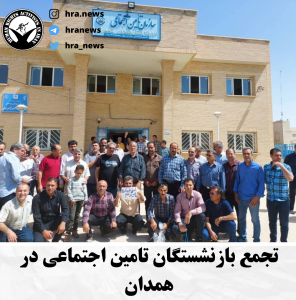
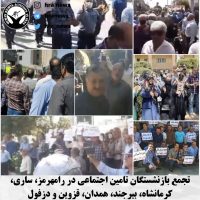
The pensioners of the Social Security Organization protested against low pensions in Karaj, Ahvaz, Isfahan, Arak, Babol, Mashhad, Tabriz, Zanjan, Kerman, Ilam, Khorramshahr, Tehran, Khorramabad, Shushtar, Sirjan, Ardabil, Sirjan, Rasht, Ramhormoz, Sari, Kermanshah, Birjand, Hamedan, Qazvin and Dezful.
In Behbahan, the green maintenance workers of the Municipality gathered to demand their unpaid wages.

Coming from different cities, a number of farmers active in poultry and ostrich farming held a protest in front of the Ministry of Agriculture Jihad.

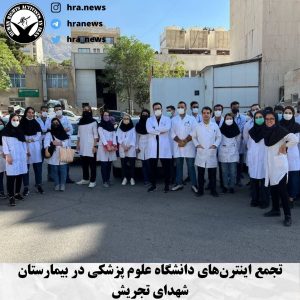
A group of interns of the Shahid Beheshti University of Medical Sciences protested before a hospital in Tehran.
 

HRANA’s Daily Review of Protests in Iran

On Monday, July 11, 2022, a number of protests took place in Iran.

The pensioners continued their protests against low pensions and poor living conditions in Kerman, Rasht, Isfahan and Ramhormoz. According to the pensioners, pensions with only a 10 per cent increase lag far behind skyrocketing living costs. They ask the government to increase pension as much as the Supreme Labour Council has determined.


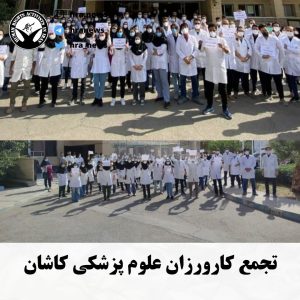
A number of medical interns of the Kashan University of Medical Sciences gathered before a hospital in Kashan to protest against irregularities and delays in payments and their poor living conditions.


HRANA’s Daily Review of Protests in Iran

On Wednesday, July 6, 2022, a number of protests and one labour strike took place in Iran.

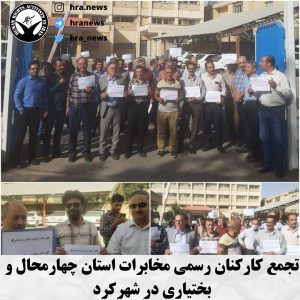
In Shahrekurd, the Telecommunication personnel gathered on the organization’s premises to protest against the cuts in benefits.

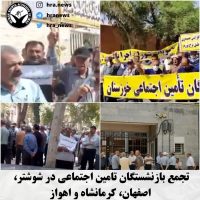
In Shushtar, Isfahan, Kerman, Dorud, Kermanshah and Ahvaz, the pensioners of held protests in front of the Social Security Organization of each city.

For the second consecutive day, the workers of contractor companies working in the Sungun copper mine, went on strike and gathered at their workplace.


HRANA’s Daily Review of Protests in Iran

On Saturday, July 2, 2022, fourteen protests took place in Iran. Read our review below for details, photos, and videos from these demonstrations:

Continuing their protests against the insufficient annual pension increase, the pensioners rallied in Shushtar, Shush, Zanjan, Isfahan, Sari, Dezful, Karaj, Ahvaz, Abadan, Khorramabad, Hamedan and Kerman. They chanted slogans against the government and called the president a liar for failing to keep his promises. In Arak, the protest turned violent by security forces.

A number of citizens, who have lost their money in the recent robbery of Iran Safe Deposit Boxes of Melli Bank, protested in front of the central building of the Judiciary in Tehran. They demanded the return of their stolen money.

On June 6, 2022, dozens of safe deposit boxes from Melli Bank were stolen by some burglars. One day after, a protest took place, which turned violent by security forces. According to some witnesses, the police and security agents used live ammunition against the protestors.


Two Inmates Executed in Isfahan

On Wednesday, April 27, 2022, two inmates who had been convicted for drug-related crimes were executed in Dastgerd Prison in Isfahan.

According to HRANA, the news agency of Human Rights Activists, quoting Kurdpa, two inmates identified as Fakhreddin Waledi, Aged 40 and Hossein Joushan, age 37, were executed in Dastgerd Prison.

In this report, an informed source stated, “Fakhreddin Waledi was arrested four years ago and sentenced to death. Hossein Joushan is a father of a six-year-old child. Five years ago, he was arrested and accused of smuggling crystal meth. Subsequently, he was sentenced to death. In the trial, he denied the allegations and insisted that the drug belonged to someone else who ran away after his arrest.”

None of these executions have been reported by official sources and media outlets inside Iran so far.

The most recent report from the Statistics and Publication Center of the Human Rights Activists in Iran (HRA) states that between January 1 of 2021 and December 20 of 2021, at least 299 citizens, including four juvenile offenders, were executed. In addition, 85 citizens were sentenced to death in this period.

As the report points out, Iran’s judicial authorities do not publicly announce over 88% of executions. These unreported executions are known as “secret executions” by human rights organizations.

Subscribe to Our Newsletter

Now is definitely not the time to stop reading!

Twenty Seven Civil Activists Acquitted of Charges by Isfahan Public and Revolutionary Court

Branch 18 of the Public and Revolutionary Court of Isfahan acquitted 27 civil activists of the charges brought against them. Some of these individuals were arrested at Sardar Asaad Bakhtiar’s burial site, one of the prominent figures of the Persian Constitutional Revolution of  1905

According to HRANA, the news agency of Human Rights Activists, the Public and Revolutionary Court of Isfahan acquitted 27 civil activists.

According to this order, 27 citizens have been acquitted of the charges of “propaganda against the regime, offensive statements against the Supreme Leader of Iran and other regime authorities, and disturbing public order.”

On April 7, 2021, the families of those who were killed during the 2019 widespread protests along with civil activists held a gathering at Sardar Asaad Bakhtiar’s burial site in Isfahan. The police raided and arrested some of them. They were released one day later.

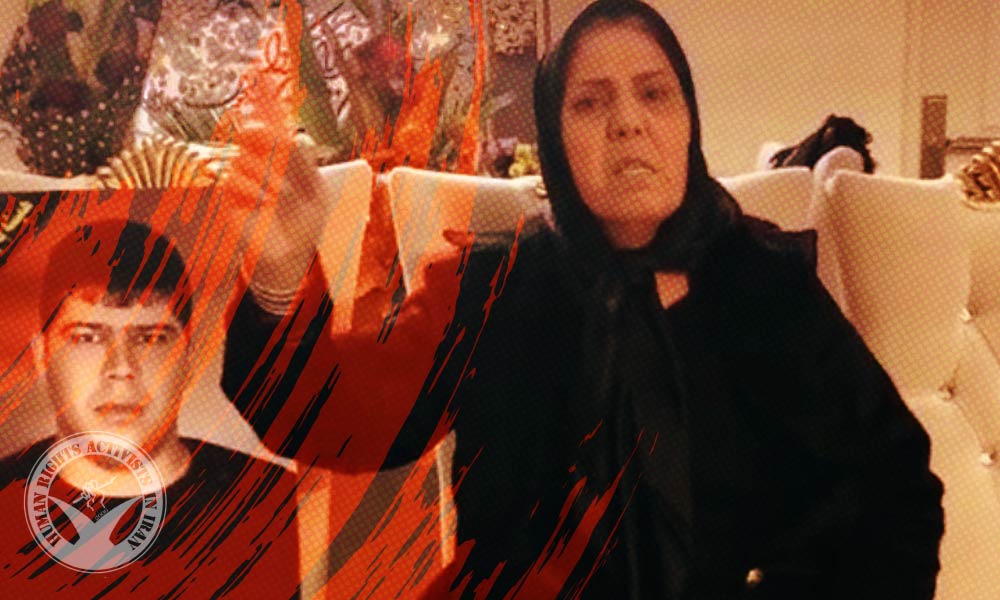
During the police’s raid and arrest, Sakineh Ahmadi, one of the individuals who was arrested, lost consciousness. She is the mother of Ebrahim Ketabdar who was killed by security forces in Karaj during the November 2019 protests.

Two Defendants Sentenced to Public Executions in Isfahan

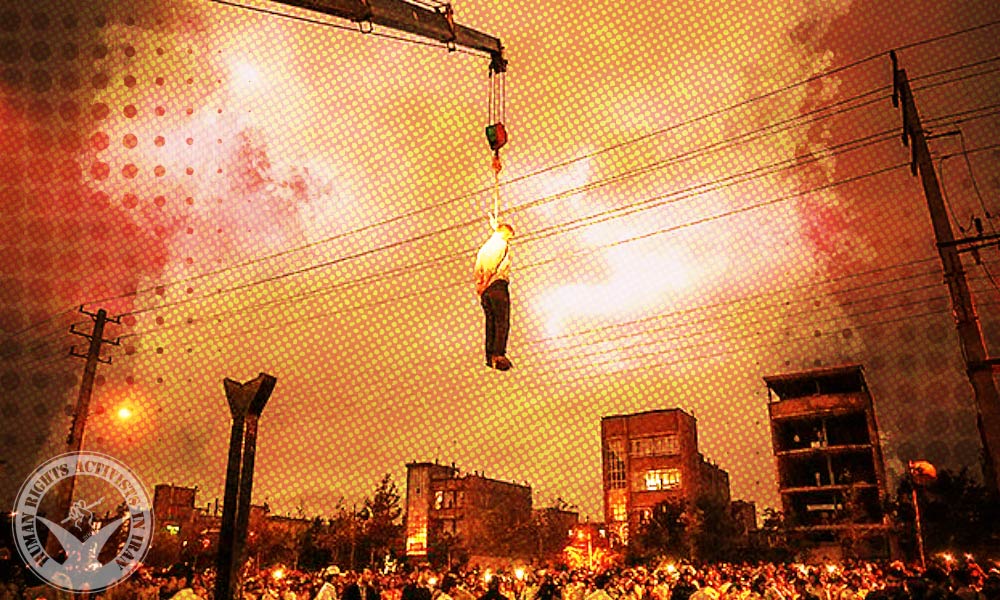
Recently, the Criminal and Revolutionary Court of Isfahan sentenced two citizens to public executions for murdering a police officer.

According to HRANA, the news agency of Human Rights Activists, quoting Tabnak News Agency, two citizens identified with their initials, as Mohammad Q, age 38, and Sadegh M, age 25, were sentenced to public execution in Isfahan.

Confirming that this verdict has been issued by Branch 1 of the Revolutionary Court of Isfahan as well as the Criminal Court of this province, Fooladshahr’s Chief Justice, Mashoudifar stated: “these citizens are accused of killing a police officer, Ehsan Nasiri, during a fight.”

Since the verdict was issued in a short time, “the verdict is appealable and the defendants or their lawyer can make an appeal to the Supreme Court of Iran,” he added.

Iran has one of the highest numbers of executioners in the world. Public executions by hanging are also commonplace since the Islamic Revolution of 1979. From March 21, 2021, to March 16, 2022, at least 333 people were executed, including 12 women and 3 juvenile offenders who were under the age of 18 at the time of committing the crime. In addition, the courts sentenced 105 defendants to the death penalty. 

The Latest on the Teachers and Educators’ Protests

After several consecutive days of protests, thousands of retired and working teachers and educators, joined by supporters, demonstrated in more than 100 cities across the country. These protests were held on December 13 by the call of the Coordination Council of Iranian Teachers’ Trade Associations.

According to HRANA, the news agency of Human Rights Activists, demands included the implementation of an already-enacted plan whereupon the incomes of teachers will be increased depending on rank, to up to 80% of the salaries of faculty members. 

They also asked for unpaid severance payments for retirees who went into pension last year. The implementation of this plan will reduce disparities in income and pay gaps. 

Chants included “teacher wake up, stand up against discrimination”, “Free Imprisoned teachers”, “If our problem is not solved, the school will be closed”.

In these demonstrations, some protesters had some handheld placards with slogans in support of the recent protests in Isfahan against water supply mismanagement.

In Alborz Provinces and in Tehran (in front of Parliament), these protests turned violent due to the interference of security forces.

In Saqqez City, teachers chanted in support of Amanj Amini, the teacher who had been previously arrested, beaten and mistreated by security forces during the protest.

Sattar Rezai Arrested by Security Forces in Isfahan

Late on December 1, worker’s rights activist Sattar Rezai was arrested by security forces and transferred to an unidentified location.

According to HRANA, the news agency of Human Rights Activists, quoting the Independent Iranian Workers Union (IIWU), security forces arrested Rezai at his father’s house in Isfahan.  About 10 to 12 undercover agents were involved in the nighttime raid.

The reason for his arrest and his current whereabouts are unknown at the time of writing.

Iranian Citizens Run Bandaged-Eye Campaign in Solidarity with Protesters Injured in Violent Police Crackdown in Isfahan

Several citizens have posted photos of their faces with bandages over their eyes as an act of protest against the Regime’s brutal crackdown in Isfahan on Friday, during which several were injured from the direct shooting of military and security forces.

According to HRANA, the news agency of Human Rights Activists, local doctors and medical staff have reported high numbers of patients in recent days. Official sources say that at least 19 protesters were injured last Friday, and two are reportedly in critical condition. However, the number of injured people are estimated to be significantly higher.

“In just one hospital, there were about 19 patients who were injured by shooting last Friday and Saturday. Therefore, with all likelihood, contrary to what official media have reported, far more than 19 people have been injured,” a specialist and eye surgeon in Isfahan told HRANA. “The distance of pellets on these patients’ faces indicates that they have been shot from a close range–maybe only a few meters. If the bullets are made of lead, even being hit from a 30-meter distance can cause irreparable damages.”

Military forces using pellet guns against protesters is by no means unprecedented. On February 3, 2018, during a protest of Gonabadi Dervishes in front of the home of their spiritual leader, Noor-Ali Tabandeh, security forces fired pellet guns at the protesters, after which several were injured and some even lost their sight.

Since the widespread use of pellet guns by Chile Police in 2019, which led to the injury of the eye injury of 445 people and permanent blinding of 34, the bandaged eye became a rallying symbol in Chile. Iranian protesters have also used this symbol to express their protest against the regime’s brutality.