Exile and Death Sentences Await Leila Tajik and her Former Spouse

Human Rights Activists News Agency (HRANA) – Leila Tajik, a prisoner in Evin’s Women’s Ward, was sentenced to 15 years imprisonment in exile on espionage charges. Her ex-husband, who reportedly served in the Islamic Revolutionary Guard Corps (IRGC) and faced the same charge, was sentenced to death.

An informed source confirmed to HRANA that Tajik has been in custody for the past 13 months, and recently learned of her sentencing to exile in Karaj.

HRANA is in the process of confirming the identity of Tajik’s ex-spouse, who was arrested along with her on September 5, 2017, pursuant to a joint case opened up against the two by the IRGC. Following the arrest, Tajik was interrogated for seven months in an IRGC outpost.

An informed source previously told HRANA, “their children, Sabah, 16, and Sahand, 19, are hurting over the breakup of their family, and are feeling additional pressures from IRGC agents.”

News sources, including the Dolat-e Bahar [a news site associated with former president Mahmoud Ahmadinejad], have reported the arrest of a number of security forces, mostly employed by the Ministry of Intelligence or the IRGC, accused of espionage, especially for Isreal.

Security and judicial authorities have been unforthcoming with any further details on Tajik or her ex-spouse’s status.

World Day Against the Death Penalty: Iran Annual Report Oct ’17 – Oct ’18

Human Rights Activists News Agency (HRANA)- On the World Day Against the Death Penalty, the Center of Statistics at Human Rights Activists in Iran (HRAI) has published its annual report, in efforts to sensitize the public about the situation of the death penalty in Iran.

HRANA’s Statistics Center relies on the work of HRANA reporters, as well as a network of independent and verifiable sources. It also incorporates disclosures to the media by judicial authorities announcing or confirming prisoner executions, and as such is exposed to a margin of error representing efforts by the Iranian authorities to omit, conceal, or restrict the collection of such data.

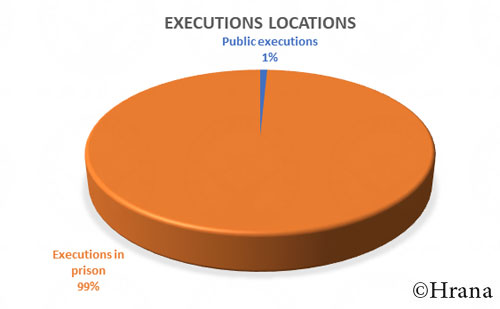
Between October 10, 2017, and October 9, 2018, the death penalty and executions have been the focus of 287 HRANA reports. Over this time period, the Iranian authorities issued the death penalty sentence to 240 individuals and have already carried out 256 executions; [that’s one hanging every 34 hours for a population about twice the size of California’s]. Six percent of the executions in Iran were carried out in public.

Females account for only three of the 256 HRANA-confirmed execution victims this year.

Five were under the age of 18 when they allegedly committed the crime they were charged with.

While execution numbers went down by 50% in comparison to the same time last year, Iranian courts have issued 7.4% more death sentences.

Public hangings and executions of women have gone down 54% and 50%, respectively.

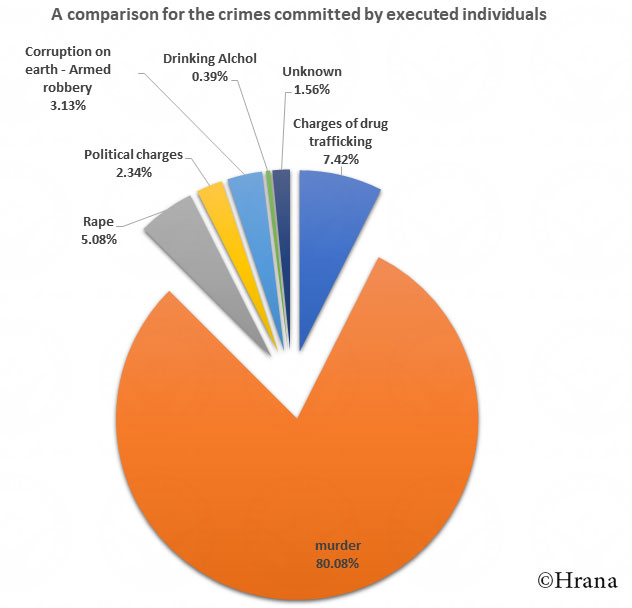
The report includes a breakdown of executions by capital offense:

Drug and narcotic offenses: 6%
Murder: 72%
Rape: 9%
Political or security-related offenses: 7%
Armed robbery/offenses classified as “corruption on earth”: 6%

The chart below displays execution numbers by the province in which they took place.

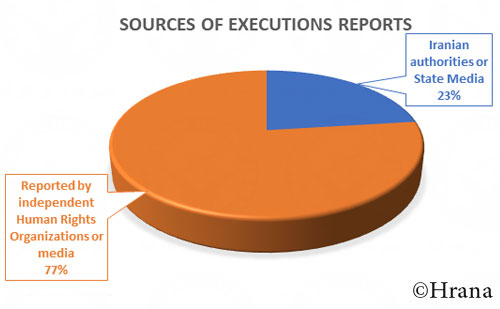
Below is a distribution of execution information sources. The chart indicates that 68% of HRANA-confirmed executions were not announced by official Iranian sources. Undisclosed executions are referred to as “secret” executions.

Open Letter from Prisoners to UN Envoy: Death Penalty is a “Weapon of Terror”

Human Rights Activists News Agency (HRANA)- On Wednesday, October 3, 2018, a letter was published to the attention of Javaid Rehman, the United Nations Special Rapporteur on the Situation of Human Rights in Iran. Its authors were reaching out from the walls of Rajai Shahr Prison of Karaj, on the western outskirts of Tehran, to raise the specter of rising execution numbers and public hangings that still mar the face of the country.

The full text of their letter, translated into English by HRANA, is below:

Javaid Rehman
Special Rapporteur on the Situation of Human Rights in the Islamic Republic of Iran

Dear Mr. Rehman,

The death penalty is not simply a social predicament for us Iranians; it is a living nightmare. We live it and re-live it in the faces of children who witness public hangings, and in the faces of prisoners on death row. In the past few weeks alone, our fellow prisoners Mohammad Salas, Zanyar Moradi, Loghman Moradi, and Ramin Hossein Panahi were executed. Our families used to see each other during weekly visits. This time around, the visit was transformed to a day of mourning – further proof that the death penalty, a medieval legacy of human societies, is a collective punishment. With all of the shock and mental anguish that their executions put our families through, one can only imagine how the families of the victims are feeling.

[The aftereffects of] the death penalty are not the lot of political prisoners alone; every death-row prisoner feels them. The whole of society bears their cruelty.  The efforts of Special Human Rights Rapporteurs, particularly the late Asma Jilani Jahangir [Rapporteur between 2016 and 2018], who helped abolish the death penalty for drug-related offenses, are admirable. However, the widespread nature of executions calls for more drastic and concrete measures. Especially in today’s Iran, capital punishment is not simply a legal apparatus, but also a political weapon of terror used to suppress citizens expressing discontent with Iran’s economic, political, and social conditions.

We political prisoners believe that Iranian people will not be freed from this inhumane punishment without a serious international intervention. In our view, the economic and diplomatic needs of the Iranian regime are the ideal starting place for negotiations with authorities to put an end to capital punishment. We beseech you, as the Special Rapporteur, to ask the international community to make their dealings and diplomatic ties with the Iranian regime contingent on abolishing the death penalty and respecting human rights principles in Ian.

We thank you, in advance, for your efforts.

Sincerely,

1- Mohammad Amirkhizi
2- Majid Asadi
3. Payam Shakiba
4- Hassan Sadeghi
5- Arash Sadeghi
6. Abul Qassim Pulat
7- Abraham Firoozi
8- Mohammad Ali Mansouri
9- Saeed Masoori

CC: World Coalition against the Death Penalty (www.worldcoalition.org)

At Least 3 Prisoners Hanged to Death in Rajai Shahr Prison of Karaj

Human Rights Activists News Agency (HRANA)- Early in the morning of October 3, 2018, at least three prisoners were hanged to death while seven others were granted temporary reprieve.

HRANA has confirmed the identities of those executed as Yasser Eslami and Mahmoud Akbari of Ward 1 and Omid Khosronejad of Ward 10. Eslami and Khosronejad, co-defendants in a murder case, spent four years in prison prior to their executions yesterday.

Mehdi Danesh from Ward 1 and Siroos Khodabandehlou from Ward 6 were among the seven prisoners whose execution was stayed.

HRANA previously reported on a mass transfer of prisoners to solitary confinement, the protocol for prisoners whose execution is imminent. All ten of the above prisoners were transferred to solitary cells on Sunday, September 30th.

By carrying out these hangings in silence, authorities — particularly the judiciary — demonstrate a continued pattern of obfuscation on the topic of prisoner sentencing and executions, in spite of their responsibilities of informing the public.

According to Amnesty International’s annual report, Iran ranks first in the world in executions per capita. An annual report published by the Center of Statistics at Human Rights Activists in Iran (HRAI) states that more than 60% of executions in Iran are not reported by the state or the Judiciary. These executions are referred to as “secret executions.”

According to registered data from 2,945 reports by the Statistics, Publications, and Achievements Division of HRAI, in the past year (from March 21, 2017, to March 18, 2018) at least 322 citizens were executed and 236 others were sentenced to death in Iran. Among these were the executions of four juvenile offenders and 23 public hangings.

Zahedan Appeals Court Ups Prison Sentence into Capital Punishment

Human Rights Activists News Agency (HRANA) – Zahedan Appeals Court has increased the 15-year prison sentence of Ward-4 Zahedan prisoner Abdolhamid Mirbaluchzehi to the death penalty. The final appeals verdict also upheld the capital punishment sentence of his co-defendant Javid Dehghan.

Both were initially tried in Branch 1 of Zahedan Revolutionary Court on charges of acting against national security and Moharebeh [enmity against God] in connection to an armed attack on police.

According to a close source, the fifteen-year prison sentences of co-defendants Mahmoud Kalkali, Omid Imani, and Alireza Bampouri — who did not request an appeal — were finalized “long ago.”

The charges of all defendants were reportedly prepared after their torture in a Ministry of Intelligence detention center in Zahedan, where according to a source they were “stripped naked, flogged,[…] disparaged and humiliated.”

Subscribe to Our Newsletter

Now is definitely not the time to stop reading!

Birjand Prison Executes Four Afghan Nationals

Human Rights Activist News Agency (HRANA) – Six years ago, four Afghan nationals planned to use underground channels to migrate to Iran, where they had invested hopes of a better life. In the early morning hours of October 2, 2018, they were executed on charges of “armed drug trafficking,” a charge to which they reportedly confessed under the duress of torture.

Shah Mohammad Miran Zehi, Ahmad Shah Issa Zehi, Mohammad Miran Zehi, and Eid Mohammad Miran Zehi were married with children and had been in Birjand Central Prison for over six years.

In an open letter, the prisoners explained the circumstances in which they were detained and coerced to utter false confessions. Mohammad Miran Zehi wrote that they had filed into a Toyota set to take them to Birjand from Zabul when they got into a dispute with their driver near the village of Bandan [a tributary of Nahbandan on the Afghanistan-Southern Khorasan border]. Claiming he needed gas, he reportedly dropped the group off at a private residence and said he would be back.

“When [the driver] returned, he was flanked by authorities. They struck me in the head and took us to the Bandan police station. They subjected us to the cruelest forms of torture in there,” Mohammad Miran Zehi said.

Accusing them of transporting more than 300 pounds of opium and two Kalashnikov rifles, Bandar authorities used violence to press them to confess, going as far as pulling a toenail from Mohammad’s right foot.

The case file against the four was set into motion when they finally acceded to the torturers’ demands, “under the pressure, the fear for our lives, the inability to take it any longer, and hoping that maybe it would make them stop,” their letter explained.

The case file was then forwarded to judicial authorities and spent five years in suspense before Judges Nabavi and Seyfzadeh of Birjand Revolutionary Court Branch 2 issued the execution sentence on January 31, 2017. The Supreme Court upheld the death sentence for Shah Mohammad Miran Zehi, Ahmad Shah Issa Zehi, Mohammad Miran Zehi, and Eid Mohammad Miran Zehi; the death sentence of Saraj Gavkhur, a fifth defendant on the same case file, was commuted to 25 years’ imprisonment.

According to a close source, the group was made scapegoats for an armed conflict that had taken the life of a security agent days before their entry into Iran.

Birjand Central Prison is in the city of Birjand, capital of Southern Khorasan Province.

According to Amnesty International’s annual report, Iran ranks first in the world in executions per capita. An annual report published by the Center of Statistics at Human Rights Activists in Iran (HRAI) states that more than 60% of executions in Iran are not reported by the state or the Judiciary. These executions are referred to as “secret executions.”

According to registered data from 2,945 reports by the Statistics, Publications, and Achievements Division of HRAI, in the past year (from March 21, 2017, to March 18, 2018) at least 322 citizens were executed and 236 others were sentenced to death in Iran. Among these were the executions of four juvenile offenders and 23 public hangings.

Iranian Authorities Execute Three Prisoners, Slate Four More for Gallows

Human Rights Activist News Agency (HRANA) – State-run news agencies in Iran have yet to confirm the executions of three prisoners this morning, October 2nd, in Urmia: Salman Khan Alilou, Hassan Hajilou, and Zeinab Sekaanvand. Sekaanvand was executed for a crime she had allegedly committed as a minor.

Yesterday, Amnesty International released a statement expressing concern about Sekaanvand’s transfer to a solitary confinement cell, the protocol for prisoners whose death sentence is imminent. “The authorities must immediately quash Zeinab Sekaanvand’s conviction and grant her a fair retrial without recourse to the death penalty, and in accordance with principles of juvenile justice,” the statement read.

Sekaanvand, born June 22, 1994, was 17 when she was detained March 1, 2012, on accusations of killing her husband. Branch 2 of Urmia Criminal Court issued her a death sentence, which was confirmed in Branch 8 of the Supreme Court. Married in March of 2009 at the age of 15, Sekaanvand reportedly endured physical violence at the hands of her husband.

Having spent two years in Khoy Prison since her initial arrest, Sekaanvand was transferred to the Women’s Ward of Urmia prison after being issued the death sentence. Prison authorities would later approve her marriage to a fellow Urmia prisoner. She delivered a stillborn baby on Friday, October 1, [2016].

Yesterday, HRANA reported on the transfer of at least four prisoners — all of whom were reportedly charged with first-degree murder — to solitary cells in various detention centers across Urmia in preparation for their executions.

The same day, two more prisoners — Mousa Nomani from Ward 3-4 and Changiz Irani from the Psychotherapy Ward — were granted execution stays of one month and fifteen days, respectively, to attempt to obtain pardon from the families of their victims, which would exempt them from capital punishment.

According to Amnesty International’s annual report, Iran ranks first in the world in executions per capita. An annual report published by the Center of Statistics at Human Rights Activists in Iran (HRAI) states that more than 60% of executions in Iran are not reported by the state or the Judiciary. These executions are referred to as “secret executions.”

According to registered data from 2,945 reports by the Statistics, Publications, and Achievements Division of HRAI, in the past year (from March 21, 2017, to March 18, 2018) at least 322 citizens were executed and 236 others were sentenced to death in Iran. Among these were the executions of four juvenile offenders and 23 public hangings.

Former IRGC Member Faces Death Penalty on Spying Charges

Human Rights Activists News Agency (HRANA) – Confirming the sentence issued two months ago in Branch 1 of the Military Court of Urmia, the Supreme Court has issued an execution sentence to former IRGC member Arsalan Khodkam, who was charged with “collaborating with an anti-regime party through espionage,” allegedly on behalf of a Kurdish opposition party.

The Supreme Court delivered the execution order to Khodkam’s attorney on September 25, 2018, a close source told HRANA.

Khodkam was detained in April of this year by the Intelligence Office of IRGC and is currently imprisoned at Ward 3-4 of Urmia Prison. He alleged that his interrogators subjected him to torture.

Earlier, an informed source reported on Khodkam’s background to HRANA. The married, 50-year-old resident of Mahabad was formerly a member of the Kurdish Democratic Party (KDP), which eventually “surrendered to the forces of the Islamic Republic.” Later, in the 2000s, he switched allegiance by joining the IRGC, which he served for 16 years before being accused of spying on behalf of the KDP.

Prisoner executed in Tonekabon on Murder Charges

Human Rights Activists News Agency (HRANA) – A prisoner convicted of murder was executed in Iran’s northern city of Tonekabon on September 25th. On the eve of his execution, the Iranian authorities transferred him to solitary confinement per protocol for prisoners whose execution is imminent.

Majid Pili, 41, was from the northern city of Ramsar and had spent three years in Tonekabon Prison.

According to a credible source, Pili was convicted of murdering Majid Zabihi. Zabihi’s wife, Zahra Ghorbanpoor, was also arrested for the crime. The judge convicted Pili of murder and Ghorbanpoor of accessory to murder for which she was sentenced to 12 years in prison.

Iran’s Supreme Court confirmed Pili’s death sentence earlier this year.

According to registered data from 2,945 reports by the Statistics, Publications, and Achievements Division of HRAI, in the past year (from March 21, 2017, to March 18, 2018) at least 322 citizens were executed and 236 others were sentenced to death in Iran. Among these were the execution of four juvenile offenders and 23 public hangings.

Alcohol Charges Evolve into Death Sentence for Urmia Political Prisoner

Human Rights Activist News Agency (HRANA) – Forty-two-year-old political prisoner Mohyeddin Ebrahimi has been convicted of cooperating with a Kurdish opposition party and sentenced to death by Judge Ali Sheikhloo in Branch 2 of Urmia’s Revolutionary Court. He is currently being held in Section 12 of Urmia Prison in northwestern Iran.

A close source told HRANA that Ebrahimi has been recovering from three gunshot wounds for the better part of a year in the Urmia Prison clinic. He was shot during his arrest on October 23, 2017, at the Iran-Iraq border, where he was found to be carrying a walkie-talkie and accused of alcohol possession.

HRANA’s source indicated the court was flippant in its verdict on Ebrahimi’s case, verbally presenting the charge of “cooperating with a Kurdish opposition party” — punishable by death — while skipping over portions of the judicial process provisioned by law, e.g. formal questioning, providing him with a hard copy of his charge sheet, or the hearing of any statements in his defense.

Ebrahimi’s record shows a history of alcohol charges: a 2010 arrest for which he spent 11 months in Urmia prison before being acquitted, and a 2014 charge that was eventually dropped due to lack of evidence.

According to Amnesty International’s annual report, Iran ranks first in the world in executions per capita.

Mohyeddin Ebrahimi is from the village Alkaw, near the city of Oshnavieh, West Azerbaijan Province.