World Day Against the Death Penalty: Annual Report on Execution in Iran 2020-2021

On the World Day Against the Death Penalty, the Center of Statistics of Human Rights Activists in Iran (HRAI) has published its annual report , in efforts to sensitize the public about the situation of the death penalty in Iran.

HRANA’s Statistics Center relies on the work of HRANA reporters, as well as a network of independent and verifiable sources. It also incorporates disclosures to the media by judicial authorities announcing or confirming prisoner executions, and as such is exposed to a margin of error representing efforts by the Iranian authorities to omit, conceal, or restrict the collection of such data.

Between October 8, 2020, and October 9, 2021, executions and the death penalty have been the focus of 253 HRANA reports. Over this time period, the Iranian authorities issued the death penalty sentence to 90 individuals and have already carried out 266 executions.

Click here to download report in PDF format

Women account for only 9 of the 266 HRANA-confirmed execution victims this year. In addition, 3 juvenile offenders, under the age of 18 when they allegedly committed the crime they were charged with, were executed.

The report includes a breakdown of executions by capital offense: 55.8% were charged with murder, 33.5% were charged with drug and narcotic offenses, 3.4% were charged with Rape, 4.8% were charged with armed robbery/offenses classified as “corruption on earth”, 1.5% were charged with political or security-related offenses, and 0.74% had unknown charges.

The chart below displays execution numbers by the province in which they took place. According to this chart, Khorasan Razavi had the highest number of executions at 17.7%.  Alborz and Sistan and Baluchestan came in second and third, with 13.2% and 9.4% respectively.

The chart below depicts the distribution of executions’ information sources. The chart indicates that 82% of HRANA-confirmed executions were not announced by the official Iranian sources. Undisclosed executions are referred to as “secret” executions.

***

Click here to download the report in PDF format.

For further inquiries please contact Skylar Thompson, Senior Advocacy Coordinator Human Rights Activists in Iran (HRA) at skylar@hramail.com

HRANA Recap: This Week’s Protests in Iran

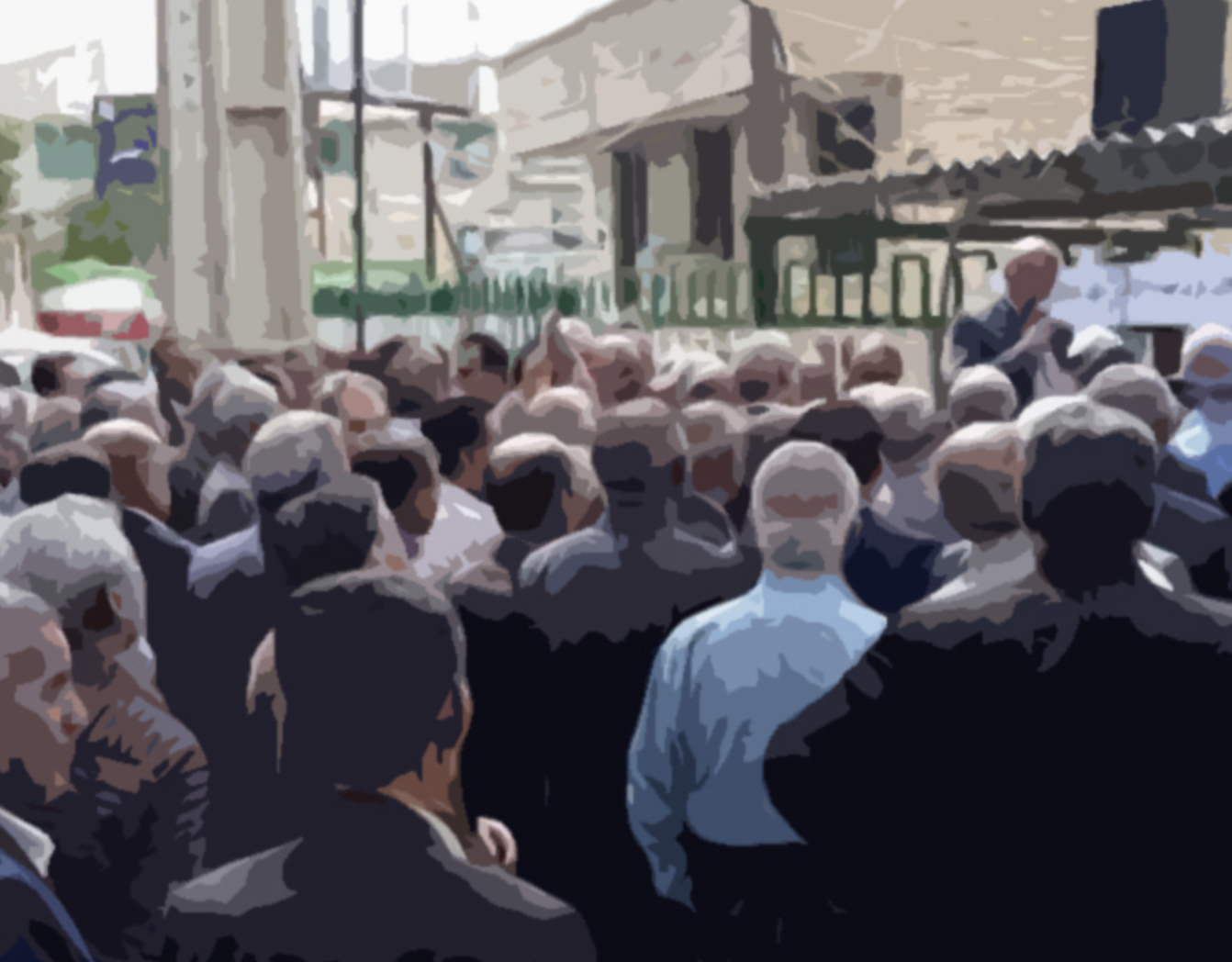
According to HRANA, the news agency of Human Rights Activists, a number of protests took place this week in Iran, many of which were continuations of ongoing movements.  Read our recap below for details, photos, and videos from the demonstrations.


Saturday, October 2

This Saturday and Sunday, a group of environmental activists of Sanandaj in the vicinity of Vahdat Dam gathered to protest against the years-long negligence from local authorities in addressing the area’s unsafe drinking water. Because of the city water is contaminated, residents are forced to carry water from the springs surrounding the city.

Sunday, October 3

Employees of coal mining company Pabdana in Kerman Province assembled this Sunday at their workplace entrance gate and protested the company’s low wages, arguing that, compared to state-owned mining companies, private companies such as Pabdana pay employees less for longer hours.

About 400 drivers of the transport unit of South Zagros Oil and Gas Production Company, for a second consecutive day, assembled to protest the company’s decision to change their contracts. The new agreements are set up so that that workers will  be employed by a contractor rather than the company, meaning lower wages and fewer benefits.

In Bandar Imam Khomeini, a number of workers working for subsidiary companies of Persian Gulf Holding in the petrochemical special zone assembled to protest against wage discrimination. They asked for a direct contract with the company rather than contractors who enforce lower wages and harder work.

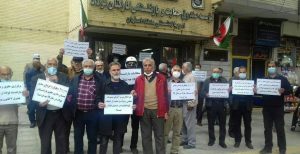
The retirees of the Social Security Organization assembled in front of this organization’s buildings in cities of Ahvaz, Rasht, Kermanshah, KHORAM-Abad, Tehran, Mashhad, Tabriz, and Qazvin, to ask for their demands. Their demands included levelling up pensions in proportion with the poverty line, enforcing the equating wages act, enforcing Article 96 of Social Security Act, addressing the issues regarding supplementary insurance, receiving end-of-year bonuses and taking work records in difficult-dirty-and-dangerous jobs into pension calculations.

A number of teachers and educators protested in front of the Parliament building in Tehran and the Ministry of Education’s buildings in the cities of Ahvaz, Shiraz, Zanjan, Darab, Bandar-Abbas and Isfahan. They asked for better enforcement of the Equating Wages Act for retirees and the Ranking Plan Act.

Personnel of the Municipality of Khorramshahr assembled in front of the government building to protest against a 6-month payment delay and a 10-month-unpaid insurance premium.

Retirees of the steel company Fulad protested in front of the company’s headquarters in Isfahan and Khuzestan provinces. They asked for levelling up their pension in proportion with the poverty line and enforcing the Equating Wages Act and addressing the problems of supplementary insurance.

A number of Haft-Tappeh’s workers continued to protest on the sixth day of their strike.

Monday, October 4

A number of students and alumni of pharmacology assembled in front of the building of the Ministry of Health and Medical Education in Tehran to protest against the monopoly on establishing pharmacies. They asked for the acceleration in enforcing the new regulations thereby the establishment of pharmacies in deprived areas would be facilitated.

On the seventh day, the workers of Haft-Tappeh company went out on strike. They assembled in front of the governorate building in Shush city.

Several workers for private coal mining companies in Kuhbanan county went on strike for the sixth consecutive day at their place of work. The workers said that, despite higher productivity and better quality of coal, they have been paid 4 to 5 million tomans less than workers of state-owned companies. Reportedly, in Kuhbanan County, more than 3000 workers are working for these private coal mining companies.

A group of personnel of social emergency workers of state welfare organization assembled in front of the parliament in Tehran and demanded changing work contract party from private to state section as well as the approval of the social emergency bill by parliament.

A group of retirees and working personnel of airline company Homa assembled in front of the building of Planning and Budget Organization. The retirees said that, despite promises from their supervisors, pensionsv for last month have not  been paid.

Tuesday, October 4

On the eighth day of their strike, Haft-Tappeh’s workers assembled in front of the governorate building in Shush city and then marched through the streets.

More than 500 workers of private companies, who are working on copper mining Sungun Varzaghan, assembled and went out on strike against low wages and hard work conditions.

Workers of the petrochemical special zone, including Persian Gulf Holding, assembled and demanded equal wage for equal work according to article 38 of Iran’s labour code and ILO Convention No. 100.

Wednesday, October 5

In response to recent violence against women (such as Faezeh Maleki-Nia who was burned to death by her father) and the negligence of the police and judiciary to prosecute and punish the offenders, a group of civil activists assembled in front of the Building of the Ministry of Justice in Sanandaj.

On the ninth day of the strike, in Shush city, Haft-Tappeh workers assemble again in front of the governorate building and then marched toward the building of the ministry of the judiciary.

For the second day, workers of private companies working on copper mining Sungun Varzaghan, refused to work and assembled at their workplace. These workers had spent last night in their tents in the same place of assembly.


Thursday, October 6

Following the protest of women in Sanandaj on previous day, several women protested in Marivan and asked that the case of Faezeh Maleki-Nia (who was burned by her father) be addressed, and called for an end to violence against women.

In Khorramshahr, a number of citizens assembled to protest against negligence and shortcomings of the municipality in collecting garbage. As a demonstration of protest, they piled up garbage bags in front of the municipality building.

In their tenth days of strike, Haft-Tappeh workers continued to protest in front of the governorate building in Shush.

A number of workers of Non-Industrial Operations Company Pazargad in Pardis Jam Town went out on strike at the workplace.


Homes Demolished and Citizens Mistreated by Municipal Agents in Zahedan

On Tuesday, October 5, on the outskirts of Zahedan, municipal agents demolished another home, leaving an entire family without shelter.

According to HRANA, the news agency of Human Rights Activists, the destroyed home is one of several like it that the municipality claims has been built on non-residential premises, despite clear preliminary real estate contracts to the contrary. One of the officials involved reportedly claimed that the municipality was permitted by a judicial order to demolish these houses.

“Four municipal agents demolished our only shelter,” a woman says in a video that was posted on social media following the incident. “They threw me down to the ground and forced my husband to get into their car. This home was my only shelter. From all these houses in the city, why did they demolish my home? We built this house hardly and we couldn’t afford even to finish the walls…It is not fair that I have to become homeless.”

“If these pieces of land do not have any legal document, why do they let the real estate’s sell these houses?” another citizen asked. “Why the officials don’t do their job properly so that people don’t fall into the mistake to purchase these houses. Why don’t they prevent people from construction in the first place? Unfortunately, it is their mismanagement that gets us into trouble.”

An urban expert also commented on the event, suggesting an ulterior incentive for authorities to “condemn” such residences.

“Province officials have to hinder those who in some ways grab these great pieces of land,” the expert said. “They claim ownership of these lands by fencing and sell the parcels illegally to poor people for low prices.”

Three workers, Including a Child, Killed in Zahedan Due to Unsafe Conditions; One Worker Injured in Shiraz

In recent days, in Zahedan, three workers, including a child, died in a work accident. In Shiraz, one additional worker was injured. Iran ranks 102nd in workplace safety out of 189 countries.

According to HRANA, the news agency of Human Rights Activists, quoting Rokna, on Thursday, October 7, a worker was injured severely at the workplace. A young worker’s hand stuck between a trolley and wall lift while moving items to the top floor of the store. After firefighters freed his hand, the emergency response team transferred him to the hospital.

According to Baloch Campaign, In Zahedan, on Tuesday, October 5, three workers, one of whom was a minor, lost their lives while digging a well due to falling well walls.

Two of these workers have been identified as  16-year-old Naser Ghanbarzehi and Musa Ghanbarzehi.

Khosro Sadeghi Boroujeni Being Denied Medical Treatment in Evin Prison

Imprisoned writer and journalist Khosro Sadeghi Boroujeni has been denied access to medical treatment by prison authorities despite his poor health condition.

According to HRANA, the news agency of Human Rights Activists, Boroujeni is currently enduring a five-year sentence in Evin Prison in Tehran.

“It is been over a month that he (has been) experiencing a poor health condition,” an informed source told HRANA. “He went several times to prison healthcare (for treatment), but he has not received any adequate treatment despite having body aches, insomnia, dizziness and nausea.”

Khosro Sadeghi Boroujeni was arrested and interrogated after being summoned to the Branch 2 of Evin’s prosecutor’s office on May 8, 2019. He was later temporarily released from Evin Prison on a bail of 300 million tomans.

Boroujeni’s trial was on July 28, 2019. According to the verdict ordered by the Branch 28 of the Revolutionary Court of Tehran, which was presided over by judge Mohammad Moghiseh, Boroujeni was sentenced to five years imprisonment on a charge of “assembly and collusion with an intention to commit a crime against the national security”, one year of prison for the charge of “propaganda against the regime”,  and to two years imprisonment on a charge of “insulting the founder of the Islamic Republic”, adding up to a total of eight years imprisonment. This sentence was later reduced to seven years after the charge of “propaganda against the regime” was dropped upon appeal.

Boroujeni has been conducting research on neoliberalism and the political economy of Iran and has written several articles on these subjects in recent years. His essay “Critique of Neoliberalism” was published by H&S Media Publishing Company in the UK. His other book “Globalization and Inequality” was published by Porsesh Publishing Company in 2011.

Subscribe to Our Newsletter

Now is definitely not the time to stop reading!

Khaled Pirzadeh Still on Hunger Strike Despite Critical Health Condition

According to HRANA, the news agency of Human Rights Activists, in-exile political prisoner Khaled Pirzadeh is still on hunger strike after 46 days in Sheyban Prison in Ahvaz.

His health condition is unstable and he endures low blood pressure and blood sugar. He is also denied the right to have a phone call to contact his family.

Since August 23, 2021, this political prisoner has been on hunger strike in protest against declining his request for the release on probation, the housing of political prisoners in the same ward with prisoners of violent crimes, and police officers’ brutal behaviour towards his family members during the delivery of eviction order.

Expressing his deep concern about Pirzadeh’s condition, the lawyer Ali Sharif-Zadeh asked the authorities to agree on this political prisoner’s release on probation.

“His family informed that he is denied any access to a phone call and he is enduring critically low blood pressure and blood sugar. His life is in jeopardy,” Sharif-Zadeh tweeted.

On May 26, 2019, Khaled Pirzadeh was arrested violently by security forces and after ending the interrogation process, he was sent to Evin Prison. He was sentenced to 7 years imprisonment on the charges of “offensive statements against the supreme leader of Iran” and “assembly and collusion against the regime”. This sentence was confirmed in the court of appeals. According to article 134 of the Islamic penal code, 5 years of this sentence for the charge of “collusion against the regime” is enforceable.

He was relocated to Greater Tehran Prison on July 22, 2020. Reportedly, at the time of transferring, he was beaten by prison guards. In August 2020, he had surgery on his foot. Moreover, he needs additional treatment and surgery for his injured spine. On July 14, 2021, they transferred him from Greater Tehran prison to exile to Sheyban prison in Ahvaz and held him unlawfully in the ward where the prisoners of violent crimes were housed.


Babak Dadbakhsh Asks Prosecutor-General for Re-Examination of His Case

According to HRANA, the news agency of Human Rights Activist, political prisoner Babak Dadbakhsh, who is currently being held in Ardabil Prison, recently wrote a letter to the Prosecutor General of Iran asking that his case be re-examined.

In regard to the way his trial was conducted, Dadbakhsh wrote, “Just to receive the verdict letter, I accepted not to appeal. However, after three years, I don’t have any indictment letter to know on what charges and based on what evidences I have been condemned. No one responds to me.”

In part of this letter received to HRANA, Babak Dadbakhsh writes, “The prosecutor-general! I am writing to you as a victim of injustice, a prisoner who has been tortured and sentenced to 25 years without having a trial. Just to receive the verdict letter, I accepted not to appeal. However, after three years, I don’t have any indictment letter to know on what charges and based on what evidences I have been condemned. No one responds to me. I hope that the law does not close its eyes and give me my legal right. I have been convicted within one minute without having an attorney. I request re-examining my case, receiving the indictment letter and using retrial. While I’m suffering stress, as forensic medicine and coroners have diagnosed, I am waiting for justice.”

In November 2017, Babak Dadbakhsh was arrested by security police of NAJA and handed to the Ministry of intelligence officials. Since then, he has been spending in various detention facilities and prisons.  He was once hospitalized in Razi Educational and Therapeutic Psychiatric Center.

In February 2020, he was sentenced to 17 years imprisonment on the charges of “spreading corruption on earth” and “enmity against God” (Moharebeh). However, in April 2021, on the excuse that not all charges have been considered, his sentence was prolonged to 25 years.

It is said that he is suffering from MDD, bipolar disorder and psychotic symptoms based on the diagnosis of Razi Educational and Therapeutic Psychiatric Center.

Mojgan Keshavarz Granted Leave on Bail from Qarchak Prison in Varamin

On Wednesday, October 6, civil activist Mojgan Keshavarz was granted a five-day leave on bail from prison.

According to HRANA, the news agency of Human Rights Activists, Keshavarz is serving out her five-and-a-half-year prison sentence in Qarchak Prison in Varamin.

On April 25, 2019, intelligence forces raided Keshavarz’s home and arrested her. She was under interrogation in the detention facility of the intelligence unit of the Revolutionary Guards, known as the 2A section of Evin Prison, until May 1, and then transferred to Qarchak Prison in Varamin. She was relocated to Evin prison on August 12, 2020, and sent back again to Qarchak Prison on December 5, 2020.

Branch 28 of the revolutionary court in Tehran sentenced the civil activist to a total of 22 years in prison. She received 5 years on a charge of “assembly and collusion in the purpose of acting against national security”, 10 years on a charge of “provoking and provision of impurity and indecency”, and 7 years and six months on a charge of ” blasphemy”.  Later the sentence was reduced to 12 years and 7 months on appeal.

According to Article 134 of the Islamic Penal Code, the severest enforceable punishment for the charge of ” provoking and provision of impurity and indecency ” is five and half years imprisonment.

Mojgan Keshavarz is 38 years old and a mother of a ten-year-old daughter.

Sentence Alternatives to Prison, Such as Purchasing Supplies for Under-Equipped Schools, Introduced in Urmia

The head of Branch 119 of the Criminal Court of Urmia recently announced that the county’s criminal justice system is introducing a number of sentence alternatives to prison.

According to HRANA, the news agency of Human Rights Activists, quoting Kargar Online, the judicial official has sentenced several men to purchase educational supplies internet packages and cell phones for school children in poor areas instead of serving time.

It is worth mentioning that Chapter 9 of the new enactment of the Islamic penal code has also highlighted similar alternative sentences.

Accordingly, under certain conditions and with the defendant’s consent, judges may enact these kinds of alternative sentences.

Journalists at Tehran-Municipality-Owned Newspaper Asked Probing Personal Questions by New Management

Following turnover in the Tehran-Municipality-owned Hamshahri newspaper’s managerial board, the extension of staff members’ contracts is being influenced by answers they give to a set of probing personal questions about their lifestyle and beliefs.

According to HRANA, the news agency of Human Rights Activists, quoting Fararu, employees are being asked questions such as “Why haven’t you married?” and “Why didn’t you vote in the election?”.

“It seems to be very serious,” journalist Mohsen Zohuri, commented. “They held an inquisition meeting for the journalists of Hamshahri and asked the question like ‘Why don’t you go to Congregational prayer?’, ‘Did you vote on such and such election?’, ‘How many chapters of Quran have you memorized?’, “Why did you get divorced?’ or ‘Why haven’t you married?’ ”

Changes in management in Tehran Municipality led to the appointment of a new director at Hamshahri newspaper. The new director has reportedly spearheaded this new procedure for extending contracts, and it is being applied to even the publication’s most tenured reporters.

“The new management in Hamshahri newspaper has set an inquisition meeting for its well-experienced and professional journalists,” a member of the Board of Directors of the Journalists’ Guild Association wrote on his personal page on social media. “They have to answer the irrelevant questions which means nothing but spying on personal lives and has nothing whatsoever to do with their occupation. I hope someone comes forward to explain that.”